Hopefully this does not come as a surprise to readers here. CTH has been outlining the most predictable outcome within the auto-sector if the U.S-Canada trade talks fracture. Today, speaking from Phnom Penh, Cambodia, Prime Minister Mark Carney said if the U.S-Canada trade talks don’t end up with support for the Canadian auto-sector, then he will shift focus to having the auto plants building Chinese EVs.
This is exactly what we predicted when Carney first agreed to import 49,000 Chinese EVs in January of 2026. Since then, both BYD and Geely are currently shipping cars into Canada. However, it was obvious that both companies would be willing to expand their assembly operations into unused Canadian auto plants.
First, here’s Carney outlining how China is his fallback position if things don’t work out with the USA. (Prompted):
Canadian media immediately picked up on the issue {see here}, because Mark Carney is going to the APEC summit in China and this is likely to be part of the trade/economic dynamic.
PHNOM PENH, Cambodia — Prime Minister Mark Carney said Monday that Canada could turn to Chinese automakers if trade negotiations with U.S. President Donald Trump fail to preserve an integrated North American auto industry.
Carney’s comments in Cambodia came ahead of a planned meeting with Chinese President Xi Jinping this week in Shenzhen, China, where Chinese auto manufacturing is expected to be discussed. The two leaders reached an agreement in January allowing tens of thousands of Chinese electric vehicles into Canada at reduced tariffs.
“We have the best auto workers in the world, and we want them fully deployed, full opportunity, in an integrated North American market,” Carney told reporters in Cambodia. “That market has become less integrated because of U.S. trade actions.”
Carney said Saturday in Manila, Philippines, that any trade agreement with Washington must leave Canada with a viable auto industry. He said Monday that negotiations with the United States remain his priority, but their outcome could determine whether Canada pursues alternatives involving European, Chinese or Japanese automakers.
Asked whether potential Chinese investment was leverage in the U.S. negotiations, Carney replied: “It’s not leverage. But action, reaction.” (read more)
Carney further stated that “Chinese investment would have to involve substantial manufacturing in Canada rather than simply assembling imported parts,” which is a little odd considering that Canada currently assembles imported parts from the U.S, Mexico and Japan. There is no “substantial manufacturing” in Canada due to climate change regulations.
BIG PICTURE: The U.S. puts tariffs on imported automobiles from Germany (multiple), Europe, China (Buick), South Korea and Japan. So, why wouldn’t the U.S. put tariffs, perhaps smaller, on imported cars from Canada?
Canada doesn’t have a big enough car market for significant auto production without export to the U.S. market.
Without a large customer base, why would any auto manufacturer build in Canada? That’s the U.S. market dependency that Carney is demanding must stay in place.
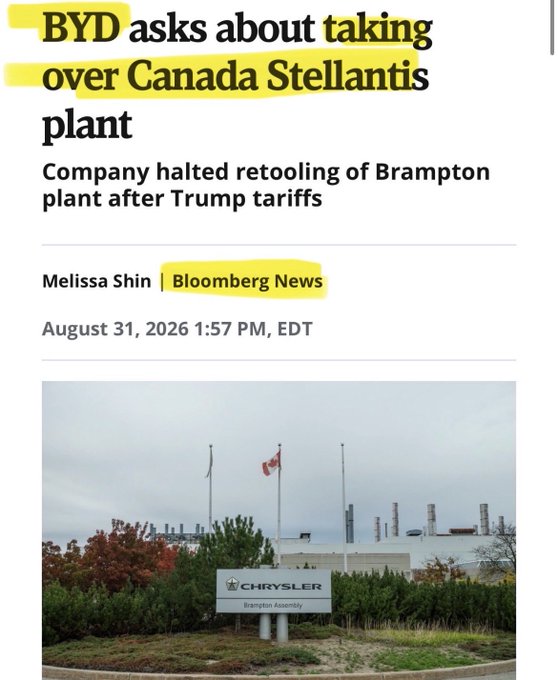 However, China represents an alternative because Canada will work for Chinese interests.
(#1) Chinese cars built in Canada would mostly be exported to Europe, cost efficiency. (#2) Canada is already set up for assembly of autos, not manufacturing. (#3) Geely and BYD would build in Canada in part because Canada already has a carbon trading scheme in place.
Chinese autos generate carbon credit certificates that are sold on the global market to multiple entities (including airlines) and auto manufacturers who do not meet their quotas for EV production. Those carbon credits are worth a lot of money to the Chinese, and they subsidize their expansion.
The move by China is easy to predict. Prime Minister Mark Carney has opened the door to Chinese EVs. It would be in Beijing’s best interest to retool and take control of closed plants to begin mass production in North America.
Canadians willingly want China to buy their auto assets instead of Americans, because the Canadian identity is defined by their main focus on ‘not being American.’ It’s all they know.
SUMMARY: Chinese EV manufacturing in Canada serves China’s purposes. They would not be limited in production to the cars that remain in Canada as part of the agreement. China would use their Canadian footprint as an export hub into Europe and save money on distribution. The appearance of Chinese auto manufacturing in North America would put pressure on the United States to permit cheap EVs to enter the market. Third, Canada is carbon credit friendly.
What types of cars does Canada produce other than “American” cars and Japanese cars made with Chinese parts ?
One problem would be that the Canadians would be expecting substantially higher wages than the Chinese pay to their own Chinese auto workers.
Regardless, he is destroying his country.
Canada will not be able to make use of the battery vehicles because of the cold weather.
No sane president would realistically consider importing them to America, the auto unions would have a fit.
Carney is destroying his country…..