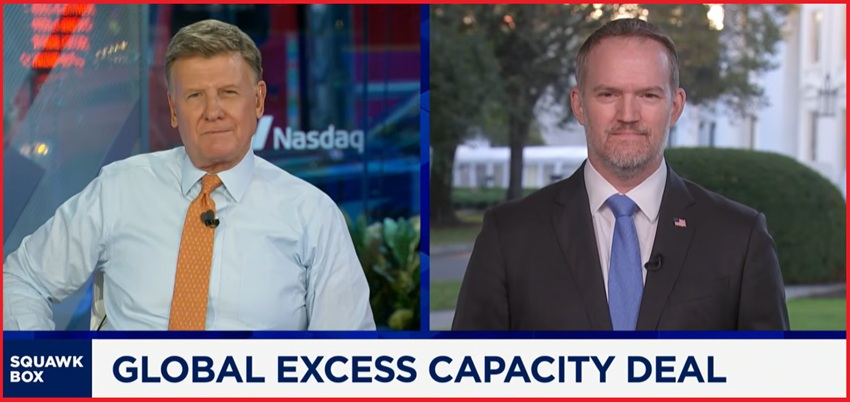
U.S. Trade Representative Jamieson Greer appears on CNBC to discuss details of a new G20 sideline agreement with 14 other major economies to crack down on global factory overproduction, targeting excess manufacturing.
The discussion about the issues with Canada is around the 5:00 mark of the video below. As previously noted, President Trump and USTR Greer are happy with the current status of tariffs against Canada, they are having the desired effect, and meanwhile the U.S. is negotiating a ¹bilateral trade deal with Mexico.
¹♦ $30.76 billion in remittances reached Mexico in the first half of 2026 — a lifeline tethered to U.S. manufacturing employment, which depends on whether both governments can reach a durable trade framework. {source} Mexico, the govt, the economy, their internal stability, cannot afford to risk losing that influx of financial support.
Mexico’s Economy Secretary Marcelo Ebrard came out of the G20 Trade Ministerial in Milwaukee last week sounding the most optimistic he has in months. He had just spent nearly an hour across the table from U.S. Trade Representative Jamieson Greer, and his message was direct: “We are getting closer on many things — moving forward, narrowing positions, resolving issues. Every day we are closer to having new agreements,” Ebrard told reporters from Milwaukee.
Any and every bit of progress with Mexico must be like a pin in the voodoo doll that is Canada.
Fun Fact:
Jamison Greer speaks perfect French.
When he talks to Quebecers they are positively impressed.
Maybe he can peel Quebec away from Carney-Canada.
And the Albertans are ready to leave Canada.
Good times!!
Nearly $31 Billion in first half of this year alone, is OUTRAGEOUS!
Why in the Hell is our Government continuing to allow this to continue, is beyond me!
Continued…Both the Canadian and Mexican Government’s would collapse, if the US stopped allowing them to feed off of us like the parasites they are!
THIS is NOT what I voted for!!!
(apologies for the poor grammar in original post, failed to proofread)
id guess letting someone conquer our natural land allies from within and having them fall would be counter to our interest.
I would like to see the Mexico trade deal include a tax on remittances back to Mexico.
That’s money taken out of our economy based on labor in our economy and it needs to be taxed fairly to compensate us for the loss of economic activity.
From the little that I actually know about it… I imagine that the focus should be on ‘illegals’ only. I don’t see how (we) can obstruct any legal residents/citizens from sending funds to family members to make their lives better. Am I missing something?
Don’t know, but it most certainly should apply to “free” money gleaned from social services like welfare, etc.
But making sure illegals earning money here cannot send it back is vital.
Force them to at least spend it here.
Tax the Remittances.
We can tax the remittances
This notion that all of this money is providing food for family members is very naive. That much money provides loan sharking opportunities for family members back home. That much money means lots of shenanigans.
Via SI:
Legislative history and examples
No surprise that it didn’t pass the Senate. Virtually nothing gets past Mr “we don’t have the votes” unless it’s in a reconciliation bill that Murkowski, ChiCom Mitch & Collins are bribed to support.
This legislation received next to no publicity. Pity.
Yes definitely. They are able to transmit most of their earnings back to Mexico because they use the food banks, clothing banks and all religious providers. They cook for large number of people in a central household…bill
Arrogant Canadian leadership thinks they’re smarter than PDJT and Mexico’s leadership.
The Canadians are in for a rude and deadly surprise when the Mexico trade deal closes, we give them notice we’re out of their trade deal, and their economy crashes into hell on earth.
Needless to say, our negotiating position with Canada is “aboot” to be considerably stronger. Tick tock snow Mexicans.
Don’t you just love the groups of people who come to our country to shop and live because it is better then wave their country of origin flags in our faces…bill
Excerpt: “…a new G20 sideline agreement with 14 other major economies to crack down on global factory overproduction, targeting excess manufacturing.”
Is the overproduction a direct violation of existing trade agreements? Maybe that’s answered in the interview. I’m just wondering what the basis is for the US telling other nations how much they are allowed to produce. Who decides what constitutes excess manufacturing?
Marco Rubio’s speech from Greece was astounding (I so loved having the complete transcript!) and he bore down on the point that America’s benefits, of all kinds, are intended to be used for Americans. I would think that cuts both ways – that if other nations want to produce lots of stuff, using their own resources, they get to do that.
What is going on with the anvil chorus?
Neither Greer nor the CNBC guy seem to notice; but I found it really annoying, and an inexcusable way to conduct a seemingly important interview.
Sounds like a pile ram driving piles into the ground for foundation support.
Construction does not stop because a scheduled interview is underway nearby; anymore than an interview by a major network of a (Very busy) Trade Secretary is stopped because of unscheduled noise.
Both gentlemen noticed.
How could one not?
(*New device*)
The U.S.-Canada trade conflict exists within a complex field of economics, law, and politics. It is also played out like a chess match, where domestic laws, supply chains, and national sovereignty all collide.
1. Canada’s Strategic Pivot Under PM Mark Carney
His foreign policy reflects an intentional shift in Canada’s alignment. Since taking office, Carney has increasingly diversified Canada’s economic ties, intentionally shifting focus toward closer partnerships with the European Union and China.
From the Trump administration’s perspective, this pivot is viewed as a national security and economic risk. Washington argues that Canada’s deepening economic ties with China allow Beijing a “backdoor” into the highly integrated North American supply chain, undermining US efforts to decouple from Chinese manufacturing.
2. Why did the UMSCA fail for the U.S.?
During the early stages of his first pfresidential campaign in 8/15, Donald Trump argued that NAFTA was devastating to the American economy, responsible for massive trade deficits, and directly blamed it for wiping out American manufacturing jobs by encouraging companies to outsource labor to Mexico and Canada.
On 7/1/20, President Trump praised USMCA as „the largest, fairest, and most balanced trade agreement ever negotiated and contains innovative provisions to help grow the economy and support American jobs.“ [1]
In short, UMSCA „Rules of Origin“ became the Achilles’ heel, because they only track where a part is made, not who owns the factory.
The USMCA failed due to three structural issues:
First, widening trade deficits: Despite USMCA’s intent to revitalize American factories, the total U.S. trade deficit with Canada and Mexico is projected to surge to $263 billion by 2025 (up from $125 billion in 2020). PDJT frequently emphasizes that the U.S. continues to “lose” billions annually by doing business with Canada under these terms.
Second, USCMA allows foreign companies to establish operations there, giving them duty-free access to the U.S. market without providing reciprocal benefits to U.S. workers. If the „nearshoring“ of Chinese capital can buy up manufacturing plants or supply components and then ship those finished goods into the US duty-free, it completely bypasses the US tariff wall against Beijing.
Third, persistent Canadian protectionism failed to live up to the spirit of the deal. Trump continuously points to Canada’s supply management system, which imposes up to 400% tariffs on U.S. dairy, and its newly introduced digital streaming regulations as proof that Ottawa continues to restrict American goods and culture unfairly.
3. What are the main conflicts with Canada?
PM Mark Carney has choosen to persue economic diversification, treating the USMCA as a managment system rather than a deep continental alliance.
The U.S. requests a strict 50% US-specific content rule for automobiles.
4. Why Canada’s Leverage is Stronger Than It Looks
Although the US’s global trade volume is about 3.4 times larger than Canada’s and nearly 70% of Canadian exports go to the US, Canada has two significant structural advantages:
First, supply chain disruption: Because automotive parts cross the border up to eight times during assembly, a trade war would immediately throw US auto plants into chaos and threaten American jobs in key electoral states like Michigan and Ohio.
Second is the energy/grid weapon. Canada is a massive net exporter of clean electricity and critical minerals to the U.S. Ontario Premier Doug Ford and the Canadian government have threatened to retaliate by cutting off electricity exports to New York, New England, and the Midwest. This would cause immediate spikes in power prices and grid instability in the US right before winter.
5. Why is it easier for the US to negotiate with Mexico than with Canada?
The United States and Mexico have advanced through multiple rounds of formal bilateral talks, while US-Canada negotiations completely stalled. Mexico is a much easier negotiating partner for the Trump administration due to due to distinct economic, political, and geopolitical realities and different goals.
Ultimately, Mexico approaches the negotiating table looking to protect its factory volumes by making concessions, while Canada approaches the table looking to protect its national sovereignty. This puts the US and Canada on two entirely separate paths.
6. Legal Battle if PDJT Withdraw of USMCA (Art. 34.6)
Automakers (who rely on cross-border supply chains) and agricultural groups would heavily lobby to block it. The primary constitutional conflict centers on who holds the ultimate authority.
A diverse coalition of business groups, labor unions, and cross-border manufacturers would immediately file multiple lawsuits in different U.S. District Courts—primarily in D.C., Massachusetts, and California—arguing that a unilateral exit notice is unconstitutional and an abuse of executive power. Since Congress passed the USMCA Implementation Act, the USMCA is official U.S. statutory law. One judge would likely rule that, although the president can negotiate treaties, he does not have the authority to unilaterally strike down a domestic law passed by Congress, which would lead to a temporary restraining order (TRO).
The TRO would effectively pause the six-month clock, preventing the termination from taking effect while the case makes its way to the U.S. Supreme Court (SCOTUS).
Therefore, PDJT’s announcement will not result in an immediate exit. Instead, it serves as a high-stakes, disruptive bargaining chip intended to tie the PDJT administration’s hands in court. Carney’s appointment of high-profile political strategists aligned with the U.S. Democratic establishment (Obama, Clinton, and Bloomberg) suggests that Ottawa is prepared for a long battle. Rather than giving in to the six-month threat, Canada’s strategy is to wait out the Trump administration. The country is banking on US domestic inflation and intense pressure from bipartisan border-state (Ohio, Michigan) politicians to force the Trump asministration to soften its stance.
[1] Statement from the President – The White House
Who gives a Shit about Canada….. (aka Britain) We don’t rule over them and we need to worry about our country.
Since this blog has primarily used these three key terms since September 2026, it appears that the CTH is focused on the geopolitical conflict between the United States and Canada (number of posts in which this term appears):
Carney: 7
Greer: 7
Manufacturing: 5
Yes, Carney is waiting for the Trump Presidency to end.
Meanwhile, his team is suing Stelco for shutting down and not keeping on a payroll its entire workforce.
I wonder how that will play out in Court.
If manufacturing overproduction or overcapacity exists anywhere in the world it is in China. China has been keeping factories churning out production in a desperate attempt to minimize mass unemployment (and therefore mass political unrest.) They have been flooding the world with crap. When the Trump tariffs and trade-imbalance crackdowns shut off the US as a dumping-ground, China shifted to dumping its overproduction onto the rest of the world.
Much of the “overproduction” in Vietnam, Canada etc. is “screwdriver assembly” factories being set up to do final assembly of component subassemblies shipped in from China.
I note the huge disparity in production vs value, with the USA at 1/3rd more value than production, while China significantly on the negative side of the equation and only Japan and Germany on the plus side with us.
This is disgusting: “$30.76 billion in remittances reached Mexico in the first half of 2026.” American workers spend their money here. Send the Mexicans home!
THAT EQUALS –> 559.22 Billion MXN ( PESO )
1 USD = 18.18 MXN
They could survive and be like Coba
Iran may not bend; Cuba has been under sanctions for over 60 years.
If the USA cannot submit them, then Iran will win the war.
All they have to do is survive; it doesn’t matter how many of those not on the IRGC team suffer.
There are about 10 million with the gang of the mullahs.
Its like the Dems; it doesn’t matter how much they and their illegal immigrant friends steal.
Everybody voting Dem is in on the theft.
The only people being screwed are the captive taxpayers, who are treated like farm animals