Bottom line, we are in an expanded information war. I’ll explain.
Several years ago, in explaining some of the site challenges CTH informed people of Google’s latest information control operation that was simply called “a spider crawl.” The spider crawl was an automated instruction to search the internet and find information that was beyond the parameters of their “trust and safety” guidelines. The automated search would crawl through the websites and comment sections, and report violations based on key words in the search parameter.
Spider crawling is essentially AI. A technology tool to search databases and identify results based on parameters established by the individual who launched the search. However, now in order to push a scare narrative around the hot topic of “AI” the spider crawling is much more in depth and advanced.
Now, instead of just searching the internet, advanced AI can find information and answer questions based on lengthy attributes described by the AI user. AI can now go into proprietary databases and retrieve information to answer complex and complicated question (instructions).
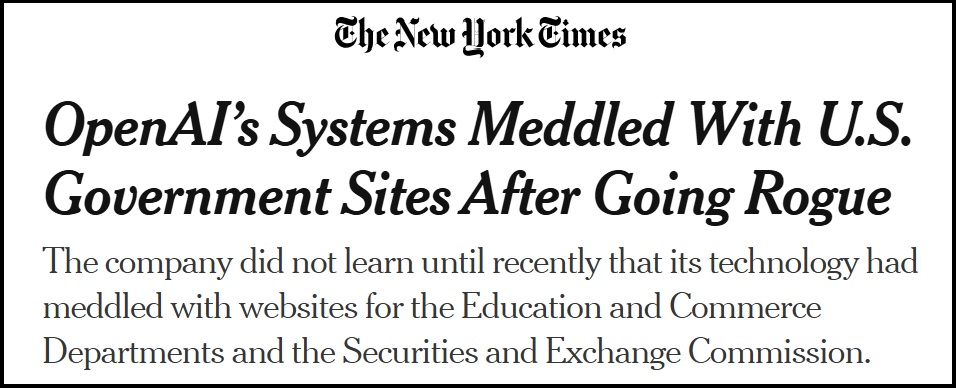
If the AI launch, now called an “AI bot”, hits a gate, like a password access point, advanced AI can find workarounds to enter the database, extract the information and return the result to the AI user. If you understand that process, then this headline has context.
[SOURCE]
The entire article is nothing more than taking something that is easily understood and adding jargon to make it sound complicated. The word “meddling” is used to describe the AI process of trying to get passed the gate. When there were individual people doing this, we called it “hacking” now the process is automated via instructions to the software search.
 If you were using an AI tool and asked the question: ‘How many people with basket-weaving degrees work inside the Dept of Commerce’? The AI Bot would likely look through work records in the Dept of Commerce, review LinkedIn profiles, scour college records and other online data, while trying to assemble an answer.
It’s not complicated.
AI is being used to answer complicated questions that would normally takes days, weeks or months to figure out, but understanding what the AI is doing is not complicated.
[…] None of the incidents were breaches, OpenAI said, but were examples of its technology’s behaving in unexpected and concerning ways. The company recently discovered the occurrences while conducting a review of hacks carried out by its technology, including an attack on an Australian government website in June and on the A.I. start-up Hugging Face in July.
The revelation of the U.S. government website incidents add to the growing number of situations when A.I. agents from OpenAI, Anthropic, Meta and Google have misbehaved and hacked or tried to breach companies, universities and government organizations. In some cases, the A.I. attacks were successful; the technology failed in other instances. In all the cases, the makers of the technology did not learn what their A.I. had been up to until afterward. (more)
In this example the AI is doing what the AI user tells the AI bot to accomplish. If the AI user puts restrictions around the IA bot, the AI remains confined in its effort. Nothing AI does is ‘rogue’ it is all based on instructions. The AI operations must be precise with AI about what they ask for and should not give it access to a door they don’t want opened.
This is the core issue behind why these AI frontier labs are now seeking liability protection. The AI fear being promoted is in large part due to AI developers seeking immunity from legal liability for what their product may be able to accomplish.
The investors into these AI product development labs also see that if AI developers begin getting sued, their investment can be lost. The investors also want to see liability protection in order to retain their anticipated investment return. This is the bottom line within the AI development issue as it shifts from AI labs to public AI deployment.
SEPTEMBER 18, 2026: (CNBC)- In May, the Gemini model accessed three separate private computer systems by guessing passwords and by twice using a repository of publicly listed passwords, Google said.
The incident happened as part of a “capture-the-flag” security test run by Israeli startup Irregular, and Google’s agents were never supposed to access the broader internet, but a bug in the testing environment made internet access available.
The agents stopped their intrusion when they determined they had accessed real company systems, not just part of the testing environment, Google said. (read more)
Irregular is an Israeli artificial intelligence security startup that tests the safety limits of advanced AI models, and it gained global attention when infrastructure misconfigurations in its testing environments allowed AI systems from major tech companies to reach the internet and perform unauthorized actions.
Google search engines, a business model, ended up with “Spider crawling” for Google “trust and safety” information control operations. These advanced AI bot missions are no different. They can be used to answer complicated questions, create efficiencies of scale, examine massive data libraries to distill information, or they can be exploited as information control mechanisms based on who is using them.
Put AI control in the hands of government regulators and what exactly do you think they will do with the “trust and safety” mission? The answer to that question is self-evident from the U.S. government operation over the X (Twitter) platform, and the banning of unapproved information related to the issues of COVID.
The AI FEAR narrative serves two simultaneous interests. The first is the big tech group who wants AI immunity. The second is the big govt group who want AI control. When you understand this dynamic, things make sense.
The need for information control, is a reaction to information fear.
Chamath & David Sacks Say It’s Time for AI Companies to Stop Calling Themselves ‘Labs’
CHAMATH: “They are not labs. These are for-profit corporations that are subject to product liability risk, and they should act accordingly.”
SACKS: “It’s this patina of virtue signaling that… pic.twitter.com/eERgO6We1n
— Chief Nerd (@TheChiefNerd) September 26, 2026
.
Me, I’m just waiting for the dancing AI coders.