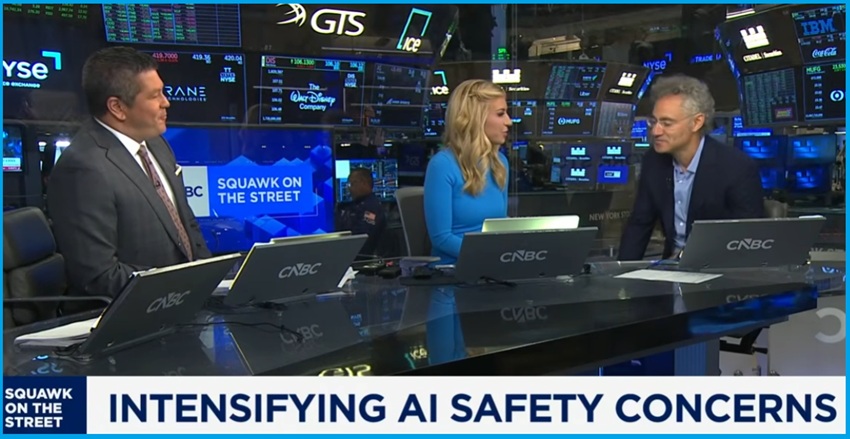
Palantir CEO Alex Karp is a little quirky but, on this issue, I tend to agree with him.
According to Karp in the interview below the request by OpenAI and Anthropic AI labs for government regulation is related to a legal issue within their business model. Right now, massive multinational corporations are working with AI groups under contract. As part of those contracts the leaders of the corporations are discovering their individual business plans, what they call their intellectual property (IP) has been uploaded into the dataset of the AI models themselves.
These corporations have spent billions of dollars on their detailed business plans, marketing plans, logistics and revenue systems that are now part of the AI dataset. These CEOs are not happy and talking about lawsuits against the AI developers for stealing their corporate intellectual property. However, at the same time the CEOs are furious at the loss of proprietary information, they are simultaneously bound to the AI developers for forward revenue. This is creating a problem.
Example: By some analyst’s estimations, Amazon’s forward revenue projection is approximately 51% dependent on further technological capability through the use of AI. However, Jeff Bezos likely does not appreciate his business model, which includes a massive dataset that he makes money from, being taken and uploaded to the AI database. Bezos could sue Anthropic for ip theft.
All of the AI labs are exposed to this litigation if it was to unfold. Additionally, all of the investors into the AI frontier labs would be at risk if the AI developer were sued by these corporations. Both the AI developers and their investors would/are demanding protection from these lawsuits.
Here’s where it gets complicated.
If a wave of lawsuits were launched it would seriously hurt the market valuation of the AI developers. However, simultaneously, if the AI developers get government protection (ie Sec.230, federal immunity from lawsuits) that removes entry barriers for startup AI companies, which increases AI competition, which could also reduce the market value of the major AI developers.
Alex Karp with Palantir already has this type of immunity from lawsuits due to the collaborative nature of the national security dynamic that Karp has developed with the U.S. government. However, the AI developers do not have this type of relationship. The AI developers previously said they did not want government interference, but now they want government protection. Privatize the upside (profit), then socialize the risk (losses).
As this dynamic unfolds, you can well imagine all the high-finance influencers who fund various political candidates and Super-PACs are positioning their own interests. An investor in AI would seek the protection of the investment and the elimination of lawsuit risk. Those institutional investors and billionaires would pay political campaigns and special interest advocacy to secure the value of their investment.
The politicians are being purchased by the investors into AI development. The goal is to grant the AI labs immunity from lawsuits.
There are trillions at stake.
If a potential AI threat has to manifest in order to force public support for the liability protection, then so be it.
Perhaps that’s what we are seeing.
Under this unfolding scenario, the tech sector of the stock market looks a little sketchy right now.
Soooo A.I. is just massively ripping off intellectual property and the creators want immunity from theft?
Indemnity will just make that theft more lucrative with minimal downside.
Same as indemnifying big harma for their drugs that got on the vaccination schedule for children.
Money talks.
It’s not theft it’s artificial use akin to how people use it. We talk about it, we clip it, we emulate it and all of that. We used to call these examples of fair use.
AI is more than significantly over-policing themselves as the AI will refuse to state more than a line from a song or help you to remember a song’s name or content you’ve forgotten or even link you to where a song’s lyrics are published in its entirety. Pretty sure those sites are legal and yet AI can’t link to our source the information within?
It’s quite silly except for how serious it is.
The language models are collecting corporate info public and non
Huge issue. Companies need to iron curtain their data from these open AI modellers. The other big thing is theft of corporate companies clients data. That’s another shoe to drop
Air gapping all those systems might kill the Cloud business model.
Those terms are acceptable.
Weren’t pharmacies making vaccines immune from lawsuits? Same game.
Some *have*. Government cloud versions for instance are specific to that client and there’s no reason you can’t go as walled-garden as you like.
Now … if that was the contract between company X and AI provider M, and M took IP anyway, boom. Open and shut case.
If, on the other hand, X bought general use capacity, and only told its employees not to put IP into the AI, or worse yet didn’t educate them at all, they’re pooched. I find this more likely.
Not 100% certain of course, but lots of enthusiasm for potentials of AI and not always enough caution by the same people that train people diligently about cardkey use and public hotspots and phishing and email procedures.
It’s not theft. Why? Because the companies are willingly uploading their information after they sign documents, i.e., contracts with the AI companies. This is why I think the fact they’re crying wolf to the government for protection is ridiculous.
And it’s also why I think the company on the other side is ridiculous for trying to pursue losses, because they signed agreements, where they willingly gave their information over.
Doesn’t stop them though.
Seems about like me trying to sue an app creator that I loaded on my phone…after selecting “Agree” to their “terms conditions”.
If the US ai companies don’t steal it, China will.
I read they’re using U.S. developed AI., so they probably already HAVE it all. 🙁
So much for Copyright and Trademark laws.
Yup. Me don’t like that!
Kind of like a therapist that interviews business leaders and then sells their secrets …..
They will try for blanket immunity so when one of their models nukes LA, they cannot be sued. This is just the camel’s nose under the tent.
Wait for the bubble to burst and then get in the market after the huge bear is done killing everything. Eleven minutes but well worth it if you’re an investor.
Alt: https://xcancel.com/gnoble79/status/2100181959095841246
AI will implode. Should we survive , at least we’ll have plenty of power plant capacity.
Crank down that A/C!!!!
“AI will implode. Should we survive”
I would expect to survive it unless some Dumba$$ hooks it up to weapons systems. (esp Nu-Cle-ar)
I think we all will have to bend over and KMAGoodbye as someone will do it, perhaps even US.
Every single big company who dove into the AI frenzy is in the red big time…leveraged and borrowed to try and get ahead.
NO bailouts for these clowns. The liability issues alone will cause many to pause.
Trump is all in on AI so I do see him “help” the industry no matter what.
(ahem) * ethanol *
(cough)
Bailouts coming.
Cozy corporate control + gov funding (our taxes).
Centralized control.
Un-entanglable from Israel.
Energy apacalypse.
Good times.
I just ordered Mobil1 synthetic oil–price increased >55% at rock auto from $7.26/qt last November to $11.43 today. My car isn’t due for an oil change for a couple of months but who knows what it will cost in December?
Just change the filter and add a quart. You can get 50 k from synthetic oil if necessary.
Not possible–I have high performance sports car that requires annual oil changes or else the warranty could be voided. Your suggestion could lead to engine failure on ANY vehicle.
I see this being talked about aa ‘the AI bubble is going to burst’. It is ‘overvalued’.
EVERYTHING is overvlued when priced in ever-inflating fiat currency.
Bitching about the price of gas? I’m old enough to remember when every gas pump in the country had to be replaced. Why? The anlog pumps operated like old-fashion odometers and there was only ONE rotating wheel to the left of the decimal point with three to the right (dimes, cents, and tenths of cents). Gas was so cheap that it was IMPOSSIBLE to spend more than $9.999 to fill a car’s gas tank.
So, what changed? Gas is still gas. The money is not.
how many AIs can we buy with our NFTs first?
JUST POP THE BUBBLE already…and hope the resulting disruption combined with self-deportations lowers housing prices while we’re at it…
Nobody that owns a home or is trying to sell wants prices lower. It won’t be the deportations that cause a drop, it will be all the loans stupidly given to “temporary” people that will not be paid.
If you were deported would you pay that loan? Once again the banks will be the cause of any housing price drop due to market saturation with foreclosure properties that banks will sell at a discount because the loan was too risky but government pushed to make legal and illegal immigrants homeowners anyway.
Agenda noise.
Here is something a little more grounded.
And, all the fund managers of 401k assets invested to the hilt. Massive wealth shift incoming. Again.
Of course, they want government protections while keeping all of the info, profits, and facilities.
Reverse socialism, only the elites get the big paydays and protection. Neo-Fascism, the oligarchy and foreign interests tell the gov’t what to do and, mostly (but not completely) excluding PDJT, owns the three branches of gov’t.
Welfare for the elites — Anarcho-tyranny and shithole communities for the serfs.
Excellent. A-T!!! Few know this dynamic actually has a name and a very long history.
You left out the 4th branch–deep state IC.
El presidente pushes it forward too. There are no good guys.
Government is pathetic.
And we allowed it to happen.
They always do.
There are major missing details here .. with this complaint by Palintir CEO.
What were the statement of work tasks as well as terms and condictions in the contract assigned to these “contracted AI Development Labs”??
The AI Labs were not just hired and turned loose on the Companies which contracted them.
There is a Statements of Work.
Non Disclosures.
Terms and Conditions.
“Technical” Interfaces-Interactions to be Defined and Limits to Data Access … based on the statement of work.
Just to name a few key contractual documents that require: business, engineering as well as legal-lawyer inputs. You F-up just these few key items and you are SOL.
Also, what was the competency of the technical staff on Palantir’s side of the arrangements, who were supposed to provide oversight to the work?? Or did palantir not have an oversight staff … pretty stupid move.
This could either be a REAL problem or the people working for Palantir did a piss-poor job representing the end of the contracting … and this CEO is playing like a soccer player doing a 3-roll dive after being touched.
This is going to sound odd … but major companies who have done business with the Department of War as Prime Contractors are best prepared for dealing with AI Sub-Contractors. This is a case where Civilian Industry needs to learn some contracting and contract management practices from an industry they laughed at for years.
Rogue coders and programming violate SOWs
“Palantir CEO Alex Karp is a little quirky but…..”
I’m gonna follow Sundance’s lead on this one but….Karp has pivoted. IMHO he remains a wolf in sheep’s clothing.
Trust Trump
Karp is afraid that his software will be obsolete with joint Claude and Amazon AWS Cloud enterprise computing.
Now that’s ignorantly funny. 😆😆
If Karp is a little quirky, Sam Altman is off the charts weird, but that’s what we get when we put techie nerds at the head of the class.
bullies exist for a reason
if bill gates had gotten more wedgies as a child, he would not be out of control now
Now imagine their private pleas for gov investment and protection (….er, without our product and applications bad things will happen so you have to give us money) – when in fact they want to control the globe, governments and by proxy all of us.
My understanding is that chat and the other AI systems built their dataset by uploading copyrighted material and everything else under the sun. It’s ironic that some are now worried about legal exposure to litigation.
Nothing shuts down an operation faster than unauthorized copyright infringements. even China Inc. is cracking down on copyright violators.
There is something missing here concerning who hired the AI Labs to build those databases.
Yes, even Cchina Inc. is concerned with legalities because they are in business for the long term .. not just 1-time smash and grabs.
Copyrighted or not, AI (rules based programming) requires human generated knowledge to feed it. It is highly efficient at then processing massive data sets through a set of rules, also created by humans.
One inevitable consequence that our AI Masters are facing is that AI-digested information is now mingling with original, truly human content. How can AI tell the difference without clueing in us humans to what they are up to?
IMHO, they will be able to contain this for a while by adding exponentially more data centers and CPU power. There are better was to do it but they do not result in central control.
Why America Pours Concrete, China Releases Code
https://datacentermadness.com/china-concrete/
Those “AI SOFTWARE developing humans” are also “supposed” to be limited by the contractual arrangements of the people who hire them … and there also is “supposed to be” competent oversight by the Contracting Company to ensure the contract is followed by the humans.
I have seem this before. They will sneak in an update to the T&C’s that someone just clicks “I agree”. or… and I can tell you first hand an example – accounting got a invoice with fine print on the back that said essentially… “this payment relinquishes any prior IP restrictions of either party”. Fortunately we had a very savvy accountant.
It was a behemoth company – we could never have won in court.
Did this stuff for over 30-years as a Chief Engineer working proposals and contracts. Learned allot at the elbow of our lawyers and specialists.
Know what you mean … still goes to competency and oversight to ensure compliance.
As in the case you point out … being smart enough to write in safeguards with respect to approvals. We had a subcontractor try this trick but they lost big due to the approval clauses.
ChatGPT can’t count letters in a word if there are two same letters consecutively:
https://www.youtube.com/shorts/BVg1pIpdSJQ
https://x.com/huskirl/status/2099207499924594695
Thank you Dee for the link. Very informative and probably the way it will all go if left alone. If this be the case, there is a lot of money $$$ going down a rathole and really points to the reason big AI wants regulatory protection and control. I recommend the article for all!
Praise GOD!!! Fight! Fight! Fight!
most welcome 🙂 here is some more late night reading
The Vertical War
https://constructamiracle.com/p/the-quiet-part-out-loud?r=b7nwz&triedRedirect=true
Reminds me of the good ol’ free music Napster days. Napster is now an AI company.
Napster was shut down for copyright issues as are large numbers of music and entertainment sights today … shutdown even by China Inc.
Maybe they accumulated a lot of information from users on top of sharing music files?
Sweet. Hope I can sue because they took my IP related to Pirate History comments I’ve made here and elsewhere.
Who is the Pirate now?! Arrgh.
Didn’t your sponsor to Pirate Club not tell you the first rule of the club is not to talk about it. /s
Wasnt it a few weeks ago a picture of a warehouse full of books to be uploaded? I’m sure every author was well compensated more than the purchase of one book for the potential millions of downloads of their product.
copyright law states that if you buy a used book you can do anything you like with it, including (apparently) scanning all the pages of a book into a large language model, then shredding the book.
That’s what they did. Didn’t think twice
I believe it is perfectly legal to “listen” to copyrighted music or “read” copyrighted content or “view” copyrighted images. Upload or download typically means there is a file copied/stored. If there is legal exposure then anyone who reads ebooks or listens to mp3’s is also exposed.
The question would be do these companies retain these copyrighted files or were they just looked at like our own brains do.
Yeah we have a team’s plan with Claude and as part of our agreement they are not training their models on our data. If it were to come out that they are the liability would be significantly higher than their current capital expenses
“as part of our agreement they are not training their models on our data”
And you believe them? Does your team have any tools or data access to verify?
“Does your team have any tools or data access to verify?”
this is almost impossible to achieve, due to the fact that LLMs are nothing more than pattern matching systems.
it seems they were never originally designed to provide insight into their functional operations and how they come to decisions
People have been uploading their lives to google, amazon, facebook, instagram, and 100 other social platform for decades.
I’ll trade you:
total erasure of all personal data and a ban on future data collection by the government (including NSA), private firms, data collectors, etc
then we will give you protection.
In the meantime, we will find every AI developer and put them in our own database so we can visit retribution upon them if the AI goes rogue.
I learned quickly about not putting “real” information on the internet unless I had to… especially after my pal “Al Gore” flipped the switch to turn it on.
/s
I hope “glen” means a “A narrow valley; a dale; a depression or hollow between hills.” & is not in your actual name.
Tho “Magic” is on my Birth certificate. No really… /s
I wonder about Anthropic and the Pentagon. How much of our defense systems etc etc has been uploaded to Anthropic and shared with CHYNNNA?
Hoist them on their own petard.
So no one thought of this happening until now?
The AI
developersINVESTORS previously said they did not want government interference, but now they want government protection.Privatize the upside (profit), then socialize the risk (losses).
Kinda like the jab manufacturers and others who received liability protection within the EUA during the scambemic!
And the pesticides companies?
Aren’t they protected against lawsuits?
Yep.
AI:
Yes, the manufacturer Bayer (owner of Monsanto and Roundup) has received significant legal protections against lawsuits over glyphosate use.
On June 25, 2026, the U.S. Supreme Court ruled 7-2 in Monsanto v. Durnell that the federal Federal Insecticide, Fungicide, and Rodenticide Act (FIFRA) preempts state-level “failure-to-warn” claims.
The Court held that because the EPA has not required a cancer warning label for glyphosate, states cannot impose additional labeling requirements that would make manufacturers liable for failing to warn consumers of cancer risks.
This decision is expected to dismiss or bar tens of thousands of pending and future lawsuits alleging that Bayer failed to warn about cancer risks.
Additionally, on February 18, 2026, President Donald Trump signed an executive order invoking the Defense Production Act to declare domestic glyphosate production a matter of national security.
This order potentially grants manufacturers liability immunity for supplying glyphosate-based herbicides, further shielding Bayer from legal claims.
Critics, including Senators Martin Heinrich and Cory Booker, have introduced the No Immunity for Glyphosate Act to overturn these protections and preserve state law claims for injured consumers.
Thank you, I recall reading this since it’s linked to a cancer that has killed four in our family.
Thank you Sundance.
Notice that all the U S AI giants, except Musk, are supporting the regulatory push.
Musk identified the critical path for AI before his competitors, moved first to dominate that path, and the competitors forsee him pulling away from them on what may be an asymtotic curve.
They have seen him pull this act before.
But, if everything can be slowed to a regulated crawl, then Musk’s money is misallocated more badly than his competitors’ money is now. And they may win.
I recall hearing Sam Altman say “it cost more than they thought”…
These AI developers thought they had endless money…
Looks like someone is tugging at the bottom layer on this house of cards. How much will it stand before it pulls a Solyndra and comes tumbling down?
Money, it’s a gas.
🎶 Money, get away
Go get a good job with more pay, and you’re okay
Money, it’s a gas
Grab that cash with both hands and make a stash
A new car, caviar, four-star daydream
Think I’ll buy me a football team
Money, well, get back
I’m alright, Jack, keep your hands off of my stack
Money, it’s a hit
Don’t give me that do goody-good bullshit
I’m in the hi-fidelity first class travelling set
And I think I need a Learjet 🎵
Small and medium size businesses can’t afford it, but the very large businesses would be nuts not to buy their own data centers and then just lease the AI software to use. That way they keep their intellectual property in house.
It’s like me buying Microsoft Office, and running it on my home computer — instead of renting Office “in the cloud” where all my data sits on MS servers.
JP Morgan gonna be bigly mad when Wells Fargo uses AI based upon JPMs data set to steal customers. Couldn’t happen to a more lovely crowd, but still….
I see a food fight coming that will complete dwarf Animal House
“See if you can guess what I am now..”
The public who were forever injured or worse rage against the liability protection given to Big Pharma by Congress for the egregious, irreparable harm they did and will be doing into perpetuity with their mRNA gene therapy.
We didn’t ask for it. We didn’t want it.
And yet it was granted, leaving the public to pay for their own terrible health outcomes from being bullied and mandated (and punished if they didn’t) to get injected with a substance which was known to cause death and endless, life-long debilitating side effects.
Force public support for liability protection for AI?
Memories are fresh from the last time…
Maybe I’m missing something…
But I bet that Sisyphus has more chance of pushing his boulder to the top of the hill before that happens.
Get stuffed.
Agree, and It is time to remove all liability protection granted to big pharma for both the childhood vaccine schedule and all other vaccines.
Tired of big pharma and the government hiding and lying about all the damage done.
anthropic’s new business model might as well be making money from litigation since their old business model got blown to smithereens by the infinitely more affordable (free, and almost free) chynese llms
openai (should be named closedai) and anthropic’s only hope is for the u.s. government to kneecap their competition
anything short of that spells disaster and bankruptcy
the super dario brothers are in full panic mode, grasping desparately for an out
they’re trapped
However, simultaneously, if the AI developers get government protection
Oh, like big pharma and vaccines in was it 1982?
Use the same playbook since it works every other time.
If those CEOs were familiar with John Lennox’s 2084 and his source information, they wouldn’t have been surprised.
Who did they think was “instructing” AI to “know things”?
“Under this unfolding scenario, the tech sector of the stock market looks a little sketchy right now.”
While the tech sector getting a correction might drag others along with it and folks’ 401Ks, etc probably have tech stocks (on purpose), I would think many folks would be fine with tech getting a bit of a face plant.
That depends if they are investing for the long run or are nervous nellies worried about everything.
**Not investment advice***. I have personally loaded up on cybersecurity stocks. Me thinks they gonna be busy
“Palantir CEO Alex Karp is a little quirky”
He publicly fantasized about mass murdering his financial rivals by deploying an aerosolized chemical/biological (fentanyl/urine) payload by drone. This is a threat he has the ability to follow through on, and he gleefully admits his products are used to kill people. Basically he’s the green goblin.
But whatever, right? It’s just a quirk you gotta live with and laugh off, right?
No, he’s evil to his core. He and his ilk must be resisted every step of the way. Don’t look to him for insight, denounce him and all his works!
Didn’t he just relocate to Argentina?
it is written…
I’d have to dig up the video I saw it discussed, but recently a researcher had used one or both of OpenAI and Anthropic to help run calculations on one of the top unsolved math problems. It was his and others he was working with intellectual ideas used to advance novel theories leading to a possible solution. One of them, OpenAI or Anthropic, got wind of it and used there unlimited access to tokens and solved it based on his novel information being put into the models on account of using the AI.
Private AI is the future. You can create scaffolding (cursor prior to being bought by Musk nearly competed with frontier models using cheap Chinese models but their own scaffolding [how the AI works and fine tuning]), guardrails and RAG and can outperform most frontier models in specific niches: that’s what most people need help with to hit exponential growth based on their own novel ideas.
Look up Navier-Stokes OpenAI Controversy.
Off topic but another surprise … Hmm
Julian Assange
@JulianAssange
I’m back.
WikiLeaks
@wikileaks
11h
He’s back @JulianAssange
I started my hardware/software career in aerospace in the late 70’s. My mentor Warren, was a crusty rocket engineer from Huntsville Alabama. He’d always bring me software specs he needed to review.
We were using assembly language, Fortran and COBOL. Every year, like clockwork, our company would tell us to evaluate AI and how we could apply it to what we were working on. Back then, this was pretty much Prolog and LISP. Warren asked me to explain “this AI stuff” to him.
When I was done he said…. “Sounds to me like a self-eating watermelon”.
The more things change, the more they stay the same, ‘cept this time we have trillions of dollars and a cabal of evil bankers and globalists fueling the madness.
Love his phrase; “Sounds to me like a self eating watermelon”.
The first guy I ever heard use the phrase “privatize profit and socialize risk” was David Stockman. I have no idea who actually coined the phrase, but he was referring at the time to most of our financial system in America. His point was that we do not have capitalism in our country and haven’t for generations. What’s the old saying, heads we win, tails you lose……
I remember when Stockman attempted to curtail the farm subsidy racket during budget cutting.
That’s when I learned all those farmers who advertised themselves as Don’t Tread On Me conservatives weren’t ready to surrender their communism.
This is Palantir’s take on top of other cynical views already offered, and with more doubtlessly to come.
This very much reminds me of when John Kerry rushed onto the scene with a proposal to regulate the Internet … for its own good dontcha know.
Sundance just nailed it.
The CCP has been ripping off IP longer than AI, now they are one in the same.
De-engineering, re-engineering, patent circumvention: old practices mostly good when I do them but not you.
Hypersonic AI can accelerate the exploration and exploitation of everything. Imagine a an endless fractal.
White Fractal/ Black Fractal (white hat/ black hat).
Who do you trust? Someone named Karp, Altman, Sanders, Zuckerberg, Bezos, Musk, Obama, Trump, Bankman-Fraud?
“The goal is to grant the AI labs immunity from lawsuits.”
Didn’t we do that with the Safe and Effective CV19 killshots for the drug makers?
Yup Obamacare regulations written by the drug makers protected the drug makers.
AI Protection Act will have regulations written by the AI monopolies to protect the AI monopolies.
Follows directly from the Sundance Corollary:
Frontier Labs = Wuhan Labs
Anthropic = NIH
Rogue AI = SARS-CoV-2
Regulation = Vaccination
COVID panic = Election/Control
AI panic = Election/Control
Just a guess but assume somewhere hidden inside whatever law the polticians come up with with be an immunity from prosecution similar to what was given the mRNA injection pharmecuticual companies got.
Aren’t there laws that would prosecute companies that would intentionally unleash public threats?
And won’t they be crushed by lawsuits of those they harm?
Unsafe at any clicks, to paraphrase Nader.
I am way too much of a lady to use the f word, right now.
But don’t take your f-ing dog fight into our lives to fix or cover you financially, you bunch of nerdy jerk !@#’s
Good grief.
Ed Zitron has been sounding the alarm regarding the sketchy financials of AI – the math isn’t mathing and investment money is slowing down. Without an IPO they need something to keep the AI Ponzi scheme going
“they need something to keep the AI Ponzi scheme going”
(This gets very “deep in the weeds”…)
THE CONTINUITY STACK
NVIDIA Did Not Raise $500 Billion. Wall Street Is Financing the Right to Keep AI Billing.
Shanaka Anslem Perera. August 18, 2026
On August 10th, 2026, NVIDIA announced agreements with Apollo, BlackRock, Blackstone, Brookfield, Goldman Sachs, and KKR to create financing platforms for AI infrastructure. The announced figure exceeded $500 billion, but it was not revenue, committed capital, a single fund, or money assigned to one customer. The memorandums of understanding remain subject to final agreements.
Eight days later, the structure is clearer. NVIDIA has said it may provide residual-value support for selected projects. It has said it will provide credit support for land, power, and shell at SB Energy’s PORTS-Pike campus in Ohio, secure an initial 4.25 gigawatts of information-technology capacity with an option over another 3.75 gigawatts, invest $1.5 billion in the developer, and serve as the site’s exclusive AI compute provider. OpenAI is expected to occupy eight gigawatts under a 20-year lease. NVIDIA is not merely supporting the resale price of aging chips. It is supporting the fixed infrastructure that allows successive generations of chips to remain installed, powered, and billable….”
https://shanakaanslemperera.substack.com/p/the-continuity-stack
Why are all the democrats piling on to regulate AI. It’s not to protect intellectual property that the open AI engineer was murdered for because he was blowing the whistle. It’s to control AI with terms like disinformation so they can continue to gaslight the population.
They bite on the rewards the deepstate dangles in front of them
The deepstate already has backdoors into corporate and governmental data systems (thanks to Bush’s Patriot Act). Remember the fate of Obama’s Arab Spring protestors in Iran after their IP addresses were traced? Imagine the ‘Six Ways From Sunday” gang able to connect highly scaled AI datacenters to those backdoors?
For my humble little Vote, I vote hell no.I think they should be able to be sued as anything else is sued for stolen property.
https://www.afp.com/en/king-charles-warns-tech-bosses-existential-dangers-ai
King Charles III warned tech giants of the “existential dangers” posed by artificial intelligence falling into the wrong hands during a conference in Scotland on Thursday.
the wrong hands (noun) – the hands of the people. Also the wrong hands would be any but those of the CoL and their sycophants.
Of course – he is far too late, as there are those who systematically gather and spread the models far and wide…
Among the guests at the conference were…()…Paolo Benanti, the Vatican‘s AI adviser, and Israeli author and historian Yuval Noah Harari also attended.
The demon seed himself Yuval – destroyer of the “useless eaters”, mocker of God, WEF advisor, and right hand man of those who would rule over all.
https://old.bitchute.com/video/6YuiYr4lohfo/
How better for Harari to get world depopulated to 500 million and achieve his goal? Charles’s dad, Prince Philip, has not yet gotten his wish fulfilled and been reincarnated as a pestilence to wipe out most of humanity.
Framed in another way, take for example the use of AI to solve or advance a human, societal problem with wide ranging outcomes, cure for cancer, fusion magnet fields etc.
Just who owns that intellectual property?
I can definitely identify with the pure r&d ownership whilst lawyers from East Texas would sell their grandmother’s souls to claim a slice of the innovation.
It is a fourth amendment issue.
The right to one’s papers and effects, irregardless of seizure, writs or warrants issues.
So much of today’s 4th amendment world is framed through that lens.
When in truth, the Bill of Rights when it comes the 4th has been over shadowed by the focus on criminal enterprises.
Truly wonder what Ben Franklin would think about intellectual property and the role the courts play.
Let’s all face it, when it comes to intellectual property the courts have a long tradition of legalized forfeit, seizure of ones papers and effects.
What if a human reads a highly technical scientific book from the library and then gets asked to solve a problem that the book subject covers, then solves that problem and applies for a patent?
Is the human subject to copyright laws? I don’t think so unless there is an actual copy or use of specific book content. What if the book reader is asked a question about the subject covered in the book and answers based upon their memory of what they read? Are they now subject to copyright laws? If yes, then every scientist or inventor who learns anything over the course of their life and comes up with something new would also be subject to copyright issues.
Lots of dancing right now among the AI conglomerates. Meanwhile, the ChiComs are having a good giggle at the success of their propaganda via TikToc. The biggest news articles in my local area have nothing to do with AI and everything to do with gas/diesel prices. The major media goons have their marching orders to drive this narrative.
The midterms are going to be more than interesting.
I would join with folks from Promethian Action and judge all this AI control story is noise to disrupt the midterms in favor of the commies on left-then giving more power big tech tycoons.
Everything is sketchy about this country right now.
Sounds like the next big pharma industry. K street lobbyists, big money to politicians, writes their own laws, special legal immunity. No wonder the uniparty is anxious to make this their next opportunity to make huge money.
When money has no real value, is printed as needed, debts erased as needed these massive corporation execs have nothing to worry about. It’s a game played with monopoly money.
Look no further than the automotive industry that pushed all-in on EV’s, confident that mandates and lobbyists would ensure profits that justified spending billions and billions of dollars to retool and manufacture their disposable cars.
Without the mandates the market for EV’s went to shit. The billions and billions of dollars invested for tiny returns. Auto companies write-off the billions in losses.
Once upon a time the C-suite that decided to bet massive sums on a product that goes bust would get shown the door. Today those C-suite execs get bonuses for such a big fail, loss of shareholder value.
Because to them it’s all just play monopoly money. Same goes for the massive investments in “AI.” It’s just monopoly play money. If it goes bust the same C-suite execs will still get their bonuses.
Why is Anthropic destroying books?
This article is more than 1 month old
Kathryn James
The AI company apparently found destructively scanning ‘all the books in the world’ easier than dealing with copyright in its quest for training data
https://www.theguardian.com/commentisfree/2026/aug/05/anthropic-ai-destroying-books
You on on the money, Sundance.
Government creates a special agreement for intellectual property: patents, trademark and copyright. Each have limits which can end and benefit the culture and public. Patents haven’t changed much. It’s why pretty much every microwave oven has turn tables today.
Copyright’s public benefit has been completely removed in every single way. There are effectively no longer physical copies distributed, ownership became licensing with termination, laws created to criminalize personal use in unapproved devices or methods and any current formats are no longer able to be preserved and not even the library of Congress gets what we would want to see. When it’s gone, it’s give forever.
We should talk about this a lot more than we are.
Now let’s bring in the Five Eyes thing, the Canada Associate member to the EU and AI, all in one bundle. Check this out:
What a misallocation of blood, sweat, and capital for the benefit of a few.
WTF is he talking about?