It is not coincidental that we have seen Australia, New Zealand, the U.K, and now Canada trigger online ‘age verification’ laws; simultaneous with a political push inside the USA to maintain FISA (702) legislation.
Separating the USA for a moment. The intelligence services of Australia, New Zealand, U.K and Canada make up four of the intelligence services 5-eyes. In essence, the British Commonwealth is the IC commonality. [Yes, there is some validity to the Lyndon LaRouche perspective (Promethean Action PAC)] Additionally, I would also posit a reminder of the international assembly who structured the originating financial sanctions against Russia; again, a commonality.
Focusing on the most recent political creation in Canada, there are three bills currently being rushed through the Canadian House of Parliament, C-34: keep kids safe on social media; C-36: stronger privacy rules, and C-22: modern tools for police.
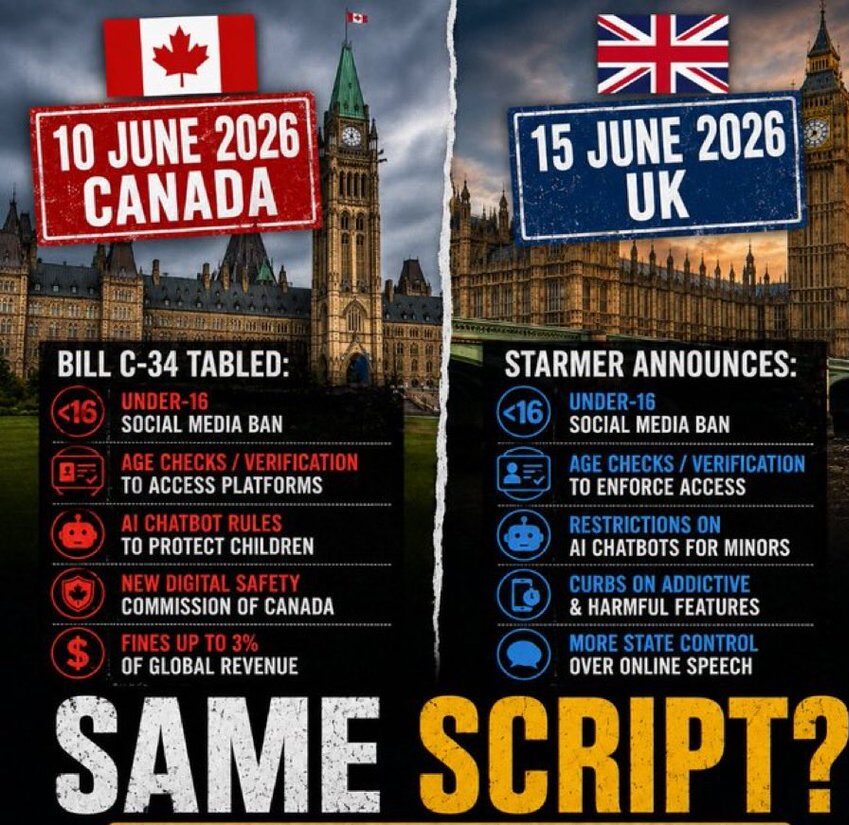 Not surprisingly, it is difficult to find non-govt-approved information about this legislative construct online.
Canadian media must remain compliant with approved government narratives in order to maintain their business model. However, putting together some various information found on non-controlled information sources, it is possible to begin discussion of the situation.
The two issues that merge with the greatest impact are Bill C-22: The Surveillance Bill, and Bill C-34: The Children’s Safety Bill.
Bill C-22 requires that all information transmission providers, every telecom and internet company, retain metadata on all Canadian users for up to one year. This is electronic metadata which we all know encompasses a lot more than just content.
Signal app, NordVPN, Windscribe, DuckDuckGo, Apple, and Meta have all formally opposed it. Signal app has threatened to leave Canada entirely rather than comply. This is a government mandated metadata storage library on all electronic communication and activity by Canadian users.
Then there’s Bill C-34: The Children’s Safety Bill, as noted by Lucy Hargreaves, a bill that ‘Applies to Everyone’, not just kids. “The government’s social media ban for under-16s is genuinely popular, with 75% of Canadians supporting it in polling. The problem is what it requires in practice. To stop anyone under 16 from creating an account, platforms need to know how old everyone is. There is no way to identify who is under 16 without identifying everyone who isn’t. This means every Canadian adult would need to submit government ID or a face scan to a third-party verification company before posting a photo, using cloud storage, or playing an online game. The bill also creates a new Digital Safety Commission with sweeping powers to set the rules, decide which platforms must comply, and approve or deny exemptions — with almost no criteria written into the law itself.”
“Australia introduced the same social media ban in December 2025. Six months later, the eSafety Commissioner told Parliament she was “not really keen” on it from the start and called it a “blunt force approach” drafted too quickly. 70% of young Australians reported the ban had little effect on their social media use. It didn’t reduce cyberbullying. What it did produce was a surge in VPN use… pushing young people to darker, less-monitored platforms.
The UK implemented age verification under its Online Safety Act in mid-2025. Within one month, VPN downloads hit over two million — the highest ever recorded — and monthly downloads stayed above one million for a year as users raced to bypass the requirement.
The EU considered its own version of mandatory message scanning (dubbed “Chat Control”) and its own Parliament voted it down in March 2026, with the EU’s legal service concluding that indiscriminate scanning of private communications is incompatible with fundamental rights.
The government’s core justification for C-22 is that Canada is the “only Five Eyes country” without a lawful access framework. But the United States has no federal mandatory metadata retention law. The EU’s highest court has struck down blanket retention twice as incompatible with human rights. When the Public Safety Minister claimed Canada’s provisions would be “in line with U.S. counterparts,” he was forced to walk back the statement within hours.” (read more)
Think about what all the critics (correctly) point out as the bigger issue behind the “age id” social media stuff.
What is the unspoken goal of Australia, New Zealand, the U.K and Canada?
Ultimately control. Govt online surveillance, correct? Some form of legal, legislated, govt authorized data surveillance that permits law enforcement to have actionable mechanisms, right?
If that is indeed the goal, then in the USA we overlay FISA (702).
NZ, AU, UK and CA get digital IDs. The USA gets 702. It’s the same basic premise; the same govt motive; the same underpinning reasoning. Just different and nuanced approaches.
Bill C-22 forces tech companies to give the RCMP and CSIS access to your data WITHOUT A WARRANT.
Meta has warned that C-22 would turn their company into “an arm of the government’s SURVEILLANCE APPARATUS.”
Some tech companies have threatened to LEAVE CANADA entirely if this… pic.twitter.com/nVV9sZ0zoi
— Canada Proud (@WeAreCanProud) June 17, 2026
Pass the law.
It has to be enforced.
How much will that cost ?
Laws are pt always the solution.
It is impossible to tell people that the very thing they think they want is not what they are led to believe it is.
They have to be shown.
“There are two tragedies in life; one is not getting what one wants, and the other is getting it.”
Attributed to Oscar Wilde…
And the digital prison door creaks ever nearer to slamming shut.
If this keeps up, it will be like the underground in WWII in places like Holland where they had to hide radios from the fascists to access outside news source to find out what was actually happening.
Humanity has always found ways to navigate around tyranny.
Then there are those pesky “unintended consequences”….
It will be especially difficult to avoid the detection of unapproved over the the air broadcasts if one is transmitting.
The FCC was quick to track down unlicensed transmitters synonymous with pirate radio even back in the 80’s. Some were clever enough to not get caught by using repeaters and varying the primary transmitter location, days, and times among other means.
It wasn’t just Holland. Everywhere in Europe people had to hide radios from the fascists. The fascists in each country were also continuously on the lookout for signs of transmission of information from the country to Great Britain.
It was the elite in Great Britain who propped up or developed Hitler-why? As a way to counterbalance the Russians. Oh, and it was Great Britain that sent Communists to Russia so that “glorious” October Revolution was arranged by Great Britain.
Once the Communists were ensconced in Russia, they decided they needed Hitler which led to World War II. But that was just fine with the elite because they are war profiteers. They make a lot of money during war. After the destruction of many countries, they make money on reconstruction of the land they destroyed.
Yes, these current decisions are all about CONTROL. This is the way to terrorize people from communicating with other people, at least this is the hope of the British elite.
So you can understand fully the nature of the British elite, the systematic rape of over 200,000 young girls by Pakistani Muslims was covered up by everyone at all levels of society because those at the top of their government made sure to let people know their lives will mean nothing to them if they dared to go public.
darn, should have kept my old selectric typewriter
The Green Dragon Tavern
Didn’t our ancestors fight this tyranny 250 years ago? No kings. 🤭
I remember hearing something about that.
Yes because the Ban has really worked in Australia, where 61% of under 16s admit they still access SM either via VPNs or Fake Digital ID. One smart 15 year old got a fake moustache and the image got accepted. VPN access has gone through the roof.
The socialist government and media here are in pretend mode whilst Australians have had enough of this nonsense and are starting to push back raising $M 4.5 in a week to fire them in 2 years. The fire the liar PM Albanese campaign started AFTER the government sought $27 donations to get rid of Pauline Hanson the leader of the One Nation Party.
We’ve had a gut full of the two party system. Sound familiar…
https://donate.onenation.org.au/fire-the-liar
Forgot the link 😁
Need a social media alternative? get on gab. Speak freely – ‘first amendment’ freely.
https://gab.com/explore
Gab and Andrew Torba have been through the wringer to allow free speech online while keeping it clean of porn too.
It’s all to protect “the children”, these governments say.
Those little innocent ones … that these same governments, their police, and their media would rather have raped by gangs of Pakistanis for decades, to prevent ‘racism’.
The biggest lies out in the open are sometimes the hardest ones to see.
this age verification is already happening here in the US. the california law pushing this (and soon to be several other states) is set to go into effect within a couple months and platforms here are already getting their ducks in a row. i personally know two acquaintences who have had to upload an image of their license in order to remain on facebook messenger and a couple other “conveniences”. the california “protect the children” law can be searched out and researched, but believe me, it is here and it is coming very very soon. mostly this has only been reported by tech sites and tech related video posts (youtube, etc) because that’s where the people in the know are – tech savy folks.
both the people i know that have had to upload their license images were “upset” they had to do it – but they cannot live without these platforms so they just did it and their accounts were immediately unlocked whereupon they quickly forgot they were upset and proceeded to be thankful they could use their messaging apps again.
long story short: the california law covers all things not just social media. this includes computer operating systems, phone operating systems, mobile app “stores” (apple, google play on android). linux has temporarily won a “victory” by not having to comply right away, but who knows how long that will last.
it’s not just the EU guys.
just one more point of clarification: neither i nor my 2 acquaintences live in california. we actually live in the northernmost state in new england on the east coast. the reason the california law is so profound is because it covers all tech that does business in or is available in california. because of that the platforms and operating systems are forced to comply everywhere they are available because they would have to have an alternate programming and distrubution method for each state which is too cumbersome, so they are complying with california law on a nationwide basis because they do not want to have to “code” custom versions of their platforms for all states… that’s how it gets done. behind your back until it’s right in front of your face…
https://www.techtimes.com/articles/317449/20260530/california-age-verification-bill-clears-assembly-linux-spared-websites-added-age-gating-regime.htm
Divorce California. Abusive relationship.
Maybe I’m a bit old-fashioned. I have never figured out a single benefit to using social media to begin with. I never signed up. Not to one of them. None , zero, none. On top of that, I use the Brave browser, and Protonmail for email. Am I going to be locked out of my own computer for this? I also run an international business and am not a locked away hermit that is able to ‘get away’ with this kind of deviance because of my (self-induced) isolation. Time will tell, and I will continue to look to God for guidance. So far, it’s working well. Walk away if you can. No one has yet to convince me of a single (in reality) merit for ‘needing’ any social media. I don’t get it!
A number of US states are pushing towards the exact same combinations that are going on in the EU – predominately blue states that are adhering to the UN/WEF agendas…including banning VPNs.
https://www.eff.org/deeplinks/2025/11/lawmakers-want-ban-vpns-and-they-have-no-idea-what-theyre-doing
https://www.msn.com/en-us/politics/government/us-states-want-to-ban-vpns-but-citizens-are-already-fighting-back/ar-AA1OTVCe
I saw online clips, of which there were many, of Brits, Scots, Norwegians, etc.
all coming from across the pond to watch their teams in the World Cup, really learning
what the USA is all about. To a letter, they appeared to be shocked.
Why the USA isn’t a hot bed of horrible people, burned out cities and riots
(well, only in the ghetto arenas of democrat abuse)! They call our Walmart a
museum and lost their minds at Bucc=ees. Our gas stations have many pumps,
our food is great with large portions. They lined danced in Texas and are
having a great time.
I chuckle that this will hopefully have major repercussions for politicians
across the world.
Lesson to learn: Most politicians lie in order to achieve power and money.
Nothing has changed since the beginning.
But yet far left cesspool of Bluesky, a place chock full of pedos, violent extremists, ANTIFA, and mentally unstable leftist filth, is perfectly fine.
The West needs to burn all this down, and start over.
The leftist Governments of all these countrys are beyond redemption.
Its despicable, that they are not being stopped. We are ALL in an abusive relationship with our rulers, the globalist filth!
“SERENITY NOW”!!! 😉
Actually, it’s INSANITY NOW, whoknowswhat later!
Soooooo does this mean Great Britain can now track its rape gang problem better and actually *DO* something about it?
Or will they still protect the rape gangs and attack the victims?
No.
it means they’ll now target more white people for daring to speak up about the rapes.
Seriously? They’re so sick and twisted they’ll likely use their “police powers” to transmit the location of vulnerable victims to the animal rapists themselves
Unfortunately, you are correct. Since the police were active participants in the original crimes and remain on the force under the protection of the crown, they will use the expanded databases to gather additional victims.
Sure looks like they deliberately let the rape gangs flourish so they could sell this as the solution.
Let’s just use britain, it is no longer great, and maybe never was
This must be why “they” allowed Starmer to stay in office?
The increased ability to identify and arrest the opposition is what will allow him to stay in office.
They failed to install these abuses with Covid, but they aren’t going to stop until we are totally subjugated to their tyranny.
The slippery slope keeps getting steeper. Hard to fight against gravity. Is it all inevitable or is there an off ramp???
As wobbly as it is, our Constitution protects us from such laws. 702 is the work around to “comply”, although I would argue it’s also unconstitutional. I wait for a 702 case to make it up to the Supreme Court and then close my eyes at the roll of the dice.
No one’s tested the constitutionality of it yet. Sundance presented another case which skirted around the heart of the question.
Correct. In theory, 702 requires a FISA warrant. In practice, 10,000 people have access to the database. I’ve posted on CTH that the 4th amendment protects us from the seizure of our papers and effects. The existence of the NSA database itself seems to violate my inalienable rights, regardless of 702.
The Constitution doesn’t protect us from anything. It is a paper document with no ability to actually do anything.
It is “The desire of the people and their government to follow the Constitution” that protects us.
Right now, virtually nobody in American government wants to follow the Constitution. They are evil.
Right now, a majority of “we the people” don’t know what the Constitution says, and no real desire to learn. They are stupid.
See the problem? Evil hearts and skulls full of mush (thank you Rush) render the words of the Constitution ineffective.
Americans believe that a system of checks and balances written down on a piece of paper, on the advice of wise men who expected our politicians to be every bit as corrupt as every other group of leaders throughout history, automatically assures that our leaders are the best of the lot.
So, to keep people from knowing that their government is slowly taking away all their freedoms as well as selling their countries to the highest bidder or those who like to cut your head off, you just stop them seeing it. Won’t work. They have been trying to saddle the internet ever since its been up and for every one of their moves there will be found a counter move. Count on it.
Anybody want to guess what all those connected AI data centers planned for in the US will be used for?
The servers can be moved out and the buildings can be converted to Soylent Green factories.
Bet that’s a more efficient system in future Canada than their current individual MAID approach. When they no longer produce cars, they will find alternate uses for the factories.
I witnessed a MAID. It was awful – horrible. And it put extreme stress on the patient. Nothing humane about it.
Mental institutions strictly for liberal use
AH-HA moment!
The corruptocracy wants complete control.
The 95% of your life they already control isn’t enough.
In the year 3535,
Ain’t gonna need to tell the truth, tell no lies Everything you think, do and say
Is in the pill you took today…
If man is still alive.
If SAVE act is so vital, and fisa 702 is so detrimental, why is Pres Trump saying they must be attached for him to sign?
The President wants the Save America Act, they, the DS, want the 702. The President won’t get the Save America ACT any other way, so he compromises.
The beauty of the compromise is if we get the Save America Act we can actually vote new people in that will get rid of the 702.
Hmm…what do those countries have in common? That’s right, they’re part of the British Common Wealth. Move along, nothing to see there.
With friends like this.
But it’s okay to rape children, right?
So long as you aren’t a native Brit.
Understand where you’re coming from, but in no way will that ever be in my comment history.
Yes, but don’t you dare fly the St George Cross!!!
(World Cup/FIFA security force England fans …now playing Croatia at ATT Stadium in Dallas…to remove St George flags.)
Absolute 🐂 💩 .
We, the institutions that are supposed to be “governing you on your behalf,” are in fact afraid of you. We’re terrified of the idea that you would be allowed(!) to “communicate.” We need to be able to record your exact geospational position on earth, every second of every day. We need to be able to record everything that you say, in the “privacy” of your own home, thanks to the cell-phones and even the vacuum cleaners(!) that you have there. We need to stare out of your front window, thanks to your doorbell.
When phones were tied to a wire, humans were free.
Or so you thought.
President Trump should scrap Five Eyes. He should announce that the only countries that can qualify for that kind of intelligence sharing with the United States are other democracies that fully respect the rights of their citizens, such as permitting unfettered free speech. He should say that none of the other Five Eyes governments qualify any longer because of these significant new intrusions and abuses of rights that they are currently passing into law or have already passed. Such intrusions and abuses are viewed as adversely affecting their trustworthiness and reliability. I don’t know what other countries would qualify (Japan maybe?), but something along these lines should be implemented.
GDP by number and by size:
USA 1 $30 trillion
UK 5 $4 trillion
Canada 11 $2 trillion
Australia 12 $2 trillion
New Z 62 $260 billion
Add up the UK, Canada, Australia, and NZ, and combined they are less than a third the size of the USA. California is larger than all of them. And California, Texas, and New York combined are larger than their combined total.
Five Eyes intelligence sharing should be halted. They are increasingly irrelevant, and their internally deployed war on the Christian West will not stop until their populations are reduced to sitting in the mud eating bugs, with government monitors watching to make sure they do it correctly.
TERMINATE FIVE GUYS EYES IMMEDIATELY! 🙂
The US could drop out and make it Four Eyes but the system is in place and would likely go on to being run by the other four.
I remember Edward Snowden saying that Singapore had a big intelligence operation based on the same as Five Eyes and was actually supplying intelligence to FE.
Agreed, JC, but removing US intel actors from the cozy incestuous relationships will go a long way towards defanging all the traitorous creatures that undermine our USSS.
Terminate the relationships, terminate the conferences and working groups, terminate the ad hoc funding streams, send Stuxnet worms throughout their architecture to erase ALL linkages to US protocols, and TREAT THEM LIKE HOSTILE ADVERSARIES.
We need to FIREWALL and AIR GAP the entire US security architecture from Four Eyes the same as we try to do with every other nation on earth. As AI comes online, digital currencies emerge, surveillance continues to mature, and individual data mapping reaches the danger point, Our Sovereign Nation needs to ensure that ANY foreign system cannot be co-opted by malicious domestic players against We The People! 🙂
It’s time to go scorched earth on these Britannic Maniacs.
THERE AIN’T NOTHING SPECIAL ABOUT THE SPECIAL RELATIONSHIP!!! 🙂 🙂
The U.K. has special needs and their PM is a special needs child with a frightened look on his visage. This is why the King tells us we have a special relationship.
😂
🙂
I said the other day that 20 years from now we will be saying that it will be better to live in Russia than the Western Countries.
The only way to be safe is not to be secure. When you are secure you are a slave to the rulers.
Canada is on the path towards national disarmament of all private ownership of firearms and now you know why.
As a Canadian, I can tell you this.
There are millions upon millions who are not complying, nor will they in the future. The number of guns turned in voluntarily is a national joke at this point. The people are ignoring these tyrannical librats.
Also, there are many, many Police Depts and other arms of Law Enforcement, in every province, who have publicly refused, and said so quite loudly, that they will not assist the Government in taking anyones guns. There arent enough jackboots to accomplish this mission of stupidity.
So this is all a show for the left, to pat their traitor leaders on the back, pretending to do something, while in reality, no one is listening……and wont.
Canadians are very well armed, and the lies told that we are not, are just that.
Pure BS. Take that to the bank of truth.
Thank you for this post. Our family loves Canada–we’ve been visiting there for 40 years and even now, when it seems so different than before, we wouldn’t miss going.
Our media really likes to take Canada to the cleaners so it’s really great for me to hear from someone who actually lives there and is one of the people.
The Canadian Trucker Convoy from a few years back was the most inspiring thing I’d seen in my 70 years. Awesome.
Humanity will always adapt.
John has a long moustache.
“The long sobs of the violins of autumn wound my heart with a monotonous languor.”
There are also other signs that the four are colluding with the US to steer the west down towards totalitarianism.
Like the way that the four were leaders in implementing the plandemic and coerced genetic manipulation shots (that the East did not coerce on it’s own).
Perhaps the deepest deception and grandest lie that so many people believe and define their lives around is that there is no God who deeply knows them and loves them and longs for an intimate relationship in which belief and trust in Him and confidence that a life of reverence and submission to His will always results in the best and most satisfying life one can live.
It is that level of dark deception that causes many to reject and abandon the most incredible and majestic gift God has given man : freedom (free will) – and submit themselves to various other lesser gods which entrap and enslave them in prisons of tyranny and despair.
This is what is witnessed in these 5 eyes nations and which the enemies of the United States are working feverishly to bring to our homeland.
They think that they are so much better than others while big brother is watching EVERYTHING they do. What a bunch of saps maybe they get it from all that maple syrup
I am thinking like alcohol laws. Can not access ifnunder a certain age
The adult should demand a law that allows use of smart phone by someone under 16.
And they can use a bag phone. Just not smart phones.
The Heritage Anglosphere is under assault from within.
1984
George Orwell said, ‘If you want a picture of the future, imagine a boot stamping on a human face — forever.’
3 minute video of Orwell’s final interview, made just a few weeks before his death. In it, Orwell explains why he wrote “1984”. It is his “final warning”.
REAKING
Using their majority in Parliament, the Liberals have passed the toxic and divisive Bill C-9, which now awaits royal assent.
I voted against this censorship legislation. Canadians should never have to worry about the government restricting their ability to express their beliefs or practice their faith.
Conservatives will continue fighting to defend religious freedom, freedom of expression, and the fundamental rights of all Canadians.
A one world government, the beginning of controlling the population. Next stop, digital currency where you will own nothing and be happy and eat bugs.
No one asks in the UK how come they need to pass speech and privacy online restrictions in a rush for “muh children” but yet no o e moved a finger for ACTUAL rape through the gangs….my point is anyone advocating for this crap is asleep.
All these countries will have a hell of a time walking all this back. The question remains: when will it happen?
If recent history is any guide, some 70 or so years past the point of no return.
Something about figuratively wandering the wilderness until that generation passes on, there might be more hope for the those that succeed them.
When it always happens: the point at which people have more to lose through acquiescence than revolt.
IMO this looks rushed. The truth is getting ahead of them and they’re forced to hurry up.
Also IMO the horse has already left the barn, “polling” aside.
Agreed.
I think I know where they got the idea to remove privacy and rescind personal freedoms. We now have a lead up to the modern equivalent of the Enabling Act of 1933.
A similar place where they got the State Firearms Control Assistance Act (a.k.a. Gun Control Act) of 1968.
MEMORIES… Gonzalo Lira
He died because of words he said that the government didn’t like. And that is where Five Eyes (minus USA) is heading.
I must say that, as a Canadian, I’m hoping those rushed Parliament bills will give a boost to the Alberta Separation movement.
https://x.com/ChanceGardi/status/2067018409359941648/video/1
Basically, they can’t surveil and control us if we have freedom, and the autonomy that comes with it. It is the steady, aggressively incremental elimination of our agency they seek. The only question with this attack on freedom is what the social media companies decide to do about it. Based on previous actions, there’s not much to feel optimistic about.
Australia, New Zealand, Canada, Ireland, Great Britain; these are ruled peoples. They may have charters of human rights and courts of law, but they are fundamentally a three-class society: Royals, Lords and Commoners sharing unequal rights and unequal treatment under the law.
I wonder to what extent the motive of The Crown outlawing slavery was expediency; to make things simpler and less contentious for ruling over Royal subjects and commoners who formed the domestic chattle of Royal Dominion and rule. It’s as if outlawing slavery simply moved The Crown society from a 4-tier to a 3-tier structure.
Our remarkable American ancestors, at great cost in blood and treasure, fought and ultimately escaped their (not so entirely) polite indenture as devoted and loyal subjects of The Crown. Citizens emerged from the pernicious bondage.
Canada may be an important trading and strategic partner bordering our North, but at some point we need to face our respective governments and governmental approach to citizen and sovereign are fatally incompatible.
The Mexicans and others further south may actually enjoy more individual freedom of mind and being than those to the north of us. We instead are an oasis of citizenship. We may be subject to government mistreatment from time to time, but we are not subjects of a government or chattel in service to a ruling class in formal service to a monarchy.
As technology advances and further shapes and emboldens the ambitions of authoritarian social order and governance subculture, the more explosive the situation is likely to become.
From this vista, Venezuela and Iran are prelude to the next era unfolding more than a continuation of the old.
Correct me if I’m wrong, but it seems like all the data centers needed for this kind of surveillance are in the USA. At least I haven’t heard of any in other countries? No data centers, no metadata storage
Many are unaware that they contribute to their own digital prison with RING door bell cameras. All cameras (RING, FLOCK, Red light, speed, DOT, ATM, Walmart facial recognition) are all tied together into one big network. The first thing police do in a crime is go to the camera network. Now add in Ai Data Centers and every person is on camera 24/7 …no matter where you go.
Once trust is lost how do you get it back? It’s obvious that the rise of the internet and social media created a new playground for the criminally minded, but how do you fix it after the fact when those charged with public safety have failed so spectacularly costing innocent users in numerous ways?
The commonworst rears it’s ugly head. This is the difference between citizens and subjects
Thank you, Sundance.
It angers me to say it but ……the Globalist NWO is moving full steam ahead in preparation to hit the ground running after Trumps influence is out of the WH.