…”A cascading series of events could cause a sharp loss of investor confidence and lead to a spike in demand for liquidity or rapid asset sales”…
That’s a diplomatic way for the Bank of Canada to say the current financial situation in Canada is tenuously at risk, if the economic relationship with the United States severs as a result USMCA points of conflict becoming irreconcilable. An interesting statement against the backdrop of Prime Minister Mark Carney having just visited New York making a pitch to American investors {citation}.
The Bank of Canada released their 2026 Financial Stability Report {see pdf here}, and Senior Deputy Governor Carolyn Rogers and Deputy Governor Toni Gravelle delivered remarks today about the analysis. I’ve prompted the video below to the point of interest, as well as the transcript for the portion being highlighted [7:12 to 9:15]. WATCH:
[Transcript] – […] “However, vulnerabilities have increased in some parts of the system. Stock and corporate debt valuations have risen and are high relative to historical norms. This makes markets more vulnerable to a sharp correction.
The issuance of global sovereign debt is also rising, and hedge funds are playing a bigger role in buying that debt, often using borrowed money. In normal times, hedge fund activity helps keep markets running smoothly. But if conditions become strained, this activity could amplify stress and disrupt core funding markets.
Individually, these and other vulnerabilities look manageable. However, the economic and geopolitical environment has become more volatile. And this has made it more likely that a new shock or a combination of shocks could cause several vulnerabilities to crystalize at once. If this were to happen, these vulnerabilities could interact and reinforce each other.
A cascading series of events could cause a sharp loss of investor confidence and lead to a spike in demand for liquidity or rapid asset sales. Funding markets could come under pressure, and stress could spread more broadly.
To be clear, the FSR is not about what we expect will happen. It is an assessment of how existing vulnerabilities—or pockets of stress—could amplify shocks and ultimately spread across the financial system.” (more)
The financial markets in Canada are tied directly to the independent strength of the Canadian economy. Which is to say, the financial system in Canada is dependent on historic ties to the United States. Pull out all of the dependencies within the economy, a result of a fracturing of the “geopolitical relationship,” and suddenly the Bank of Canada faces a “cascading series of events” they have not previously had to entertain.
A significant number of multinational corporations within Canada are geographically centered due to American proximity and the dependency that has historically been considered a partnership. That relationship has now changed, and despite Mark Carney saying that Canada can be stronger standing alone, there is no economic model for Canada to retain its wealth position without the inherent subsidy that proximity to America provides.
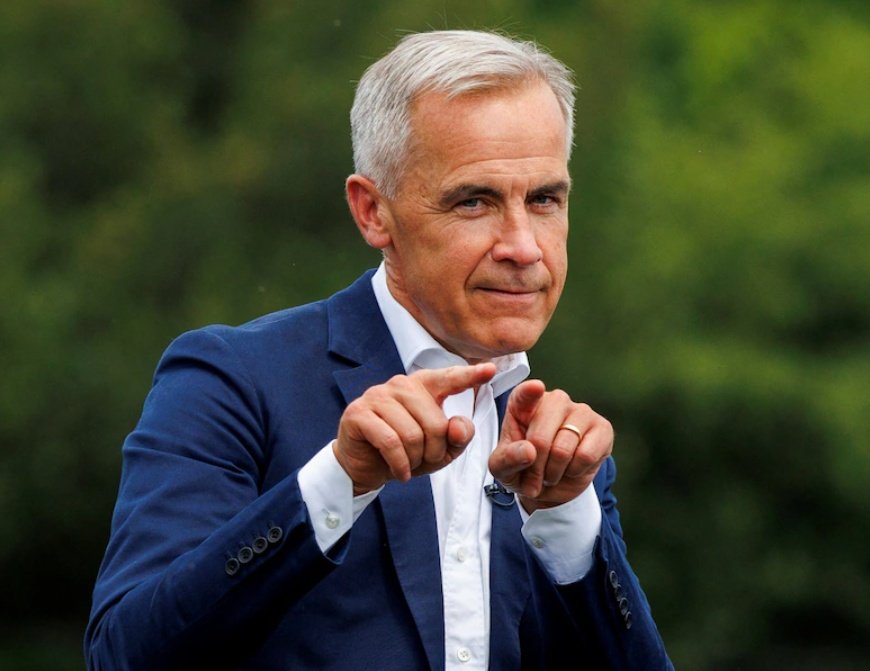 During his visit to New York, Prime Minister Mark Carney is quoted as saying, “the world is undergoing a rupture, led by the United States. Technological change is accelerating at a pace we have not seen in our lifetime. The U.S. is transforming all its commercial relationships, as is its right. The world is becoming more divided and dangerous. Canada has responded quickly to these shifts by diversifying our partnerships abroad. We have to care ourselves and be true to ourselves.” Given the nature of Carney’s anti-Trump political advocacy, he could say nothing else.
However, there is no independent Canada economic construct that can survive a disconnect from the United States. There is no ‘partnership’ with Europe and/or China, or a combination of partnerships, that can replace the one-way nature of the subsidies from the U.S. economy that Canada enjoys.
If the Canadian people, workers and companies therein, have to rely on their own domestic economic activity to fund their GDP, their lifestyle will have to modify in very significant ways.
One large example that will no longer work is the Canadian energy policy. No country is going to align with Canada to assemble goods for the American market if there is no way for the product to enter the United States.
If the U.S. blocks Chinese steel as a component good, then Canada has to make their own steel for whatever the product is. The same applies to every raw material that is then processed at the industrial level before it takes the form of a component part. Canada will have to extract the raw material, transition it via dirty carbon emitting industrial processes, then mold that product into the component – regardless of the finished product. The Canadian economy is no longer set up to do this at scale.
Canada extracts a vast amount of raw material; but then ships that material elsewhere for industrial modification at scale (example: oil to fuel, wood to lumber, Canola oil into xxxx, etc.). Shut down the transition phase of the product due to trade agreement conflicts with the USA and Canada is left with a bunch of raw materials they then need to sell at a discount to Europe and Asia.
Previously, in almost every FTA, the EU and Asia would purchase these materials in exchange for using Canada’s proximity as a gateway to the USA market. The EU and Asia trading or selling back component goods, Canada assembling them and shipping the item into the USA. Take the United States market out of this equation and what happens to the Canadian economy and all of those previous free trade agreements with third party countries. See the problem?
Thus, within the New York Times article discussing Mark Carney’s visit to New York, it ends with this:
Lori Turnbull, a political scientist at Dalhousie University in Halifax, Nova Scotia, said that opening reflects the impossibility for Canada of fully or even substantially replacing the United States as a trade and economic partner.
“Canada is going to have to find a way to deal with this, and the American are still going to put on the tariffs,” Professor Turnbull said. “We’re in the weak position and they can call the shots.” (link)
The Bank of Canada is cautiously optimistic Professor Turnbull is correct. However, given the severity of the trade friction, in combination with the antagonisms of Carney, the Bank of Canada is also saying: …”A cascading series of events could cause a sharp loss of investor confidence and lead to a spike in demand for liquidity or rapid asset sales.”…

No way they haven’t been planning on a major financial crisis to blame on “selfish USA” when Canadian trade has to go and make it on their own. Now that the game is up, their mission is to tear a giant hole in the financial system. They are no different than the rioters screaming “burn the m-f down!”
Because this is what monarchy’s do, they are the lowest of the low. As Jack Posobiec aptly names them in his book “Unhumans”.
they will burn it down in order to rule over the ashes.
I am of the opinion that Carney and the WEF types are less concerned with wealth accumulation (they are already rich) than they are with teaching the peons a lesson.
‘you are a global warming / vax skeptic….? Watch this…..’
Specifically, what is the point of being a billionaire if no retail clerk knows who you are or Gives AF about what you have? The clerk can travel in her own car, buy anything her heart desires from the grocery or clothing store, can watch a movie on her own big TV. These things used to be reserved for Kings, except Kings never had it as good.
So the retail worker must be put in her place.
The common theme throughout history seems to be: The party stops when they run out of other people’s money. Chavez and Castro each enjoyed a few fun years expropriating others’ wealth for their vanity. The subsequent years have been terrible for their subjects. The mayor of NY is of s similar mindset.
if its energy Canada needs, Alberta has ’em by the gonads
they don’t want energy. they want any money that alberta produces .
This.
They have all the resources they need to build a strong manufacturing economy, but refuse to. They’d rather sell all their resources away to the highest bidders.
Why do you think a significant plurality of Albertans – and a growing number of Saskatchewans – are talking secession?
Canada is… “Freddy the Freeloader”…..That’s reality….
When it comes to paying the bill (NATO)…Canada has “Alligator Arms”….
Going next to alligator tears!
“How did you go bankrupt?” Bill asked.
“Two ways,” Mike said. “Gradually and then suddenly.”
Canada has been FingA for years, now they are going to FO rapidly…
So sad.
On another website, a poster was wondering why his homeland of Canada was getting hit harder by price increases than other countries. I told him his prime minister was making a series of bad financial decisions. His was response can be summed up as, “Huh?” A lot of Canadians have no idea what’s coming.
I wonder if the state owned media and virtual censorship have anything to do with it.
Nah, can’t be.
FAFO
Another episode in the series, can a duh, were bankers warn of impending doom.
the bankers are the ones who ended the unbelievable crack down on the protesting truckers.
US company Cleveland-Cliffs bought Stelco, a Canadian steel company, in 2024. Stelco has a blast furnace steel making facility in Ontario with a capacity of 2.5 million net tons. It also has a cold rolled, coating processing and finishing facility at a second location in Ontario and a steel scrap processing facility.
That might help if the Communists were willing to give up the carbon tax scam and allow such businesses to be viable.
But they want power, not money. They want all of a small political economy, not a share of a large market economy.
Communists have never been good at Capitalism.
Capitalists haven’t been very good at it, either. An entrepreneur gets to a certain point and then starts paying the govt (writ large) to protect him from competitors. Goodbye capitalism, hello corporatism.
You’ve struck on one of the issues that I think we need to change; turning the regulatory and legal environment around 180 degrees, so that as the number of competitors decrease through mergers etc. incentives are introduced for more competitors enter the market.
Admittedly, I do not know how we would go about this, but I do know that while the founders wanted a free market, they didn’t want a crony market that ends like a game of monopoly with one player at the end owning all the cash and all the properties on the board.
You can’t have corporatism without govt intervention. Could it be as simple as reducing regulation and monetary manipulation steadily down to zero? Then ensure that the govt functions to secure our rights to life, liberty, and the pursuit of happiness and little to nothing else.
The hard part is in the sequence of events undertaken to do the regulatory dismantling. The corruption of the current system has left it all very precariously balanced. I’m struggling hard here to avoid a Jenga riff.
Yea, it’s that hard part of changing the government from an organized crime racket to a neutral referee that I do not currently have a solution for.
You may want to think about it in a different manner John.
Canada is but one of a world of dominoes. Many think the UK, whose social engineering costs alone have now exceeded their income – and have taken several gut punches as PDJT rearranges the furniture, will be the first domino to fall. Considering that Canada is the weakest commonwealth nation, it will likely follow quickly.
There are quite a few – including some very good, long experienced macro analysts who think the first half of the 2030’s is when the final straw that initiates the domino collapse will hit. In such a situation, don’t know if our own nation will be restructured enough to withstand the effects as they fall across the world, if it happens.
Such a time would be the opportune window for the change you specifically mention. Of course, there are those who have drastically different plans for that time and have been in planning much longer…
While it looks likely that you are correct, the outcome I’m most hoping for is that Trump has a plan, that we return to the Constitution, that the UK and the other dominoes get rid of their sock puppets and get on board; and that maybe we can get through the transition without too much pain.
Just remember – while it is good to hope, Hopium can be the most addicting substance in the world, and it keeps people from preparing for the worst in many cases.
Agreed, hope is like water, necessary, but too much, or too little will kill you.
“The worse, the better.”–Lenin
The important thing to remember: It’s On Purpose.
Barack Obiden tried to plunge us into Depression, but couldn’t because Americans support Israel.
Purchase of Alaska in today’s money: $130-150M
Louisiana Purchase in today’s money: $340-442M
I say hold and wait for the price on Canada to bottom out, while providing emergency supplies to its poor, naive citizens.
We have tens of millions poor, naive (and dependent) citizens in this country, so why acquire more?
Ones that have had decades of indoctrination considerably exceeding that here and have grown up in a socialist like system of government dependency. There are a fair number of great people there – but the ratio is all wrong.
Right. I don’t think we could ever take them; they won’t be able to be reformed. And even if things got so bad there they wouldn’t realize they were hoodwinked, they would just blame us, and so coming here they would immediately join the ranks of Antifa and our Democrat party to take the nation down.
Don’t be fooled by their similar English and race mixtures. They are NOT Americans and never will be. They aren’t like South Vietnamese, or people who come from Nigeria, or wait for decades from South Korea or someplace.
They will not EVER , EVER, EVER have a thought: “we were fooled, we were wrong, I want what MAGA USA has”.
Just won’t happen. They are walking corpses.
Much of the current generation could never be American, yes, but don’t sweep away the younger generations yet.
They have the most to gain – and lose – in how this all plays out.
Buy a province at a time.
Make each province a territory – a probationary state.
Give the residents the choice of continuing Canadian citizenship – by moving to rump Canada – or provisional status as American citizens.
No welfare, no corruptocracy jobs, no anti-American media allowed -> would-be Ds leave voluntarily or break the law and get deported.
A limited state – low taxes, low regulatory load -> would-be R families stay (and more come).
20 years as a law-abiding, net tax-paying citizen: Congratulations, full citizenship!
20 years as a law-abiding, net tax-paying state: Congratulations, full state!
The anti-Americanism is almost entirely top down, same as in the US. If citizenship is something rewarding to be earned rather than something the Cult of the State punishes you for wanting, most people choose to be citizens (and the Antis go to where they can be parasites).
There might even be a chance of getting some plan like this past the RINOs and Democrats.
alberta has something else in abundance other than oil. if they can get water west and south of the mississippi watershed, they could make trillions selling it to the western states.
They have considerable untapped natural resources – but as long as the current type of government is in control, they are as useless as mammaries on a boar hog.
Maybe this is the way the global elites want the average person to “own nothing and he happy”? Destroy jobs and the economy, destroy the financial system, then they can recreate a fiefdom. “All hail Lord Carney…”
I think it more likely that they honestly don’t know how to proceed; Trump and MAGA are by far the largest threat to their power that they have ever faced in their centuries of existence. When your history is always being able to increase your power by the control of both sides of any conflict or operation, you do not have the foundation of experience to counter such a novel problem, as having to become reactive instead of proactive.
Trump screwed up their plans in 2016, they overreacted out of fear, and only made the situation worse by stealing the 2020 election, now he’s back with a vengeance and has outmaneuvered them at every single turn; busted up their operations in Venezuela, Iran, EU, Canada, Mexico, NATO, politics, banking, and financial controls. They truly do not know how to react, and are quickly reaching the point of utter desperation.
The lowlife rats in Canada will do what all tinpot dictators do when in a jam…blame the US and create hatred among the people.
Wag the Dog in reverse!
I like this assessment.
That said, unless President Trump has a successor waiting in the wings to carry on this fight, it’s over in 2.5 years. Trump needs to reach a point where a decent successor simply cannot screw up the gains won with such sacrifice to this point.
It’s also why Trump has had more assassination attempts on his life than any US President in history.
Agreed. I think in reality we must be the successor, by returning to the basis of the Constitution and then paying attention.
Brilliant assessment. They need to get on board or continue going down with the sinking ship. But first, they need to swallow their pride. That’s the toughest thing for them.
Read Klaus Schwab’s book, “The Great Rest”.
That is precisely what they want – a return of the masses to some form of feudalistic/communal society, where one must pay fealty to their overlords just for existing. A society where the people’s “betters” will inflict artificial shortages on a recurring basis, so that the people won’t rebel against their “benefactors”.
Pretty cold stuff in their plans.
Um…that’s “The Great Reset”, not “The Great Rest”. My bad….
I suspect Mark Carney has moved all of his money and investments quietly to safe places. Now he is kicking the hornets’ nest and waiting for the SHTF, then while Canada is in flames, and chaos is everywhere, Mark Carney quietly departs for Europe with his boatload of money singing “Happiness is Canada burning in my rearview mirror”, to live happily ever after. Just play that country music song by Mac Davis from 1980, “Lubbock, Texas in My Rearview Mirror”, (a great song) why reading the “Happiness is Canada burning in my rearview mirror”. When that song came out, I was 28 years old and I still sing it in my head every once in a while. They don`t make good music like that anymore, in my humble opinion. Forgive me, I got to rambling too much.
Have never seen anthing like this in modern history; a nation having leaders that began by silencing any news that the government didn’t like, then walks it toward bankruptcy and now proudly with their MAID program, ending the lives of citizens and calling it suicide probably in some strange mental gymnastics because it is cheaper than providing their vaunted free medical care.
That it sits on our country’s northern border is scary and there are some really fantastic people I’ve known over the years who were Canadian citizens and it just floors me to wonder what the heck happened? Can’t ask them because, being senior citizens, their children put them into a program that my friends were told had great maid service and the next thing I know is I’m reading their obituaries. Still don’t know how to think about that.
Hopefully the events being forecast won’t spill over into our own system. Is there enough separation to avoid that ?
As interconnected as the global economy is, and as connected to the Left as the media is, there will be a massive spillover into the our own system. This current war – and it IS a war – is designed to do just that.
The question really should be – are we prepared to accept the sacrifices being “collateral damage” obligates us to accept?
I have never seen anywhere in history where major conflicts did not have collateral damage.
As I said before I have always been suspect of Canada from my many fencing tournament visits. This is going back to 1980s. I have only been to the eastern power centers but I could feel and see the Socialism from my first visit in the early 1980s to my last in 2018.
You reap what you sow. Hard winter coming. ….
This.
For the European aristocratic “elite” powers (and their families), and for the feckless bureaucrats and elected “leaders” doing their bidding…a very hard winter is coming.
Oppression and affliction is not a sustainable model. Sooner or later, the harvest of what has been sown comes to pass.
Is Mark Carney changing his tune? Is Mark Carney lying about changing his tune? One thing is for sure, he’s never said these things before as his economy crumbles, his efforts to find new business abroad fail, and the deadline approaches. And he’s now speaking like a broken man.
No talk of “elbows up.”
“Spike in demand for liquidity”. I’m not broke, just having a temporary cash flow problem.
Stimulating and thoughtful comments on this thread. Treepers are in touch with reality, brilliant even with Professor Sundance leading the way. Pray for the people of Canada. Revival may be their only hope of a turn around. The beast system runs deep.
Quote: “The financial markets in Canada are tied directly to the independent strength of the Canadian economy. Which is to say, the financial system in Canada is dependent on historic ties to the United States. Pull out all of the dependencies within the economy, a result of a fracturing of the “geopolitical relationship,” and suddenly the Bank of Canada faces a “cascading series of events” they have not previously had to entertain.”
This is precisely where the “51st State” reference comes from: if Canada is simply a ward of the US economy, then all pretense needs to be shed, and Canada removed from being a British Commonwealth to being a US territory.
If they had no desire to be placed into such receivership, then….I guess that possibility should have been thought about before their government wonks embarked on enacting their ridiculous energy and manufacturing policies.
Canada will not survive in its current form for long. I’m also thinking Australian and New Zealand are not very far behind.
The UK is simply a lost cause at this point. Canada needs to start taking a very hard look at where they want to land – and with whom – when the USMCA gets replaced with bilateral agreements, and is finally phased out.
The Canadian trade representative is not currently conducting talks with the US, and has no future talks scheduled. July 1 is rapidly approaching. Not really sure if they have any strategy or plans for what they want to discuss. I guess it’s OK to stick your head in the sand on this issue. Or in the snow, as the case may be. Next 30 days should be interesting, to say the least.
Shit happens…………
33 years and counting without the Stanley Cup/le Coupe Stanley. 😆😆😆
Forget Justin Trudeau, I’m old enough to remember when Pierre Trudeau announced around 1977 that he was “reorienting” Canada’s trade away from the U.S. and toward what was then known as the European Community. Carney’s brainstorm is likely to work out about as well as Trudeau pere’s did…….