…”A cascading series of events could cause a sharp loss of investor confidence and lead to a spike in demand for liquidity or rapid asset sales”…
That’s a diplomatic way for the Bank of Canada to say the current financial situation in Canada is tenuously at risk, if the economic relationship with the United States severs as a result USMCA points of conflict becoming irreconcilable. An interesting statement against the backdrop of Prime Minister Mark Carney having just visited New York making a pitch to American investors {citation}.
The Bank of Canada released their 2026 Financial Stability Report {see pdf here}, and Senior Deputy Governor Carolyn Rogers and Deputy Governor Toni Gravelle delivered remarks today about the analysis. I’ve prompted the video below to the point of interest, as well as the transcript for the portion being highlighted [7:12 to 9:15]. WATCH:
[Transcript] – […] “However, vulnerabilities have increased in some parts of the system. Stock and corporate debt valuations have risen and are high relative to historical norms. This makes markets more vulnerable to a sharp correction.
The issuance of global sovereign debt is also rising, and hedge funds are playing a bigger role in buying that debt, often using borrowed money. In normal times, hedge fund activity helps keep markets running smoothly. But if conditions become strained, this activity could amplify stress and disrupt core funding markets.
Individually, these and other vulnerabilities look manageable. However, the economic and geopolitical environment has become more volatile. And this has made it more likely that a new shock or a combination of shocks could cause several vulnerabilities to crystalize at once. If this were to happen, these vulnerabilities could interact and reinforce each other.
A cascading series of events could cause a sharp loss of investor confidence and lead to a spike in demand for liquidity or rapid asset sales. Funding markets could come under pressure, and stress could spread more broadly.
To be clear, the FSR is not about what we expect will happen. It is an assessment of how existing vulnerabilities—or pockets of stress—could amplify shocks and ultimately spread across the financial system.” (more)
The financial markets in Canada are tied directly to the independent strength of the Canadian economy. Which is to say, the financial system in Canada is dependent on historic ties to the United States. Pull out all of the dependencies within the economy, a result of a fracturing of the “geopolitical relationship,” and suddenly the Bank of Canada faces a “cascading series of events” they have not previously had to entertain.
A significant number of multinational corporations within Canada are geographically centered due to American proximity and the dependency that has historically been considered a partnership. That relationship has now changed, and despite Mark Carney saying that Canada can be stronger standing alone, there is no economic model for Canada to retain its wealth position without the inherent subsidy that proximity to America provides.
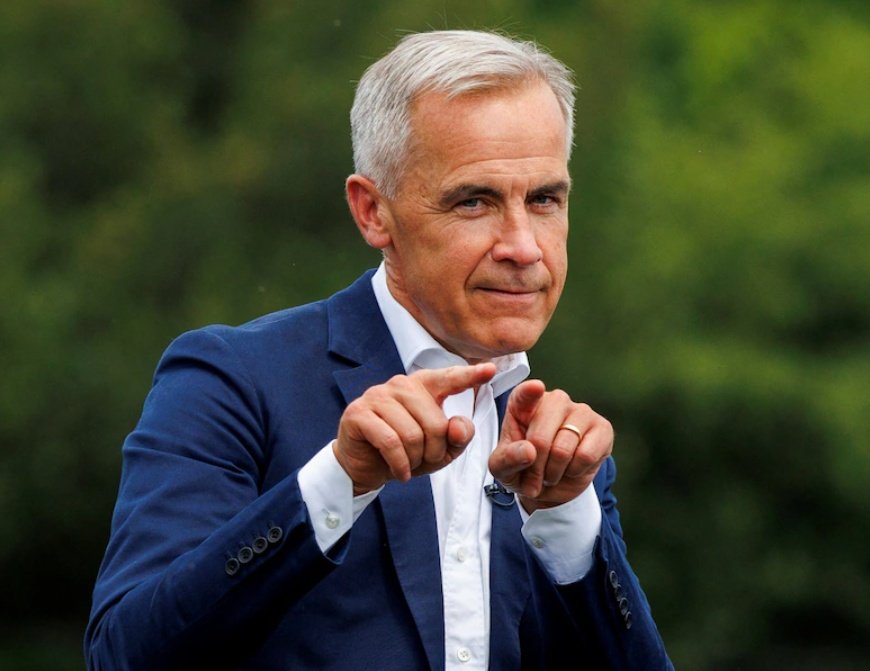 During his visit to New York, Prime Minister Mark Carney is quoted as saying, “the world is undergoing a rupture, led by the United States. Technological change is accelerating at a pace we have not seen in our lifetime. The U.S. is transforming all its commercial relationships, as is its right. The world is becoming more divided and dangerous. Canada has responded quickly to these shifts by diversifying our partnerships abroad. We have to care ourselves and be true to ourselves.” Given the nature of Carney’s anti-Trump political advocacy, he could say nothing else.
However, there is no independent Canada economic construct that can survive a disconnect from the United States. There is no ‘partnership’ with Europe and/or China, or a combination of partnerships, that can replace the one-way nature of the subsidies from the U.S. economy that Canada enjoys.
If the Canadian people, workers and companies therein, have to rely on their own domestic economic activity to fund their GDP, their lifestyle will have to modify in very significant ways.
One large example that will no longer work is the Canadian energy policy. No country is going to align with Canada to assemble goods for the American market if there is no way for the product to enter the United States.
If the U.S. blocks Chinese steel as a component good, then Canada has to make their own steel for whatever the product is. The same applies to every raw material that is then processed at the industrial level before it takes the form of a component part. Canada will have to extract the raw material, transition it via dirty carbon emitting industrial processes, then mold that product into the component – regardless of the finished product. The Canadian economy is no longer set up to do this at scale.
Canada extracts a vast amount of raw material; but then ships that material elsewhere for industrial modification at scale (example: oil to fuel, wood to lumber, Canola oil into xxxx, etc.). Shut down the transition phase of the product due to trade agreement conflicts with the USA and Canada is left with a bunch of raw materials they then need to sell at a discount to Europe and Asia.
Previously, in almost every FTA, the EU and Asia would purchase these materials in exchange for using Canada’s proximity as a gateway to the USA market. The EU and Asia trading or selling back component goods, Canada assembling them and shipping the item into the USA. Take the United States market out of this equation and what happens to the Canadian economy and all of those previous free trade agreements with third party countries. See the problem?
Thus, within the New York Times article discussing Mark Carney’s visit to New York, it ends with this:
Lori Turnbull, a political scientist at Dalhousie University in Halifax, Nova Scotia, said that opening reflects the impossibility for Canada of fully or even substantially replacing the United States as a trade and economic partner.
“Canada is going to have to find a way to deal with this, and the American are still going to put on the tariffs,” Professor Turnbull said. “We’re in the weak position and they can call the shots.” (link)
The Bank of Canada is cautiously optimistic Professor Turnbull is correct. However, given the severity of the trade friction, in combination with the antagonisms of Carney, the Bank of Canada is also saying: …”A cascading series of events could cause a sharp loss of investor confidence and lead to a spike in demand for liquidity or rapid asset sales.”…

Wonder if Alberta becoming the 51st state would count as a shock?
Remember Brexit? Expect anything different?
The elites did not want Brexit and sabotaged it. Labor was willing to partially destroy the UK to prevent Brexit from working. The Green Energy and Islamists have finished off the UK.
Not as long as the Crown retains power to dissolve Parliament
Can the Queen close down Parliament?
At any time the Sovereign could dissolve Parliament and call a general election.
Can the Queen overrule the Prime Minister?
The monarch remains constitutionally empowered to exercise the royal prerogative against the advice of the prime minister or the cabinet
https://ontario-bakery.com/canada/could-the-queen-dissolve-parliament-in-canada/
There’s no reason to accept Alberta as a state. A Canadian “conservative” is left of most American democrats.
Yes, I agree.
How many Canadian conservatives do you know?
Encourage them to declare Independence. Defend them from the old Canada military (A troop of girl scouts should do the job). Set up trade and defense agreements. No need to make it a state.
Not true. Canadian conservatives are generally as conservative as you are, believing in our respective traditional values. Think about it. Many of us having grown up on farms or in the many rural areas, or from military families don’t buy any of the far left crap. Sadly, it seems we are in the 20+% range of the population.
That’s right. Let them be their own country. The oil money flowing in will turn them all in to capitalists.
How many Canadian conservatives do you know?
I guess Albertans are not keen being the sole support and succor for all of Canadian socialism.
We can partner with Alberta, after their Albertexit. And the husk of Canada which remains can borrow from Panda.
That’s worked out really well for all these African nations. Belt and road? In reality, noose and shallow ditch.
https://www.reuters.com/business/finance/african-nations-now-send-more-money-china-than-they-receive-new-loans-2026-01-27/
Three hundred thousand signatures on the petition to withdraw from Canada…so far.
But of course the Powers That Be are making it increasingly harder and harder for Alberta to do so.
Because of course they are….
https://www.bbc.com/news/articles/clypn8py4zwo
…if Canada is going to “hang”, Carney will make certain they “hang” all together.
Excluding himself of course. That just wouldnt do.
Of course not, Eagle…
He’s….special
(I’ll leave it to others to interpret what exactly I mean by that 😎)
I wonder if one cascading effect of Alberta leaving Canada would be to prompt other western provinces to follow Alberta’s lead and also leave?
Certainly would think that Saskatchewan is right there behind them.
Time will tell, if Alberta manages to secede from Canada or remains tied to an abusive relationship with Ottawa.
no offense to the people of Alberta, but we don’t need millions more hard-left liberals voting in American elections and voting themselves shares of other people’s stuff.. We have our hands full with the leftists we already have.
There are precious few Canadians that would align with MAGA in any way. A Canadian “conservative” is still a democrat vote in America.
Alberta voting to leave Canada does not necessarily mean they will ask to become a U.S. state or be accepted as one (the affect on the composition of the Senate undoubtedly would have one side or the other resist letting them become a state). They could just as easily become their own independent country. And with all their oil to bargain with, they could probably enter into a trade agreement with the U.S. on pretty good terms.
There are a number participating here are there not?
<—– Correct. Many, many, many.
Felix is, well, ignorant. And misinformed.
Well, that is some BS right here.
So myself, and a great number of Canadians that post here and have everything in common with MAGA voters are now ” democrats? “. Because you say so?
Anyone one of you that think that way are grossly misinformed!
You are dead wrong. You know nothing of Canada and what a good majority think.
I guess stolen elections are only an American thing. Who knew……
Seriously. I want to be a little more direct in my criticism of your statement and to the ones who upvoted you, in a much more linguistally abusive way, but the rules say I gotta be nice.
You can take that statement and aim it northbound, from below.
Humility and respect is not your thing. Blanket statements are…….You dont know me pal, or my family, or my friends, or people like me that reside up here. Of which there are millions upon millions who detest anything the left does. Your cold anger with all of this is no different than that of American patriots!!
Millions upon millions of us absolutely hate the prog leftist scum that stole our election and our pride and dignity. That is just for starters.
You poked the bull here, so the horns you get. There are many, many, many people, whom you just insulted. Who do you think you are exactly? A Canada expert?
Man. This stuff just gets my ire up. You have teamates up here, who are the same as you, but you choose to insult us.
Good job, hoss……I would assume you and your 7 upvoters dont know my country, and apparently think, you are above us all.
We are every dang bit as patriotic as any American. Come and visit real Canadians, come up the the bush, where you might find your rednecks are the same as ours, even a little crazier perhaps.
We hate Libtards as much as you do!
Normal, hardworking, patriotic, family oriented citizens and Christians, ( who are NORMAL ) who want freedom and opportunity for our familys, is not a leftist position.
We despise Carney/Turdeau beyond words.
Last time I checked, we have been infiltrated, our media captured, our news captured, our society forced to eat Woke all day….
Does that sound familiar? Or are you too high on your horse?
Well, that is some BS right here.
So myself, and a great number of Canadians that post here and have everything in common with MAGA voters are now ” democrats? “. Because you say so?
Anyone one of you that think that way are grossly misinformed!
You are dead wrong. You know nothing of Canada and what a good majority think.
I guess stolen elections are only an American thing. Who knew……
Seriously. I want to be a little more direct in my criticism of your statement and to the ones who upvoted you, in a much more linguistally abusive way, but the rules say I gotta be nice.
You can take that statement and aim it northbound, from below.
Humility and respect is not your thing. Blanket statements are…….You dont know me pal, or my family, or my friends, or people like me that reside up here. Of which there are millions upon millions who detest anything the left does. Your cold anger with all of this is no different than that of American patriots!!
Millions upon millions of us absolutely hate the prog leftist scum that stole our election and our pride and dignity. That is just for starters.
You poked the bull here, so the horns you get. There are many, many, many people, whom you just insulted. Who do you think you are exactly? A Canada expert?
Man. This stuff just gets my ire up. You have teamates up here, who are the same as you, but you choose to insult us.
Good job, hoss……I would assume you and your 7 upvoters dont know my country, and apparently think, you are above us all.
We are every dang bit as patriotic as any American. Come and visit real Canadians, come up to the the bush, where you might find your rednecks are the same as ours, even a little crazier perhaps.
We hate Libtards as much as you do!
Normal, hardworking, patriotic, family oriented citizens and Christians, ( who are NORMAL ) who want freedom and opportunity for our familys, is not a leftist position.
We despise Carney/Turdeau beyond words.
Last time I checked, we have been infiltrated, our media captured, our news captured, our society forced to eat Woke all day….
Does that sound familiar? Or are you too high on your horse?
Some weird stuff happened to my post when I edited it. Posted half of it twice or something.
Im sure you get my drift here.
Dont insult the Canadian posters here. Or question our loyalty to Conservative ideals.
Or people like me will respond, with some truth bombs. I always react when I see this high lipped, high browed assessment of my country.
You dont know me or anyone else from here, that are on your team.
We have both been infiltrated with Communist/Marxist/Globalist scum. Our elections messed with. The left is on the march across the globe, or did you not notice this? Pretending not to know things is not a good look.
You are no better than I or the rest of the Canuck Treehouse posters.
Bob tell us how you really feel!
LOL
I’m sorry your country is run by french communist limousine liberals.
We are much too close to that down here 🙁
I guess he should have saved the “tough guy” act for private chatter rather than blast it all over global media.
the attempt is to utilize congress and others to block trump. really is the only cards he had to play. not likely to work
He could have kissed up and stopped being an a**.
Plan A seems to be to wait out Trump and hope the next administration will return to the Old Normal. There is no Plan B.
This Canadian lady could have just summed up her remarks by saying; “Pucker up! The Canadian financial system is going to collapse before long”
Beat the crowd at the bank and get your money out now before the rush.
Paper for kindling.
Biden, Obama, Harris was the “Old Normal?” No thank you. Yech.
I’m not too sure anybody in this World has conceived a Plan B! Have we?
Maybe Plan A was something else entirely…
Q: is there any Canadian ownership history to any vote tabulation hardware or software?
A: Yes, Dominion Voting Systems is a Canadian-origin company founded in Toronto, Ontario, in 2002/2003
*It is an assessment of how existing vulnerabilities—or pockets of stress—could amplify shocks and ultimately spread across the financial system.*
Pockets of stress? 🤔
Will Sundance do a deep dive on Nark Carney and his relationships with Goldman Sachs, the Bank of Canada, the Bank of England, Brussels and the WEF.? What county would self-impose a carbon tax to appease the European ‘s and their protectionist but incredibly selective Carbon Border Adjustment Mechanism (CBAM)?
Put Mark Carney into the search bar at the top of the main page and you will see that Sundance has done NUMEROUS deep dives into him already! This current action is a result of all of the prior actions taken by him, and Justin Castro Trudeau before him, and Sundance has been predicting this very debacle in the Canadian financial markets for YEARS!
🎯 💯 Right on vikingmom. Here are a couple of links that I hope will give a bit of insight alongside Sundance’s excellent work.
The first is a chart of Carney’s entire known web of grift including his Brookfield and CCP entanglements, all of the contacts from his career that Northof49 has outlined above, and whom he’s engaged with again now he’s in power, as well as his personal investments.
It’s a pretty big chart so takes a few minutes to load but it has receipts for everything. It’s by David at Moose on the Loose, an independent journalist.
https://miro.com/app/board/uXjVJHS5Gx0=/
And Vesper on X has many detailed posts about Carney’s career and goals as well as his CCP and Brookfield connections:
https://xcancel.com/vesperdigital/status/2059071504961130805#m
https://xcancel.com/vesperdigital
Middle finger.
Canada central bank telling the gov’t of Canada to make nice with the U.S. and do what President Trump wants or your entire financial system will crash.
Trudeau did explain that to Trump in Mar-a-Lago a while back. Don’t make us pay our fair share to NATO, or else we go belly up. Trump to Canada: interested in being our 51th state?
The very fact that they published and spoke such words, could start the first domino falling. Fire sale. Very bad.
The fact that we’re controlling Venezuelan oil leaves Canada with zero leverage. We produce light sweet crude that’s lacking the heavier elements needed to produce all of the needed products. We import heavy sour crude from Canada to blend with our light sweet crude to make the optimal blend for refining. Venezuela is the largest oil reserve on earth and it’s all heavy sour crude. If we can quickly ramp us Venezuelan crude production we will have zero need of any Canadian product. Further increases of Venezuelan crude oil could displace Canadian crude oil from the world market. Canada would be left with little to no high value exports. Canadian standard of living would drop significantly. Unless Canada abandons their current energy policies and reindustrializes the future of Canada is mass poverty.
Interesting how the pieces all fall into place, isn’t it? Love to watch a plan unfold.
Canadian truckers should try again, and we don’t need another failing country on our border.
if the truckers are going to do another protest rally, they should save their fuel and simply park their rigs. What is Carney going to do….. force them at gunpoint to get to work?
The shelves will be empty in 3 days. The phone calls will flood Parliament Hill and every MP’s riding / district office.
The truckers will be in the driver’s seat.
“here is our list of demands….. Unless and until they’re met, we are parked”
a list would be fairly easy to put together.
It is unfortunate, that any sort of action like this, would fail.
Canada is now Little India. Ask any Canadian, who tells the truth. There are a million or more East Indian truck drivers. Many of them are illegally here, illegally obtained their licenses, who maim and kill Canadian citizens because they are not properly trained.
I was witness to the Truckers protest, when they rolled through my little City of 52,000 people. Many of them stopped to fuel and eat, etc, some stayed overnight. It was -30 celsius that night and into the morning. Ask me how many East Indians or immigrant drivers in their convoy? I saw none. Not a one.
What I did see were the same amount of trucks pass by, in a days time, that were loaded and working. When you look the names of the companys that did not join in the protest, and who was driving them, you know right away, the solidarity is not there.
Most of them would never stand up to the Government, who let them all in….they would not park their trucks. Their loyaltys are not to Canada or the native population.
Anyone: I’d like to share this piece with a friend in Canada, but cannot figure out how to forward same via email. At the bottom of the piece the “Share” buttons do not include email. Am I missing something? Thanks.
Send the link to them:
https://theconservativetreehouse.com/blog/2026/05/28/canadian-central-bank-warns-of-cascading-series-of-events-leading-to-spike-in-demand-for-liquidity/#more-283825
https://theconservativetreehouse.com/blog/2026/05/28/canadian-central-bank-warns-of-cascading-series-of-events-leading-to-spike-in-demand-for-liquidity/#more-283825
copy the link above then paste it to the body of the email
Easiest way to share is to share the web address (URL) of this article instead of the text itself.
Click or touch to very top title of the page, once or twice, to see the HTTPS:// high-lighted long title.
Click or touch once more to see the Copy and Cut options.
Click or touch “Copy”. You now have the whole URL of this article in the Copy buffer.
Invoke your normal email provider program.
Type the name of recipient into TO.
Type in a Subject like ‘“CTH Article”,
Locate cursor in the Text area for email content. Paste the Copy buffer into this location. Windows also can use Ctrl-V.
Send the email.
The recipient will need to click the “Link” in your email to read the article.
Does your browser have “Email Link” as an option on the menu?
That’s usually the quickest and the browser does the formatting so the link isn’t mangled.
You can copy the link (control + C) – go up to the tab bar; then paste it to the email message you’d like to send (control + V). Easy peasy.
Start with Ctl A
Send the page link in an email?
Alberta has economic grievances, Quebec has cultural grievances. Canada is a mess of unhappy right now.
+++
Brian Lilley
@brianlilley
Avi Lewis says the separatist movement in Alberta has no comparison to Quebec’s separatist movement.
Calls them MAGA aligned.
For the record, the NDP, since the 2005 Sherbrooke Declaration, has advocated for 50% +1 for Quebec to separate.
Cont reading thread and video linked…
https://threadreaderapp.com/thread/2060062520019234946.html
+++
And
If Alberta was a country…
If Alberta votes to leave Canada, the U.S. and Alberta can team up and take it from Canada by force if necessary.
Alberta is a “red state”. Make it the 51st U.S. state!
What about the Yukon? Do Yukonders feel a close affinity to Ottawa?
You mean the state of Grater Alaska? Lot easier to just extend a contiguous border. Than calling it Upper Idaho (or what ever)
Eastern-Alaska
Yukalaka
Youkallalaska
Yukonaka
No. They do not.
Make no mistake.
The left is hated by most rural folks. That is a fact.
Ottawa is no mas, to most of Western Canada, except BC. BC has fallen to the socialists.
Canada’s constitution establishes a complex, hard to achieve, multi layer process for Alberta to navigate to successfully secede.
It’s intentionally difficult so as to make it impossible for Alberta to secede. The vote in Alberta is irrelevant.
Having said that, when the secession process fails-and it will-does it make any sense whatsoever for the United States to invade Canada and seize their land? Would it even be moral for the United States to commit such an egregious act of war?
Food for thought.
That’s a nope. But what will happen is all kinds of unemployment, runaway inflation, empty shelves, and unhappy Canadians if the Prime Minister doesn’t reverse course.
The only way to make it IMPOSSIBLE for the people of Alberta to separate from Canada is by armed force.
Words on paper cannot forever enforce slavery and tyranny against those who pick up weapons and take the fight to the tyrants oppressing them.
The Canadian military cannot fight its way out of a wet paper bag against a determined enemy.
Mao was correct: Political power emanates from the barrel of a gun.
If the people of Alberta want freedom, they will have to be willing to shed blood (theirs and that of the tyrant Canadian army aligned against them) to achieve it.
If those who seek freedom in Canada are not willing to risk losing their own lives fighting for it, and taking the lives of scoundrels enslaving them, they do not DESERVE freedom.
Freedom from tyranny DEMANDS a bloody, muddy fight. Tyrants will slit throats to stop a jailbreak of rebels seeking freedom.
It is not a “polite academic debate” when you tell tyrants trampling your rights to go to hell.
The Tree of Liberty MUST be watered with blood, as Thomas Jefferson correctly noted so long ago.
This is not some brand new “newsflash.”
a militia could fairly quickly be raised by sending out a notice to all Ducks Unlimited and Wildlife Federation member.
All of whom can make a 2″ group at 200 yards, most of whom shoot farther than that with 300 Win Mags and the like….. 500 ….. 600 yards……
🙂
Good point Mrs. Sunshine.
If Alberta wants to leave they will and not too much the weenies in the eastern part of Canada can do.
I’m always amazed and annoyed at how government functionaries always use political parseltongue to mask what they are really saying.
Translation for regular folks-
“The stupid economic decisions we have made in the Canadian government will cause the United States to drop us like a hot potato. As a result, our entire economy will go down the crapper toot sweet. We are so screwed.”
You nailed it. No wonder Trudeau ran off with Katy Perry, instead of going down with the ship. Is he hoping for a US spousal visa?
Difference Between “tout de suite” and “tout suite”“Tout de suite” means “immediately” or “right now” in French, while “tout suite” is a common mishearing or miswriting of the same expression.
[this is not intended as a grammar nazi post]
Yes it is intended as a grammar nazi post or you wouldn’t have posted it. We knew what he meant.
have a banana
tout le banan, monsieur FW (the capitalization is an english term)
I apologize. That’s how we spell it in Southern Indiana.
I’m lucky I can read and write at all. 😂😂
There aren’t many French folks in Scipio.
I am embarrassed to admit that although I lived in Columbus Indiana for five years back in the 80’s, I had to look up where Scipio is located. And before you ask, I don’t think I ever saw Mike Pence when I lived there.
Pence used to pump gas and wash windshields at the gas station on Central and 25th Street in Columbus. Everybody thought he was such a good boy with a bright future.
That prediction didn’t age well. Yet Columbus still has a sign with his name on it at the edge of town. Good grief!
In northern Illinois and…I still say:
“Well bless their heart.”
Brought to the people by the Quiefnadian duo
Justin Trueblue
And Snark Blarney
Letting “greens” set your economic policies and “socialist”s spend your tax revenues has not served Canada well.
This. I disagree with SD slightly. The only thing holding back Canada from being one of the wealthiest countries in the world is their energy policy. If they were to elect a “drill, baby, drill” administration along with allowing heavy industry to use those cheap energy sources the world would line up to trade with them.
Alas, they have chosen their own destruction cuz the WEF told them… or something.
Canada’s delusion: “the dependency that has historically been considered a partnership.”
Not to worry. Canada will simply euthanize half the population to lessen the welfare bill.
MAiD + GAC = Euthanasia of Useless Eaters + Sterilization of Imbeciles.
Just like Dear Old Adolph and Oliver Wendell Holmes were aiming for a century ago. Eugenics Final Solution to too many generations of imbeciles and useless eaters.
“Medical Assistance in Dying” and “Gender-Affirming Care.” Madison Avenue marketing treatment for crimes against humanity. Aka democide. Truly the work of Mad Men.
Same. Damn. Thing.
96% of “patients” are white, and 1.8% are East Asian. For some reason, the parasitic invaders, who are always first in line to suck up medical resources, are taking a pass on this particular service:
https://www.bbc.com/news/articles/c0j1z14p57po
“If they would rather die, they had better do it, and decrease the surplus population.”—Ebenezer Scrooge
Uh Oh, Canada! 🙁
What other outcome could there be if the USA has a $35T GDP and Canada has a $2T GDP? They’re not going to win a trade fight…accept it and play nice…or FAFO. Option 2 hasn’t worked out well for anyone that has tried so far….
Canadiens are mourning the loss of a hockey legend today. Sadly, he killed himself.
https://www.espn.com/nhl/story/_/id/48901936/4-stanley-cup-champion-claude-lemieux-dies-60
Cheered him on when he wore Avalanche colors. But he was a dirty player you didn’t want to play against.
Hmmm….don’t humans generally cheer on the dirty players who are on their political teams while they jeer the dirty players on their opponents teams?
it was awesome when McCarty took a run at Lemieux in that brawl game. Lemieux, of course, turtled and had to rely upon both linesmen to save his life, which otherwise would have ended with his head through the boards by the player’s bench.
Lemieux is lucky it wasn’t Clark Gillies who ran him; his obituary would have been in 1997.
I love hockey 🙂
Dayton, Ohio, USA had a great team and then the snooties in local gvt killed the Dayton Gems.
Lemieux knew it was coming for what he did to Kris Draper’s face the season before. I made a point during the mid to late 90s to watch Avalanche/Red WIngs games if they were televised nationally (54 – year Flyers fan here in east central PA). I get your point about Clark Gillies, too bad he was retired by then. 😄
I guess Canada cannot print money to shore up their financial short falls.
Maybe King Charles will float them a loan?
Yeah, right.
International sovereign debt is about to be the house of cards that falls.
I would love to see Trump meet with the Alberta Premier publicly.
IT’S ALL JONI’S FAULT!
The underlying cause of the crisis facing the Canadian Banking System is the crisis facing the Canadian economy and…
the underlying cause of the crisis facing the Canadian economy is the dismantling of its industrial base that took decades to accomplish and…
the underlying cause of the dismantling of the Canadian industrial base is the delusional thinking spawned by the 60’s counter-culture that believed with all their hearts that turning bombers into butterflies was morally superior to manufacturing bombers or manufacturing anything else and…
That has me wondering who’s to blame for brainwashing generations of Canadians into thinking they are stardust, they are golden and they’ve got to get themselves back to the garden?
And also wondering who’s to blame for the generations of delusional thinking that spawned delusional leaders like Mark Carney and Justin Castro Trudeau who ran Canada into the dirt?
That would be Joni Mitchell, of course!
Well, Joni, you finally got ’em back to the garden, and it’s as green as all get out, with lots of windmills that won’t turn when the blades ice up and solar panels that don’t work in the cold and electric cars that won’t start in those Canadian winters and gas tanks full of red algae, but…
they all have no jobs, no money, no health care and no future…so what’cha gonna do now, Joni?
Maybe forget about those losers and move to LA?
Oh, she’s already living there!
💯 🎯 🤣 Turns out the big yellow taxi took away the wrong person…
Don’t it always seem to go that you don’t know what you got ’til it’s gone? 😁
“A cascading series of events could cause a sharp loss of investor confidence and lead to a spike in demand for liquidity or rapid asset sales.”
Which in the business world would IMMEDIATELY be followed by a statement from Canada’s outside auditor that there is doubt that Canada itself can continue as a going concern, and a “going concern statement” is almost always immediately followed by bankruptcy. This statement above is just a heads-up for what is coming if Carney isn’t stopped from completely ruining Canada’s relationship with its largest customer.
Canada’s annual total exports are $564 Billion, of which exports to the US are $409 Billion …. 73%. What in the WORLD are they thinking?
Carney had a lot of help from the guy that held office prior to him. Carney is just keeping the status quo.
The Coffee & Covid guy, Jeff Childers, calls this kind of thing a “polycrisis”.
No más S’il vous plaît. US version; no more silver platter or words to that effect ehh Carney!
Canadian real estate might become VERY affordable soon.
Canadian real estate is white a good chunk of the year
Canada needs new liberty loving leaders.
Who love Canada!
I had a discussion with a Canadian work compadre. He said Carney had nixed Doug fords zero carbon initiatives to lessen energy prices. I need to research if this is true. But this segment here is a major hole that Canada cannot replace it severs
Other than Rush downloads and seal clubbing tourism, what’s left of the Canadian economy?
Maple Syrup….maple syrup that is inferior to Vermont Maple syrup…
money changers always have been and always will be satan’s whores….. clear back to biblical times. That’s what canada gets for putting a money changer in as PM.
Cry harder…
God bless the Republic
Don’t insult Ladies-of-the-Evening!
Elbows up your doopah!
“against the backdrop of Prime Minister Mark Carney having just visited New York making a pitch to American investors ”
I hope those investors were visited immediately afterwards by rifle and scope companies; those are businesses with a real future in Canada.
Carney has NOTHING to offer investors, unless it is to suggest they invest in his company, Brookfield, and he will make sure and let them know in advance what economy crushing policies he has up his sleeve. Pelosi North.
What is he going to do; force Alberta to stay? Send the army to stop separation (see above business opportunity).
Pass more speech laws; more censorship laws; more immigration and immunity for beach shi**ers?
If the BoC is worried about the value of the C$, all they have to do is peg a price to the US$ and add or subtract liquidity at the price point. That dumb f*** Carney knows that, but what fun is it being Central Banker when all you can do is listen to the market’s demand for your currency?
Trump, please, Nuke Ottawa.
You’ve been more prescient on this issue than 95% of Wall Street.
Carney’s intellectually stunted at best, CCP-controlled at worst.
Sundance has analyzed the macroeconomic issues for the US and other countries for years now and I, for one have learned a great deal from every article like this. I am very grateful for the information he communicates so helpfully, as well as his analysis. He shines a light on the subject without jargon, and without technicalities that make it difficult to process. So thank you, Sundance.
Hoping to NOT see a label “Made in Canada from globally sourced materials”….
Lexus.
Incredible.
Net Zero is going to tank the Canadian economy… with the benefits going to the carbon offset traders.
Such as Brookfield, i.e. Marx Carnage.
…”A cascading series of events could cause a sharp loss of investor confidence and lead to a spike in demand for liquidity or rapid asset sales”…
No problem. Just print more money. It’s so easy, even a Snow Mexican can do it!
the people of Canada largely support their government’s lunatic environmental policies. That’s fine. Now live with those policies without sponging off the US taxpayers.
Even the great Milton Friedman couldn’t figure out an economic system where the parasites thrive feeding only on other parasites.
I’m just a dumb farmer.. but how can the Prime Minister be this ignorant???? Hubris never saved a country.
I don’t think he cares about, “his” country.
We have a big, black fisher going through our side yard out in the country all the time. I’m sure his/its family is there, along with their friends, big black bear, brown fox and the occasional cougar.
We live in a dangerous yard.
Canada acts like they are our dangerous backyard.
They need to realize they are chipmunks that chirp loudly while scurrying among the bigger, badder animals.
Shot self in leg, declare permanent disability, tell neighbor to support your choice of failed physical therapy.. sounds like welfare to me with no plan to better yourself
Reality bites! You cannot ride the gravy train in perpetuity. Eventually someone or some event cashes in the chips and the reality of your faux economy and the farce you’ve been living becomes front and center. Always, is then how do you face the music? Does Canada rightfully blame themselves or do they blame PDJT and the USA. They’ve been playing the US and it’s workers, tax payers and businesses as sucker’s. Useless bunch of leftists that just suck the life out of everything they touch.
Canadians should read the writing on the wall and convert any cash at hand to tradable goods for when hyperinflation starts and makes their cash only good for toilet paper.
Maybe PDJT & Treasury Sec. Bessent have figured out a way to short Canada?
It pertains to correlation:
Four strong winds that blow lonely seven seas that run high
All these things that don’t change come what may
But my good times are all gone and I’m bound for moving on
I’ll look for you if I’m ever back this way
I may go out to Alberta weather’s good there in the fall
Got some friends that I can go to workin’ for
Still I wish you’d change your mind if I asked you one more time
But we’ve been through that a hundred times or more
If I get there before the snow flies and things are going good
You could join me if I sent you down the fare
But if you’ll wait until it’s winter it would do no good
But the winds sure can blow cold way out there
Four strong winds that blow lonely…
Love their music~
This song was written for the many mostly men who travelled so far to Alberta to find work when things looked bleak in the east. They would come here in droves make their money and then go back and bad mouth Albertans to their friends and families.
Comment pages in Canada are still filled with their tirades.
And that is partly why I dislike eastern Canada so much.
Let Canada and Canadiens BURN.
Aka, the cash drawer is empty.
Be careful What We wish for, 40 Trillion in USSA Debt can Sink the Ship, along with swamping. Canada.
But Change is on our door step, cya as you think best, but the GrubMint don’t care about you.
Alberta says: we are no longer OPM.
What a time…. Canada elites pick a guy that has never run anything and engineer him as Premier. Carney immediately puts his foot in his mouth and is going to align with the Chamber of Commerce and Democrats….and throw in a dollop of CCP. Elbows Up Pal.
His appearance is that of a slightly younger version of Joe Biden. Unclear which one is smarter.
The real fear is that is a trade rupture will trigger a market sell-off, which triggers a leveraged hedge fund unwinding, which freezes liquidity, ultimately paralyzing the real economy all at once.
The Great White North is about to find out how cold it gets when Trump pulls away the economic blanket.
There is 1 sane politician in the entire country. His name is Maxime Bernier, head of the Peoples Party of Canada. The media despises him and refuses to acknowledge either him or his party. On one occasion his popularity rose above 10% but a series of media attacks cooked his and his party’s goose. This will not end well.