Take heart, we only need to wait approximately 60-days until we see a major price decline in diesel and gasoline prices in the USA. Once the midterm election is over, prices will begin their retreat with the finished collapse mid-January.
The non-pretending reality exists within a generally non-western perspective that current “market prices” are not driven by oil supplies, refining capacity or the other various justifications used by the speculators, traders and various regional spot-market control systems. The prices are being controlled in order to influence political outcomes.
Once those political influence operations are concluded, the stakeholders in the market price approach will moderate their justifications accordingly, and prices will plummet. Sound nuts? Well, let me explain who agrees.
On my side of the argument is Russian Federation President Vladimir Putin, who does happen to operate the world’s largest gasoline station – at least, according to the professional republicans. Others on my side include Chinese Chairman Xi Jinping, Saudi Crown Prince Mohammed Bin Salmon, Qatari Sheikh Tamim bin Hamad Al Thani, Turkish President Recep Erdogan and Venezuelan interim President Delcy Eloína Rodríguez Gómez.
Others who accept the reality of this position, albeit with various political limits to their ability to speak openly about such matters, include President Donald J Trump, Treasury Secretary Scott Bessent and Secretary of State Marco Rubio. Unfortunately for this aligned group they are stuck inside the largest western political system who controls global finance and world economic outcomes.
What all of these aforementioned names understand is that “market prices” are entirely detached from the archaic terminology behind supply and demand; a quaint concept that stopped applying years ago – but pretenses must be maintained or else the masses may find their pitchforks, see: DSA pitchfork suppliers.
A second subset of allies who unintentionally support this perspective, includes those who use the terms “sold at a discount” where “sold at a discount” in reality means sold outside the western market pricing approach.
 How many times have you seen the term “sold at a discount” repeated when you are reading about former Venezuela oil being sold to China, or current Russian oil being sold to India?
It’s such a common term it is accepted without anyone ever asking, ‘what is this discount you speak of, and how is it applied’? No-one seems to ask that part.
We accept this terminology created by “western market pricing” advocates just as we accepted the term “service driven economy” in the era before Donald Trump.
The reality is that ‘western market prices’ are not an outcome of supply, demand or even availability or production capacity. Western market prices are determined by speculators, traders and regional benchmarks created by “independent agencies.”
Remember those pesky housing loan bond rating agencies, Standard and Poor’s and/or Moody’s during the lead-in to the 2008 financial crisis. That type of rating ‘independence’ is akin to the benchmarks of these regional independent agencies within the energy markets; which is to say, they are not independent at all – they are part of the manipulated western financial system that determines ‘market pricing’.
Behind that curtain are the traders, speculators, ideological banks and financial systems who create the finance system for the energy market. Want to stop oil exploitation, change the lending requirements to favor windmills and solar panels etc. Not coincidentally changing these lending rules and regulations was Mark Carney’s former job. Does that sound like an open market approach?
Thus, when you really understand how this pricing is structured you begin to realize the price of diesel has nothing to do with the supply of it and the price is more controlled by those who wish to generate financial -or political- outcomes from it.
You don’t have to take my word for it, review the words of the world’s largest oil/gas producer about this rigged game. {SEE HERE} Wouldn’t Vladimir Putin be the subject matter expert?
“How, in fact, is the price of gas formed on the European exchanges? It is not determined by producers, but by exchange traders.”
In essence, right now “the west”, specifically Americans, are paying fuel costs based on market commodity prices. The most recent examples are oil, LNG and now the headline leading, diesel fuel. However, the actual supply of diesel fuel is not driving the price. The price is being driven by speculation and trading, which is based on arbitrary price formulas created by western multinational corporations and financial markets.
Right now, Russia is overproducing diesel fuel, and shipping it out of the country to allies. Yet diesel prices in the west are determined by commodity traders, and the pricing mechanism is disconnected from the supply. {SEE HERE}
This is why Secretary Bessent essentially said yesterday, he was “evaluating” calls for a U.S. export ban on diesel. Bessent knows it makes no sense to halt U.S. exports of diesel fuel, because (a) the US has no ability to store it, and (b) if we produce more than we can store, that doesn’t lower the USA price.
Our US diesel supply doesn’t lower the US diesel price because the price is set by market traders, by the western financial markets, not by production or supply. There is a disconnect. It’s the same reason why Oranges grown in Florida cost the same as Oranges shipped into Minnesota. Local supply does not determine local price; the rigged commodity market does.
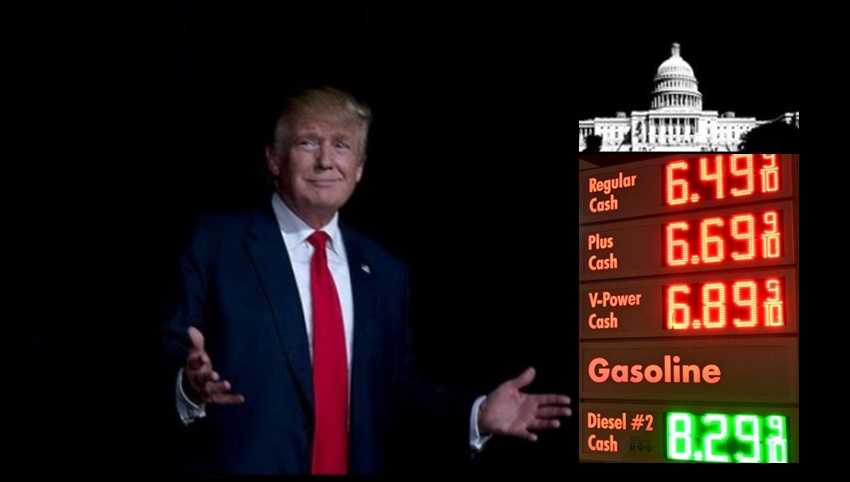
The USA could be swimming in diesel fuel and yet the price at the pump remains $6/gal.
Ironically, or not, Sylvain Charlebois, a Canadian describing the potash issue, exposed the western price manipulation in this article {SEE HERE} when ultimately, he asks, ‘how can Belarus sell potash so cheap’, and ‘Belarus could put pressure on Canadian potash prices’.
If Potash pricing is determined by western market commodity prices, then how can America get a cheaper fertilizer product for their farmers by buying from Belarus? The answer is in the part of the conversation they don’t want us to have.
Belarus can ship the product far cheaper to the USA because Belarus doesn’t need to participate in the “western commodity” pricing structure. Belarus can increase production and sell at a price they determine, exactly like Russia.
Apply this level of potash thinking to oil, gas or diesel fuel, and you realize what BRICS have been arguing about western price manipulation. Suddenly the price is not attached to supply, demand or production capacity, but is really connected to an elite rigged game of market price controls.
The price of USA gasoline and diesel will drop as soon as the event behind the price control is concluded.
That event is the USA midterm election.
does at a discount mean the ‘western speculator system’ made a high price for us, and then discount it to other countries because ‘we are the only situation they wish to influence’
Wish vs CAN?
Just think about we paid the highest drug prices in the world. We pay the highest education prices in the world. Our healthcare prices are off the charts.
Manipulate the masses by controlling prices.
Sadly the pretend MAGA masses on the right are easily fooled.
“Sadly the pretend MAGA masses on the right are easily fooled.”
That statement is a contradiction. It acknowledges that there are operatives masquerading as pro MAGA but are fooled by the gaslighting media and analysis.
Them (pretend MAGA) being easily fooled is part of their operation: to gaslight others that are still MAGA, and/or gaslight those that do not have TDS.
IOW, put into zeitgeist and encourage the perception that President Trump is a failure, incompetent, BIBI’s b*tch, etc.
The ministry of propaganda has their talking heads continuously babbling the affordability crisis and blaming the Trump agenda. Yes we see this. And we know why. To affect the outcome of the elections.
“Belarus doesn’t need to participate in the “western commodity” pricing structure. ”
how can the usa do this, or are we stuck in this because we live in the west
Manipulating prices to influence consumer behavior and maximize profit is a documented feature of capitalism.
there has to be someone that can shed light. can you audit speculators to see if they are using news articles for their pricing like the fbi did for fake warrants
Its a better system than Communism.
Anything is better than communism.
Wrong.
That is the feature of corporatism.
Capitalism is ruled by supply and demand.
Capitalism is not ruled only by supply and demand, but they are central to its operation.
Corporatism is a political and economic ideology that organizes society into functional groups—such as labor unions, agricultural associations, and professional guilds—based on their common interests, which then negotiate collectively with the state to determine policy and economic outcomes.
Is it chiseled in stone, this documented feature of capitalism? Or is it a convenient piece of paper used to tell consumers that complete central government control of everything will insure no prices can be manipulated. And the almighty corporate government will handle the profits?
Anytime there is an exchange of anything (goods, services, ideas, etc.) there will be those who exploit it for their advantage.
When you have ‘complete central government control’, then what you will get is the government manipulating prices.
Rapacious capitalism.
There are cheaters, manipulators, and exploiters in every form of commerce. The love of money is the root of all evil.
All forms of commerce can be used to “influence consumer behavior and maximize profit” not just capitalism.
Go form a commune and see how quickly and easily the cheaters and manipulators game the system to their advantage and the disadvantage of the people being honest and hard working.
That’s what the love of money does to some people.
No, it is a feature of monopolies or oligopolies with traders involved. The market can be controlled. Especially if government wants to control our Behavior. Everything needs to be smaller. Smaller government, smaller corporations and most likely we need the Free American Consumer Act. Americans cannot pay a higher price for anything than what is charged overseas. The True Consumer Protection Act.
Remember during Covid…Wuhan Flu…. small stores and corporations were closed for the big box stores. Eliminate the small businesses that put downward pressure on prices.
Wrong.
We haven’t had capitalism in the United States for almost 100 years.
Capitalism has been replaced by government manipulation of supply, demand and costs in nearly every sector of our economy. Government does this through taxation and regulation.
It’s a rigged game. That’s why it’s called “cronyism,” or, as Texas Midget called it, “corporatism.”
its the USAs system. they made it.
The prices will stay the same in Cali tho. At least that’s what I’m expecting.
Unfortunately there is a Newsome controlling everything in CA.
I don’t have extensive knowledge of how the oil markets work and how pump prices are set, but for the past several months I’ve been getting vibes that our economy is being artificially tampered with, not unlike the negative impact created by the contrived Covid Panic and subsequent lockdowns of 2020.
. . . . and it appears it is.
I’ve been getting the same vibes.
The negative impact to the US economy by lockdowns etc. was only part of the damage to the US by the contrived covid panic.
The other part of the damage to the US was done by the coerced genetic manipulation injections. (Not coerced on Russia or China, BTW.)
All of the damage continuing long-term, but the biological damage by the shots irreparable for the most part with manifestations projected for decades or even multi-generational due to genomic integration.
https://www.vigilantfox.com/p/first-peer-reviewed-study-finds-direct
https://www.malone.news/p/definitive-evidence-of-dna-adulteration
The Art of War by Sun Tzu exalts subduing the adversary without fighting. The long-term damage to the US and West by the shots appears to fit this model. The question is: Who considers the US and West as the adversary to be subdued? (Its obvious)
They are using the Trump admin and HHS as puppets:
https://www.zerohedge.com/medical/maha-leaders-warn-trump-rfk-jr-over-inaction-mrna-vaccines
Very much looking forward to what President Trump will do pre-midterm election to bring oil prices & consumer fuel prices down.
100% Even if just a little to give the impression things are getting better, and thus vote to stay course.
Most people judge by the price at the gas pump and the cost of groceries at the store. Economic theories and politics mean nothing to them, and rightly so.
Just the price at the gas pump and the cost of groceries.
The problem is too many states have long periods of early voting, with some going on right now.
“We, as the directing monopoly of energy prices, have no need to concern ourselves with the plights of the hapless masses who believe in the ancient supply and demand concepts that would normally control energy prices. We as the directing monopoly will continue to do as we like. Screw you.”
Yours sincerely
George Soros
As then Donald Trump said to Don Jr as he prepared to descend the “Golden Escalator” to announce his 2016 run for Presodent,”Now we’ll see who are friends are.”
Fair weather friends mostly it seems, they turned out to be.
Then as time moved on, “assassins” who all missed their target…
I know people are hurting badly.
I can only pray, as all should, that discernment be granted to erstwhile MAGA voters that they may see clearly their pain is being used as a tool to defeat the only man who puts their interests, their livelihoods, first. Against the global interests which seek to crush then enslave them.
There can be no sitting out this election.
Evil has its hand on the door handle and is waiting to strike.
Evil has perfected the use of the greedy and power hungry.
The photo of Christine Lagarde should be enough to give the game away.
0bama sent her to the IMF and she is there today. Ugh.
This globalism deal??? Did Barry set this up?
And—-
Can we benefit from creating our own market/ exchange?(would that cut into Saudi $$$???)))))
How many times can President Trump pull a rabbit out of his hat? With early voting comes a wave that might topple his goals or place more unwanted roadblocks.
I think he should have finished off Iran months ago…employing a business strategy, versus a military one for Iran, is cutting the outcome of his goals too close for my comfort and I suspect many other voters.
I will not vote for any democrat this November, yet must hold my nose while voting for the other party (republican) as opposed to not voting at all.
<How many times can President Trump pull a rabbit out of his hat?>
A lot…He doesn’t have a receding hare line 🙂
Diesel was $6.99 in a poor south side ‘hood, on Monday morning.
The price for regular gas had a huge variation, again on the south side…$4.39 to $5.00
Me…I refrain from buying anything extra…with holding my consumer dollars in the dollar amt. that equates to what I perceive as too high for gas. And am only buying gas for my predicted needs. Does it hurt TPTB, no, but it makes me feel better. Five dollars a week, not much, but its in my wallet and not someone elses.
Chicago just has to be rid of President Trump or Communism fails.
Communism always fails as it is inherently defective.
With the presence of Trump, it will just fail faster.
The UNiparty globalists always require a *fake* narrative to contrive their *fake* polls against President Trump. The *fake* polls are then used to make their *fake* elections seem plausible.
The fact that CONgress and the Supremes have both refused to remedy this widespread election fraud tells us all we need to know.
Yep. They’re both fake too.
Look at them in a different way. They are slaves to oligarchs.
The oligarchs throw their slaves out there for your entertainment (i.e. voting and holding meaningless congressional hearings).
They then get their marching orders from the oligarchs and do what they want as they are owned by them.
Then Donald Trump came along and through his actions made it very easy to see that they are in fact just owned property.
That is why Trump must be allowed to execute his plans.
The good news in all of this is I have heard President Trump say, for over 10 years, that he specifically wants the price of fuel, and of food, to be low. He’s said this before, literally. We want stock prices to rise but we want food and fuel prices to be low. So if anything can be done about it by a sitting President, he is on our side on that one.
And the Injustice Department does what on rigged prices to manipulate people ?
Companies and those responsible should be investigated 24/7
Your identification is with the Father and with the son, It cannot be one or the other, because they are both ONE
Why doesn’t Trump make this a major talking point and loudly accuse the markets of manipulating oil prices to help the Demunists win the midterms?
Is there something that stops him from doing that?
What prevents the US from selling fossil fuels internally at “discount” prices if Russia can do it?
The hell with the “markets”.
its the western speculators that discount the shit i think. where does the discount originate
Maybe nuclear bomb threats if done before all the Gordian knots have been cut — trillions at stake when those manipulating markets are exposed.
My guess is that the average person will not understand.
The MSM will scream in outrage about how PDJT is lying in order to cover for their Big Corporate Sponsors.
Just look at what they did to him when he mentioned Ivermectin may be useful in fighting Covid.
He’s busy saving the Hemisphere. Teaching the ignorant is not up to him.
are ‘they’ not saying that
‘they’ want to coerce people
to fixate on 1 thing during the short term election time (Nov)
and
ignore the many, many other good things during election time (Nov)?
[ and hope that the coerced short term fixation (see the conditioned response experiment of Pavlov’s dogs)
will cause a short term miss approval
and effect have a long term causation to do many, many wrong things –
and have people be stuck with the result of their wrong short perspective? ]
Some ___ ists think of people being easy to manipulate, like pavlov’s dogs.
Are we, or are we not easy to manipulate?
p.s.
As grandpa said decades ago ‘don’t take any wooden nickels’
The list of hoaxes upon the public since then, is llllonnngggg….
‘prove all things, (not just 1 thing)
hold fast to that which is good’
Thess. 5:21
People know
(not all people know)
Love thy neighbors….
Golly gee!!!! Then I’ma gonna vote them demonrats in…
release the reserves … oh, wait
The reserves are crude oil. It still has to be refined.
Across many years, I used to stay for a week at a time at the same Air BNB in Chiswik Park, London–3 or 4 times a year. On the main busy downtown road, there were multiple small fruit/vegetable stands. The prices (in UK mind you), were ONE-THIRD what I paid in grocery stores in Florida. I Never understood it, until now. Thank YOU, SD!
You/we are subsidizing that extra 2/3rds. You are paying all yours and 2/3rds theirs.
Adam Smith was not wrong. Its just that Gov’t can’t keep their hands off using energy to manipulate political outcomes. They eff with the Supply side via war, sanctions, regulations, taxes, etc to distort the market price.
it looks like regulations and bombing arent considered fraudelent in making speculators raise prices. a coordinated regulation and bombing campaign is legal.
So what can be done about it?
looks like making trading deals with eastern europe or other countries outside of our western.
and our us companies need to be targeted too. they are here in this land. they can make the same money without participating in evil profil that is specifically to overthrow a president.
Remove the sanctions on Russian oil, remove ENV regulations that are used to block pipeline and refinery construction, eliminate ethanol mandates, stop providing tax incentives for windmills and solar farms, remove green energy mandates from utility companies and bomb Iran back to the stone age except for their energy infrastructure.
That would be a good start!
This sounds like price fixing.
Thank you Sundance!
Thank God.
We will keep praying as you all say and keep thanking God for everything he has given us!
✝️🙏🤗🦅🇺🇸
And the Fed gleefully follows along with interest rate hikes based on diesel prices. It’s all rigged.
and zelensky bombs them to aid that.
and he gets the bombs from nato to do that.
and us congress passes bill to get bombs to nato to do that
all conspired to effect the midterms
This reminds me of the discussion regarding the price of oranges. Supply/demand rules do not apply.
add me to your list. I’ve never doubted it.
Bingo! Excellent article and 110% correct!
Now, if only those who trust, and continue to be deceived by the MSM, would only listen.
Tom Luongo on gold, goats n guns podcasts has been covering this for awhile now. He talks about how the “City of London” uses collateral (ie sanctioned Iranian oil) for the yen carry trade and then uses the cheap money to lever up on futures or whatever market they want to control…
It seems to me that Pres. Trump, in his usual style, might jump into this situation–tariffs, etc., and turn this global nonsense upside down and come down hard on the army of ravenous grifters who seem to have a firm griip on world oil prices.
And the damage will have been done.
I suspect Trump has the “real” polling data — he seems OK with waiting out the deep state on Iran. He knows that once Iran/Hormuz oil market manipulation is taken care of, a MAJOR chess piece will have been removed of the board!
Hopefully, as it relates to fairer elections, Trumps proactive approaches bypassing courts and Congress where possible will make the November field of play just level enough that he (and we) squeaks it out.
Deportations, lower funding of groups, things be can try and do
I think PDJT really doesn’t give a damn about the outcome of the midterms. Whatever the outcome, come post-midterm, he is going to unleash hell regarding policy moves. He will have no concern about being re-elected and, if his plans work as expected, in two years this country will be thriving like never before. Rubio will be elected the next POTUS in a landslide.
I suspect Trump has the “real” polling data — he seems OK with waiting out the deep state on Iran. He knows that once Iran/Hormuz oil market manipulation is taken care of, a MAJOR chess piece will have been removed of the board!
According to ConservativeReview.com there are way more than enough RINOs in both chambers to reach the 2/3 supermajority needed to impeach Trump if he tries to do that.
Further, they report spot prices for short-term delivery, not long-term supply contract pricing.
Diesel pricing is the new Covid.
It’s the same commodity price manipulation they do with gold, silver, and the US dollar. Prices based on stock derivatives and news trends rather than the actual commodity’s supply and demand. Notably, Trump’s enemies include elite “speculators” and central bankers.
so, i read this post from sundance right before i left the house, and the first stop i’ve made is …. the gas station ! first thing i noticed is price is up since my last visit… by about 20 cents.. there’s a man over next to my vehicle filling up pickup truck, trailer with lawn/landscape equipment …. i get a nudge, and think, spread the news ! but i’m shy … so i take a few steps toward my car, and then turn around and walk over to him and say , “ gas prices will go down after the midterms… so don’t lose heart”….
and he says to me … “oh i know, it will take more than gas prices to change my mind” !! ♥️
and upon further thinking …. i think we need to speak up when we’re out and about .. encouraging others .. i know he encouraged me .. ♥️
but then, that’s the way God works … isn’t it.
Thanks for clarifying what many of us were thinking. We have to accept the reality, but I will inform anyone I can regarding the treatment we citizens are receiving. Just overtaxed pawns in the midterm chess game.
Ask yourself who is calmer now about the midterms, Trump of the Fake news? I think Trump has the “real” polling numbers — we just need to ignore the noise and get out to vote like we have been doing.
Other than a quick spike in February, natural gas is basically flatlined. Now why is that?
With all the whining about inflation and lately about gas prices I look back to an earlier time in my own life, when I was starting out. I measured gas prices in terms of how long it took me at work to fill the tank.
Do the math for yourself. How much gas does an hour of work buy today compared to another point in time? I think you’ll find that the cost per hour of work is much better now than in most times in the last 50 years. And then add in that the real measure isn’t gas per hour worked, but miles you can travel for the hour of wages.
Take the number of gallons you could purchase for an hour of work then and calculate how many miles it carried you in the cars of that time. Now do the same for present day.
I just ran the numbers for today at prices and wages I see around me, with miles per gallon for cars then and now. Then I got 34.5 miles per hour of work (at minimum wage). Today I’d get 86 miles for an hour at minimum wage.
IMHO, the dems will make prices go up after the midterm
Thank you for repeating this type of argument to an old manufacturing Capitalist. It has finally sunk in. I am gob smacked.
You are priceless.
A number of years ago Delta Airlines attempted to buy a fuel refinery. The objective was to secure a reliable supply of jet fuel; this was shot down very quickly.
Connected?
Politics be damned- someone needs to make clear to the masses the true nature of how the western economic system is nothing more than modern day slavery.
Though Trump was going to investigate theproducers here? USA is part of OPEC because it allows our producers to charge more. People this OIL companies are American but they are married to dollars and have NO RESPECT FOR USA CITIZENS.