For a long time on these pages, we have discussed the false term “free market” as it relates to global economic manipulation we all have grown to understand. We shifted to a more non-pretending description of “controlled markets” when discussing how multinational interests intersect with trade and the consumer economy.
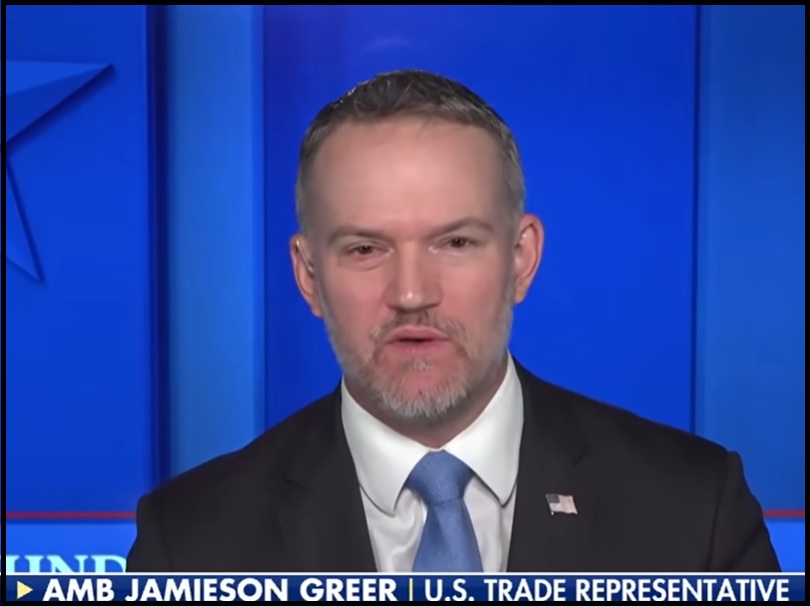 What USTR Jamieson Greer has published today [SEE HERE], are the specifics within the “controlled market” approach. USTR publishes the outcome of non-market influences and strategies within 14 economic systems (14 countries).
Focusing on production capacity, the Sec.301(b) investigation details how each economy is controlled by government planning, strategy, subsidy and govt investment that exceeds the free market demand for products.
Because the USA is a highly prized consumer market, the over production in non-market economies makes it almost impossible for us to compete. If a government subsidizes an industry, then invests within the industry to expand production capacity beyond natural demand, the economic output -often dumped cheaply into the global market- puts artificial downward price pressure on the sector of focus and makes competition impossible.
Today, USTR Greer quantified each of the 14 economies studied (14 research pdf’s) and then assigns a specific tariff rate to each of the economic systems. The tariff is a net tariff, meaning ultimately the baseline tariff applied to each nation will be the Sec.301 determined tariff, with exceptions and sector specific overlays.
WASHINGTON– Today, United States Trade Representative Jamieson Greer determined under Section 301 of the Trade Act of 1974 that the acts, policies, and practices of 14 economies relating to structural excess capacity and production in manufacturing sectors are unreasonable and burden or restrict U.S. commerce, and are thus actionable under Section 301(b) of the Trade Act. The Office of the United States Trade Representative (USTR) has also published economy-specific reports that support the determinations.
The 14 economies covered by today’s determinations are China, the European Union, Singapore, Switzerland, Indonesia, Malaysia, Cambodia, Thailand, Korea, Vietnam, Taiwan, Bangladesh, Japan, and India. The Trade Representative has not made determinations with respect to Mexico or Norway at this time.
“For decades, many of our trading partners have adopted industrial strategies built on targeting manufacturing, wage and labor suppression, financial and other support, non-market economy inputs, and other market distorting practices that tilt the trade balance in their favor while eroding America’s manufacturing base,” said Ambassador Greer.
“In recognition of this, since 2016, leaders ranging from Donald Trump, to Joe Biden, to Xi Jinping, to Emmanuel Macron have recognized the threat that structural excess capacity and production poses for the global economy. But where successive statements at the G7, G20, WTO and other fora have not resulted in change, President Trump is proposing to take action to bring about the elimination of these unfair acts, policies, and practices. In doing so, we can level the playing field for American workers and chart a new, more sustainable course for the world economy.” (read more)
You will note the absence of Mexico and Canada on the Sec.301 investigative list; within the interview below [approx 06:50] USTR Greer outlines why those two nations are still in discussion based on immediate and direct feedback.
We have a large market because we have people who can buy. They have tried to destroy that for decades.