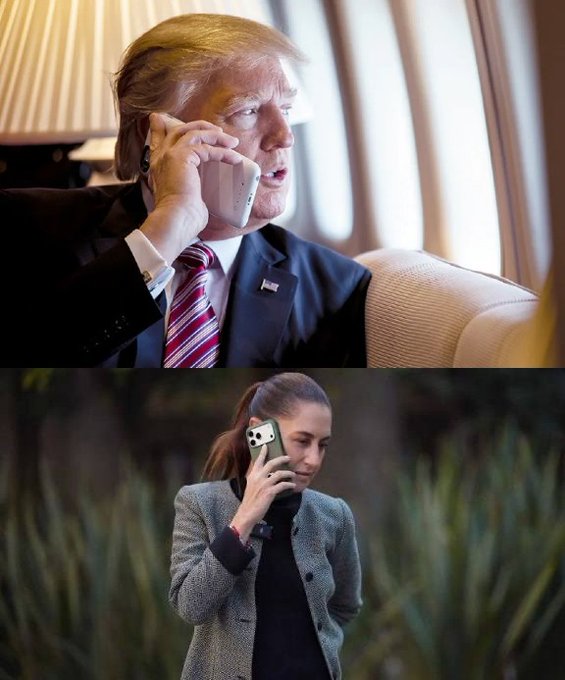
 It was reported yesterday that Mexican President Claudia Sheinbaum and U.S. President Donald Trump had a cordial conversation about ongoing trade and security discussions. {link} The phone call likely took place as President Trump was aboard Airforce One returning from China.
Previous to this phone call, “Gerardo Mérida, a retired Mexican army general who served as public-security secretary in northwestern Sinaloa state, was detained on Monday in Tucson, Ariz., court records show. Mérida is one of 10 current and former Sinaloa officials, including Gov. Rubén Rocha, indicted last month in the U.S. for allegedly taking bribes from Sinaloa cartel leaders to protect their billion-dollar drug empire. U.S. prosecutors say that the Sinaloa cartel is one of the world’s top producers and smugglers of fentanyl into the U.S.” {link}
The Trump administration is not slowing down on the intention to remove Mexican drug and human smuggling cartels, despite the reported domestic protestations from within the Mexican government. There appears to be a rather unusual dynamic at play.
Inside Mexico the federal government is publicly criticizing the U.S. position; however, simultaneously Mexican President Sheinbaum is promoting a working relationship with President Trump and the U.S. position.
According to the New York Times, Acting Attorney General Todd Blanche has now shifted the prosecutorial focus to charge the designated Mexican cartel targets as terrorists.
(NYT) – The Trump administration this week instructed federal prosecutors to use terrorism statutes to target Mexican officials complicit in the narcotics trade, a significant escalation in its campaign against drug trafficking from Mexico, according to a U.S. official familiar with the remarks.
That new directive was announced Wednesday by Aakash Singh, an associate deputy attorney general, during an internal conference call with prosecutors in regional offices and represents an aggressive new tactic in the administration’s counternarcotics strategy that is almost certain to further strain its relationship with Mexico.
The initiative is the latest expansion of a hard-line policy that has defined President Trump’s agenda since his return to the White House last year, when he signed an executive order designating Latin American drug cartels as terrorist organizations. Within months, the U.S. military began blowing up boats in the Caribbean Sea and Pacific Ocean, killing nearly 200 people the administration says are drug smugglers.
The Justice Department directive, which has not been previously reported, comes two weeks after federal prosecutors in New York indicted the governor of Mexico’s Sinaloa state, who is also a member of the country’s governing party, and nine other current and former Mexican officials. Days earlier, the death of two Central Intelligence Agency officers in a car crash in Mexico revealed a covert element of the White House’s clampdown on cartels. The developments have sharply intensified cross-border tensions. (more)
From a national security perspective, the general instability of law enforcement within Mexico, some parts of Central and South America along with Cuba appear to be a renewed focus of the Trump administration.
Thank God!
Hopefully she’s grateful but doesn’t want to get hacked up in pieces…
They killed one of our family members and many multitudes of others from these horrid drugs.
Greed and power.
Satan’s army deserves eternal hell.
Retired Magistrate here: I know some people are concerned about the price of gas and food and we are impacted by that also; however, President Trump is looking at the big picture. He wants to leave a legacy of peace, security and a better of way of life for not just the United States but for other countries as well. If President Trump can accomplish those goals it will have a lasting positive impact on not only this generation but the future generation also.
So I can live with the higher prices right now in return for a safer and better future for my daughter and my grandchildren.
🙌 Amen!
Unavoidable that often you have to take a step back to take multiple steps forward.
True success and accomplishment is impossible without that component.
Yes absolutely, you watch oil prices drop like a rock when the oil companies don’t want to get stuck with expensive fuel.
Big oil is still trying to undermine President Trump, you watch.
Things that make you go huh????
After all he’s done for them. Maybe he should take a second look at EV subsidies, just for effect.
RESPECTFULLY
WATCH the INDY 500 For Your EV FIX
( they ARE Hybrids BECAUSE They CAN NOT LAST 500 Miles on a CHARGE )
https://cleantechnica.com/2022/05/30/indy-500-will-gasoline-alley-become-electric-avenue/
https://racer.com/2026/05/15/manufacturers-and-teams-look-to-take-the-next-step-in-year-2-of-hybrid-engines-at-indy
i CAN TOW a 8,000 lbs LOAD on my 2,000 lbs Trailer with my 6,800 lbs Excursion loaded
with 1,200 lbs INSIDE and STILL GET 400 Miles on 1 Tank of 40 Gals
and
Refuel being BACK on the Road Again in 15 Minutes
( i Actually drive and STOP for a Break Every 1 1/2 to 2 Hr intervals to Walk about )
Economies of scale in engineering are the real challenges today. Diesel-electric locomotives have been successfully used in railroading for many years. Indy racing had its moment back in 1967 when Andy Granetelli (sp?) brought gas turbine powered, four wheel drive car to the Brickyard. I was there for that race, so believe me when I say that that car owned the track that day. Had a minor part not failed in the last couple of laps, automotive history might have taken a different turn. Unfortunately the Indy big shots at the time didn’t want the turbine competition, so they eventually outlawed it by restricting air flows.
I believe there is a place for hybrid technology. Pure EVs, however, are like windmills….useful for limited applications, but political boondoggles when forced on everyone.
Lol. OPEC is being dismantled. American oil companies have their greatest champion in Trump.
Try to keep up.
God bless you for saying that Marcia.
The Corrupt Corporate Media continues to amplify the “affordability” meme as a strategy to undermine President Trump.
I pray that there are enough of us who think like you do who understand that temporary hikes in gas prices are a small price to pay in return for the long term securing of our life, liberty and pursuit of happiness.
This is our last stand🙏🇺🇸
Anyone that doesn’t realize there will be some ups and downs while he fix’s planet earth, we’re never really understanding what we are up against. It’s that simple.
Here Here!
Sort of like your child (or you when you were a child) complains and pouts over having to wear braces on their teeth for a couple of years. And your parents try to tell you that you will be thankful when they come off. But it seems like forever.
And when you grow up and have a beautiful smile, you finally realize.
When I was 15 years years young, I thought that was the longest year in my life. Sixteen was the magic number to get a driver’s license. Now at 76, the years are flying by and my birthday is just another day! Now in retirement, everyday is a Monday, LOL
“So I can live with the higher prices right now” …..
if, as Promethian Action has been predicting, Trump demolishes the City of London and its chaos model for world governance
Well said Marcia
Amen!
Amen Marcia.
So much is transitory…bill
FILTHY LIBERALS
I’m from the former Canada.
I hope President Trump is saving the worst for last.
Canada is the Empire’s last outpost as Britains IQ gets lowered by every Koranderthal that enters.
Canada51
WOLVERINE PANCAKES!!
I love those wolverine pancakes….!
Koranderthal, nicely done. : )
Koranimals is what I have used this past generation.
from Sask here…. I hope you are right, that Trump closes the border to everything Canadian while at the same time expelling diplomats, visitors, visa holders, the works.
This should collapse the Canadian economy in about 3 days, and with what gas is left in their tanks, or money in the bank to buy said gas, it would be nice to see a few million people surround Parliament Hill until Carney is dragged out by his ankle and promptly Caucesu’d
Koho, Sherwood, or Titan in everyone’s hand
Example
England 🏴 May 16/26
End result
Starmer RESIGNS
Koranderthal is excellent!
Carnage Carney is not knowing what is about to HIT HIS NET ZERO CARBON CREDITS SCAM TAX AGENDA
100 % TARIFF ON ALL GOODS TO BE EXPORTED TO THE GOOD OL USA 🇺🇸
AND LIKE STARMER
CARNEY AND HIS DAYS IN OFFICE ARE NUMBERED
Every one of these actions is going to have a direct response on the Ex-pats living in Mexico, a tit for tat mentality, just one of the many reasons I decided to leave Mexico when I did. 🇺🇲
I hope not, and maybe it is just too costly to run off all the $$$$ brought in by the ExPats. What to do?
No te olvides
1:36 looks like I am driving into Chicago…2:40 looks like Lake Shore Drive…
Yes. Panama is an excellent place to visit and/or enjoy retirement. The country uses the dollar and the coffee and chocolate are super.
Yes, if it wasn’t for that stinkin’ humidity it would be tempting.
Lived in Panama for a couple of years and miss Don Sami’s street empanadas, the beach, and the Canal Zone amenities. Pre-Jimmy, the peanut farmer.
Yes…good move….I’m betting that if you saw PDJT docket you’d see Canada and Mexico near the top. Both must be dealt with.
Not at all. 90& plus % of the Mexican people like what President Trump is accomplishing. They have prayed and are praying daily that USA is successful getting rid of the cartels.
Gracias Dios!!
No Fear!
No Worries!
Now it’s clearer to recognize the Divine Intervention of Butler, Pa. et al! Heavenly Father has a plan and Sundance is included! God bless America!
Sacrifice isn’t an end but a beginning to achievement. The greatest sacrifice of all didn’t eliminate the necessity to do our own in order to get greater rewards. President Trump might be tightening the purse strings right now but the end result will be worth it.
A thousand mile journey begins with the first steps. Thank you POTUS!
Don’t forget she has a top cartel boss in “prison”. It looks like they have to move HQ to the protection of the state, in order to keep the money flowing into Mexico. Americans be damned.
She now knows in order to save his life and get protection from Uncle Sam, the General is singing like a bird.
She’s got to be terrified at what he’s revealing.
Wonder who initiated that call?
We really need to stop pretending that Sheinbaum represents the best interests of the Mexican people. She is no more legitimate then the currently installed Communist President of Brazil (Lula). Trump knows and he should be the only one allowed to pretend not to notice.
100% RC.
On “the list,” chosen — installed.
By….dems and sore azz.
First Sinaloa.
Then Arizona.
All installed through various forms of election fraud.
💯💯💯
That was a huge amount of cheating.
And boy, as an Arizona resident, I’m waaaay past ready.
When governor valley girl gets perp walked, we’ll be having a block party on my tab.
Include the many judges in Arizona and surrounding border states.
Suitcases stuffed with cash can sway many
It appears to me that President Sheinbaum is attempting to play for two teams at the same time. That is a very dangerous strategy.
Yes, very dangerous. I think she’s playing the wait Trump out game. I doubt it will go for well for her.
This is great to see it happening to a Failed Narco State that is directly responsible for the deaths of over 100.000 Americans yearly.
When are indictments for the Chinese officials gonna fly ?
/s
All of the Federal Mexican government is connected and part of the Drug cartel and the storage locations should be addressed and receive incoming.
But what about all the criminals in the U.S. that are not being dealt with in so many federal crimes ?
Couldn’t happen fast enough.
Oi caramba!!
I’m far more concerned with what Sheinbaum says/does in private than what she projects in public as she’s forced to play protagonist to PDJT in order to keep herself & her loved ones alive. I’m positive she’s fully cognizant of the fact that there are individuals in her immediate orbit that are on the take & would be willing to sell her out to the cartels in a heartbeat either out of self preservation and/or personal gain.
We’ll see how this plays out.
Is the NYT inferring the cartel caused
“ …Days earlier, the death of two Central Intelligence Agency officers in a car crash in Mexico revealed a covert element of the White House’s clampdown on cartels. The developments have sharply intensified cross-border tensions (more)” … ?
(I could not read the rest of the article and do not really speak NY Timesian)
Hopefully boasberg doesn’t shut it down
Highly recommend Don Winslow’s books. Not saying they’re historical fiction; yeah, they are.
Or fact cloaked as fiction?
Am I the only person wondering why Gerardo Mérida was in Arizona and did he come here legally?
Did he come here to be willingly arrested rather than whacked in Mexico?
Thinking the same thing. He he entered legally, would have thought he’d be arrested right then.
Judge Biasbutt will order immediate release of the Sinaloan terrorist.
Go get them!
“To protect and defend from all enemies, both foreign and domestic,” isn’t just a suggestion. It’s an Oath!
So nice when the adults are in charge! God continue to bless our President.
Border Hawk News
https://borderhawk.news/doj-indicts-10-current-and-former-mexican-officials-for-cartel-involvement/
Finally, a real war on drugs. Common fking sense. Should have been done decades ago. I wonder why…..
Our youth, our children are our future. The #1 National security issue.
In addition, no need to leave a safe productive Mexico.
Greatest POTUS ever!
These guys are not “getting nabbed” without Sheinbaum knowing or assisting; notice as SD wrote “ Inside Mexico the federal government is publicly criticizing the U.S. position; however, simultaneously Mexican President Sheinbaum is promoting a working relationship with President Trump and the U.S. position”
I think she understands the longterm benefits of the trade deal as compared to the cartels .
That’s dangerous business until nabbings and military assists can continue; hence, Iran. One, no nukes and two, funder of terrorism is destroyed. You take out Iran’s ability to create issues for our Middle East partners (UAE, Saudi Arabia) they can start to fend for themselves. No need for longer term US presence. Our resources are now used in our hemisphere to help our neighbors rather than those on the other side of the globe. You know “nab people” and help militarily:
For example on February 22, 2026, a raid happened in Jalisco, Mexico, that killed Nemesio Oseguera Cervantes (“El Mencho”), leader of the powerful Jalisco New Generation Cartel (CJNG).
Mexican Armed Forces (Special Forces, Army, Air Force, and National Guard) led and carried out a raid on a compound in Tapalpa, Jalisco, where they killed CJNG leader El Mencho and several other cartel members during firefights.
The United States provided critical intelligence support, including a detailed target package on El Mencho’s location, through the new Joint Interagency Task Force-Counter Cartel and other agencies, but placed no troops on the ground to respect Mexican sovereignty.
It’s all about strengthening our hemisphere for national defense.And prosperity here.
And I thin Carney may become the biggest loser as a result of the recent POTUS to China.
Interesting times
Which nation almost always ranks in the top three most dangerous locations for a journalist?
Mexico.
A journalist who does too thorough a job or is seen as disrespectful is prone to become a journalist who is thoroughly dead.
I’m not sure I trust Blanche, but it sure does seem like he’s gotten a lot more done in a few months than Pam Blondi got done in a year
in processing all this the onion peeling metifore raises. Once the alga fuel issue is stable, I think compact nuecular, would replace many issues, driving prices furtherddown and simeltainously lowering usage, to vehicular operations and away from other concepts. The tech, is now highly advanced.
My spellcheck went awol – apologies.
The more she helps out the safer she will be! Plus, she could go down in history as saving Mexico.
Want to kill a snake cut its head off!
Think how much time was lost with Pam Blondi. She must have been running out the clock.
Detained here in AZ at the liberal mecca known as Tucson, hmmm. So the upper levels of the cartel believe that they are safe on the north side of the border?
Claudia is afraid of Trump more than she is afraid of the Cartels
Mexico is sitting on a lot of Silver.
Recent observations in Mexico as it relates to silver mining:
https://skillings.net/mexico-silver-mining-security/
was detained on Monday in Tucson, Ariz., ….. low hanging fruit. It’s very doubtful Scheinbaum is going to be too upset at this one. Perhaps the FBI can lure some more over the border by impersonating underage boys.