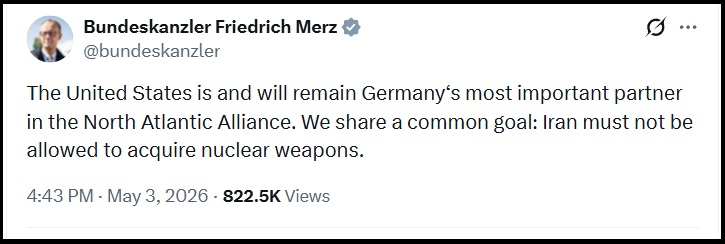
Six days ago, in Marsberg, German Chancellor Friedrich Merz criticized the U.S. approach to Iran, saying Washington was being “humiliated by the Iranian leadership” and demanding the conflict end “as quickly as possible.”
Three days ago, President Trump responded with an announcement that U.S. troops in Germany would be drawn down, and there would be a 25% tariff on all imported European autos. {GO DEEP}
Suddenly, Friedrich Merz reverses his position:
Imagine that.
But seriously folks, when people argue that it’s not about the economics of the thing – remind them, it’s always about the economics of the thing.
Germany is facing a perfect storm of economic consequences following their decision to chase the climate change agenda (Build Back Better) and eliminate their coal and nuclear power plants. Combine the German/EU policy to stop purchasing cheap LNG and oil from Russia, in addition to skyrocketing energy costs from oil/gas flows from the Middle East, and the outcome is rising manufacturing costs leading to massive layoffs.
The German industrial economy is the heart of the EU economy, and President Trump is now hitting them both right where it hurts.
Chancellor Friedrich Merz is already facing serious political issues within Germany as the economy continues to contract. The political opposition parties are on the rise and Merz is in a very precarious position. President Trump is exploiting this vulnerability by apply further economic pressure on Germany.
Just yesterday….
Via Bloomberg – “Germany’s automotive industry pleaded for an urgent de-escalation in the tariff dispute between the US and the European Union and called for immediate talks between the two sides after President Donald Trump said he would increase auto tariffs on the bloc next week.” (read more)
Let him cook.
President Donald Trump's plan to withdraw at least 5,000 US troops from Germany has raised concerns among residents living near Ramstein Air Base. pic.twitter.com/hllQNYiuYg
— DW News (@dwnews) May 3, 2026
.
Good.
Let the President draw down the number of military in Germany even further.
Just keep the airbase and hospital open.
Any combat troops can be either repositioned in another friendlier nation, or based in the US or elsewhere.
From what I understand, it would be very very difficult for DJT to officially get us out of NATO.
Perhaps Our President can do what the French President de Gaulle did 60 years ago, and withdraw the US from the integrated military command of NATO.
We would still be technically part of NATO, but definitely pursuing an America First policy.
If THAT doesn’t wake up ‘Europe’…
Nothing will – and we should then organize our worldwide military strategy to take that fact into account.
The USA cannot be the world’s policeman.
We can only try to protect or defend our actual critical interests.
This nation needs to prepare and adjust for when ‘Europe’ is more Eurabia than Europe.
Within 30 years, does anyone really think that the ‘Europe’ of 2055 will bear any resemblance to the Europe of 2025???
I have heard likewise that we have legal hurdles to getting out of NATO. Rather than “withdraw the US from the integrated military command of NATO”, I would prefer that we remove our money from NATO, and simply sit on the sidelines watching like a hawk guarding our interests, not theirs.
Well, withdrawing from their military command would mean less $$$ going to our NATO ‘friends’.
Less troops
Less money
It’s all good!
Heck. The Europe of 2025 is vastly different than the Europe of 1985. It is unrecognizable from what is was already!
Glad you see it, too!
Absolutely!
Within our lifetimes –
Europe has changed dramatically – and not for the better.
Mark Steyn has been making that point for 25+ years – as did Pat Buchanan.
The Europe that existed when NATO was formed in 1949,
Is no more.
well said
Bring that 2bil going into the German economy right back here to the US!
Not a bad idea.
You nailed it Border Bob!
Thank you!
I certainly pray that no American leader ever sends our military into Europe again.
If the euro-peons don’t want to save themselves… it’s not our job to do it.
‘God helps those who help themselves’.
With all of the current innovations in modern tactics and weapons…I’m not sure that we don’t need to review the value of putting forward the number of assets and troops on foreign soil now. The cost of maintaining them is tremendous. The current use of tanks and infantry have a leaning to the old cold war mode of warfare. We have a hard time not manning and equipping based on the last war. However, the politics of making any changes to our defense structure is fought at every level both by foreign governments as well as Congress. As Sundance says “there are millions at stake.” Just for instance, do we really need to put pilots in aircraft now? Do we need to put millions in revamping the ancient A-10 Warthog?
Never had people shooting at you
until the Warthogs show up! Make more Warthogs!!!
Well, concerning tanks there is the single armored cav unit (regiment) in Germany and a US brigade typically on rotational deployment to Poland. Additionally you have V Corps HQ in Poland.
As far as “last war”, there apparently was a decision not to deploy a MDTF fires unit which is very much intended as a “next war” thing.
Apparently you have been protected all your life!!! Ever looked death square in the face? You damn well would appreciate the appearance of a Warthog! From a Vietnam vet!
Having spent some time at Ramstein , I know that half of Germans like the US and half hate the US. Goodbye Krauts!
Pretty much sums up life around any base, including here in the US. “Dogs and Sailors Keep Off the Grass”. What local business would like is if they could get the troops to throw their paychecks over the gate so they don’t have to actually deal with them.
fritz around fritz out.
I like that!
Bring the troops home to oversee the mid-term elections.
Sergeant Schultz, knows he screwed his country and europe.
I hope they can eat oil.
We should have heeded Sen. Robert Taft’s advice and stayed out of WWII, the continent wouldn’t be over run by terrorists now and we wouldn’t have wasted billions of dollars on countries that hate our guts but love our money. WEho knows, maybe the U.S. would adapt some of the immigration laws of the new regime over there.
Remember what Rush always said. If you want to understand anything just follow the money.
There has been no need for massive troop levels in Germany or any other EU nation since the end of the Cold War over 30 years ago.
Ignorance or ignoring the handwriting on the wall for decades. Challenges weren’t met nor were mitigations implemented. Economy decline heading toward collapse – were they really that clueless?
Germany’s economic challenges have roots going back to around 2015, the situation has significantly deteriorated since then. Because their economy remained dependent on high industrial exports, particularly from the automotive sector, they began facing stiff competition from China and high energy costs.
After 2015, German wage costs began rising faster, eroding its previous cost-competitiveness advantage within the euro zone.
By 2019, the price-level gap between Germany and other euro-area countries had narrowed.
At the same time, private investment started declining, falling to its 2015 level by 2024 after a 5% drop the previous year.
Underinvestment: Public investment fell to 2.8% of GDP, below the EU average, with infrastructure and education suffering from decades of underfunding.
Industrial decline: Industrial production in 2024 was at just 90% of its 2015 level, while countries like Poland saw significant growth.
Overreliance on exports: The economy remained dependent on high industrial exports, particularly from the automotive sector, which began facing stiff competition from China and high energy costs.
U.S. tariffs have significantly impacted German automakers’ sales and profitability, particularly through a 25% tariff on EU-made vehicles announced in early 2025, later reduced to 15% under a temporary EU-U.S. deal. This has directly affected Germany, which accounts for 65% of EU auto exports.
Price Increases and profit declines.
BMW reported an $1.1 billion earnings hit in 2025, while Audi estimated €600 million in losses due to tariffs.
Sales disruptions with over 760,000 EU vehicles (worth €38.9 billion in 2024) exported to the U.S., with two-thirds coming from Germany.
Automakers face tough choices and strategic shits – absorb costs, raise prices, or pause shipments. BMW temporarily absorbed tariff costs on Mexican exports, while Volkswagen paused assessments of U.S. deliveries.
Production relocations, with firms like Volkswagen and Mercedes-Benz accelerating U.S. production ref.( VW’s $14 billion investment in North America) to bypass tariffs.
All these, with broader stock market impacts when major German carmakers lost 6-8% in market value post tariff announcements; which also disrupt intra-company trade with a supply chain strain; especially cars shipped to U.S. subsidiaries.
German firms are pushing a diversification shifting focus – to Asia and other markets to reduce U.S. independence.
Note :
High import tariffs significantly increase the final price of German cars in Asia, often doubling or more the original cost.
India: The 125% tariff (on top of other taxes) has historically made fully imported German cars extremely expensive. However, a new India-EU Free Trade Agreement is expected to reduce this tariff to 40% initially, and eventually to 10%, which could make models like the BMW M4, Mercedes-AMG G63, and Porsche 911 substantially more affordable—potentially reducing prices by up to 33% in the first phase.
Thailand & Vietnam: With tariffs of 80% and 70% respectively, the final price of a German car is nearly double its European price. These high costs protect local industries but limit the market for imported vehicles to a small, affluent segment.
Compounding Factors: The final price is further inflated by additional local taxes, such as sales tax (7% in Thailand, 10% in Vietnam) and excise duties, on top of the base tariff.
In essence, tariffs are the single largest factor making German cars significantly more expensive in these markets, far outweighing the cost of shipping.
TSCHUSS!
Bungholedancer Friedrich Schmertz in a reverse move Lol
article in mining.com today, “Germany sees US as vulnerable to squeeze on potash supplies” looking for vulnerabilities so Germany can gain an advantage against the United States in trade matters:
https://www.mining.com/web/germany-sees-us-as-vulnerable-to-squeeze-on-potash-supplies/