Big things are happening quickly as President Trump continues to disrupt historic global structures of control and influence.
The United Arab Emirates (UAE) has announced they are leaving OPEC in order to manifest their own sovereign economic destiny and increase domestic oil production without the limits and rules of the OPEC cartel. This is a significant alignment with President Donald Trump who has actively argued against the OPEC assembly and the oil price controls they have historically imposed.
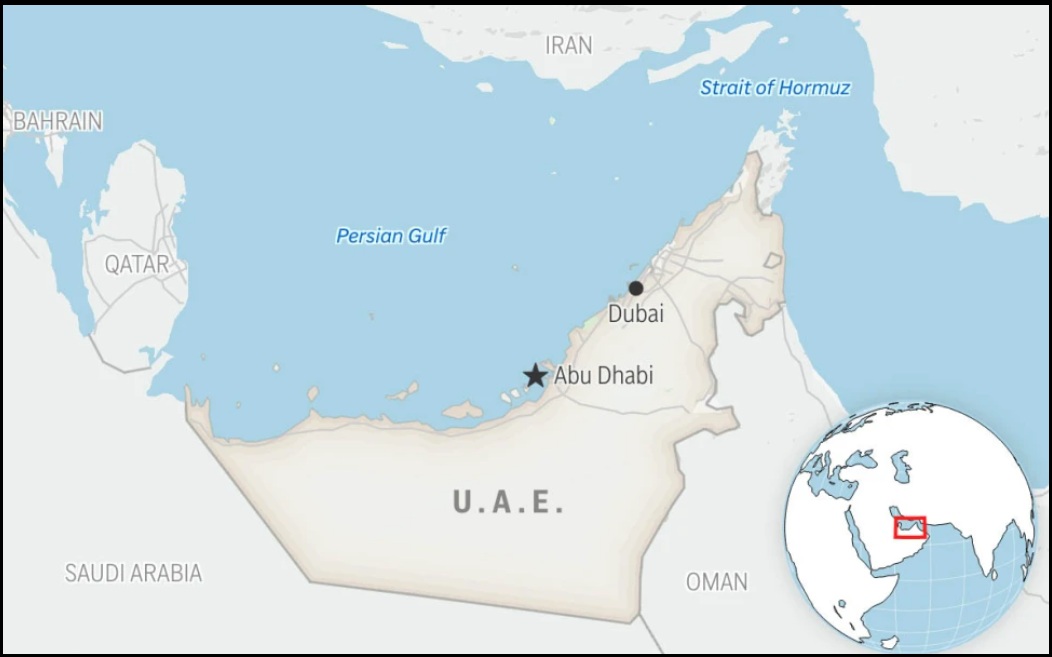
DUBAI, United Arab Emirates (AP) — The United Arab Emirates said Tuesday it will leave OPEC effective May 1, stripping the oil cartel of one of its largest producers and further weakening its leverage over global oil supplies and prices.
The UAE’s decision had been rumored as a possibility for some time, as it pushed back in recent years against OPEC production quotas it felt had been too low — meaning it wasn’t able to sell as much oil to the world as it had wanted.
“Having invested heavily in expanding energy production capacity in recent years, the bigger picture is that the UAE has been itching to pump more oil,” Capital Economics wrote in an analysis. “The ties binding OPEC members together have loosened,” it said, particularly after Qatar withdrew from the cartel in 2019. (read more)
As noted by CNBC, “The UAE has played an influential role in OPEC’s decisions over nearly six decades. It was the group’s third-largest oil producer in February behind Saudi Arabia and Iraq. The Gulf state joined OPEC in 1967, seven years after the organization was founded.”
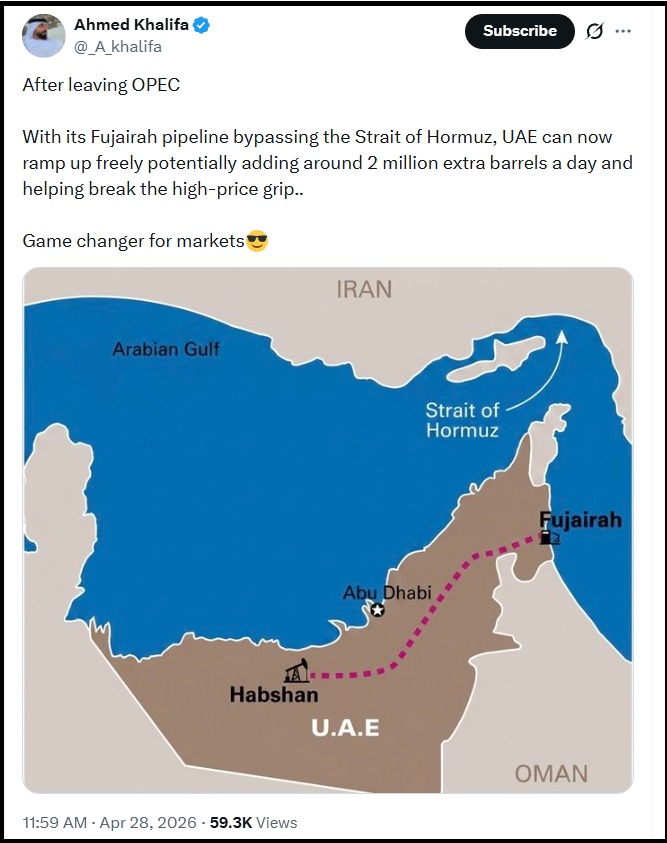
This is where things get really interesting…. Because the UAE can effectively eliminate the Hormuz chokepoint, and Secretary of Treasury Scott Bessent previously outlined something very important to the UAE:
LAST WEEK:
WASHINGTON – US Treasury Secretary Scott Bessent said on Wednesday that a number of allies in the Gulf region and in Asia have requested currency swap lines from the United States to help deal with energy shocks and other fallout from the Middle East war.
Bessent told US senators that both the US and the United Arab Emirates would benefit from a proposed swap line that President Donald Trump said he was considering on Tuesday.
Bessent did not name the countries making such requests, but told a US Senate Appropriations subcommittee budget hearing that such facilities would help stabilize financial markets amid turmoil from the Iran war.
“And swap lines, whether it’s from the Federal Reserve or the Treasury, are to maintain order in the dollar funding markets and to prevent the sale of the US assets in a disorderly way,” Bessent said. “So, the swap line would benefit both the UAE and the US, and as I said, numerous other countries, including some of our Asian allies, have also requested them.”
The US Treasury last October provided Argentina with a $20 billion currency swap to help stabilize the country’s peso during a tumultuous election period that helped strengthen the position of President Javier Milei’s party.
That swap line, backed by the Treasury’s $219 billion Exchange Stabilization Fund, provided Argentina with a safety net of dollars that the central bank could use to help prop up the value of the peso and prevent a devaluation ahead of the vote. It has since been repaid.
REQUESTS FOR RUSSIAN OIL
Bessent also said that he extended sanctions relief on Russian seaborne oil for another 30 days after requests from a number of countries that are most vulnerable to oil shortages from the closed Strait of Hormuz. The requests came during last week’s International Monetary Fund and World Bank spring meetings, he said.
The action reversed his comments last week that he would not renew expiring sanctions waivers. A separate waiver to allow countries to buy Iranian oil stranded at sea lapsed on April 19. (more)
The UAE can bypass the Hormuz chokepoint, and Saudi Arabia can pump oil to the Red Sea via their east/west pipeline.
If Trump keeps the blockade against Iranian oil shipments in place, the UAE and Saudi Arabia can fill the global oil void; however, they need to get outside the OPEC restrictions to do it. Thus, the UAE exiting OPEC makes strategic sense both now and in the geopolitical longer term.
However, in the short run the UAE needs financial stability as the switch is done. Enter Scott Bessent with the currency swap lines for the UAE.
Brilliant planning.
Iran just lost all their leverage.

SD, what are the long term effects of this action by the UAE?
Opec will have a harder time price fixing
More supply, less cost.
I feel like this is may be the beginning of a mad dash to monetize their oil before the alleged “new battery technology” becomes a reality….like selling your horses before the ICE became ubiquitous …..
Monetizing oil ahead of not so groundbreaking battery technology is kinda silly.
All that “clean energy” tech, i.e. wind turbines, solar panels and batteries cannot produce the many thousands of other products that support a high standard of living that petroleum can. Petroleum is not going away anytime soon.
I was primarily referring to the Auto market and trucks and what people will ultimately see at the gas pumps, which is what they feel every day if solid state battery promises of 800 mile range and five minute charge become a reality the ICE in vehicles doesn’t make a whole lot of sense anymore.
and then free’s up the remaining oil for the myriad uses you mentioned, which means prices plummet with apparent glut.
and this today…..
https://www.reuters.com/business/autos-transportation/average-price-car-us-you-could-buy-5-new-chinese-evs-2026-04-28/
the current pace of iteration in tech is changing eveything we thought we KNEW.
Something to consider — solid state batteries use way more silver than solar panels… Still need oil/coal/gas to produce electricity.
Good to know….maybe back into silver now that its back down 😏
Not much out there matches energy density of those except nuclear which BLOWS THEM ALL away….
and solar on ones roof will be totally adequate to keep ones “daily driver” topped up….
A good portion of that price for Chinese cars is based on their selling carbon credits in the EU and subsidizing their EVs. 800 mile range and 5 minute charging will come along when the magic wands become a reality. Tesla’s highest charger is rated up to 250KW and which in a hour will give you a supposed 1000 miles. To get 800 miles (80% range) in 5 minutes would require a rate almost 10 times the 250KW. Good luck finding such a charger even if they actually become realistic. I will stick with an ICE or possibly a hybrid. Pure EVs are not an answer.
Hybrids make most sense at the moment….(fwiw….I’m currently shopping for a 4wd 5L F150) so no ev fan ….AT THE MOMENT….
But…….
Just bought a F150 King Ranch with the turbo 6 and love it. Looked at the hybrid and just didn’t work for me. If you have to rely on the grid for your transportation you are in for a rough time. In Texas we keep adding wind mills and solar without adequate reliable (gas, coal, nuclear) sources. During 2025 there were 8,760 total hours. I consider a high demand hour where we exceed 65,000MW. There were 1,882 hours during 2025 that we exceed 65KW. Wind had an installed capacity of almost 39,000MW. Wind actually produced less than 10% (>3,900MW) of its installed capacity 12.3% of the time. In fact it was producing less than 30% of capacity 56.5% of the time.
No question you can’t rely on wind when demand is high. Of course many of the energy experts believe demand reduction is a key factor. I always like the look on their face when I point out that the ultimate in demand reduction is a mandatory rolling blackout or rationing.
The whole concept of all these redundant systems makes little economic sense. It is like having to own 4 or 5 cars just to have transportation 24/7 on demand. Your wind vehicle doesn’t work 60% of the time during rush hour (peak demand) so you have a solar car which doesn’t work at night nor during high demand rush hours. So you have a battery car which has limited range. So, you have to have an ICE (and that includes hybrids) vehicle to provide backup. The proponents of this say it’s economical because you don’t have fuel charges. Bull. You have 4 times the infrastructure and operating costs (insurance, maintenance, depreciation, etc.) when you can could have only the single expense for the ICE vehicle which can be driven 24/7/365.
I hope you find a good deal and enjoy your F150.
Too funny….I am actually contemplating heading your way (texas texarkana NM,OK to look shop) since I’m in the midwest and with the salt it is impossible to find a clean one….. hoping for a clean ’23 Lariat coming off lease…..🤞🏻😉
plus you’re in the quintessential target rich environment for pu’s…..😜
3-400kw is what I got from Grok when I 1st read about the SS battery tech…..
Those are conconsidered disposable cars
Getting 800 miles of charge in 5 in minutes is a BEV is not going to be intrinsically safe anymore than would be running a car on a hydrogen fuel cell.
There are hard limits to the chemistry and physics involved.
To quickly charge that sort of battery is going to require a lot of instantaneous power, a significant fraction of a megawatt or more at those rates. Something goes wrong with that and there will be a big boom. High voltage/amperage systems are not to be trifled with. To say nothing of the expensive upgrades of the electric grid that would require to handle loads from chargers capable of that.
ICE cars are going to be safer and generally cheaper barring undue influences on the market. Gasoline is largely a waste byproduct from the distillation of petroleum into more valuable fractions like diesel and kerosene anyways.
Yup. None of these libs, progs and stupid people in general understand a thing about the laws of physics and laws of chemistry.
Everything to them is a panacea with no connection to reality.
I drove a 2007 Prius for years and loved it. I bought it used in 2008 when gasoline was $4/gal. I gave it to my daughter in 2021. Her family drove it until my granddaughter wrecked it a couple of years ago. The frame wasn’t bent, so a body shop bought it for a rebuild. Apparently that vintage Prius has value (beyond the catalytic converter) in Boulder, CO.
I expect that my next vehicle will be another hybrid.
I’m not a big fan of hybrids insofar that I think that the fuel savings is not really worth it to me for the trade-off of higher repair costs for a more complex electrical system.
More choices is a good thing in the marketplace though, as everyone has different priorities of what they need or want most out of their automobiles.
My expenses for my Prius amounted to gas, tires, oil, and 12-volt batteries.
After I gave the Prius to my daughter, she had to replace the brake pump (~$1,600) and the battery array (another $1,600 or so). When these cars first entered the market, there was an anticipation of hybrid battery array replacement every 3 years. This car made it over 15 years before needing that maintenance item. I think the car had 200k miles on it when the wreck occurred.
Wonderful little car.
Bonus: It fit well in most parking spaces.
5 minute charging is pure BS, and will never happen!
FYI….FWIW
Lithium-ion already hits crazy fast charges in labs, like 20C rates, and solid-state cells just tested by Donut Lab hit 11C: zero to 80% in 4.5 minutes, full in under eight, with temps only hitting 63°C. That’s not theory; it’s independent lab data from this year.
Well I don’t care for the open pit toxic heavy metal mining for lithium, nor for the African slave children mining for Cobalt.
The spontaneous explosion possibilities also mean I’ll never park a battery car in my garage.
And the 5mph fender benders voiding the possibilities of future insurance mean I won’t drive one at all.
I’ll stick with the century+ proven technology.
before expanding the mileage range, work on the temperature range.
there are too many markets with extreme temperatures where the battery cant operate efficiently if it can operate at all.
then there are all the byproduct of petroleum that wont be cost effective if the primary use of petroleum is not fuel.
However i am going full paul krugman here on the possibility of batteries replacing jet fuel in the next century
Apparently operating ( or charging) temps not an issue with solid state batteries……
Did you hear that fusion energy is less than a decade away?
I heard that too – 40 years ago.
I’m not going to much stock in specific timelines to commercialize it until there’s a practical demonstrator of the design.
My teacher, Miss Huber, 5th grade Chicago Gresham Elementary School, told us in 1950, “Many people will be going to work in helicopters within10 years.” I’m 86 and still waiting.
Hopefully we all won’t be badgered by drones in another 10 years…
And what are batteries principally charged with across the planet?
Coal and oil are not going anywhere, anytime soon.
Key word in your comment – alleged.
My dad is a retired Electrical Engineer. Says battery technology is 30-40 years from now to where it needs to be to replace the internal combustion engine at that type of scale, couple that with infrastructure to support battery powered vehicles needed. Its a pipe dream in our lifetimes.
In anyone’s lifetime. Nothing stores energy and has the ease of use like the carbon-carbon and carbon-hydrogen bonds.
Practical electric cars are going to require something that has not been invented yet.
Something that can store electrical energy at higher densities then the best batteries or supercapacitors are yet capable of. They would also necessarily have less self-discharging issues over time, be fairly inexpensive, and reasonably safe to use or operate in a wide variety of conditions.
Cheaper gas
Cheaper fertilizer
Cheaper medicine
Cheaper cars
Cheaper airline tickets
Cheaper everything
The Trans Alaska Pipeline is already in place oil availability is endless yet DC controls how much flows.
Do you think the UAE has a green lobby like the US does?
Of course they do.
Its job is to make sure WE don’t compete with THEM
So, will someone take this out like they did with Nordstrom?
They took out Nordstrom? I just bought a shirt online.🤣
😂😂😂😂😂😂
The Nordstrom in downtown Indianapolis closed in 2011. If they had an oil pipeline they might still be open.
Lol!
Did you mean the Nord Stream pipeline?
Autocorrupt got ya
The coolest thing about this is it’s ready to go.
And so long as all parties continue to support Oman’s complete neutrality (despite being bisected), this can work.
Less cartel based control. Sundance has in the past discussed how even the Anniversary or Valentine’s day Rose business is controlled. If you have competition vs consolidation you get less corruption.
One way or another, it will unleash a supply side price war.
UAE may open with lower price, to build market outside of OPEC, or say, “We have plenty of oil and will gladly sell you some if you are in dire need (think India) but for us doing you this grand favor you must pay us our pr-r-r-rice.”
If the latter transpires, another supplier jumps in and says, “We will sell you our oil for less.” Meantime OPEC tries to shrewdly bet its hand against a changing table in which the U.S., Venezuela (!), UAE and Russia hold wild cards.
Prices bounce around for a few months and generally trend lower as OPEC sputters to maintain its declining domination of the world market.
We’ll be down to $2-something per gallon at the pump within months, possibly lower, (except in places like California, where forthcoming increases to current $.90 tax per gallon will escalate as a revenue generator.)
The cartel is less a cartel, and when other members see the UAE pumping more oil they will want that freedom to pump as well. UAE just did a “Make UAE Great” move that frees them to do what is in their own best interest with their oil, not OPEC’s best interest.
Iran has oil coming out their eyeballs right now and is staring at shutting down mature oil wells that, if capped, may never produce again.
Now their neighbor announces they are separating themselves from the worlds supreme oil price fixing operation. I believe others will soon follow UAE. They want out from under the yoke of OPEC. It appears this was what our President got agreement on when he went over there last year.
This creates real market competition / more choices. Long game, Iran is being reduced to an also ran in the oil trade.
Its the economics.
Marvelous
All old cartel pacts should die
OPEC
NATO
EU
USMCA
Keep going
UN
WEF
Five Eyes
Especially UN. It helps Palestinian terrorists and Hezbollah. President Trump Board of Peace should be a great replacement.
EU Too
China Belt & Road
FBI
CIA
HUD
FBI
CIA
IRS
Dept. Education
oh my.
the list is endless…..
There certainly is a whole lot of house cleaning to be done here in the U.S.A. !!!
God Bless America, President Trump, and all who see through the stupid, destructive activity of the so called New World Order.
DNC
RNC
HPSCI
SPSCI
SPLC
ACLU
EXCELLENT, MV Man !!
Notice that UAE has beachfront property outside the Straight of Trump/Hormuz. That will allow them to load tankers offshore.
There biggest oil port is there. Free of the Straight of Hormuz, but not free of Iranian drone attacks.
If they are smart they will pipe it to the other side
It appears that everyone else in the neighborhood is doing exactly that.
Even Iran would be smart to do that. I predict this war will end with a DMZ along the Iran side of the Strait of Hormuz.
They, or we, could make the Strait of Hormuz much wider by pushing the Iran waterfront several miles inland.
What the 3 most important things about real estate:
Location, location, location!
And I suspect our VSGPDJT knows THAT!
But they still must transit the SoH to reach their markets.
UAE and Saudi have pipelines that bypass the SOH.
Saudi’s go to the Red Sea, so Iran’s terrorist proxy Houthis can threaten that exit too.
If they dare… who can predict the death throes of a mad dog?
The Gulf’s oil price fixing wall will have a bigger crack in it next week.
It seems that restrictions on production & price fixing are losing their appeal worldwide.
Perhaps the globalist oligarchs worldwide commodities price fixing will be next.
More production, lower prices. Industrial economies thrive and green economies look foolish to those suffering under them.
This sounds awesome. Hopefully other major opec members like Saudi Arabia join UAE to help crush British /Deep state control of oil supplies and thus world economy.
Qier Starmer tried so hard to show up in Saudi and “negotiate” with MBS, the day after the ceasefire was signed.
‘Wonder if he made a trip to Dubai? Maybe not.
*Perhaps, Pres. Trump will lean forward, as Charles enjoys a piece of Choc. cake and
inform him that OPEC is falling apart.
“Global leaders” should probably avoid PDJT’s chocolate cake!
I wouldn’t be surprised.
Gulfies have diversified and modernized their economies considerably. They’ve got young populations who don’t have to rot with the “resource curse” that’s held these countries down.
Fracking in the U.S. made us the #1 oil producer in the world.
Me thinks President Trump has fracked OPEC.
Bad for the oil cartel.
Lower gas prices for consumers.
Just in time for the mid-terms.
Suck it, democrats.
No wonder our UNiparty, ever bowing before the city of London, wishes to see the greatest President of our lifetime ‘un-alived’ posthaste!
Any moar winning here and the normies may start to get a clue as to who’s been lying to them all along, who’s been selling out our country to the highest bidder(s), and who has effectively kept them “unaware and compliant,” as Hellary is wont to say in private.
And then they may realize who has been telling us the truth all along- President Trump- as he digs the free world out of this godforsaken mess *they* recklessly created for their own selfish interests.
To paraphrase Sundance: the democrats are (batshit crazy) power-hungry ideologues and the republicans are just plain greedy mofo’s. Together they have conspired to destroy the free world.
Amazing
Well you know he doesn’t know what he’s doing and he doesn’t have a plan and to top it all off he’s like Hitler…. sarcasm btw.
Hhhhh, this is exhausting. Just Bring gas down. 4.29 here is Pittsburgh, pa. And the price of food is killing us.
Yes, it’s tough having to think through how PDJT’s policies will ensure long term cheap energy for the world that directly impacts the price of food and many products dependent on oil like your clothes and much of your car.
And he has to weigh that against the costs of our military bases subject to ballistic missile strikes at the whim of the IRGC !
Problem is if that takes 2 years to play out for a great long-term solution, there are a few intervening elections. Fickle, low attention span voters, domestic media enemies, Neocons and UniParty all around…. can we make it 2 years?
Or can it happen in 2 months? 🤔
I’m in MD. Our gas is crazy (high) because of the flippin’ democrats and their taxes!!!
Same in virginia
$3.59 in TN yesterday.
Pittsburgh has high food prices. Milk is $2.00 more per gallon in Pittsburgh than in central FL.. Giant Eagle is reduculous..I switched to Aldi’s and walmart. Prices on eggs and butter are down from Dec 2022 when butter was 6.99 a pound and 18 eggs were $8.99.. Im down to 100 a week, my husband was spending 230..
Try Costco.
In Oklahoma, Costco milk $2.50, Costco eggs (2 dozen) $3.50, Costco Heavy Whipping Crm. Quart $3.50.
Rescue the free world.. banish satanic forces.. bring down the price of goods and services.. whatever floats your boat. MAGA has something in it for everyone.
$6.25/gallon in Southern California.
$3.55 in Texas. Down from $3.75 2 weeks ago
$4.19 in Tucson AZ.
Say thank you to the CA gas tax, CA boutique gas blend requirement, and forcing CA gasoline refineries to close down.
Price of food is tied to energy costs to grow it, harvest it, process it, and transport it to market. Watch those dominoes fall over one more growing season once energy (gas and diesel) prices fall.
I keep a photo on my phone of gas sign @ Costco from April 15 of 2020…..$ 0.95 9./10 diesel $1.51 9/10 ….DJT 1 (won😝)
I am still deciphering this piece of news.
Are they with Iran?
Are they with Saudi Arabia?
I think the next one to watch is Oman.
Oman likes to play negotiator.
Not on our team.
I have now come to the opinion they (UAE) has drawn a line in the sand and are with China and they will be trading in Chinese yuan.
A third of UAE oil goes to China which accounts for 6% of Chinese imported oil. Another almost 2/3 UAE oil goes mostly to Asian nations including India and Japan and islands.
I think UAE will throw Israel under the bus. Israel helped with sending Iron Dome missile defenses to UAE to battle Iranian incoming.
This will ultimately e a negative against Netanyahu.
If UAE goes with its oil sales being paid in Chinese yuan and not the $petrodollar, UAE managed to deplete needed Israeli defensive munitions and basically lease their Abu Dhabi pipeline to China.
Will China now learn from the Europeans and put their markup on the other buyers of UAE oil? After all, racketeering is not only a business but a sport.
PDJT will be visiting China soon.
Interesting to be a fly on the wall.
https://www.hellenicshippingnews.com/tankers-uae-crude-oil-exports-on-the-rise/
Just my humble opinion.
we just did a currency swap with the u.a.e.?so i would say no to the yuan.
Less regulation
I wonder if they are betting on the Iran wells having to be shut down and permanently damaged due to no place to store the oil and then filling the void created by the shut down with their own oil.
Without OPEC limitations they can pump and sell as much as they want.
It would be very profitable for them.
Win-win
This is a financial calculation. The UAE is one of the largest investors in the world in Private Equity, Private Credit, Hedge Funds, Real Estate, etc.
They would rather have more cash today at potentially lower oil prices in order to be able to turn around and invest that cash in higher returning assets and to diversify. It is a better ROI than pumping less at higher prices over a longer time period.
Now this is right on the money.
They understand the time value of money and opportunity costs.
I want that suspicious cat picture framing my surmise here:
OPEC is LONDON controlled.
Was Deliberately designed to “manage/thwart/limit” oil production, rather than increase/improve/unleash it.
Do you think this UAE news may have been timed while King Chas III was in DC?
Very. Stable. Genius.
I remember back in the day whenever “OPEC” was mentioned in the evening news, the first thought that came to mind was how much gas was in my vehicle because the pump price was guaranteed to rise within 24 hours or less. I’m glad they are being dismantled.
OPEC was demonized because Nixon closed the gold window and OPEC ‘raised the price’ of oil to maintain the terms of trade that had been struck when 12 barrels of oil was worth one ounce of gold.
WSJ editor Robert Bartley outlined it nicely in his book, The Seven Fat Years. “When the gold pool dissolved in 1969, a barrel of oil was worth almost 1/12th an ounce of gold. ….. In the first half of 1974, after ‘the shock,’ a barrel of oil was worth amost 1/12th an ounce of gold.”
The closing of the gold window is probably THE most significant public policy decision of the past 60 years. If not for the economic dislocations caused by no one knowing what the value of money was, there would have been no inflation or stagflation in the 70s, Penn Square might not have made big loans to Mexico based upon ever higher oil price predictions, no financial crashes of the stock market, no sub prime crisis, no George Soros (you can’t bet against a fixed currency).
Perhaps no immigration crisis, since third world economies were thrown into chaos by fluctuating currency valuations and helpful loans by the IMF.
A monetary system tied to the productive output of the planet is obviously superior to whatever measures are used by central bankers.
It appears Iran is on both sides of the Straight. Who was the genius that thought that was a good idea? Some British Twit?
After things settle down to normal in Persia, the Persian oil fields will also be free of OPEC influence. The lands now called IRAn were called Persia for thousands of years before British Intelligence renamed them.
https://en.wikipedia.org/wiki/Name_of_Iran
Iran was named after the Aryans.
They have been saying most of my life that the US was going to run out of oil soon. OPEC was limiting supply to keep prices up and limit their sales of their oil so they did not run out.
That is another elitist scam President Trump exposed that has been used to rob the ‘little’ people.
After President Trump demonstrated that the US has plenty of oil by making the US a number one producer of oil, the Arabs have figured out the way they are going to make money is to produce and sell all they can.
I think they see a non-Euro centric order and want to be a sovereign nation.
I definitely see a non-European order attempting to evolve.
Will it happen?
I am a prophecy watcher and this is all interesting because it is above my comprehension.
yucki on April 26, 2026 at 5:10 pm said:
“In late February 2026, two weeks into the Iran war, Mohammed bin Zayed Al Nahyan picked up a phone in Abu Dhabi and called Benjamin Netanyahu. Iran had fired 563 missiles and 2,256 drones at the United Arab Emirates, more than any other country in the region, more than Israel itself. Emirati air defenses were saturated.
MBZ asked for help. Netanyahu ordered the Israel Defense Forces to deliver a complete Iron Dome battery, dozens of interceptors, and several dozen IDF operators to UAE soil. The system was operating in Abu Dhabi within days. It intercepted dozens of Iranian missiles. Axios reported yesterday afternoon that it remains in country.
This is the first time in the seventy-seven year history of the State of Israel that the IDF has deployed an active combat air defense system to defend an Arab capital. It is the first time the Iron Dome has been used outside Israel or the United States since it became operational in 2011…
It was deployed in 2026 to defend Abu Dhabi from Iranian Shahed drones and Fattah ballistic missiles. There is no precedent for this.
The detail that breaks the story open is the timing…
Iran’s sustained barrages had pushed Israel’s own anti-missile systems beyond their physical limits, forcing the IDF to ration its most advanced interceptors while Israeli civilians took direct hits…
Times of Israel reported today that Netanyahu’s coalition had repeatedly refused to fund interceptor production, with some members arguing for offensive capability over defense. Netanyahu sent a complete Iron Dome battery to Abu Dhabi while rationing the same weapon for Tel Aviv [Jerusalem]…
https://substack.com/@shanakaanslemperera/note/c-249507268
David from Israel can correct me, but i pretty sure the Iranian missiles were not dealt with by the Iron dome, as it is most effective against short range missiles.
the iranian ballistic missiles were dealt with by davids sling or the arrow 3.
I find it highly unlikely that Israel gave away a system they needed desperately.
I would have to look back 10-15 years to confirm, but i believe the Iron Dome was conceived by a former Mayor of Sderot, who lived under constant rocket and mortar from Gaza. I think it was a Peretz. Was Defence Minister for a bit
Scoop: Israel sent “Iron Dome” system and troops to UAE during Iran war
https://www.axios.com/2026/04/26/israel-iron-dome-uae
(Axios reported it first, later confirmed by all major news sites.)
Any chance they will try to move Irans oil for them?
I really do not fully trust these nations as they send billions into our country to attempt establishing Islam here.
Certain politicians and governors are suckers for these sweet billions
Ah, beautiful logic in use…
Suh-weeeeet!
Brilliant move….the sphere of influence in oil movement completely changed in alignment with US interests.
The biggest loser? China…no more cheap Iranian oil. Next big loser? Europe….
And Iran has no leverage….and without a bomb being dropped.
The arabs appreciate strength and common sense and they appreciate respecr of tbeir customs and cultures….Trump has presented all of that. Add to that they do not want to see a powerful Iran.
And this right after Merz said Iran has outsmarted the US. What an ultra maroon.
And Persians are contemptuous of Arabs.
How will this play out?
Exactly. I have questioned our energy independence, if we can get there again, but yet OPEC controls pricing anyway?
I also would like to know if natural gas is going to decrease anytime soon. Our gas is budgeted annually and it went up last August $50 for the year and we had another $50 increase last month to make up for the “cold winter” that I don’t think was that remarkable. $175/month is ridiculous. It was $75 a month since before Biden but it continues to rise drastically.
Smart move for the UAE. Here’s a map of world oil production, with the USA double our next closest competitor (this is from 2024, when Autopen wa still at the helm. Numbers under Trump even better.):
https://worldpopulationreview.com/country-rankings/oil-production-by-country
Now let’s look specifically at OPEC crude oil production by country. This bar chart shows Jan-March, 2026:
https://en.macromicro.me/charts/106023/opec-member-countries-crude-oil-production
The UAE is taking the long view here, not just in terms of their economy and sovereignty, but in terms of their defense. An alliance with the USA, and Russia (it’s coming, God willing) strengthens its defense against China.
I expect other OPEC nations to follow suit. Dominos.
The UAE was the first -or one of the first- to sign our President’s Abraham Accords.
Having to offer swap lines to some of the worlds wealthiest countries is shocking. Now we aren banker of last resort?
Looks like UAE no longer believes in Peak Oil. Or the jig is up the lie is going to be revealed.
Oil is Abiotic, meaning the earth makes this stuff on a daily basis from deep down heat and pressure and a lack of oxygen forms the black goo, not dead Dino’s.
Believe it or not, Russia and Ukraine worked together years ago and concluded oil is abiotic origins. Then here in the U.S., 1995 Eugene Island, Louisiana they found perplexingly refilling themselves after being depleted.
President Trump knows cheap inexpensive energy fuel economic growth and that the Peak Oil scam is like the Climate apocalypse scam meant to keep the people DOWN!
I don’t think that there is enough “ancient biological material” to justify the amount of oil that is being extracted every day. Much of it from depths that decidedly argue against the idea that a dinosaur was ever down there . . .
Like it or not, Mother Earth continues to hold mysteries.
Oil/gas came from the microscopic stuff that makes us sea floors, algae, plankton, sea plants, dead fish – basically ancient slime. Put it under intense pressure and temperature deep in the earth’s crust via plate tectonics and the carbon and hydrogen atoms combine to form hydrocarbons.
Coal comes from ancient trees and surface vegetation which when submerged as in a peat bog or an ancient sea or large body of water, and ultimately forced deep into the crust it’s compressed in concentrated carbon (coal).
if we are to believe that Dinos roamed the earth for hundreds of millions of years, there should be plenty of material to keep producing for at least many more hundreds of years.
but then again, fantasy writers did always have the challenge of keeping their fantasies internally consistent.
Yes this is very intriguing. But the “fossil fuel” dinosaurs-becoming-oil is just a stupid naming convention. Obviously dinosaur bones don’t become oil. And there’s not enough of them anyway. Instead, presuming biotic origin, it was the humongous amount of plant material buried during the worldwide flood. Polystrate tree fossils in coal beds are one notable clue for this.
Trying to focus the dinosaur bones as fossil fuels distracts from what the real biotic material was and what it implies about evidence for a global flood.
My belief tells me, God made a world of abundance a never-ending abundance that is regenerated by what he created.
If we all could live long enough, we would see California get slowly suck under tectonic plate right next to it and all of that soil that sits on the surface would make oil for the rest of us to use.
MAGA Fabulous!!
Assuming that, at some point, Iran’s Islamic radicals will be overthrown and the Iranian people will be free once again, my only issue with all of this is that, if the blockade continues, will the free Iran be able to begin to produce oil again for the global market? Or is it only a matter of drilling new wells, considering that the existing ones will no longer be functional….???
YES!
OPEC is a monopoly that has exerted control over the entire world for far too long. Oil producers should have to compete instead of collude.
And I see people blackpill all the time. Weenies!
The “rules based international order” is crumbling right before our eyes.
The promises made by President Trump in his first Inaugural Address (in my opinion, the greatest address since Washington) are being fulfilled in real time.
The wins just keep coming!
President Trump, the Very Stable Genius, is the Greatest Of All Time!!
As soon as the US/Israel start bombing iran again that pipeline is history. Then back to the Strait for the UAE. Simply reality,
Why did they not make it “history” when they actually had lots of missiles?
Our President is such a genius! He is absolutely the most perfect person to run our country now. What a shame he has to fight our own repugnant rino congress to do anything. Most people would think they would want their names on the winning side of these happenings.
I’m hearing Susan and Barbara’s next installment from Promethian Action already.
Iran’s oil being taken permanently offline?
The shared gas field between UAE and Iran going to be all UAE in the near future?
It’s {spit}–Qatar–{spit} that shares the gas field with Iran.
This is good news, indeed. Thank you Sundance!
I’m guessing Venezuela is out of OPEC, too?😏
As I recall, when I started driving gas was $0.32 per gallon and oil was about $18.00 per barrel. There seems to be more to the pump price than the cost per barrel. Would sure be nice if it correlated.
A question. Could the President declare the closing of California refineries as a national security emergency since much of our transportation, ports and military are located there? In so doing, could he assume operational ownership of those refineries and not allow them to close and to keep processing oil? I mean, he re-opened an off-shore pipeline there in spite of the CA crazies.
I love it !
Man will always bypass restrictions if he has the incentive.
The leverage lost by the City of London and Lloyd’s … any guess at the consequences?
That pipeline that eliminates Hormoz can’t carry and extra 2M BPD of oil. Any bump in UAE oil will have to travel via ship. However, Iran will be seriously impoverished in coming years. Their capacity will drop after they stop pumping and global prices seem like they will be more competitive as Russian Oil goes mainstream again and UAE /Venezuela increase output. This will happen even if Iran finally gives up in a week or two.
Cracks in the old order are widening.
Things are quickening.
Indeed. Comey indicted 86-47 today.
The all at once/
Have been reading Iran can not sell any oil due to the naval blockade.
They must keep their oil wells operating and they’re running out of places to store the unsold oil.
If the wells have to be shut down they risk damaging them long term or possibly forever.
To restart the wells repairs would be very expensive if not impossible to do.
If all of this is true you have to assume this is part of Trump’s plan to force Iran’s surrender.
Yes but Merz in Germany said Iran has outsmarted the US.
I know……
Cartels are never of good intentions and OPEC should fall like the EU Among other global thugs
Apparently, the people who rum the Panama Canal are reaming the Japanese for buying American oil.
https://www.asahi.com/ajw/articles/16528277
By gosh, this is a meld of TRUMP, “FIGHT, FIGHT, FIGHT !!!!” and William Wallace, “FREEDOM !!!!”moment, the chance of the ME deciding their own destiny.
If the ME is finally free to decide outside the Bank of London and Euro Overlords, what would the future hold, for them.
Historical stuff.
No wonder King Eunuch came for a visit.