Against the background of the Oleshky ceasefire, Fox News’ Trey Yingst sat down with Ukraine President Volodymyr Zelenskyy to discuss the current situation in the ongoing NATO proxy conflict with the Russian Federation.
Zelenskyy’s recent attacks into Russia, or at least to the extent we can call them ‘Zelenskyy’s attacks’ when we really don’t know what interests are directing the targeting, have been hitting very specific Russian energy infrastructure. Ukraine targeted Novokuybyshevsk oil refinery, and another big refinery in the Samara oblast owned by the Russian state energy giant Rosneft.
Then came another major drone strike. According to ASTRA on November 1, a drone attack targeted the LUKOIL refinery, also known as NORSI, in the city of Kstovo. The facility is among Russia’s five largest oil refineries and has an annual processing capacity of approximately 15–17 million metric tons of crude oil. The NORSI refinery produces gasoline, diesel, aviation fuel, fuel oil, bitumen, and other petroleum products. It is Lukoil’s largest facility.
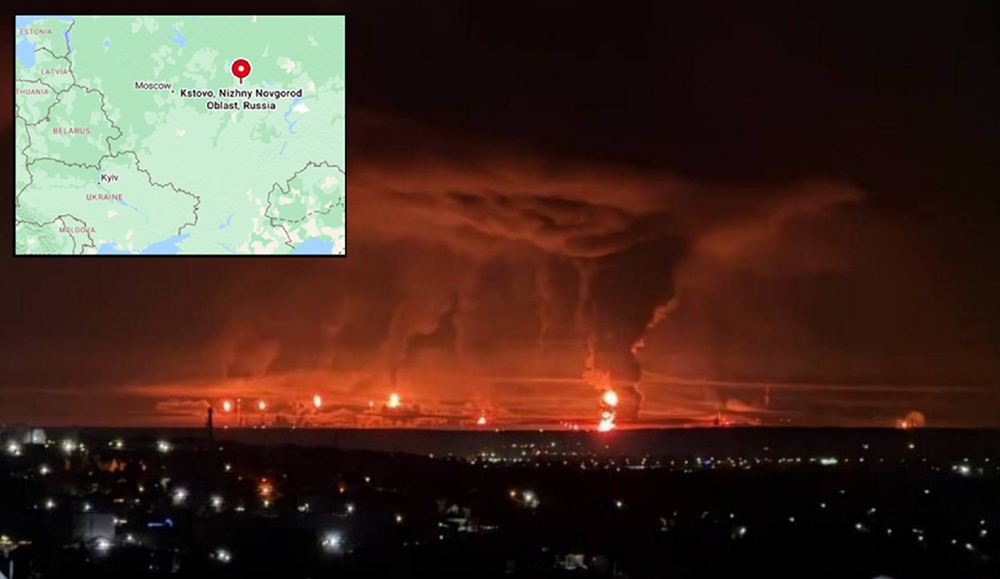
You can see from the insert (image above) the drone attacks into the city of Kstovo travelled a considerable distance to reach their LUKOIL target. It should also be noted that since the time of the Trump administration’s requests to stop targeting Russian oil refining capacity, Ukraine has actually expanded those attacks specifically targeting refining capacity.
The attacks against Russian oil refining in the Samara region happened at the same time western media attention was following the ceasefire in Oleshky, southern Ukraine. The full geopolitical context here needs to be considered.
Ukraine officials told the Kyiv Independent newspaper they never agreed to a request from President Trump, Emissary Steve Witkoff and Jared Kushner to pause refinery strikes for 30 days. The raids on Russia restarted during the ceasefire in Oleshky apparently as Zelenskyy sought to take advantage of the media distraction. As a consequence, Kremlin officials said, Kyiv was “simply ignoring” US wishes.
The strikes deep into Russia also restarted immediately following statements last week by Zelenskyy about the full restoration of their ability to use Starlink satellite guidance systems. The timing cannot be simply coincidental.
Last month President Trump lifted US sanctions on Russian diesel in an effort to lower the global impact of rising diesel fuel prices. What Zelenskyy is doing is not only counter to the request from the U.S. administration but is factually counter to the interests of everyone living in Europe including -in the longer term- Ukraine.
The continued strikes against oil refineries only benefit a narrow segment of western financial and banking interests. However, those stakeholders are the same interests attempting to use NATO to expand conflict with Russia and remove the roadblock that President Trump represents.
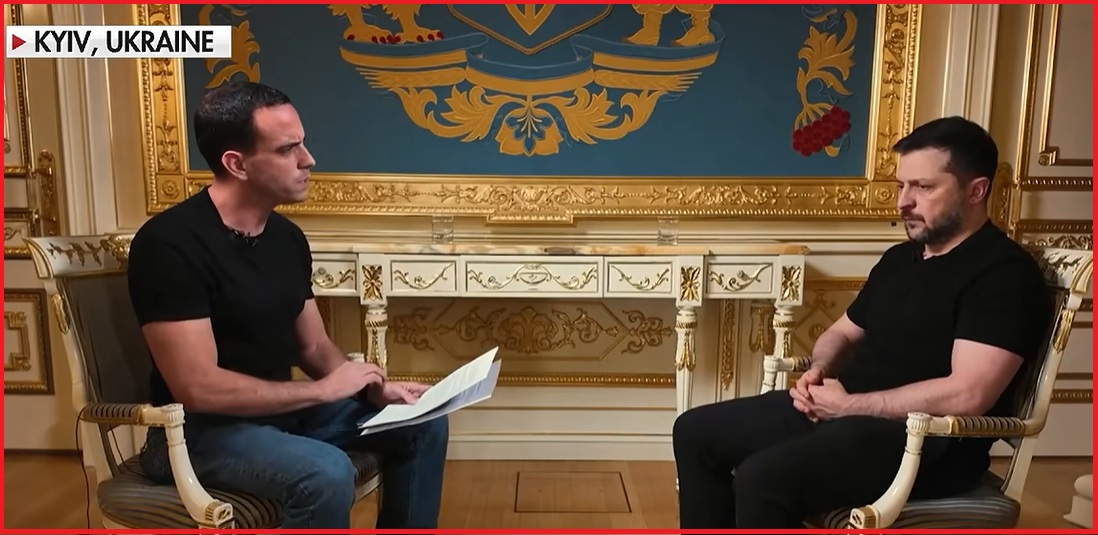
This sets the stage for Fox News’ Trey Yingst to ask Zelenskyy specifically about the targeting of Russian oil refining against the backdrop of President Trump requesting he stop. Zelenskyy never answers the question, instead he deflects and says if President Trump gives Ukraine patriot missiles, then Ukraine will consider stopping their attacks against Russian oil refineries. WATCH:
.
 The people behind Zelenskyy, essentially all these western financial interests who operate within NATO, ultimately do not want President Trump and President Putin to form a strategic partnership.
♦ Which circles back to the catch-22: Canada, the U.K and Europe are all facing the same problem…. MONEY! Where are they going to come up with the funds to pay for a military investment they have declined to make for the past 50+ years?
It’s not just an issue of finding funds for a standing military, hardware, ships, submarines, aircraft, tanks, heavy and light artillery, missiles and drones etc., they also have to fund the technological capabilities to use and deploy modern weapons.
They need advanced manufacturing, steel works, technological guidance systems, large numbers of strategically placed satellites, a space program that includes rockets to put them into orbit, and much, much more.
At scale this is multiple trillions, and that doesn’t include the baseline manufacturing systems needed to create all this independent infrastructure.
It’s one thing to say, ‘we will build out our military capacity’, and it’s another thing entirely to actually build it.
Does Canada or Europe even have the human resources (engineering) to create all this infrastructure? Think about it. Then overlay three decades of an energy ideology that expressly limits their capability to even follow through with such an endeavor.
When you really stand back and look at the required level of investment needed, in addition to the time it takes to build all of the ancillary processes that are required to meet such an expressed objective, it really puts the position of the Canadian, British and European opposition to President Trump into context.
What is more feasible? Doing what is required to build-out your own military defense systems; or is it simply easier to get rid of the person who stops you from using the USA as your standing army?
25+ years of Global Warming, Climate Change, Net Zero, Carbon Trading, Carbon Taxing, Build Back Better etc. advocacy, revolves around the singularity of one issue, energy production.
From that baseline the western nemesis of a multi-trillion investment and banking system, built around the destruction of the coal, oil and gas carbon-based energy sector is Russia.
Additionally, over the past 10 years as western interests have stopped building oil refining capacity, Russia has expanded oil refining capacity.
All ‘modern’ opposition to Russia in the last 25 years, is now culminating…. But the root is something everyone misses. The root commonality of interests is Energy Production and the carbon-trading schemes.
The advocates for the system of dependencies created by the “climate change/net zero” energy processes are the same advocates who have created carbon-trading exchanges. And those same advocates supporting Ukraine are specifically supporting the targeting of Russian energy production vis-a-vis Russian oil refineries.
The British, European and Canadian climate change group (ideology, banking and finance) – what Mark Carney called the “middle powers” – versus the USA, Russia, China, Mexico, South/Central America, Southeast Asia and the Middle East. That’s an interesting geopolitical contest.
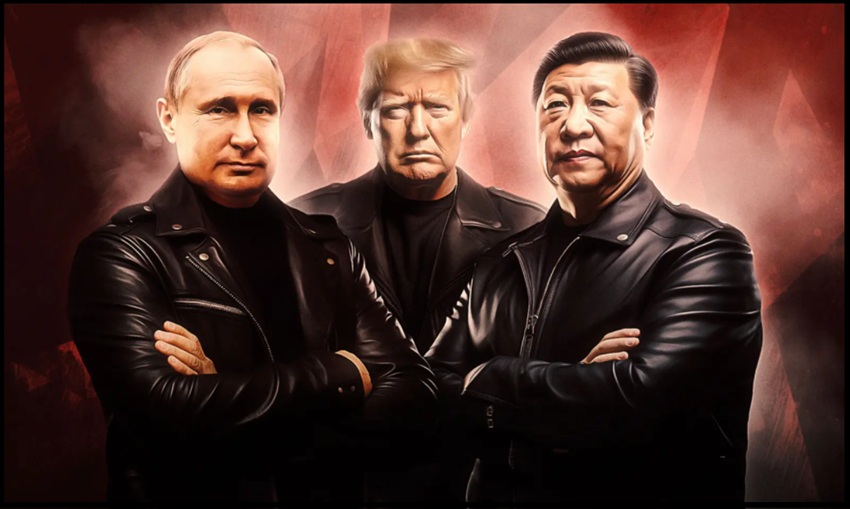
Russian President Vladimir Putin has inquired about the potential for the U.S. to remove sanctions against Lukoil, a quasi-private energy company based out of Russia. Before, getting too weedy about it, remind yourself of the statements that surfaced during the Trump-Putin summit in Alaska, August, 2025.
You might remember that both the U.S and Russia spoke of strategic partnerships surrounding the energy sector. Obviously, this makes sense when we consider the “west” is actually fractured on the topic of energy. There are two competing interests that overlap in the financial side of the issue, the ‘trillions at stake’ aspect.
On one side you have the “climate change” team, those who are fully invested (literally) in the financial mechanisms of the climate change, green new deal, build back better talking points. The Green Energy team in the west. The Paris Climate Treaty and carbon-trading proponents et al.
On the other side you have the pragmatic energy team in the west. These are the Trump-minded and aligned western perspectives that look at oil, natural gas (LNG), clean coal and nuclear technology. These are the “all the above” aligned voices in the more pragmatic view of low-cost energy production and development.
In the middle, between both sides of the fracture, are the banking and finance systems. This is the BIG MONEY play, with the Climate Change team supported by banking ideology inside the city of London, while the Carbon Use team is constantly having to assemble finance and insurance from outside the banking control mechanisms.
The Climate Change team have support based on ideology within the finance system. However, the Carbon Use team have the advantage of low-price outputs, global dependency and actual profits as leverage. This is a fight essentially inside the larger energy sector, and we are all very familiar with it because it has been happening for decades.
That little sleaze bag Zelensky has got to go
With a side of Tusk, Macon, Merz…
Take em out by the sack full.
“Zelenskyy never answers the question, instead he deflects and says if President Trump gives Ukraine patriot missiles, then Ukraine will consider stopping their attacks against Russian oil refineries.”
Cokeface McDick Piano Player apparently also has big balls. All collaborators in the US Senate, House and elsewhere running interference for or abetting him are committing treason.
At some point, Z-Goblin Vert will be squashed.
The capital expenditures for the four major hyperscalers alone (Amazon, MSFT, APPL and Meta) will approach $1 trillion in 2027 to fund their AI build out. Much of that is debt funded by those same financial interests. These data centers require massive amounts of cheap energy to make that debt payout.
I’m convinced WEF/globohomo prefers AI as their control mechanism vs green new scam. Not sure how Zs actions square with those interests.
When all the Dems and repubs and people I see jumped on the bandwagon with their blue/yellow yard signs, lapel pins and social media avatars, I smelled the stink on this whole thing. My .2 cents is STOP taxpayer money and US weapons to this pint-sized, tinpot Dictator.
Going to be some mighty big changes come Wednesday.
President Trump needs to give little z-man one missile.
Right up his ___.
Then cut off all star link and other satellite coms.
I FULLY AGREE!!! Who are the characters hiding under Little Z-Man’s skirts??? Pull off his skirts and expose them! I’m sure we’ll find a lot of European politicians in addition to many US politicians! Including whole BIDEN Familly!
Then cut both them and Little Z-Man off COMPLETELY!!!!!! Break away completely from 5 Eyes! I’ve worked with them and you cannot trust them as far as you can throw them!
Time to cut off funds to the little man.
Z Must have gotten orders to really provoke the Russians. Get them to do something big to kick off a real war with the EU/NATO. This is not going to end well for anyone involved and these leaders in the EU, England and UKR don’t care about their citizens. They seem willing to sacrifice them for the sake of power and mostly money since they’re all going broke.
We’re watching old Europe implode. Good.
JMO.
He has gone from threatening US’s security interest, to actually attacking US’s security interest.
All bets are off for his continued operations.
MAGA / America First isn’t just our motto, it is our duty!
The use of political pressure, economic influence, and military threat has not prevented unseen powers from continuing the war between Russia and Ukraine. None of us normal people have insight into the decision making, but all of us see the futility of the engagements starting with the mysterious moves from Russia in early 2024 – the maneuver Col MacGregor among others declared would end conflict within a matter of a few weeks.
Was the Russian Bear over estimated and the Ukrainian orphan under estimated? Or is the military clash only theater to distract from a different objective? None of what we see in that region is believable on it’s face, just as none of the action in the ME is.
Global power concentrates around food, energy, money, and the tools that acquire or sustain those commodities. Cooperation is only possible between cultures of similar strain so without that connection, friction and the evil cousins of jealousy, envy, and anger, control the actions of otherwise sober men. Is that an explanation for the Rus/Ukr conflict?
I doubt things are that simple. Most likely the motivations are far more intricate, but still center on the three items required for civilization. When someone has a clear explanation I’ll be a ready audience.
I don’t know how FAFO translates into Ukrainian but something tells me Little Z Man is about to find out and it will be the Ukrainian people who pay the price for his arrogance. Does he really think that he’s dealing with Biden? Obama? His arrogance will quickly be his stupidity.
When he whines about Starshield, did someone in the O’Biden administration secretly give him access that is not known to Musk? If he has patriot missiles does anyone really believe that he would only use them as defense against incoming attacks? Nope, he sneaks his little drones around through EU sympathizers airspace to attack Russia. Come out and fight like a real man Little Man.
Give us weapons or we blow up Russia oil. Once we have those weapons, we will blow up Russian oil.
The problem is Europe and elements of the US Deep State. Ukraine couldn’t do this on their own. Continue to purge the Deep State and embargo energy exports to Europe until it stops.
“If you do this, I may consider doing what you want me to do.”
Weazelinski
It is impossible to negotiate with a Semantics 101 liar.
Tuesday November 3/26
Wake up , coffee ,
then
VOTE MAGA RED .
Period
Let’s call it what it is…blackmail. Zelensky is blackmailing the Trump administration for Patriot missiles. Give us the missiles or we’ll keep attacking oil refineries in Russia. Why is he doing this? To hurt Trump.
He’d make a good Democrat. Thinks just like them.
Little Z is nothing more than an annoying piss ant, coke head gremlin!