Alternative for Deutschland (AfD) party leader Alice Weidel represents the opposition leader within the current German political system. The AfD party is on the rise within Germany as the severe leftist and globalist policies carried out by Chancellors Angela Merkel, Olaf Schulz and Friedrich Merz have severely compromised the German economy.
Beginning with the catastrophic energy policy decisions, Ms. Weidel walks through the problems currently being faced by country of Germany and the urgent policy changes needed in order to attempt recovery. Thousands of businesses along with industrial manufacturing are currently collapsing. The economic spiral is shedding tens-of-thousands of jobs, and the bureaucracy of the European Union is compounding their ability to respond effectively.
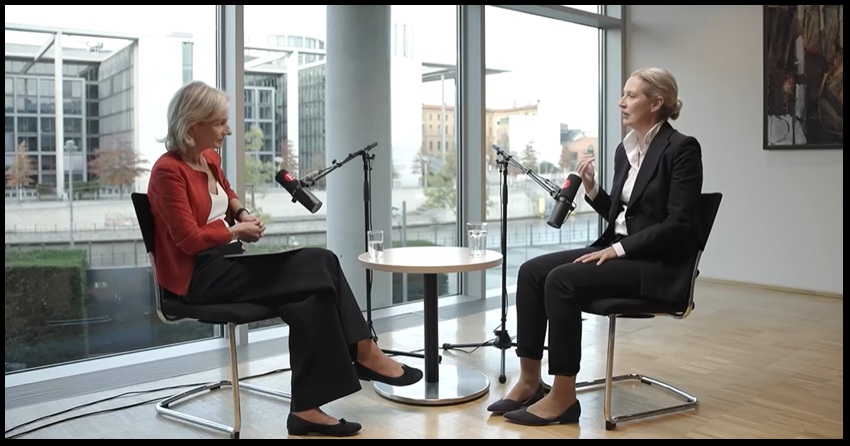
Germany has always represented the economic engine of the EU, and as a nation the primary prism by which the German people evaluate their status is through the prism of economics. From that perspective Germany is in severe trouble. AfD party leader Alice Weidel outlines the structural reforms needed in order to get out of this economic mess. WATCH:
“Alice Weidel is one of the most important politicians in Europe today. She is the co-leader of the Alternative for Germany (AfD), the right-wing populist party which is leading in Germany’s national polls and came top in two recent state elections. Ms Weidel is skilled at voicing Germans’ frustrations with mainstream political parties. In conversation with Zanny Minton Beddoes, The Economist’s editor-in-chief, in the Bundestag in Berlin, Ms Weidel discusses the AfD’s economic plan and its stance on Russia and Ukraine.”
Personally, I do not see a way that Germany can escape this spiral and simultaneously remain inside the European Union. The actions Germany needs to take, example ‘energy policy’, are not in alignment with the climate change interests of the EU bureaucracy.
Additionally, the migration and open border policy of the larger EU only makes the issues worse inside Germany as the migrant subsidies are at a scale that requires high taxes from the production class.
War will be the only solution out of the mess these people have created.
Not gonna be a fun winter for them.
I have no sympathy at all for these brats that thought they would yoke the American People and bark out orders at us while they ride along in the cart we’re pulling.
👍
Winter is coming.
In more ways than one…
Death by Ideology.
Gotta keep the Muslims they let in warm.
And fed and insured.
EU is globalist union of communism and Islam.
If France doesn’t sound the alarms…
Is Germany open to rethinking green policies?
The people may well be by now. But it won’t happen as as long as their current leaders continue to profit from Carney The European’s Great Green Grift.
Climate Change is not about Climate or Energy, really.
It is about Money and Greed, Political Control and Raw Power for Impoverishment and Tyranny.
All to make life Cold, Lonely, Poor, Sick, Enslaved, Hungry, Desperate, Nasty, Brutish and Short–the agenda of hell.
But even the Assassinations by Nazis Merz and Zelensky of AfD candidates and Charlie Kirk will not stop what is already coming: the Glory of the Lord, Hallelujah!
Habakkuk 2
And all will know it is by Your Hand, Father God, Amen!
Every time Germany is hurting for cash, it ends up in war.
As we can all see, the EU/NATO clowns, and their vassals, desperately want war with Russia.
And we can also all see, PDJT is bypassing them all, which gives them fits of rage.
Interesting times. Hopefully history does not repeat itself. The mere fact these idiots want to go all out, against a very large nuclear power, shows how extremely unstable these Eurocrats and their leftist bootlickers are.
Interesting, but also dangerous times for sure.
All of the EU are so screwed.
Play stupid games, win stupid prizes! Sad…
the goal of the those who cannot be named is to destroy western europe
and, in their eyes, decimation of their economic and demographic bases is proceeding swimmingly
they don’t believe the climate change hoax for a moment, it’s simply the excuse and hammer used to deny the energy sources required to sustain a thriving economy
when it comes to demographics, the melatonin deficienct are to be eradicated
all of it is happening right before our vary eyes, and quickly
remarkable
good luck
the war germany needs is against the e.u.it needs to be broken up and all countries go their separate ways and attempt to make themselves great again.
The solution is simple:
1) Leave the EU
2) Dump the Euro, bring back the Deutschmark
3) Deport the foreign invaders
4) Tell the Euroweenies in Brussels to pound sand
My suggestion is for Germany to get the hell out of the EU, then join forces with the USA and Russia. Yes, I said Russia where they can get all the cheap energy they will need to get their economy back in shape. Then the hard battle of deporting the Muslim trash back to the ME. If Germany can successfully do this, then you will see other EU countries do this as well.
Sundance is right, they cannot survive if they stay within the EU.
The EU cannot survive without Germany. Toss off the EU yoke.