Considering that European NATO partners are urgently trying to expand the Ukraine conflict and assemble a united NATO war effort against the Russian Federation, it is worth reviewing the current position of Russian President Vladimir Putin.
Vladimir Putin held a press conference on the sidelines of the SCO summit in Kyrgyzstan. A transcript is below:
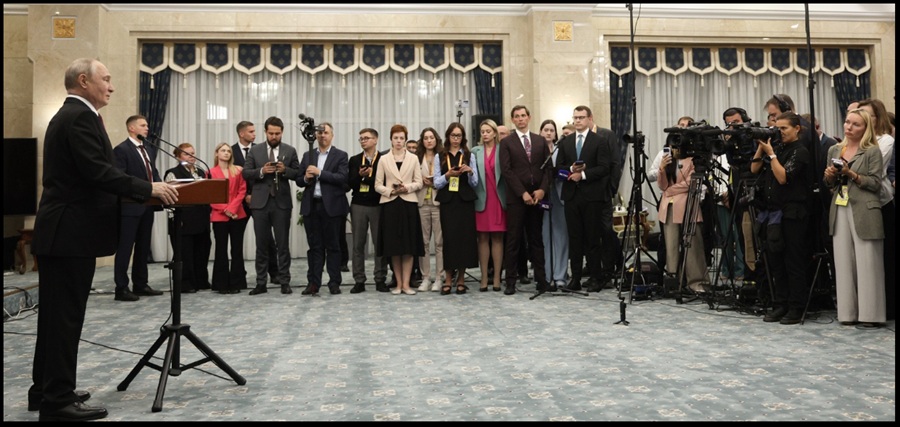
Olga Knyazeva: Today, very much attention is given to our contacts with the United States. The CIA director has reportedly visited [Moscow] to offer trilateral Russia-US-Ukraine talks.
Do you think we need any negotiation tracks now or possibly new intermediaries, including American ones?
Vladimir Putin: First, communication between our intelligence services is maintained at all times. You may have noticed that we have recently handed over to the American side an American citizen who was serving a prison term in Russia. We did that for health and humanitarian reasons. He is a simple guy, a drinker and a brawler with health problems, so we sent him home to get medical assistance.
It was my first point. Communication is and was always maintained, even in the most difficult periods of the Cold War, and even more so now. Direct contacts are also maintained between the senior officials of our intelligence services.
As for expanding the number of negotiators, we believe that negotiations, any kind of negotiations, should be primarily filled with concrete content. If anyone is making or can make a practical contribution to this process, we are all for it.
The only thing we would like to avoid is to carry on a senseless process. If anyone can make a positive contribution to this negotiating process, which has been frozen to some extent, as we see this, we would not be against this. But this requires the involvement of specialists, the military and diplomats, of course.
On the other hand, we are quite comfortable with working with those who we know well and generally trust. These people are close to President Trump. In my opinion, they are sincere people who try to add practical content to our efforts. And President [Trump] trusts them, which is very important and without which no negotiations are possible. The thing is that everything is pointless if these people coordinate some issues with us but their top leader reviews the arrangements they make and divides them by a thousand or more. As far as we can see, he trusts them. That is why Mr Kushner and Mr Witkoff are always welcome here, and we enjoy working with them.
Viktor Sineok: Russian troops are currently advancing towards Kramatorsk and Slavyansk, and strikes on Ukrainian military facilities are ongoing. Has the turning point in this conflict already been reached, and will the enemy, as the saying goes, begin to crumble? Or does that moment still lie ahead? And what is the present situation at the front, and how do you assess it?
Vladimir Putin: I have no doubt whatsoever that the enemy will, indeed, crumble. Matters of precise timing are always exceedingly complex, and these are precisely the questions to which it is best not to attempt definitive answers – neither in respect of timing nor of any other specifics. For war is an enterprise that is harsh and difficult to predict.
Nevertheless, questions of the sort you have just raised invariably arise at every meeting with media representatives. That is why, before entering this hall, I proceeded to my office upstairs and have just spoken directly with the Chief of the General Staff. I would note, however, that the information I receive is sourced from a wide array of channels, from virtually all command bodies of the special services and our agencies which, in one manner or another, are engaged in the special military operation. Accordingly, the picture – at least as it appears to me – is fairly objective. I have just received the latest reports from him [Valery Gerasimov] and from other colleagues.
I would like to add, of course, that hostilities always involve casualties, which is sad and it is always a tragedy and faces us with new challenges, especially at this time of rapid scientific and technological development.
The biggest challenge is posed by unmanned vehicles, which operate in all spheres – underwater, on sea, land and in the air. This is a serious challenge to us, but we are coping with it. I am confident that all tasks in this sphere will be fulfilled. I have no doubt whatsoever about this. I can conclude this from the speed our defence enterprises have accumulated.
But there is more to it. You know, I was pleased with my meetings with representatives of small and medium-sized businesses and our nascent engineering schools. The average age of their engineering professionals is 35 years. I have recently held such a meeting and I was really pleased and impressed by this fact. We may be lagging behind or moving ahead of the enemy in some spheres, but we will certainly overcome all challenges and fulfil all our tasks.
But the main thing I would like to say in reply to your question is this. Despite all challenges, Russian forces are accelerating their offensive in the zone of the special military operation. They are not simply advancing but accelerating their movement.
The liberation of the Donetsk People’s Republic is proceeding as planned. I would like to note that in August alone we assumed control over 270 square kilometres of the republic’s territory and 15 localities. Here are the details.
The units of the South Group of Forces are confidently, I repeat, confidently advancing, overcoming the defence lines and engineering fortifications of the enemy, advancing… (Addressing Viktor Sineok) You have said “charging ahead.” Well, they may not exactly be charging ahead, but they do move unhurriedly in a high drone threat environment, advancing towards the eastern suburbs of Slavyansk and Kramatorsk and the southern suburbs of Druzhkovka, which are between 1.5 and 4 kilometres away in different sections of the frontline. Moreover, they are approaching Druzhkovka from several directions, bypassing it in the south and approaching it from the east.
Troops from the Centre group are advancing on several key axes simultaneously and are now engaged in street-by-street fighting to take the city of Dobropolye. This is a major, heavily fortified logistics hub, with both permanent and semi-permanent defensive structures in place. I will not tempt fate by predicting the outcome, but I am confident the result will come.
Forces from the West group – I am not sure whether this has been reported in the media – have encircled a large enemy contingent on the eastern bank of the Krasnooskol Reservoir, near the village of Peski-Radkovskiye, and have begun to neutralise it. Thirteen Ukrainian armed forces battalions, totalling around 5,000 troops, are trapped in the pocket. This happened recently, and I do not know whether the Ministry of Defence has issued any statement or has been able to confirm it. The figure is probably somewhere around 4,500 to 4,800 troops – roughly that number. Moreover, this encirclement has been physically sealed. That is to say, not just under fire control, but physically complete – we have them fully surrounded and are now tightening the ring.
The offensive in the Zaporozhye Region is also proceeding actively. Units and formations of the Vostok and Dnepr groups are pushing forward on a broad front towards Zaporozhye. They liberated nine communities in August, and fighting is now underway in the central districts of Orekhov. The troops there are operating calmly, but with great confidence.
The North group of forces continues to establish a buffer zone along the Russian-Ukrainian border in the border areas of the Sumy Region (there are now only 12 kilometres left to Sumy itself, before the ring road) and also in the Kharkov Region. Over the past month, 14 communities have come under Russian control, including the liberation of Kazachya Lopan and, as of yesterday, the town of Svyatogorsk.
In the north-eastern part of the Kharkov Region, another enemy grouping of up to 2,000 troops has been completely encircled. The pocket formed there is substantial – 460 square kilometres – and encompasses 27 communities. Its elimination will allow the line of contact in this sector to be pushed back by at least 20 kilometres from the border areas of the Belgorod Region.
I would like to remind you that our actions were taken in response to the Kiev authorities’ provocation, namely their incursion into the Kursk Region.
We continue to target Ukrainian military facilities, industrial enterprises, and the port and logistics infrastructure that operate in the interests of the Ukrainian armed forces. As you know, we are doing this in response to the Ukrainian regime’s continued attacks on Russia’s civilian infrastructure and its fuel and energy complex, including oil refineries. I have been told that last night a large number of drones tried to get past the air defence systems of Moscow and St Petersburg, targeting civilian facilities, including oil refineries. They attempted to hit three oil refineries. Taking all this into account – the attacks on Russia and these facilities – the Russian Armed Forces were instructed to prepare and deliver mass strikes on Ukrainian energy facilities. They are targeting our facilities; we strike back. This is roughly the situation.
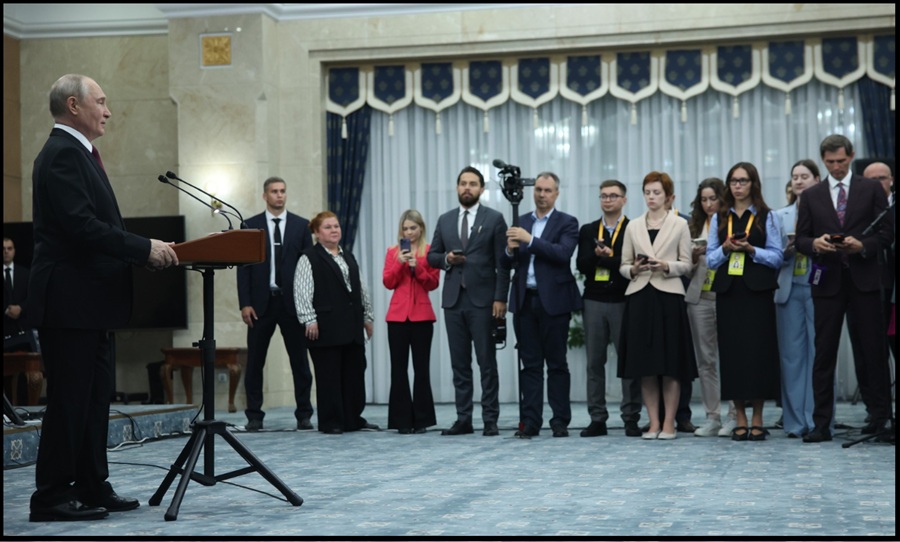
Alexander Yunashev: May I ask an additional question about drones?
Vladimir Putin: Yes, you may.
Alexander Yunashev: Good afternoon, Mr President.
The German authorities have stated that Russia is behind the drone incident in Leipzig, claiming that it was a Russian drone armed with explosives. However, this is a murky story. They have denounced the lease for the Russian House and want to shut down our consulate general in Berlin. At the same time, Zelensky openly threatened our air force several hours ago, saying that civilian aircraft have no place in the sky used by Ukrainian drones.
What can you say about this?
Vladimir Putin: Let’s start with the first part, about the actions of the German authorities. I believe that it mostly has to do with the internal political situation. The Chancellor’s political standing is complicated. He is not trusted by his citizens, and it is clear why – because he does not uphold but sells out national interests, and because of apparent economic missteps: enterprises are being shut down, people are losing their jobs, and living standards are plummeting. It is not clear why they did what they did. They have only one explanation: they need to stand up against “aggressive Russia.” You want proof? Here you are; they have planted it.
I would like to remind everyone that some time ago – several months or even a year ago – the German authorities accused Russia of blowing up the Nord Stream pipeline. I was really surprised that they came up with such a strange idea because we were interested in selling gas to Europe. We would be ready to provide gas today too. They only need to press the button, to make the decision to do it. But they don’t have the stomach for this, because of the US sanctions and everything else.
Good, but now they need to explain the reasons behind their actions. Considering the falling ratings and the upcoming elections, including in Saxony, this puts the political future of the German ruling circles in question. I believe that this is the explanation. I think that this is yet another blunder, and that it runs contrary to the interests of the German people.
What was the other part of your question, about a statement?
Alexander Yunashev: Zelensky has said that the skies are unsafe for civilian airlines. Is this a threat?
Vladimir Putin: I have not heard such statements, but if he did say this publicly, this sounds like a claim to state terrorism. I would like to note that they are asking us to resume talks and hold personal meetings. We don’t negotiate with terrorists. This is the first point.
Now, about the second part of your question. If, God forbid, such tragedies happen, we will provide a reply, let no one be in any doubt about this.
Gleb Ivanov: Mr President, you have recently signed an executive order authorising the Government to place critical infrastructure facilities under temporary administration if their security is not ensured. Could you elaborate on this executive order? First, in what cases do you intend to implement this, and second, could this lead to the nationalisation of these assets, turning them into state property?
Thank you.
Vladimir Putin: Of course not. What are you talking about? This is not a matter of nationalising anything – do not even think about it. There was never any such intention behind this move. Nationalisation is not an option. What compelled us to do this was quite straightforward. There is a saying, you know, that a man will not lock the barn door until after the horse is stolen. The adversary has started targeting civilian sites, including oil refineries. Did the adversary succeed in inflicting damage? It did. But why? Among other factors, and primarily because they were not protected. Unfortunately, our companies – I have had many face-to-face and collective meetings with them – these companies have been saying: “This is a matter for the law enforcement agencies, the army, etc. to handle.” But once we discussed this, they understood that they also had to be part of this effort.
Let me assure you… I said that there were attempts to target three oil refineries this night alone. These attempts failed. Why? Because these facilities were already protected. This does not mean that no strikes will ever get through. It might happen every now and then, but this elevates the protection to a whole new level. We have yet to complete repairs at just 10 percent of our oil refineries, so there is no way we can afford to have those of them that were repaired suffer from any strikes.
Therefore, we must all work together. This executive order is designed to achieve just that: to enable public administrations on the ground, including in municipalities, cities, regions and republics of the Russian Federation, as well as law enforcement agencies, and the Defence Ministry to work together to defend critical sites. This is all there is to it in terms of the purpose of this executive order. And it works, you know.
Of course, everything is possible, and there is always a possibility that something penetrates these defences somewhere, since the defences are not always effective. That said, this is the purpose of this executive order. And we can see that it works. (MORE)
[There is more about the current politics of Armenia]
I trust Putin more than any member of the Uniparty in the United States.
In the 2016 election, when there was a push to not have PDJT’s name on the NYS ballot, I was ready to write in Mr. Putin’s name. Several people, as well as myself, used to vote for the Libertarian candidate in Presidential elections (because of the electoral collage system) as a protest to the uniparty candidates often endorsed by the NYS Republicrap party.
I did exactly the same thing ! In NY, there was Zero chance of McScum or RINOmney carrying the state so I voted for Gary Johnson both times. As much as I had come to despise both of them, I’ll admit, if it had been close enough to matter, I probably would’ve held my vomit and voted for them. Just to keep 0Zero out.
It is remarkable that the Libertarian party cannot muster 50,000 in an election in this state (with it’s population) to keep an automatic line on the ballot. There are millions of otherwise rational, intelligent people that when it comes to politics, vote their party line.
I know people that are still registered (D), even though they have not voted for one in years.
Careful with throwing around names of that ilk. Any moment that association to you could be a liability?
There is a Conservative Party line in NYS. I have been a member since 1996. I am careful to avoid liabilities; however, sometimes having principals and taking a stand will have consequences. So be it.
He is ruthless and cunning and Russia first. And I fully agree with you and I ll add the EU, Australia and Canada to the untrustworthy.
China of course stands to reason.
He is ruthless and cunning and America first. That’s why I voted for him 3 times.
These two have some shared ground, which is always better than a chasm.
he -VVP- have to be ruthless to oligarchs …otherwise he would end same as we are now….not able even pass Save Act.
His explanation about why the Germans are trying to start a war was so refreshingly blunt and honest. I wish our politicians were not bought and paid for so they could speak this way.
impossible our pols can express facts honestly for they would have to admit they’re trying their damndest to off us and replace us with 3rd worlders, robots and ai
But even if they were not bought and paid for, so many of them are complete idiots. I can’t imagine the Russian Duma to have any morons like max waters, adam shift, talarico, newsome, piglosi for example
He is as blunt as he can be. I have a feeling he knows who owns most western politicians. And may know just how blood thirsty they are……
Of course he knows. The K G used ta B are professionals and just as good at digging up the dirt on the western politicians as our own agencies are. Only the western intelligence agencies are looking for control and not to protect their own people. Quite a shame.
IKR
Putin is a KGB thug, and an expert in disinformation and duplicity. He is NOT a “good guy” by any measure.
Other than being KGB thugs, many Uniparty tools would fit the same description.
I don’t trust Putin as far s I can throw him. I also don’t trust Uniparty RINOs like Thune.
I shudder a bit at those in these fora who seem to be on Putin’s “side” in this mess. I truly don’t get it. I’m not a Ukraine supporter….and I’m not a Putin supporter. Both sides are corrupt and untrustworthy actors.
While I mourn the huge loss of life in the Ukraine war, I DO NOT mourn the depletion of either side’s military resources or the economic stress being placed on both of them. I sincerely wish we would stop helping Ukraine.
That’s about where I am, but he’s more honest / open than anyone in the EU or American larger media.
Why would Putin be trustworthy after the US and NATO lied to his face about NATO expansion?
He isn’t now. He wasn’t prior.
..after what happen since G7 June 2025… VVP do not trust western politicians…..but he got iron nerves talk to some of them….
No one said he was honest or a great person, but people have to take a side even when it’s unpleasant sometimes. That’s what separates the kids from the adults.
Disagree.
I DO NOT have to “take a side” in every situation.
When Iran and Iraq were beating each other senseless a while ago, I just sat back and ate popcorn.
I’m close to the same attitude with Russia and Ukraine. Again — I deplore the huge loss of life…..but I choose neither side in this morass.
Welcome to Switzerland!
(Swiss cheese has holes in it)
So does Swiss logic…
I trust Putin to be a nationalist for himself and Russia period.
I hope we can say the same of our leaders some day. Put us first and let everyone else fend for themselves.
If we approach all international relationships that way, we’ll know where each party stands.
They’re trying to start ww3 and if they’re successful millions maybe billions will die. I’d make a deal with damn near anybody to avoid that. It’s geopolitics, feelings are stupid and unimportant in this context.
The difference is that John Thune wants the United States of America destroyed.
Vladimir Putin doesn’t.
Nonsense.
Putin would party big time if the US collapsed tomorrow.
r0ng.
0.o
Nonsense. He would rejoice if the US Deep State who invented this War collapsed.
Just like we will, praise God!
Psalm 9:16
The Lord is famous for the way he punishes the wicked in their own snares!
T y.
IMO Thune is currently a bigger threat to our country than Putin.
😈
Obstruct, obstruct, obstruct ….and then let’s all go home and take our twentieth vaycay of the year.
😎
Useless jackass.
🫏
Grasshopper ..would you celebrate end of current USCorp. and restoration Constitutional Republic if it happen tomorrow or you love present western uni-polar world ????
Thune wants power, regardless where it originates.
“ I sincerely wish we would stop helping Ukraine.”
I agree!
The Russians are depleting the United States as we have been and are actively involved in this war. In my opinion, Trump has zero respect for Putin. Trump is “escalating” in Ukraine to coerce Putin to bend the knee to Trump. We’ll see if it works.
I thought he was an attorney with the KGB?
Yes, President Putin worked as an attorney with the KGB.
0.o
Using your criteria wouldn’t George Bush be a even bigger thug? Seeing as he was the DCIA, not just some mid level employee…
Absolutely.. there is nothing about Europe that is trust worthy.. never has been
lol, me too.
Amen sister.
He has more credibility than most of the European leaders, but I wish someone would ask him about the rumors that Russia is helping Iran build hypersonic missiles (to use against US forces).
Don’t be so foolish. Putin is KGB and he’s extremely ruthless and dangerous.
Substitute Deep State for KGB.
You just described the Uniparty.
I wonder how many Russians would privately agree.
We do not live enmeshed in the Russian political environment with its diminished political opposition. For all the problems we have in our Potemkin republic I am doubtful that I would want to live in Russia.
I also trust him more than anyone in the EU.
First of all: he deeply loves his Motherland. Second: Like all Russians, he knows what War is, especially global war.
Europeans have forgotten all these things. Their “EU,” especially, doesn’t care about any(!) European nation.
They are all clamoring for “World War,” but have no concept of what that ACTUALLY means. They also vastly overestimate their ability to fight any sustained conflict. As I said, they don’t remember. Anything.
Putin is the only grown-up in that room.
It bears repeating what History teaches us about Europe. “War” is their default state of affairs. Not thirty years after “the War To End All Wars” (WW1), they were all right back at it again (WW2). They’re hungry for Chapter Three. Eighty-odd years of peace is much too long …
Amen, sister! 👍
Yes, Putin is a good guy…
if the USA and Russia were allied, we could easly survive the globalist’s agenda…
Z…. and his dear friends (include BB..?) do not like idea US & RUSSIA to be friends………
I really don’t give a damn about what z likes or dislikes…
Re “BB”: Be more specific…Don’t know to whom you are referring… Perhaps: Bill Barnes? BB King? Brigitte Bardot? Bertolt Brecht?, Ben Bernanke?
you are not only one….and goes almost from the top to bottom of rinos party…
Well at least he loves his own country and its people. If only most politicians in the rest of Christendom were the same.
Putin would have never survived the KGB and Russian politics if he wasn’t just as shrewd as he was tough. I have a feeling he doesn’t bluff.
President Putin and President Trump tell it “straight up”, “the way it is”, honestly. Everybody else acts bewildered and befuddled and stammer on about what in the world is gong on. It’s simple. Listen to these two men. Straight Up. That’s it.
Putin is self-assured enough to forthrightly acknowledge some military shortcomings (damage to refineries, risk of drone attacks, battlefield casualties etc.) He does not reflexively deny, cover-up behind preposterous lies, invent lame excuses or attempt to push blame onto somebody else like his western counterparts always do.
156 upvotes? Really?
Same here, i don’t trust the uniparty.
“it is worth reviewing the current position of Russian President Vladimir Putin.”
As well as believe what he has to say, instead of the lying MSM pressitutes controlled by their deep state masters.
Sadly, I listened to the EU-NATO drool where it sounds like they almost believe their own BS. Everything about them is nothing short of pathetic.
Yah. I’m listening to their soft shoe shuffle about how intelligent they think they are while reading the comments here. And holy mackerel fish – there are bones it seems between me teeth I feel need to be removed.
I trust Putin and Trump. They both have undeniable INTEGRITY.
This article contains a good review of how we got here.
https://www.armstrongeconomics.com/international-news/ukraine/zelensky-is-determined-to-create-world-war-iii-threatens-commercial-airlines/
Thanks. I used to be on his mailing list. IDK what happened. I stopped receiving them and cannot get them restarted when signing up again, like I am blacklisted or something. So now I read when I come across them on Lew Rockwell or Global Research.
It might be your email provider. “Protecting” you.
I have a Verizon email address, Spectrum is my ISP & mobile carrier. Every other politically incorrect thing I get comes through, only once in a while does something wind up in the Mozilla Thunderbird SP*M folder. I click “not sp*m” to send it to the “Inbox”.
I have subscribed to his public and private mailing list for about 20 years. I never get all the daily blogs. I have to go directly to the site to see what’s missing. You aren’t blacklisted bu AE. It’s your and my provider. Try another email address.
Thanks
Deplorable, click on the site that Toolnut gave us and then add to bookmarks. You can visit any time then.
Oh, that has been bookmarked!
You gotta love Vladimir…
“we have recently handed over to the American side an American citizen who was serving a prison term in Russia. We did that for health and humanitarian reasons. He is a simple guy, a drinker and a brawler with health problems, so we sent him home to get medical assistance.”
Not really………..
Without even researching other sources, I am certain this press conference will not be published elsewhere, so I thank you.
President Putin refutes “nationalization”, disparagingly and dismissively.
I think it is telling that at the same time, the newly installed Burnham in Britain (I am deliberately removing “Great”) announced yesterday at his first appearance at Parliament’s Dispatch Box that he intends to undo one of Margaret Thatcher’s greatest legacies, and will ” re-nationalize” their infrastructure as he attempts to draw Britain nearer to rejoining the collapsing EU.
Every word of this interesting press conference no doubt was deliberately and purposefully chosen.
Excellent.
(Take that, Merz.)
it has fully become Less Britain. I fully expect the Muslims to shove the royal family out within the next five years.
There was a rather bawdy comedy show in Britain years ago (okay…a lot bawdy) called “Little Britain”. British humour can be that and some of it we found Britishly amusing…
Less….Little…tragically no longer Great.
https://www.ctvnews.ca/business/article/dutch-bank-shifts-86-tonnes-of-gold-from-us-canada-to-uk/
Oh yes…I saw that, CT.
Someone is getting nervous.
Lemmings they be,
one and all rushing headlong into their destruction
GB, the commonwealths and the PU.
The very cradle of modern western civilization is returning to the Dark Ages.
Victor Davis Hanson summed it up well I think, monti…he would agree with you.
“The West has mastered the technology of civilization but embraced the politics of barbarism, creating a modern medieval world where progress and regression coexist.
A horrifying hybrid.
I am still having difficulty processing how far it has fallen and so fast.
Yes, I know what you mean Betsy. It seems to have gotten much faster now.
Maybe our President is pushing the cancer to the surface and it’s much worse than last time.
Evil has seen its moment, sis, and , not standing on ceremony, is taking it.
Different heads of state do not appear to be operating in the best interests of their nations. Some have intentionally disconnected their country’s economy from sources of energy (Germany). Others have facilitated mass immigration into their borders (Germany, Spain, U.K., etc.) and have intentionally overwhelmed individual towns (Piddignton, U.K. and Cueta, Spain). While some countries punish their citizens for incorrect thoughts or flying their country’s national flag (U.K.).
Putin has been quite lucid and direct in his public comments for decades. He is operating in the interests of his country. Despite his KGB background, he appears to be more of a businessman these days. I suspect that he draws the correct link between a country’s strong economic health and the ability of its population to prosper and grow. The 1990s were an incredibly chaotic and dangerous time in Russia. Boris Yeltsin at the helm / bottle did not inspire confidence that the country would survive intact. This experience has undoubtedly influenced President Putin. Ironic that Russia has elections while Ukraine does not.
Your first sentence says it all, Bat.
President Putin has a keen advantage over “leaders” (as you describe them) of Russia’s enemies. In that he loves and treasures his country, its history, and her people, where they do not. There is no way one can say that they do.
I watched a short video yesterday, taken by some Russians watching Putin’s motorcade traveling fast and advancing up a wide street on Moscow.
And then suddenly, as if heading for a NASCAR pit stop, his car broke ranks and came to a quick stop, doors opening, security jumping out, followed by a casually dressed Putin himself. He approached the crowd and immersed himself amongst them, shaking hands, smiling, chatting.
Eventually whoever was filming swung his phone around to get a better view, showing the ones standing with him. They were all young, in their 20s or 30s I’d guess. And they were all exuberant. That struck forcefully with me.
Fancy Burnham, Macron, Merz, von der Leyen, Sanchez…any of them…doing the same.
They daren’t.
And to my eye that is one of the most telling differences.
Russia is not the USSR, something that somehow European potentates cannot or deliberately will not acknowledge. An historical fact which cripples those “leaders” who are gagging for WWIII and the opportunity to conscript their own men (whom they despise) for cannon fodder.
How the putative “cannon fodder” who know what their governments think of them would react remains to be seen…
I say advantage Putin.
Betsy: The list of appointees you cited above were not elected by their nations’ citizenry. Von der Leyen was tabulated via secret ballot. Quelle catastrophe.
Where can I find video of that quick pit stop of the motorcade?
It was a TikTok video posted by someone in a comment elsewhere. I’ll leave a link and hope it works.
Also on Youtube, though the filming was after he stopped. It has been posted also on FB, so if you are on it, you will find there also. Different angles on each of them.
Thank you, Ad rem 😘
I’ve just posted two links, but my comment has gone to moderation. I think it’s because of the TikTok link, so I will repost the less exciting YouTube one for you. Check FB also where it has been posted if you would like to use your search engine to hunt for it.
Also, all but von der Leyen are elected leaders in the UK, France, Germany, and Spain.
They are all subservient to the vdL and the EU hierarchy. But you are correct about her election…not elected by the European hoi polloi.
Thank you Betsy.
Macron did in fact run for national election, allowing registered voters across France direct choice. I stand corrected on that.
The other fellows (Sanchez, Merz, and Burnham) were not elected by the populace as a whole. My understanding is that each were elected in their individual districts, similar to a Debbie Wasserman or Chip Roy representative winning re-election in the House. Once their minority party formed a coalition with other parties, one of them was selected to be the Prime Minister or Chancellor. The CDU won 28.5% of seats in the Bundestag in 2025 (leading to the Merz selection) and the PSOE won 31% in 2023 (leading to the Sanchez selection).
The process of PM selection in the U.K. is a bit more confusing to me. But there was never a national election where Burnham campaigned across the country to be PM.
🤨
It looks as if Marine Le Pen is well in the lead for next year’s presidential elections in France, even though (or maybe in part because) the courts there have told her she can run, just not campaign in public. We will see if the French voters have found their “Resistance” souls.
Or if the election is free, fair, and untampered with.
Thank you Betsy. “Fancy Burnham, Macron, Merz, von der Leyen, Sanchez…any of them…doing the same.
They daren’t.” I would like to bear witness if that ever happened, if they dared.
You might have to beat your way through the crowds who, as the Brits say, want “their guts for garters” 😎
Is his first name really “Fancy”? Who would name their child that?
🙃
Putin calling out the false flag behind the drone incident in Leipzig, Germany…
Everything here is perfectly true:
“Let’s start with the first part, about the actions of the German authorities. I believe that it mostly has to do with the internal political situation. The Chancellor’s political standing is complicated. He is not trusted by his citizens, and it is clear why – because he does not uphold but sells out national interests, and because of apparent economic missteps: enterprises are being shut down, people are losing their jobs, and living standards are plummeting. It is not clear why they did what they did. They have only one explanation: they need to stand up against “aggressive Russia.” You want proof? Here you are; they have planted it.“
Logic tells us Putin is correct about the manufacture of this drone event as a means to gin up EU anti Russia frenzy.
I sure hope the US knows better….and will call out this “false flag” officially with intelligence.
Putin could probably wipe out that whole airport and Germany couldn’t stop it (but the US in Germany/nato could). Straight logic that crossing that particular red line would only be done for something extremely important, not some crappy German airport. How many has it been now? Underwater piepeline, fake attack on the Polish airport, fake bombing in Monaco, fake airspace intrusions, it’s endless. I can’t believe there’s still people blind to it.
*fake meaning it happened but it was done by Ukraine et al.
NATO ceases to exist without US participation.
PDJT has no intention of allowing the US to participate in this EU Wet Dream Adventure.
The Eurolosers can shoot spitballs at Moscow alone.
NATO is important to stop Europe from starting a war. People have misunderstood this fact for 70 years.
They do have a habit of killing each other and dragging the rest of the world into their fights.
France, Germany and England. The bane of the modern world, they have brought us two world wars and now the fools are trying again.
NATO was meant as a deterrent to the USSR. It no longer exists.
NATO is now a hammer looking for a nail.
The Europeans are bankrupt, have stolen the Russians Sovereign Wealth Fund, have no real off ramp for their disastrous green new deal and are awash with the barbarians living off their social welfare programs awaiting their final collapse in order to establish the Caliphate.
They are willing to kill the youth of their nations in order to steal Russian land.
NATO is now a European Suicide Pact and we need to bring our troops and assets home.
https://x.com/SecGenNATO/status/2094818411066904731
I don’t like Putin, but I respect him.
We don’t have to “like” Putin. “Liking” someone is an emotion and emotions are irrelevant in geopolitics.
I trust President Trump, and I trust the working relationship that he has built with Putin. I think that relationship will prevent WW3.
Putin simply seems much easier to work with than anyone in the EU, as his motivations are straightforward. Two men who both want their respective nations to thrive can come to an agreement that satisfies both. Trying to deal with fools who only desire the enslavement, robbery, rape, and destruction of their own people is impossible.
Agree. This country wasn’t built on somebody’s feelings.
Thank God.
Our society has run amok caring about people’s feelings more than they care about the Constitution of the United States.
We used to be drinking buddies. He tells great jokes. But he’s kind of impatient. He was always russian me to finish my beer.
Obviously, an adult entered the room.
So is the threat to Russian civilian aircraft a new “terror premium” now that they lost that income from the Strait? Who will be dining the insuring?
It seems to me they are out of money. Everything they do seems just another fraud to bring in billions ASAP.
Creating a crisis to require nationalization of infrastructure could also fit the pattern of needing fast cash as well.
“doing” the insuring
Maybe ask who bought a lot of insurance stock shortly before the announcement?
Thank You Sundance.. it’s nice getting news worthy opinions from the other side of the EU
I have great respect for President Putin, as well as respect for the relationship that President Trump and President Putin have. President Trump is America first. President Putin is Russia first. They understand each other, and each other’s motives. A good thing.
The White House invited Russia to send a delegation to this year’s G20 summit (the EU nations are not happy with this):
https://newrepublic.com/post/214936/russia-joins-g20-summit-trump-invite-backlash
The Russian press certainly act more like grown ups than their American counterparts.
Press “freedom” might act different for the Russians.
Civilized behaviour should be expected under any form of government.
Ever been to Russia??? The Russian people have more freedom than we have here in the USA…
I bet they don’t/wouldn’t tolerate antifa, etc.
Do they have a high Mooslim population?
Been there several times over the years,
Yes the Russian people enjoy REAL freedom like we had in the 40’s and 50’s…
Freedom has NOTHING to do with tolerating antifa… That is simply a failure of law enforcement…
Yes, Russia estimates that about 15% (which would be about 20 million) of their population is muslim…
The Russian muslims live primarily in the provinces of Dagestan, Chechnya, Ingushetia, Tatarstan and Bashkortostan, where the majority is about 90% muslim… (Going from memory, may have misspelled some of these provinces)…
The aforementioned provinces have been part of Russia for hundreds of years, , consider themselves Russians, have not attempted to take over Mother Russia like they have in the EU and here in the USA…
For one thing they got independed foreign policy and they build -MULTIPOLAR WORLD…..
With the exception of the current administration’s cabinet…I’m trying to imagine any of the US presidential candidates or proposed candidates, in the place of Putin. His best answer, and off the cuff, not political, was to the question of securing “critical infrastructure”. So good! It actually IS the responsibility of private business, critical or not, to be responsible for their own security. The answer would never be to hand it over to the government’s care. “What are you talking about?”!
COULD THIS BE RELATED?
Dutch bank shifts 86 tonnes of gold from U.S., Canada to U.K.
— The Dutch central bank said Wednesday it had moved 86 tonnes of its gold reserves out of the United States and Canada to London, citing “increasing geopolitical unrest.” —
The DNB bank said gold reserves held in London could be traded more easily than those held in New York and Ottawa.
“This makes it the quickest for DNB to deploy in a crisis situation,” said the bank in a statement.
“With this step, we have improved the deployability of the gold reserves. We assume that we will never need to deploy the gold, but it is nevertheless necessary to strengthen our resilience and preparedness,” said DNB President Olaf Sleijpen.
https://www.ctvnews.ca/business/article/dutch-bank-shifts-86-tonnes-of-gold-from-us-canada-to-uk/
This further fuels my suspicions that the globalists are out of cash.
I suspect they blew through the confiscated Russian fund, thinking they could write it off in peace negotiations.
Them saying that civilian airliners are fair game is so far out there, that I’m wondering if it’s their new “terror premium” (due to loss of that money in the straight).
They are now saying they need to nationalize infrastructure (because they claim Russia is blowing up stuff that the EU is probably blowing up themselves). Again fast cash.
Now they transfer this gold.
I think they are out of money.
Pretty sure you and me used to pay for all that.
Yes.
0.o
The “Art of the deal” is a real butt kicker Lol
Zimbabwe printed quite a few $100 Trillion notes that have never seen circulation. I gave one to a sibling once as a gift. That was the most money that I have ever spent on a relative. Perhaps those $100T notes can be used now. The picture on one side of the note is a pile of rocks (I suspect that it may be dried elephant dung, representing the government at the time).
That seems to be very stupid.
And exactly how does one “deploy gold” — and if it is sitting in a NY or Ottawa bank or a London bank, how does this affect “deployment”?
Right? What does this even mean?
There is that word again, “geopolitical unrest”.
I don’t what deploying 86 tonnes of US Canada gold to London even means, but it smacks of utter desperation. Is their stock market about to collapse? Why would they need to do this?
The move, completed between March and August 2026, involved 86,000 kilograms of gold — roughly a quarter of the Dutch central bank’s North American holdings with 59 tonnes sold in New York and bought back in London, avoiding the need to melt down bars and reducing quality risks and 27 tonnes physically shipped from the US and Canada to DNB’s vault in Zeist, Utrecht, and then moved on to London.
The estimated value of 86 tonnes of gold is approximately $19.0 billion USD or €16.7 billion EUR, based on current market prices.
The gold may have been moved in an effort to help avoid a hard banking collapse.
0.o
Interesting. Thank you.
Imagine this while the music of the ” Twilight Zone” playing in the background – the Dutch Central Bank move their physical gold from the U.S. to London. I don’t know the facts of the matter, but am wondering if that is where the stolen Russian wealth was sent also?
The speed at which it can be transferred and used. What good does it do you to have a cow in another state if you need milk today? They’ve also seen how Bessent can shut down financial tools. They see the Canadian trade war and how the U.S. is in control. Probably was smart to get their physical gold closer to home, especially if the EU declares war on Russia and we don’t play along.
Might be they need to be able move it quickly, and given the possibility that Russia might sue the EU and it’s member states for the theft of it’s money, keep it from being frozen here in the US in a lawsuit.
Actually, it makes sense if you consider the reason for having the gold in Canada is to cover purchase credits, and they dont expect to be making any purchases from canada in the future.
The Dutch move will boost reported US exports and therefore boost GDP next reporting period.
Whenever gold is relocated from storage in the USA to storage someplace else it is counted as an export in economic statistics (even though it was only being held here, but owned elsewhere.)
One of the reasons Biden’s GDP was reported as higher than it otherwise should have been was because countries were pulling their gold out of the US. One of the reasons Trump46’s GDP was reported as lower than it should have been in his first few quarters was because countries were once again returning gold to the US for safekeeping.
Economic stats are squirrelly things.
If this war does escalate into the next big one I hope historians properly record the expansion of NATO and the Obama administration pulling of a color revolution in Ukraine. But I digress.
I can see the US Congress/Senate and many RINOs in the Executive and DC Bureaucracy swamp successfully pushing us into a NATO war…They will time it after the midterms and wait out boots on the ground until our Lion President is out of office…There is Power and Trillions at stake…
I sincerely hope that Ratcliffe the other day gave Putin both the intelligence and a nod/wink to bomb the shit out of Ukraine and Rapidly, bring them to heel – before the EuroWeenies can even react.
Furthermore, I sincerely hope Trump will call Rutte and tell him if he and the rest of the “coalition of the willing 🙄” think they’re going to pull the US into an Article 5 situation over this fake, phony, False-Flag German Airport drone strike, they’d better Forget It. Moreover, if they even try it, he will use it as a justification to lobby CONgress for a full withdrawal from NATO.
Putin doesn’t need our permission …
But he could definitely use the intelligence……
Sundance, thanks very much for the translated transcript you provided of President Putin’s media Q&A assembly. It is always much appreciated.
Also, do the Russian people have a similar person or persons on their end who do the same when President Trump has to entertain the MSM zoology department?
He’s got Herr Merz dead to rights. Putin definitely see’s this ridiculous claim about the drone at the airport for what it is. Maybe Putin reads CTH! 😉😎
If the Russians were behind the “attack” in Leipzig, then where are the Russian drone operators? Naturally, the efficient German security services must have either arrested them, or killed them in a dramatic gun battle, eh? Where are the POWs, where are the bodies? There are none!
Putin strikes me as being someone much like DJT, a man who says what he means and means what he says. I agree with him that the same worms in Brussels, who fabricated the Nordstream story for domestic political consumption have also fabricated the drone story in order to justify the war with Russia, which they have been overtly seeking. They need to divert attention from their own political shortcomings (in terms of the harsh realities now faced by their subjects) and, they are in no position to reimburse Russia for the funds which were stolen and donated to the Ukraine war machine. Even if they are 100% telling the truth, which I doubt, why would you send your youth to die in a war that can not possibly be won, over such flimsy evidence, when no one was hurt in Leipzig and no equipment was damaged? This is insane!
In time, we will no doubt find that this is yet another false flag operation, which was falsely attributed to Russia. If Russia wanted to blow up Ukrainian aircraft, they are perfectly capable of plucking them out of the sky, or destroying them on Ukraine tarmac and they have no need, whatsoever, to do it in a “neutral,” hostile country.
In retrospect, pushing the EU to live up to their NATO commitments was probably a mistake. Perhaps, just perhaps, they would be making more sensible decisions now, if they were effectively militarily toothless.
A significant statement by Putin.
“The biggest challenge is posed by unmanned vehicles, which operate in all spheres – underwater, on sea, land and in the air. This is a serious challenge to us, but we are coping with it. ”
Underwater drones…….now what would possible targets for underwater drones be? pipelines like the German one?
Shanghai Cooperation Organization. Very interesting stuff. 25th annual summit, and I never heard of it before. If western media had real news organizations, we would all know more about them. Instead, we get Von Der Leyen and Rutte’s latest theatre.
Q: What’s wrong with that photo (you might ask)?
A: The press is respectfuling listening without pushing & yelling over the next person.
Many don’t like Putin. Understandable, but there are things about him to like, and one is the September 11th “Tear Drop Memorial” Putin/Russia gifted to USA. Google a photo. It’s stunning. Here’s a description. Make sure you read to the end where the town of Bayonne removed his name. Shameful.
Some Amazing Facts’s Post
After the September 11 attacks, Russia gifted the United States a 100-foot bronze monument called “To the Struggle Against World Terrorism” — better known as the Tear Drop Memorial.
Built in St. Petersburg and shipped to Bayonne, New Jersey, the sculpture features a 4-ton stainless steel teardrop suspended inside a jagged crack — its metals sourced from a secret Russian military aircraft factory.
The jagged opening was deliberately positioned so that, standing in the right spot, you can see exactly where the Twin Towers once stood across the water.
At its base, granite plaques bear the names of every victim from both the 9/11 attacks and the 1993 World Trade Center bombing.
Jersey City was offered the monument first. They rejected it. Bayonne said yes — and became home to one of the most powerful 9/11 tributes on earth.
Vladimir Putin attended the 2005 groundbreaking. His name was on the dedication plaque for 17 years — until Russia invaded Ukraine in 2022, and Bayonne quietly covered it up. The monument stayed. His name didn’t.
Democrat Mayor Jimmy Davis pushed the effort to remove President Putin’s name from the monument and with some public works clown, had tape placed over the name right after the SMO started in 2022.
Now, there is an acrylic board covering up the name.
While Davis was mayor there had been a plan to somehow permanently remove it.
Davis quit as mayor at the first of this year after he won an election for Hudson County, NJ sheriff.
<edit spelling error>
The new mayor by all indications is also Democrat.
So far she has not made a public comment as to whether or not President Putin’s name will be permanently removed from the monument.
0.o
Shameful.
Now that the wheels are starting to fall off the Gravy Train fondly known as The Ukraine, perhaps the end is finally in sight?
Looky here what happened in Estonia today:
The Defense Minister resigned over a $70,000,000 (euros) scandal.
Apparently, back in 2024 Estonia contracted with some phony baloney Indian company that had zero experience in selling artillery shells to supply artillery shells to the Ukraine and needless to say, the few shells that were delivered were deemed inadequate or incomplete.
The Kyiv Independent news agency published the story, so there’s probably more to it.
https://kyivindependent.com/estonias-defense-minister-resigns-after-wasting-70-million-euros-on-faulty-ammunition-for-ukraine/
0.o
Imagine what would happen to any private citizen if he had “lost” US $81,000,000.00 of taxpayer money…
You would be hunted to the ends of the earth, and rot in jail forever.
SUNDANCE and TEAM – Thank You So Much for this.
I watched the entire presser. PUTIN is outright impressive in more ways than one.
He answers in logical, at times quasi-detail, replies and that, without any papers in front of him.
I respect only two world leaders: Trump and Putin.
That reporter appears to be young enough to be conscripted into a future war, given that Ukraine has raised draft age eligibility to 60.
That appears to have been a civilized encounter,
Grown ups asking questions and getting straight answers. Also the questioners names were shown,
Just like the good old days.
As long as rino’s are embedded in the Republican party we won’t have a two party system. They need to be gone……else it’s a fools system.
And there it is as plain as day, when asked about the drone attack on the Leipzig-Halle airport, President Putin said, “…I believe that it mostly has to do with the internal political situation. The Chancellor’s political standing is complicated. He is not trusted by his citizens, and it is clear why – because he does not uphold but sells out national interests, and because of apparent economic missteps: enterprises are being shut down, people are losing their jobs, and living standards are plummeting. It is not clear why they did what they did. They have only one explanation: they need to stand up against “aggressive Russia.” You want proof? Here you are; they have planted it…”
Those in control of the EU/UK have been so destructive to their own countries that the native population is furious. They have had multiculturalism shoved down their throats for decades while the government keeps on going with more and more immigration. Meanwhile the countries are failing economically, why? because the leaders do not really care if they fail or not. Those nominally representing the EU countries take orders, they don’t create the policies, policies are decided by the people at the very top.
The people living in these countries know far less about who is responsible for their plight than we do here in America. The only people they know to get angry with are their chancellors, premiers, or Prime ministers. But these people can’t change the policies even if they would want to. The recent immigrants are happy, because they are safe from the taliban or other terrorism, every one else is not so much.
The war in Ukraine is being waged by people who do not care how many dead men are created. This is their supreme monument: dead men, women without husbands, parents without sons, destroyed towns or villages, destroyed buildings. It has been so since the Middle Ages first with Venice, then with the Dutch East India company, then the Anglo-Dutch empire and finally the British Empire. It’s a long history of destruction all so that the wealthiest people in the world may get wealthier.
That is the work of Satan and always has been. We can watch the innocent people being plowed under for the sake of the wealthiest of the wealthiest. These are those who want to see more aggression towards Russia, when we all know this is but the latest false flag event.
Maybe someday Europeans will rise up against those who may at a future date want them all to enlist until there is no one left. Right now Europeans do not show any sign of active rebellion. Very few have even a memory of a time past when people were willing to give their lives for liberty, and freedom, as opposed to giving their lives so that an anonymous rich person could get even richer.