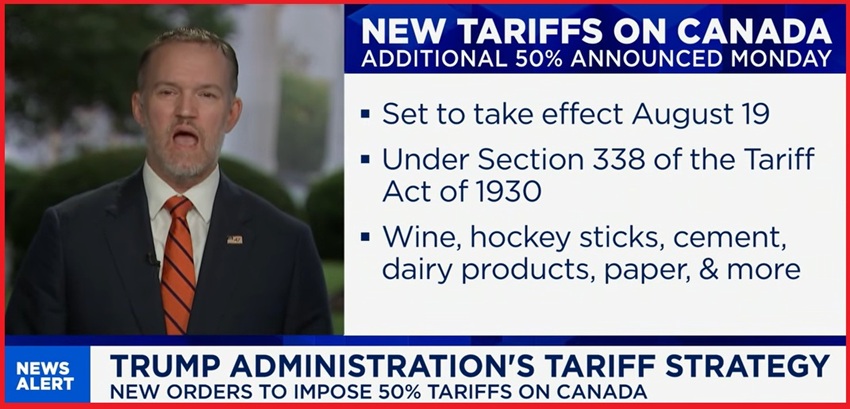
In the first half of this CNBC interview with U.S. Trade Representative (USTR) Jamieson Greer, the Ambassador walks through the reasoning, purpose and intent of the recently announced 50% tariff rate against Canadian imported goods.
As noted by USTR Greer the Canadians are applying two separate metrics within their trade agreement with Europe and the USA. Toward Europe there are no limits and quotas on dairy products, toward the USA there are severe limits and quotas applied by third party brokers (co-ops owned by Canadian dairy farms) leveraged by the Canadian government. This is one example of Canadian duplicity.
Additionally, by the various provincial governments of Canada banning the import and/or sale of U.S. products, and with Canada putting caps and limits on automobiles, these USA trade actions are being confronted by the 50% countervailing duties against Canadian imports. Greer also calls ‘bulls**t’ on Carney’s double speak. WATCH:
The trade discussion with Canada returns at the 10:00 minute mark. Jamieson Greer notes we have always had trade issues with Canada for decades. There was a significant percentage of the population who are against offshoring jobs, which is what NAFTA essentially did in North America.
It is also worth emphasizing that President Trump wants Canada to diversify. Both U.S. Ambassador Pete Hoekstra and President Trump have said, repeatedly, President Trump wants Canada to go make other bilateral deals with other nations.
Why? Two main reasons.

#1) If Canada has to enter a bilateral trade agreement with another country, suddenly they learn what reciprocity means. They have to give something in order to get trade benefit. This is a completely new concept for Canada who have taken advantage of the USA for a long time with ZERO reciprocity in mind.
This is what former Prime Minister Justin Trudeau was talking to Trump about in Mar-a-Lago (December ’24). In essence, Donald Trump wants Canada to go and try to cut more favorable trade deals, so they will learn how good they had it.
#2) If Canada cuts a trade agreement with, say, Europe, the terms of that FTA purchase in/out then become a standard in their trade allowances.
This permits team USA to turn to Canada and say, “wait, we want the same terms”. We might even ask for most favored nation terms due to scale and scope.
Canada is not prepared for this type of bilateral relationship at all. The CUSMA trade negotiator Dominic LeBlanc just discovered the problem following the current Canadian effort to diversify FTAs. Suddenly, LeBlanc has admitted quietly they have no response.
For around 40+ years (USTR Greer would argue 60+ years) Canada has benefitted from the U.S. economy purchasing their goods, allowing their businesses unlimited access to the U.S. market and yet simultaneously restricting the Canadian market from similar reciprocity. Those terms are no longer acceptable.
“Greer also calls ‘bulls**t’ on Carney’s double speak.”
YES !!!
It is about time we have a President & his administration willing to set the record straight, instead of acquiescing to “playing the game”.
In personal relationships, in business, and now, in trade talks…
The saavy and excellent successor to Robert Lighthizer, Ambassador Greer, and his boss understand this.
Carney and his negotiating team will understand it, too.
Eventually.
No more “giving” to the recalcitrant “takers”.
💯🎯 Betsy!
Learned this important lesson with some family and friends…tough love , boundaries…then peace
🤗
We teach people how to treat us, sis
School’s in session for Carney & Co, and Headmaster Greer will be taking this class.
School of hard knocks, good for the hard headed carney…let’s see if he makes it to first grade 🤣
A ready supply of dunce caps in the supply closet.
Carney at the chalkboard:
And Brother Bessent is monitoring the session.
The Dynamic Duo.
Something tells me the Canadian negotiators have no idea what’s coming.
This is the CTV political analyst. At the end of a relatively short clip, he mentions going to the Supreme Court to decide if these tariffs are illegal.
https://www.ctvnews.ca/video/2026/07/21/crazed-orange-menace-reid-reacts-to-trumps-newly-proposed-tariffs/
100% Betsy. Boo Hoo Snow Mexicans. They’ve have a spanking coming for 30 or 40 yrs.
I can’t tell you how bad I feel for our Canadian brothers and sisters, dear sir. They can see what’s coming. As for their fellow brethren who cannot?
Hoping something breaks their delusions. As in Britain, they have been ill served by successive PMs who care nothing about them.
Don’t know how you do it, Betsy, but…Kudos!
I should add that this applies in politics and governance as well, Sturmudgeon.
Unfortunately it is a lesson the Republicans are either too thick to learn; or they know it, and it suits their purposes to ignore.
(We know which one the Democrats are.)
SPECTACULAR, and most timely post, Miss B! Your pictures speak 10,000 words….
Disregarding the Canadian fat slob with no table manners or decorum in a professional setting, he still stands as the Poster Child for the clueless formerly-proud Canadian populace at-large that was born in a bountiful country and has NO IDEA of the charge of Civic Responsibility and Stewardship. I TRULY LAMENT the passage of the Canada I knew as a child and pray that their fate will not be too unbearable! 🙁
I always considered Canadians to be sensible people, MHB. They were once. But then the whole world was deliberately turned inside out.
There is a saying I picked up in Britain when one is sizing up another person as trustworthy or not.
“I like his face.”
I know the first time I heard it exactly what was meant.
And so, I say of Ambassador Greer, I really like his face.
Steely eye contact, a quiet reserve, a listening demeanor, a brain you can see working. In short a poker face which will serve America well in the negotiations.
Advantage Greer.
Well played, Milady! I truly miss the Canada I knew and loved. As for our young Tradester (as well as our present Ambassador), in nautical terms…. “I like the cut of his jib!!!” 🙂
I understand your “Hiraeth”, my friend. That longing, an ache, for times past, perhaps a home, which exist no longer. There is no commensurate word in English. These days something we must all feel for what was but is gone.
Yes, Ambassador Greer is, for the brief assigned to him, truly the designated Master and Commander of the USS America.
You ROCK, Girlfriend. Keep On Truckin’!!! 🙂
I do not like Carney’s face.
Nor I, Lindy, amongst many others.
Ms. Betsy love your sign! Dealing with some takers as we type. Good grief, giving a mile and they still have the hands out. Going to buy some fishing poles here and teach, ahh you know the end. 🙏🏽😎
I do know, WorkforHim 😉 And yes…🙏🏻 🙏🏻 🙏🏻….always.
Canada’s “One Way Street” signs are being torn down They don’t know how to go any other way. Rude awaking coming for them.
I don’t like them. Do 100%.
Excellent 💯🎯🇺🇸🦅💥
“and no other president’s done anything about it.”
And therein lies the problem. Why is that? For Democrats, it is probably UAW power inside the Democrat party. For Republicans? NATO romanticism perhaps, not that Canada actually contributes much even by NATO standards.
I’m a cold-climate American, and I have no beef with the Canadian people, per se.
But their government, like our Blue states, is run by leftist useful idiots.
Thank you, Mr. President!
Useful to themselves…. mostly.
Canadians elect their leaders.
Just like we do?
Yep… up till now… it’s been fraudulently.
Those Canadian people keep electing those Canadian governments…..
Deliberate sabotage or politically tone deaf?
Greer giving the Federal Reserve an excuse to raise interest rates right before the November elections. Tariffs are hugely unpopular along voters and investors New tariffs give the Democrats ammunition to use against us.
Greer hints new Trump tariffs on dozens of countries: ‘Expect action soon’ on CNBC Squawk Box
U.S. Trade Representative Jamieson Greer signaled another round of President Donald Trump’s tariffs is on the way.
https://share.google/jEhnfaaRmtbWUzVg8
You would benefit from ignoring the panican leftist on the MSM. How many lies have they told to the American people?
BTW, how did the latest economic prediction from the “experts” go?
Or maybe President Trump knows what he’s doing. There’s s thought.
Keep trying.
Oh the concern…./s.
Your mistake is using Google News, or Google for anything.
You are so obvious.
Good grief! Spouting a lefty “concern”?
Or maybe you are a lefty…
Bye Felicia.
Do you rave?
This situation looks similar to the adult child still living at home with his parents, getting shelter, eating their food, and not contributing or providing value. Canada is our de-facto child, needing support.
It seems like President Trump is pushing to toss that adult fledgling out of the nest in order to let them see what it’s like to make it on their own.
“the adult child still living at home with his parents, getting shelter, eating their food, and not contributing or providing value.”
How about when the parent dies and the 58 yr old dope-smoking-since-a-teen offspring will not move out so the house can be sold?
Taking over the living room and dining room as their own master bedroom with their clutter and mess so that Real Estate agents will not even list the house.
Their vehicle registration is suspended for an insurance lapse because they do not open their mail. Not even when they have been told there are government refund checks in the pile inside of the box.
In either instance (Canada and my brother), I foresee things going badly and they have absolutely no one to blame except themselves.
Bless you, Deplorable Infidel.
Thanks; however, that has already done.
Ephesians 1:3 Blessed be the God and Father of our Lord Jesus Christ, who hath blessed us with all spiritual blessings in heavenly places in Christ:
As Executor, I guess I will just have to sell the house as-is and split the proceeds with my three younger siblings, instead of doing some repairs and cleaning, etc.
It would cost the estate $3500-5000 + to do an eviction. IDK how much more $ the house would sell for after that – nor the time frame. Prime time for real estate sales in NY is now, not during the winter.
Get him a Sharpie and a piece of cardboard. Then point him his new real estate, right at the end of the highway off ramp. If he’s smart, he’ll grab his blankie on the way out the door.
There are several choice bridges nearby. He can use the blankie to wrap up and carry the cannabis consumption devices. He starts using first thing when he gets up every morning, the only break from bong hits is when he is at work.
Never forget that anyone who is against the Administrations actions is against the United States citizens being treated fairly when trading with Canada PERIOD.
Those who are have ulterior motives .
Just as the 67 key Wall Street supposed analyst who all in concert incorrectly forecasted poor economic growth numbers when in actuality they were superior to all the other so called industrial powers.
How many time can we hear the quote”unexpectedly beat the market’s expectations “ before we , in mass , realize all the Wall Street analysts are nothing but lying globalist.
Supporting Trump is the only game in town if we are ever to dig out of the hole we are in.
Its unclear, to me at least, whether US dairy farmers actually meet the quotas st vu the canadians. The tariffs only apply once the quota limit is met. This article atttwmpts to clear things up, but also does mention that the US uses the same mechanism re. Sugar and the quota we impose, above which a tariff arises.
https://www.farmprogress.com/farm-policy/the-real-story-behind-canada-s-250-dairy-tariffs
The article is too nice to Canada. Everything is okay is the gist. The new tariffs are not part of the USMCA structure. The article does no even address provincial bans on imports which have no quota.
In the video Greer mentions that US dairy farms are not allowed to sell direct to retail in Canada. They must instead sell to other Canadian dairy co-ops – who have no incentive to buy a competing product. No wonder the quota isn’t met. How much Canadian lumber would be sold in the US if they were only allowed to sell it to US forest co-ops who had their own tree farms?
The Canadian government can suck on rotten eggs.
The lady interviewer who jumped in towards the end seemed shocked that the “guarantees” of NAFTA were going away.
It’s almost like she’s been in a coma since 2016 and never heard President Trump fiercely criticize NAFTA.
“You mean the guarantees of the old way of doing business are going away????”
Good grief lady! Get a clue!!
The only “guarantees of the old way of doing business” are that the elites line their pockets while the taxpayer gets fleeced.
Good riddance!
I was looking at all of the interviewers to see if they were wearing a Canadian flag pin…they certainly appeared to be on the side of Canada. I was hoping that Ambassador Greer would have said to them…”I’m on the American team and I wear an American team jersey…which team are you on”.
Yet, the Canada stock market has only gone up nonstop for months….
It better collapse soon, or my put options will be worthless
Works pretty well when they sacrifice the value of their currency. Sounds familiar.
So far so good for those of us who like Canadian rock music. Did not see tariffs for Rush or Triumph downloads on any list.
The Guess Who only……..
Hmmm. Elbows up an additional 50%.
OK then. 🤪
Ooh boy, he’s in La La land.
They would have had better odds between 1812 and 1864 by leaning more on the British military (even though Canada was not nominally self governing in the British empire until 1874). Afterwards? Not so much.
While Ford may be a blustering ape, he’s also a mouthpiece for powerful global financial cartels associated with City of London, EU, etc.. So it’s worth considering his choice of words… specifically “dismantling.” In what ways is the US an assembly of parts?
In the documents Trump just declassified and released we saw how efforts were made to break our unity along the lines of race, class, and ideology.
But we’ve also got corrupt, radical blue states–most of which have large, critical sea ports–who might be radical enough to secede from the union OR do things that choke the int’l supply chain to the rest of the country by effectively shutting down the ports in their states.
The next logical question would be, how would provincial unity in Canada enable that to happen?
Indeed, what couldn’t be done by plain force would be sought through sedition.
United, there’s no force on this planet that could overcome us. We would have to destroy ourselves first, to fall victim to foreigners with designs on our lands.
it’s always Ford’s time of the month…every single day! 😂
Carney’s Anti-Trump Bloc Faces Reality: The Tariff Ultimatum
https://www.prometheanaction.com/email/e2be4d64-d646-4132-bd2b-486a3a1c3758
Gonna be rough.
Time to cut little brat brother loose and let him learn about the real world. We’ll be praying for ya! 😂
Vocabulary question: Is the word “misleading” used in Florida-speak (as per header) synonymous with the phrase “lying his fool head off” in Texas-talk? I now we’re trying to be civil and use decent language on this site (much appreciated), but lie is a perfectly appropriate word and we can’t fight them is we don’t understand what they’re up to.
The best comment to me was that Canada has provided a better trade deal to EU dairy farmers than they have with the USA. So I am pretty sure we are letting them know in our negotiations that we want that deal too!! So why can Canada not see that it’s a simple choice. Give us that same deal or we will tariff you. And why would any of this concern the Canadian people when they are openly admitting they are not going to buy US products anyway. So put all of our stuff back in the shelves and let the consumer choose what they want. But the big squeeze is on, and let’s see how thing play out from here.
OMG. I arrived at our family cottage on a US island in Lake Erie a month ago and immediately went to the island’s only wine store (no spirits — only sold by the drink in the numerous bars). I was told that my favorite Pelee Island white wine, Chardonnay type, was no longer available. The store mgr said you couldn’t get it; would have to arrange with the winery and have them send it to the US. It used to be c. 10 yrs ago that you could go over there by boat and purchase the wine yourself. Things have changed. Don’t see the Canadian boaters coming over to our docks like they used to. They were terrible “tippers,” complained about our patriotic events, even though our Perry Victory and International Peace Memorial National Park commemorates the longest undefended border in the world between two countries, i. e. US and Canada. Not sure they contribute a “loony” (coin with a bird on it) to the upkeep of this park where we daily fly the Maple Leaf alongside the Flag of the USA and that of Great Britain. I do feel sorry for the longtime vintners on Pelee Island who make a good product!
“Toward Europe there are no limits and quotas on dairy products, toward the USA there are severe limits and quotas applied by third party brokers (co-ops owned by Canadian dairy farms) leveraged by the Canadian government.”
This was news to me. European cheese is available in stores here, but it has been heavily tariffed, making it always more expensive than similar Canadian cheese. European butter like Kerrygold is never available; New Zealand butter appears sometimes, but again, is always more expensive than Canadian butter. European yogurt and milk are never available.
Hope there fall really hurts ALOT
As a Canadian, I see the Muslims here EVERYWHERE. The same people that President Trump banned from the USA, because they can’t be vetted!
Look what happened in Spain. Once the Muslims that worship Allah got to be a certain percentage of the population, they TOOK OVER & Ruled for a 1000 yrs., Before they were defeated & thrown out. That is why they have Magnificent Mosques & other Muslim Architecture in Spain.
The same thing is going to happen here, BUT President Trump is NOT GOING TO ALLOW the World’s Longest Unprotected Border anymore!