President Trump is navigating a narrow path through a minefield of foreign and domestic opposition to his preferred trade position on the USMCA. Ironically, or not, on the issue of ending the USMCA we likely have more allies in the labor unions and Bernie Bros than we do amid the congressional republicans.
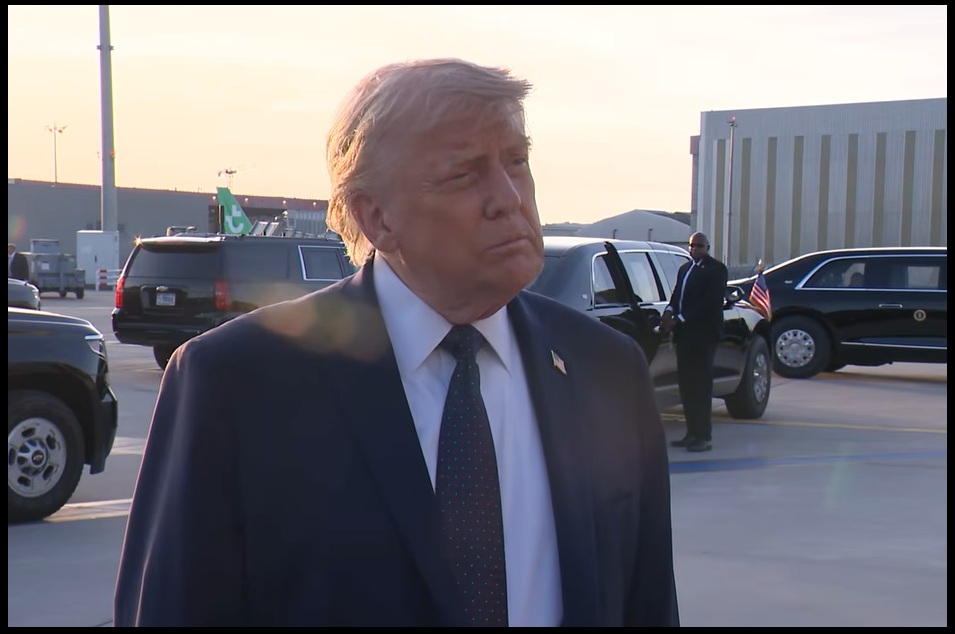
President Trump was asked again today about his position on the USMCA against the backdrop of a hot-mic moment when Canadian Prime Minister Mark Carney was telling him about caps on Chinese EVs coming into Canada. [Prompted]
“I would rather not have the USMCA. The primary reason I wanted it was because there was no way out of NAFTA, which was the worst trade agreement ever made — like, ever — and they had no termination… I would prefer not having an agreement, but I’m open to doing it.”
Several desperate Canadian trade watchers have framed President Trump’s “that’s good” response to Carney as if Trump was approving of the Chinese EV deal. Again, folks are just not looking at Trump’s position through the correct lens.
Trump doesn’t care about the issue. Trump is ambivalent to the issue. It’s the same mindset Trump has carried throughout all questions and comments since the questions were first raised.
The reason for Trump’s ambivalence about the granular, sectoral questions is simply because in the big picture of Trump’s outlook, he doesn’t plan on staying in a trilateral trade deal. Any bilateral trade deal Canada makes with a trade partner is perfectly okay, because Canada is not going to be connected to the USA in a trilateral obligation.
President Trump tells you his intention, then reminds himself of the opposition to his intention, then softens the original statement against the context of domestic political challenge he understands he has to overcome. This outlook is often expressed similarly in the comments of U.S. Trade Representative (USTR) Jamieson Greer.
Think of the scenario like a divorce. The ex-wife says to Trump, “I’m buying an EV.” Trump responds. “that’s good,” from a position they are no longer in a relationship, and he simply just doesn’t care.
Fully invested in the USMCA, Mark Carney says, “we put a limit of 49,000 EVs on the trade agreement with China.” Completely ambivalent Trump responds, “that’s good.” It’s a generic throwaway response because Trump no longer considers the USA and Canada to be in alignment or meshed in a trilateral agreement.
That’s why, when questioned, President Trump didn’t even recall the moment, yet he is being asked about it because it’s the most important thing on the mind of the Canadian side. It’s a little bit funny – but totally Trump.
Soon, when the USMCA moment circles around to the 12 o’clock position of immediate action, Trump will just turn to Jamison Greer and say, “ok, tell them we’re done now.” That’s it. Figure out the way to exit legally, let’s get out of this thing and start working on the optimal solution of a bilateral trade agreement with Canada.
The remarks today are the umpteenth time President Trump has repeated that the USMCA was the optimal way to get out of the quicksand NAFTA trade agreement. Once that NAFTA break was finished, the inherent value of the USMCA ended. Now Trump wants to end the USMCA and get to the core approach he has mentioned for over a decade; two bilateral trade agreements – one with Mexico and one with Canada.
Good day to donate. Lot of work going on here! 🙂
Promise it wasn’t a setup getting the first post! AND beat Mrs. Sunshine! (off to buy a lottery ticket). LOL
Never understood the “first post thing.”
Do we get a prize for it, or points? Am I missing something?
lol, it’s just for fun really.
Hey no biscuit….
Liked your nic a long time.
Our pup (12 yr old rescue) LOVES her biscuits. (Chewy baked no grain peanut butter flavor)
Had a good friend tell me all dogs are rescues. 🙂 love them
We are the really the ones rescued.
Agree with you Ed.
Many chances at first post over all the years here.
Kinda like want to add info… not jabber.
Not that I’m aware of. But as Ricky Bobby said, “if you ain’t first, you’re last”…😉
You can’t trust a person with 2 first names.
You’re not missing anything.
There isn’t any prize, but some folks act as if there is a prize. ☀️
Many years ago there was discussion about first commenters grabbing the spot in order too intentionally sabotage then entire discussion in some form or fashion, often times changing the entire topic. Barnabus isn’t doing, but many are skeptical about one other person’s intent as she repeatedly gets the first post and I don’t think anyone here believes in coincidences. IIRC SD even had a name of such commentors.
I thought of it, as a welcome to the Treehouse porch , pull up a spot join the discussion…
I’m convinced the person with the cute profile is a bot with a bot army that hovers over the Treehouse. It’s suspicious how many times she gets the first post. Can you say astroturf? Plus, so many comments are way too mundane to garner so many upvotes, usually more than anyone else.
I agree 100%, particularly about the mundane comments. The whole gig doesn’t ring true. The pattern is too obvious.
YES!!!! It is always just a one liner that will whet the appetite of the Treehouse readers and get a million upvotes. I scroll past now when I see the same poster with the cute female make a comment.
I can see the pattern and I feel like I am being played just like I was when I listened to MTG, Bannon, Gen Flynn, Tucker, and all of the others in Influencer-ville.
Agree OLS! We are being played. No bona fide Treeper believes in ‘coincidences’, particularly repeatedly getting the first comment on post every week. “It” is probably a bot and yes, we are getting played I’m totally taken off track in the discussion.
As we say in our family…
It’s not a competition.
But if it WAS a competition, I won.
LOL
I get it, and completely understand. Way to go Barnabus. 😁
Done and dusted!! (albeit in Canadian dollarettes!!)
Carney is Brookshire. In his mind he is the next Birk/Hath. He is stealing Canada blind; unfortunatly, there is not much left. lt may be green but it is not greenbacks. Dreamers.
Just sayin…… it is BrookFIELD where he is sending all our dough.
Canadian denial isn’t just a river in Egypt.
Canadians voted for this and they had a choice with Pierre Poilievre who was actually 40 points ahead in early polls. Now, some folks will scream that he is no different than Carney or Sparkle Socks but that’s not the case!
Poilievre is a Mitt Romney. Instead of failing in a couple of years with Carney, it would take 4 years with Poilievre.
Canada is just a short time behind the UK. The only difference is “the bands” think they own all the west.
“Sparkle Socks” … we haven’t used that term in a long, long time. Yet, still relevant.
Watched the US/Paraguay soccer match this past Friday from LA. Plenty of celebs shown on camera including Trudope and his new squeeze, Katy Perry. 🤢🤮
Why do we need a trade agreement with Canada?
We do NOT need one!
Because they have to buy stuff from us.
And becsause we share a really long border with them. We can all play nicely in the same sandbox if we choose to. It’s just that some kids ride the short bus and allowances must be made.
That generally open US northern border is how the Chinese and Canadians are still waging a bio-chemical war against the US. Very few cities in the US are not still having high numbers of Fentanyl ODs. Chinese chemicals to Canadian Fentanyl labs exported into the US is still killing thousands of Americans daily.
The Canadians are far too much in love with the Chinese Dragon.
I begin to think that the Mexicans, meanwhile, are finally beginning to wise up.
Dragons, after all, have exactly one intention: They intend to eat you, or, as the case may be, to burn you to a crisp.
Canada is in a desperate situation they created. Now they’re very weak.
And so is the British Empire. It never really went away; it just shifted from the sea jurisdiction to the air jurisdiction and continually tries to convince the world that it has controlling power. Every former Commonwealth country is on the same sinking ship — they never actually formed new independent governments when the Commonwealth was formally dissolved and the same bad actors hung on and kept playing the game.
Don’t tell that to Promethean Action
Yes, I like Susan & Barbara, but as Susan said in a video recently, if the subject doesn’t eventually end up nailing the City of London as the culprit, she’s just not interested & won’t invest the time to read it.
Therefore, all info/discussions must lead to blaming the CoL, and that always leads to some form of distortion of the actual facts.
By “the Mexicans”, do you mean the people, or the gov’t negotiating trade policy?
I love my president, but I don’t know why we’re renegotiating his signature achievement from just six or seven years ago?
Because Canada is a repackaged of Chinese goods.
They toss a maple leaf over the panda and they get product into america.with out tariff . Canada’s margin becomes a portion of the tariff that otherwise China would pay.
He’s not asking this in good faith. I am seeing paid trolls on other boards I frequent with the same mouth diarrhea. As others have pointed out, the answer to his question is right in the post, were he really interested in one.
USMCA Trade agreement in Trump’s first term was his signature agreement at that time because it gave him the path necessary to get to where we are today. Pres Trump can now move forward however he wants in USMCA to achieve his goals not the globalist’s goals
Uh, because it probably was a useful vehicle to get the USA out of NAFTA; NAFTA is old news, so the USMCA lost its value (in his view of the America First goal(s)
The last paragraph above………….
“The remarks today are the umpteenth time President Trump has repeated that the USMCA was the optimal way to get out of the quicksand NAFTA trade agreement. Once that NAFTA break was finished, the inherent value of the USMCA ended. Now Trump wants to end the USMCA and get to the core approach he has mentioned for over a decade; two bilateral trade agreements – one with Mexico and one with Canada.”
SD does a real good job explaining in the post above the comment section
Canada was not even going to be in the agreement because they arrogantly weren’t cooperating. They came very late to the party and were going to be shut out as a result; It was Nancy Piglosi, according to Sundance, who blackmailed Trump into including them last minute as a condition of congressional approval.
So it is fortuitous (providence ?) that he is in office again, 6 years later, when it is due for review/renewal, and he can terminate it (them), Now !
President Trump has no intention of renegotiating the USCMA. USMCA is already dead. It’s heart just hasn’t stopped beating yet.
The plug is about to get pulled.
And MX is SO, SO VULNERABLE to the consequences of a “no trade agreement” scenario. Terribly so. La Presidenta Narcoterrorista is too dumb to even understand how utterly dependent MX is on US good will. Very sad for the MX people.
Why do people show they haven’t read the article by the questions they ask?
Just stirring up trouble.
Pretending not to know things.
FFS.
Prob because MX & CA resumed their massive cheating on ROO for cars, steel in CA, so the effort to correct the NAFTA errors became a joke, and P. Trump KNOWS IT.
However, he knows that there must be demonstrable proof of such cheating, and the unsuccessful US attempt to rectify it, before a more stringent effort is made to get MX to comply (which it will not do anyway), or to abandon the USMCA completely. But P. Trump must have a wily strategy to get it done with good optics.
The few Canadians I’ve spoken with are fine with no deal. Carney has told them that all the new trading partners will make up for the loss of USA trade. They even go on to say they should stop the electricity and oil that flows into the USA as retribution for rejecting Canada.
In other words, they’re willing to shoot themselves in the foot in an attempt to hurt the USA.
Canada playing proxy for a belligerent third party simply will not be tolerated with our sizable border either.
Canada may yet end up being a territory of the United States in the not so far future over being a colony for foreign powers to North America hostile to the United States of America.
At least Alberta. They’ve got the oil anyway…
None of those Canadians hang out here with us!!!
They’ve shot themselves in the foot just like the EU leaders did regarding Russian oil. Oh well.
Precisely. President Trump wants to excise USA from these unfavorable business deals with nations. He sees the bad deals and knows how to clear the runway!
“Oh, that’s good”, is interpreted to mean, “Oh, fine – we’ve got a deal now.” Hahahah. Hope springs eternal as the saying goes I guess.
ROTFLMAO: “They said ‘six years’ because they were sure that I wouldn’t still be here . . .” 🤡
Where are you going??
We will miss you Mike.
I can’t tell if you are being funny, but Mike is quoting President Trump.
He (the President) finds it humorous that the deadline for terminating the USMCA is now, when he expected to be retired from being president having been re-elected in 2020. By all rights he wouldn’t have been in office to terminate USMCA in 2026, except for being cheated in 2020. The same people who cheated him now lament he is in office to get rid of USMCA. The jokes on them !
Astute observation, sir!
Should have listened to the video. Then you can keep up with the conversations🤣🤣🤣🤣
Chynese bot?
Just look at the announcement today from BMW regarding earnings. That is what happens when you allow China to dump their products in your country. Canada is going to find that out soon. Very soon.
Without back door access to US markets, Every foreign investment in Canada will walk.
Without backdoor access to US markets, every foreign investment in Canada will RUN!
There’s a certain irony in the parsing of the word, Canada…Can and Nada, which literally means ‘can do nothing!’
Canada can not manufacture cars, they can only assemble Chines car parts. Canada can not manufacture the windmills, solar panels and lithium auto batteries that are the heart of the so-called Green New Deal! Even the electric generators and water turbines at Niagara Falls that produce a quarter of Ontario’s electricity are manufactured in the U.S.
Justin Trudeau already admitted that Canada needs its huge trade surplus with the U.S. to survive as a nation, but what does The Great White North have to offer that America needs?
The short answer is nada!
It’s probably not a good idea to purchase a car made in Canada in the near future. Who knows if future pink-slipped line workers leave bolts undone or mess with other parts just to fck with Americans who they blame for all their problems. Does Stellantis in Canada make Jeeps?
Add: then again, with the tariffs, Canadian made cars will be more costly anyway.
You talked me out of ever buying a Sino-Canadian-Energizer Bunny-powered car…not that I was in the market for one!
Harley Davidson employees were doing the same when AMF bought them. A handful of washers in the engine cases before assembly.
They did it to themselves.
Sad for the people of Canada.
Rush and Triumph downloads and awesome seal clubbing.
Don’t forget Anvil.
Not too crazy about the word “preference” being used. We’ll see what happens.
“Trump doesn’t care about the issue. “
Trump’s become the Honey Badger of the world stage.
If you have a smidgen of love for our country how can you not love President Trump!
He’s fighting battles daily for us.
Thank God for saving him.
And thank you Sundance for sharing his work.
Amen to that! Sundance’s column is like a course in advanced geopolitics & finance! I have leaned SO MUCH from him over the years, an education I would not learned otherwise! We are all in his debt.
Can’t stump the Trump
Very cool.
I do not think that President Trump can terminate the USMCA effective July 2026.
As I read it, if the parties cannot come to agreement to renew the USMCA, it will continue automatically with an annual review.
Congress seems to have a role also.
U.S.-Mexico-Canada (USMCA) Trade Agreement
If the parties cannot agree to renew, it automatically renews?
That makes no sense…
Click on the link to the agreement and read for yourself.
Renewal can be visited July 1, 2026. If parties fail to agree to renew, the agreement terminates in 2036, and they meet annually until to come to terms.
It specifically involves congress to make changes.
Read the actual agreement.
“Article 34.6: Withdrawal A Party may withdraw from this Agreement by providing written notice of withdrawal to the other Parties. A withdrawal shall take effect six months after a Party provides written notice to the other Parties. If a Party withdraws, this Agreement shall remain in force for the remaining Parties. “
Note, President Trump has not issued a formal notice of withdrawal.
Trump Says U.S. Won’t Renew USMCA, Setting Up Months of Talks – TT
I hope, and maybe even suspect that PDJT has a plan to end-run the uniparty rats who are bought off to stop him from dissolving this trilateral trade deal.
None so blind as those who will not see.
.
What worries me about Carney’s actions are that:
1. They know Trump will not renew. They are aware of this;
2. They know how devastating it will be to their economy. It is obvious;
3. Carney is aware that Europe and China will not come to their rescue. They have made it clear.
Looking at the utter destruction that UK and European leaders have intentionally heaped on their native populations….
It becomes clear they INTEND to destroy Canada’s economy.
Carney, Starmer, Macron, Newsome, Mandami, etc.,
THEIR GOAL IS DESTRUCTION!
Thinking they are just stupid is a mistake. Their actions are in line with being okay with where this is headed and just pacifying the public until it is too late and they can then blame Trump.
They are okay with this or they would respond differently.
Destruction IS the goal.
Any normal, rational, logical person would grasp what is occurring but I think many have denied reality for decades and cannot accept a real world if it goes against their belief system. Some people have believes the lies for so long that they can’t accept truth when they hear/see it or they as you state know exactly what’s happening, but don’t know how to deal with things so they do nothing.
I don’t know how these leaders can screw their people into hardship and poverty and live with themselves. They, literally, take the money and run. Trudeau is a good example as he globetrots with girlfriend Katie. Merkle is another run.
I agree with you and up until recently would have agreed that’s what is happening.
But look at Europe where they are internationally turning their countries in third world hell holes.
INTENTIONALLY
Mandami is not stupid. He’s boldly wreaking communism on NY.
Turn them into beggars because they are easier to please.
It’s intentional.
They are almost all EXTREME PSYCHOPATHS! That’s why.
Makes sense to me!
The globalist agenda has long been to collapse western nations and to replace them with global governance.. The head of the snake has them all. Those appointed European leaders are dismantling their countries from within per the agenda – they have no will of thier own. They are puppets, actors. Not much different than our last dozen or so Presidents…… until Trump.
The nations of Europe long ago surrendered their soverenity to a commision of globalist-appointed bureaucrats. UK and the other Commonwealth nations still operate under the thumb of the Crown. The DeepState is the thread that runs through it all. America has funded it – providing the color revolutions and wars.
Now, there is Trump. They can all have tea, sit by the window and watch.
Yes. We need to change our thinking from them being blind or stupid and acknowledge they are agents of destruction.
Likely Carney feels like Trump. He knows USMC will not be renewed and he just doesn’t care. It fits into his long term plan AND, as a bonus, he can deflect the blame to Trump.
God versus Satan. This is a spiritual war being fought through Politics, Economics, Education, and Religion.
Satan destroys everything under the guise of Build Back Better and the people fall for it.
Of course, it’s up to us to fight back and not just passively wait for God to intervene. He wants to see which side of the battle people will choose.
That’s what the demonic does, and everything you’re seeing is, indeed, a spiritual battle!
Ergo they become our 51st state. Then we’ll take proper care of them.
All the very please Brits are piling through the door of anything with booze in Dallas. In several larger bars they keep chanting Keir Starmer is a Wanker. lmfao
It seems the Football Cartel frowns greatly on that being shouted at games back home.
Mrs. Jones has said that stadium security has been confiscating St. George’s Cross flags from the English fans. Is that true?
“that’s good” is superb. Beats the Monte Walsh “you can’t believe how little I care.”
“I don’t really care, Margaret.”
After his Iran deal fiasco can Trump be trusted on trade deals? Or will he surrender on that too?
His Iran deal is EZ pickins for a genius like him. Knowledge plus experience = wisdom of a stable genius.
What do you mean fiasco? Explain.
Means he voted for Zero, Biden, Kamala and is prepping to vote for Gavi-poo.
EZily confused.
Troll
BREAKING: Canada’s Parliament officially passes ‘Bible ban’ Bill C-9
Canada’s House rejected a final attempt to stop Bill C-9, which threatens to criminalize quoting the Bible, including on homosexuality. The radical bill will soon receive Royal Assent and become law.
https://www.lifesitenews.com/news/breaking-canadas-parliament-officially-passes-bible-ban-bill-c-9/
Wow. Just wow. Just what we need on our Northern border.
Horrible, but not surprising, considering Canada was the location of the Land-o-Lakes conference back in the late 50’s or early 60’s, if I’m not mistaken.
Have they banned Muslims from expressing their opinions of homosexuality? Have they banned atheists from speaking negatively against homosexuality?
Or is this specific to the Christian Bible and Christians solely?
These are rhetorical questions. I already know the answer. We are in a Spiritual Battle between God and Satan.
Tragic.
May God protect President Trump. He’s dealing with BS people from every direction.
Interesting video from a few days ago..
In most matters, people need to understand it’s not what President Trump SAYS…..it’s what he DOES. If you use that perspective in most issues, whether Canada, G-7 or even Iran, it’s less confusing to the ‘observer’.
I look at PDJT’s polite, bland words as mere niceties. Why should he wear his intentions, plans, and ideas on his sleeve for the world to try to derail?
That would be like player poker with your cards face up.
Thinking the Executive may negotiate but trade agreements must be approved by Congress. So any negotiations to be approved by the Legislature. I thought.
45-47.
The dash matters!!!
Yep!
Chinese EV’s will not last for very long in Canada. They will be reduced to piles of rust after a few years. Just ask the Russians they are dying to buy German again. Other issues are people getting locked in and out of their cars, sponataneous combustion, locked acceleration, autonomous driving crashes, plastic gas pedals breaking,thin body metal and more. This will be fun to watch…