The discussion remains controversial depending on the location. Generally, data centers located in rural isolation do not seem to be too controversial. However, data centers built in proximity to population centers stimulate a great deal of opposition.
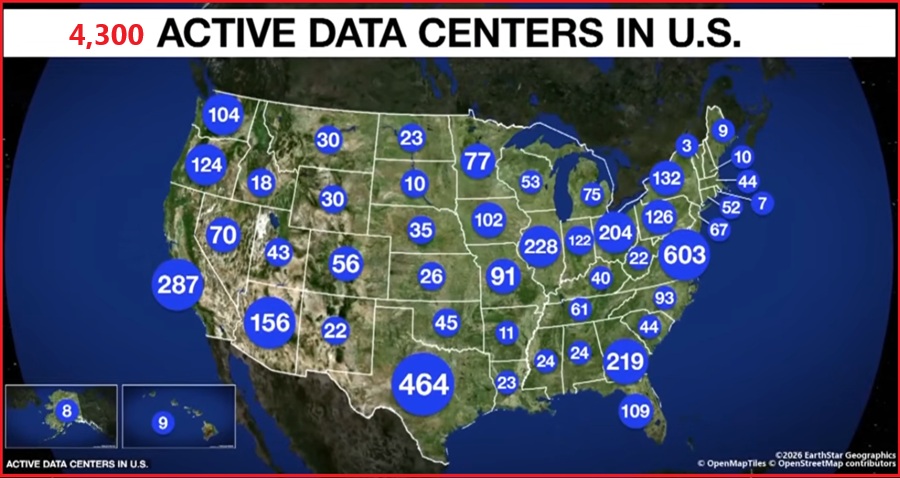
Recently New York state banned the building of Data Centers as politicization of the construct has become somewhat of a Right/Left divide. President Trump notes the importance of data centers:
(VIA TRUTH SOCIAL) – One of the biggest Driving Forces in the Future for Jobs, are Data Centers. They are big, strong, bold, and Money Machines for the State in which they are built. Governor Kathy Hochul, for political reasons, has terminated all Data Centers being built, or to be built, in New York State. These Companies are now being sought in Alabama, Florida, Texas, Arizona, and many other States. Both the Taxes and the Jobs amount to LIQUID GOLD! New York State has made a terrible decision.
All of this Income, and other Benefits, will be going to Red States, and some Blue, where Data Centers are sought as Cash Cows, with Lower Taxes and Record Setting Jobs. They must pay for their own Water and Power, and any leftover goes back to the State and local Community. Data Centers are tremendous WINS for the States and Communities that are lucky enough to get them. New York should change its Policy, IMMEDIATELY. The Radical Left Dumocrats must not be allowed to cause us to lose Data Centers, AI, and all of this incredible new Technology, to China, and other countries!”
The hardware side of the Data Center expansion is leading to increased revenue for raw material providers, chip makers, computer systems, fabrication shops, electrical components and construction.
At the same time, the software side LLM builders and AI companies are trying to figure out how to make stable profitability within the sector.
 CTH watches the tokenization and subscription fees for various AI model use with the same perspective CTH viewed over a decade of false claims within the financial market that told lies about social media viability and data processing costs.
Now, we watch the seemingly exponential growth of AI capabilities and associated costs with the same pragmatic perspective.
Robotic pool cleaners were introduced two generations ago. Did the pool cleaner business dry up? No, it expanded.
Robotic vacuums broke into the popular household appliance market five years ago, you probably have one, did it eliminate maid services? No, still growing.
AI can now write its own code to generate outputs. Are software developers getting fired? No, demand for software designers and engineers is up.
The mainframe approach, the one AI brain to run all systems, will never work – it is cost prohibitive (see first paragraph – wash, rinse, repeat). Deny this reality at your own investment risk. If needed, politely absorb the ridicule – for it matters not.
CTH predicts AI will become a localized and optimized sub-set for each sector of the economy, requiring each major organization and corporation to adopt specific cost/benefit data libraries and networks for use and functionality.
At scale, a thousand coders each working on Gemini, ChatGPT, Anthropic, Fabian, Grok, etc. will become 100,000+ software designers working inside individual companies to create personalized, targeted, bespoke AI data systems and networks; each system specifically tailored to the industry or sector of business. The intranet of internets will happen again.
Creating and selling AI system networks and integration functions that are personally tailored to highly specific company functions, creates an entirely new sector of the technology industry that has not even begun yet. [There’s an investment opportunity there]
Will AI robots replace some repetitive human functions? Yes, the ice rink Zamboni will likely not have a steering wheel, just an emergency joystick. A reference for a comparative industrial scale Roomba vacuum, or the robotic pool cleaners.
However, at scale the robotic industry is slower than human efficiency in almost all sectors that matter; the cost benefit analysis will limit growth. The maid service sector will not be impacted any more than the software developers.
It is not an issue to fear some AI task efficiencies will grant more time available that will be filled with alternate task capabilities. Human productivity will increase in certain sectors of the economy, but humans will not lose work opportunities. Blue collar jobs will continue to expand as each of the hardware tools developed will need manufacturing, installation, maintenance and monitoring.
The further downstream the worker is from a repetitive function within the [XXXX] industry, the more irreplaceable they become.
 As to the bigger picture of fully developed AI and the intersection of information and knowledge; yes, the automation of AI can present an issue. However, all AI concerns can be mitigated so long as multiple, alternative AI systems exist within the larger information realm.
As a nation we need dozens of different AI models each competing within the industry for the best AI product.
As long as we have multiple AI systems, alternatives to the hive-mind, we do not need to fear the AI network as a source of information. If we don’t like the AI outputs, we can switch to an alternate AI provider.
If the subscription cost of the AI is too high, then as long as we have a competitive market where a lesser expensive, perhaps bespoke AI option can exist, we should be okay. Let the free-and-fair market decide.
If AI outputs don’t offer empirical truth or real value to the end user, we should be fine as long as consumers have alternative options available. AI providers should be information providers in the same concept as cell phone providers. The key is to have multiple, competing AI systems available for industrial, business, professional and personal use.
On the upside of this information worry dynamic -in the pragmatic and optimistic perspective- we have the cost limiting nature of a massive singular AI information network.
A single AI central brain handling over 360 million users at once, all requiring identical responses that update with every tiny change in a multi-trillion datapoint-per-millisecond data stream, is far beyond the capacity of any computational AI system. The costs tied to such a setup are only now becoming clear, and AI business models are starting to fall apart in real time. This is a hard truth that isn’t going to change.
Within the AI business, those who can carefully write AI input instructions to achieve maximum value in AI output -industry by industry- will become increasingly more valuable.
Those who can train AI to be cost effective -and provide materially beneficial outputs- within their granular sector of business, within each company, will become priceless to the organization. Wage rates will follow competency.
The one key issue about AI to emphasize is the need for multiple competing models. If China (hive mind) has their model, and Europe (another hive mind) has their model, and the United States (entrepreneurial competitiveness) has multiple competitive models – we will win the AI race and simultaneously we will retain freedom.
What we don’t want is a singular AI model to win the support of the United States government and then end up with an AI regulatory system where the govt starts defining terms of “safety” to eliminate information adverse to the interests of the government that regulates it. Both China and Europe will predictably do that.

Water and electricity conservation used to be being jammed down our throats, and suddenly there’s plenty of both for data centers.
Any idiot can see that “data centers plus flock cameras plus bluetooth tracking plus central bank digital currencies = prison planet”
They’re going to try it because that has been the goal of totalitarians for centuries. They’re going to try it because they can.
“Water and electricity conservation used to be being jammed down our throats, and suddenly there’s plenty of both for data centers.”
Yup. Imagine that. Already, data center impacts and energy guzzled have eaten beyond all the “eco”, “green” and “sustainable” pipedreams of the last half century.
Your point goes to why so many anti-datacenter campaigns in liberal urban and suburban areas appeared so fast and in unison. Sleeves out of their vests. The data centers were planned decades ago in primarily rural areas. The protests were quickly organized in areas that datacenters were never planned for, or will never be built in. The not-in-my-backyard greenies have been pacified.
You also hone in on the true agenda of those pouring many trillions of capital into this: Surveillance and central global control. There is no business case for AI or for these massive data centers. Blackrock and the likes are not funded to “invest” in dystopia for financial return. The long game “return” is control – world control – the eternal evil.
Oligarchies, BigTech or otherwise are not compatible with our constitution or our liberty. I just do not get why these trillionaires are so celebrated.
AI needs massively scaled computing centers. The data collected needs data centers. The unfathomable scale, complexity and limitless ability to correlate that data in real time is what this is about – not the AI computing models used to forge the chains of our enslavement.
Yes I agree totally!!!
“The costs tied to such a setup are only now becoming clear, and AI business models are starting to fall apart in real time. This is a hard truth that isn’t going to change.”
Hard No. Our tiny rural town/county banned them. Neighboring County put a project underway on hold. The data centers will break our grid and ruin our water supply. Not accounting the noise/pollution.
I don’t care what Trump says. The A.I. “experts” don’t know what they’re doing.
They know what they are doing. It is about creating a lot of wealth very quickly. Nothing else matters to them.
Agree completely Born Free. The opposition I see in my area is not a “China-driven” campaign. It is grassroots – local residents feeling and experiencing, yet again, the politicians’ and moneyed interests total disregard for the impact to local communities, environmental impacts and costs. Not only do these centers get state incentives and tax breaks, they take precedent over water and land resources. This is devastating for an agriculture community like ours. The investors and owners get breaks while the citizens pay the costs in the form of higher taxes, utility bills and environmental disruptions. Also, a longer (or maybe near-term) problem is renegade systems put into place intentionally (China) or otherwise, that could put our country and others in danger due to malevolent actions by the software. Our county has put a temporary moratorium on these centers and I foresee recalls and voter opposition to any politician promoting these centers. Hard pass for us as well!
Trump only knows what he is told by the likes of Peter Thiel (Palantir) and other tech moguls. He hasn’t heard the “other side”, or won’t entertain a contrary point of view.
Oh, they know all right, they just refuse to follow best practices.
“Will AI robots replace some repetitive human functions? … Yes, the ice rink Zamboni will likely not have a steering wheel, just an emergency joystick. A reference for a comparative industrial scale Roomba vacuum, or the robotic pool cleaners.
However, at scale the robotic industry is slower than human efficiency in almost all sectors that matter; the cost benefit analysis will limit growth. The maid service sector will not be impacted any more than the software developers.”
[Quote from this article >President Trump Highlights Importance of Data Centers< at TheConservativeTreehouse.] The artificial intelligence is the AI that operates the robots, whether the robot clanks around or is inside a computer box.
It’s possible to see robots & AI working in a Ford factory assembling cars and trucks along with human workers. … Judging from the comments, some people seem to reject the AI-Robot idea, and expect to be purchasing a human assembled Ferrari from Italy. … [But then again, some comments could be, by China-agents or people that wish to have their cars assembled by the non-union Chinese slaves in China.
China agents just want to steal the artificial intelligent AI technology from America, and inhibit the AI usage in our country.]
My comment has received no notice or traction here in response to this column. … The comment is about how AI will be used to make life easier for people, as AI will simply become part of the Industrialization of the world.
There is an idea that AI will solely be used to ‘spy’ on citizens here in America, if AI in the form of ‘data centers’ are built here in America.
The increase usage of more AI data centers will occur whether the data centers are built here in the USA or overseas in Communist China.
***************************
There are already massive ‘data’ centers already controlled by our government, and they are being used by the nefarious politicians.
Please see TheConservativeTreehouse > Part IV – Covering Up the Biggest Political Scandal in U.S. History< +Please notice, there are other such columns.
The ‘data’ centers controlled by our government were used by the Democrats to spy on their political opponents, and then government and political actions were taken by the ‘crooks’ in opposition to their opponents.
*************
As another note: Cash payments are used by >crooked politicians (Typically Democrats) to practice their trade. See the case involving New Jersey Democrat Menendez with large amounts of cash and gold bars in his home.
Cash payments are also used to pay illegal immigrants and other people to avoid the expenses of paying good wages for American jobs, and to avoid paying the government fees for the benefits that come with an honest paycheck.
An enormous number of people (mostly Democrats) in our country that want to reduce any trace of illegal activity.
Still waiting for AI to expose criminal politicians and cite their crimes.
This is NO need for all these data centers. Commercials here in PA saying how wonderful these things are, and they don’t use any way, if at all Yep.
Study that hideous Republican state senator traitor Greg Rothman. Beyond despicable behaviours related to data centers. He’s double dipping by selling / representing the land sales through his real estate brokerage company and then forcing secretive legislation through with Shapiro to change zoning , give tax abatements and run electric costs through residential existing clients to cover data center costs.
he’s a horrible Republican. Just horrible.
Huge, windowless data center buildings are ugly. On this basis alone, they have no place in a normal civilization.
They use enormous amounts of energy, and they require an enormous amount of water to cool them.
They take up an enormous amount of space. They are encroaching on everyone’s backyard. And they are multiplying with no end in sight.
How sustainable are they? Will those huge, ugly buildings still be in operation 10 or 20 years from now?
How much more information of ours do they need to collect?
Wonder how fireproof they are? Just sayin’
Well, how else are you supposed to die of mine and keep the rich rich and the poor poor haven’t you seen these semi trailer? Machines filled with machine upon machine that sucks up the power in the water that’s what they’re doing with it. Their data mining mostly in the bitcoin sense in that sort of thing so if you can stay on top of it, you can put your 500,000 bitcoin in when there’s only 1 million of them created well guess what you stay ahead you’ll end up with 750,000 sooner or later you end up with all million and he who with the most money thinks he won. All this is in the end times explanation in Daniel, Ezekiel, Matthew, Jon, and my favorite book of Revelation.
If you think data centers are causing an uproar just wait until the US changes the dollar bills to polymer. 😱😱
It will probably burn better, I’ll give them that.
True though lighting cigars with them might add a plasticky taste.
Not going to bother the druggies that much. They’ve smoked worse.
While they are much more durable and less prone to damage and last longer, they are also much more expensive to produce and people don’t like them because they have a slippery feel when dry and sticky when damp or wet. If you have travelled overseas in recent years and converted dollars into local then you have probably encountered examples of them. Cannot imagine Trump changing to them since he ditched the penny over their production cost.
I use them daily
Or Trump signature this year.
Data Centers are all over VA and destroying the rural areas. Energy costs are doubling because of them, and many parts of the state are in a drought because they use up the water supply.
>> “Data Centers are all over VA”
The cost of turning blue […in the face]
2 democrat senators from VA. Kiss of death.
Well said.
In my very humble opinion may I suggest that our Republic is in need of individual states’ collection of information (by non-political groups) concerning their pros and cons on data centers already existing. A meeting of the appointed groups/individuals representing each state would meet to discuss these findings, return to their respective states, report their findings, and allow each state to make its own decision concerning data centers.
Since we are a Republic, if individuals are not in agreement with a state’s plan regarding data centers they are free to move to another state that meets their needs.
Simplistic? Maybe.
But let us not forget we are a REPUBLIC and have the right to take a stand individually!!
Problem is that it’s too late. There is no political will. There is not even any political awareness or intellectual capability to comprehend it among the pollical class. The land is purchased. Zoning, permitting and financing is done. All necessary state/local politicians and bureaucrats have been bought and/or bulldozed.
Public indifference/apathy is common. No one seems to care that they literally have no say in what data is collected about them, who it is given/sold to or, how it is used. They carry around powerful data collection device feeding the data centers 24/7 from the boardroom to the bedroom. Search warrants are moot because all information about us has already been collected and continues into the future. We’ve clicked “I Agree” so many times that there in nothing about us that’s not available, down to the minutia.
“…Where the Spirit of the Lord is there is Liberty (FREEDOM)”
2 Corinthians 3:17
Don’t give a damn what he says about data centers…all of the previously enumerated issues remain – as do I as a very hard NO!!
https://iaeimagazine.org/electrical-fundamentals/how-much-electricity-does-a-data-center-use-complete-2025-analysis/
United States Data Center Energy Usage
The U.S. Department of Energy’s 2024 report provides the most authoritative data on American data center consumption:
2014: 58 TWh (1.4% of total U.S. electricity)
2018: 76 TWh (1.9% of total U.S. electricity)
2023: 176 TWh (4.4% of total U.S. electricity)
2028 projection: 325-580 TWh (6.7-12% of total U.S. electricity)
This represents a compound annual growth rate (CAGR) of 18% from 2018 to 2023, with projections suggesting this could accelerate to 13-27% between 2023 and 2028.
God Bless America
I predict data centers will be obsolete very soon.
See the fiber optic cable boom in the 90s, the massive overbuilding produced “dark fiber”. A good read on the topic…
https://www.technostatecraft.com/p/dark-fiberan-archaeology-of-the-dot
Water is a huge issue in Texas. Many rural areas are supplying water to urban areas and many rural property owner wells are running dry.
Edwards aquifer is in danger already. Housing starts have been stopped in Travis Co more than once in the last 40yrs due to drought. This is truly insane.
They are really pushing the data centers in texas, lots of ads on how good they are….if they are so good, why are we told business x was going here, then at the last min, oh, no it’s a data center…..
there is no input from communities (they are planning 3 in our county and 2 on the borders of neighboring counties)
When you are given 2 options, it is a psyops,,,,, the truth is NOT being told….. THIS is what bothers me
I think I am going to FOIA the contracts that Flock cameras have….. is it in my city? county? State? well, I think I have every right to know and protest.
Sorry I am ranting
I’m in TX and there is a flock camera at the entry to my neighborhood. 🤬
Do not aim a green laser (available at any Home Depot or Loews) at the camera.
Sounds like how they crammed the VAX down our throats with false positive advertising and promotion.
‘NO THANK YOU
Coffee & Covid, Substack, had an excellent in depth article and links to finding the flock cameras etc…It was a funny, enlightening piece!
Wish I could remember where I read it, but there is a map out there that you put in your address or your state your city your ZIP Code, and it will pinpoint all the flock cameras for you.
deflock.org
It will also give you an alternate route to travel to avoid the surveillance.
He’s ( PDJT ) on the wrong side of this.
It’s important to build out all the Data center storage and processing required for all those flock cameras….
Winner, winner, chicken dinner!
I work in software. The current LLMs are good at writing code, it is probably their best use case currently. But the thing about most companies is that there is more software needed than there are available resources to write it. Having AI to write code drops the cost of code, which allows us to write more code. Just like reusable rockets lower the cost of getting into orbit, which allows more uses for space.
I would put data centers in Alaska and North Dakota, because they can also co-locate greenhouses or housing that can use the waste heat.
Is this an opportunity to use geothermal? Electric and water is the quick, easy supply without using any imagination or innovation.
Well, the truth is data centers have been around for about 25 years or more, when the internet came into being they already had a data center waiting, small but there.
My issue with data centers is that they store everything about ‘us’, I don’t know about you, but I like my privacy. I do not want every Tom Dick and Mary knowing my business where I’m at where I’m going where I’ve been or just on the net posting this, simple as that. That is dangerous on some many levels. On the other hand, I have nothing to hide, you ask me I will tell you without fear. But my political opinion and belief in a supreme being called God and a son called Jesus Christ, will become a problem. It Is Written.
Waiting for the mitigation…and laws passed to protect people before I jump on the data center train.
https://substack.com/@theodorascarato/note/c-280292902?r=b7nwz&utm_medium=ios&utm_source=notes-share-action
My concern is the speed at which these huge data centers are being built… whether we want them or not. The threat of constant surveilance by people like Mamdani and the Democrat Socialists is of great concern.
For the sake for clarity it would be interesting to see the number of “data centers” that existed before 2020.
Because the best I have been able to discover is that there are only a few hundred planned or new under construction at this time.
Data centers have been with us for more than 20 years …. some claims it goes all the way back to 1945 when the Military Logistics and Code breaking Computers were put into service.
Also, the majority of the data centers have actual use that does not include AI-Spyware, Social media and Cell Phone data.
Got no problem with demanding better oversight of the new MEGA Data Centers being built with respect to their much greater infrastructure demands and environmental impact … but the discussion of usage needs to be better refined and focused on real problems
If the Trump Administration wants Americans on board with the data centers, then they need to do a better job of selling them to the public. Explain specifically why these data centers are so important so that stomaching the two electric price hikes I’ve experienced in the past six months is worth it. Explains what measures are being taken to ensure data center jobs and construction aren’t just going to the usual illegal alien, H1Bs, and DIE hires. Because right now, from my perspective, this whole situation sucks. I remain unconvinced that any of this burden is worth the sacrifice.
I think you’re correct that the administration needs to do a better job at selling this.
But in the end I think it’ll be like xbox vs. PlayStation and the Chinese will do a better job at vilifying data centers and putting out misleading stuff than the administration is about putting good information.
The Chinese don’t have to vilify the data centers. Our community has put a moratorium on them and we will recall or vote out any politician who invites a center into our agricultural area. This is grassroots opposition. Is it possible that the backers of data centers are putting a Chinese label on the opposition to malign the grassroots citizens who have legitimate concerns in order to shut down (or censor – wow, when has that ever happened?) opposition?
Each Person has a “financial Instrument” (Bond) attached to their Name via BC, this was/is the old System perfected through the City of London, that which Trump is dismantling in real time.
What Data will Data Centres use and how will it Trade it?
The “Internet of Things” comes to mind, where each “thing” is Traded. You, I, the Bee pollinating the flowers are all “things”.
Is the new System any different to the old System, or is it the same shit, different day?
Its all about “money”, he who worships Mammon dies in the hands of Mammon, he who worships God dies in the Hand of God.
AI is overrated and a bubble that will burst.
The ROI is not there.
Only a few will survive and yes, people will get dumber that rely on AI.
Far more efficient LLM hardware *and* software are being released already. Soon the “datacenters” will will only need a tiny fraction of what’s being built for computing functions. Does anyone believe that the builders and operators can’t already see this? What will be the actual use of these huge facilities dotted around the country?
On July 4th, in the small Oxfordshire town of Piddington, the townsfolk voted 175 to 7, to secede from the UK. Why? They were protesting the announcement by the Ministry of Defence that they will be housing 1250 single men, asylum seekers, vetted and unvetted, in an old MoD building right up the road.
Can anyone doubt that this is an invading army, coming to overwhelm and wipe out the English natives of the town? Nobody was asked if they wanted this. No vote was held. No consent was given.
The UK is a testing ground for what the globalists intend to do here. Make ready.
https://x.com/AllForProgress_/status/2076962420036161731
I hate that Trump goes down this road with blue states. There are still diehard MAGA voters stuck in them! Hochul is a curse on NY, but all she did was pause certain data centers for a year. One that was put on hold would destroy more farmland and an animal preserve. It’s okay she’s selling out all our rural farmland for solar and wind still, which I thought Trump put a stop to! I can’t stand the woman, but I feel like the average American is being left to fend for themselves and will never have a chance to escape! He used to brag about the number of counties he won, but seems to have forgotten the people who voted for him are still in those same counties!
It’s happening in supposedly red states, too. Texas, of all places, that already suffers from drought. Abbott is a worse disgrace than Hochul, because he’s a fraud.
Sundance makes some good points, as long as competition exists in the AI market place, we will adapt.
BUT … if the government makes AI controlled by DEEP STATE … then we are screwed, like China and EU are. So … do you think Trump will be president in 2026 and 2030 … or some DEEP STATE kamala type will be president?
That is the whole point, how far away are we from losing the USA to corrupt forces, … NOBODY knows. Thank GOD for Trump, … but … hard to find a Trusted Warrior Patriot like Trump, right?
Trump, I guess , had to enter the AI age. Sundance suggests in a few years, America competitive market should minimize the dangers (we hope).
As to people currently having to deal with the problems of having DATA center near them, … is higher energy costs and water issues … a concern … that could effect elections/ public opinion (msm talking point).
I guess the jury is out … but I am in fear of AI manipulation in USA. And not sure Trump has looked at this issue from all sides, with knowledgable far-seeing wise people. (?).
No “trusted warrior patriot” would push the evils of AI and data centers. Um “in a few years” it will be way too late. The dangers are right here, right now.
Profit over the people regardless of how destructive. The wealthy will never be subjected to the pollution of data centers. Run the low income out of their homes and neighborhoods and take the land. Its happening everyday.
I can’t get the picture out of my mind that Sundance posted at the beginning of Trumps 2nd term of his meeting with the tech bros. Was that a warning? I become more disillusioned with this administration daily.
I swallow pride easily in defense of the downtrodden as the towel I will throw in becomes filthier by the day.
I too remember the caution Sundance had back then with Trump seeming to “warm up” to the Tech Bros. I believe Sundance was warning us, rightly so? And maybe Sundance has thought about it more, and prayed for wisdom, … and looked at past trends of “human advancement tech”, and feels as long as America “stays competitive in the market place … we should be ok (from past experience). Valid points.
I hope Sundances vision holds true to AI intergration into America.
The next three to five years will be tumultuous in the AI/tech sector.
Zero-day attacks on computing systems are on the rise. AI has made it very much easier to find attack vectors in software.
Right now, open-source stuff is taking a lot of hits (Linux, etc…) simply b/c the source code is available and running it through AI analysis is relatively easy. What used to take a very experienced person weeks/months to discover and fix is now being found by script-kiddies who have zero qualms about using their newfound exploits. They are now finding exploits that have been in the code for decades that 1000’s of ill-wishers in dark-corners were unable to discover by ‘human power’, so to speak.
Ultimately, it makes the s/w better by people fixing it, but that’s what I mean when I say ‘next few years are going to be bumpy’. I shudder to think of what exploits will be found in Windows. Though its source is private, it would only take one ‘social justice embed’ in MS to release it.
I would not be surprised to see large numbers of new attacks on financial institutions causing massive disruptions (and losses).
These attacks will be turned against the AI vendors as well.
Humans will absolutely lose work opportunities to AI. At my company we are hard at work developing s/w to replace humans at the jobsite. Not my call, but its happening regardless of what I think. If the response then is “learn to AI”, well… that’ll be as well received as ‘learn to code’ was.
One of the things the current AI’s are exceptional at – reverse engineering the binary executable back to source code. I am 100% positive there are Windows or other programs that have a functional source code base that has been recovered from the binary images.
I’ve used Ghidra and while its pretty good, it doesn’t give back source that’s useable w/out a fair bit of ‘fixing up’. It’d be a monumental task to recover the windows kernel source, but I’m sure it’ll happen at some point… and I mean recover enough that ‘the great unwashed’ hackers can make use of it. That’s when the real issues will begin imho… 1000’s of 7th grade hackers causing mayhem.
I think Trump has fallenfor the AI hype. Shame.
The President is 100000% wrong about this. Data centers are NOT for AI. That kind of capacity is not needed at all. Data centers are for the surveillance state, in combination with the Flock devices (no longer just cameras) and whatever the next hell the deep state has in mind for all of us. AI is pure evil. Period. It must not be allowed to take over this country. I don’t care what Chyna or anyone else does. The “new” US outlined above must not be allowed to happen. THIS is the hill to die on. Data centers and AI must be destroyed, before they destroy what little of America we have left. I absolutely hate where this is going and will do all I can to help stop it, while it can still be stopped. Mr. Rodgers (Trump) wants to change America just as much as the commie left does. I too want “change” just not what the left wants. I want REAL, TRADITIONAL AMERICA BACK! I want the 1950’s Americas back. Hell, I would settle for the 1990’s back at this point. I have been a political junkie for 50 years and I have never been let down to this degree by any President in my lifetime. I knew what I was getting with all the others, good and bad, but Mr Rodgers has totally failed me. We would have been better off if he hadn’t run again. The country would have fallen and us Patriots could be rebuilding it back correctly.
This is how it goes: they build the data centers. Locals energy costs skyrocket. Local property taxes increase and then they hire H1B and other visa holders and no Americans get any of the jobs. This is the “golden age.”
In 1961 IBM’s 7030 supercomputer know as STRETCH was introduced. Its was not located in a single space. Each STRETCH unit required approx. 2500 square feet of space, the size of a single family home. 9 known units were built at these locations :
Los Alamos Scientific Lab – New Mexico 1961Lawrence Livermore Lab – California 1961US National Security Agency (NSA) 1962Atomic Weapons Establishment – Aldermaston, England 1962US Weather Bureau – Washington DC 1962MITRE Corp. – Bedford Massachusetts 1962US Navy Proving Ground – Virginia 1962Commissariat a’ lenergie atomoque – France 1963IBMDue to advancements in miniaturization, all that’s left of the STRETCH models are preserved components, consoles, and parts on display at the Computer History Museum in Mountain View ,Ca. (Silicon Valley)
This definitely raises the question of where these giant structures will be in just 5 years given that miniaturization advancements are coming at exponential speeds. Is all this construction necessary or is it a plan to get American workers back to high paying jobs. Maybe both.
Me no expert on all of this, just observing from a distance.
Got news for you. People in rural areas don’t want electricity & water-guzzling and mind-numbing generation noise, either.
No one seems to care what the data centers will do to the wildlife and livestock and people in the “rural areas.”
I agree. There is nothing good about data centers. People went nuts over Smart meter emissions, headaches, and other health issues, wait until they get a load of these. They are affecting livestock and wildlife in ways we know and don’t know…yet.
IMO:
That would be a good start.
This is the contamination released by “Goat” LLC
(Meta) and why is a cooling system releasing this bacterium Cupriavidus gilardii ?
What is a data center server system contains this ?
This bacteria goes after the sick and immune compromised individuals.
I wonder if all the Data centers by the 100s are going after people just like C++id and the jab.
“Cash cows” for billionaires while everyone else tries to avoid stepping on cow pies.
Consumers are already suffering the affects of computer component inflation from AI. Then they move in mostly automated AI driven AI data centers and their electrical bills spike BUT without the jobs for the local populace like used to happen with traditional manufacturing and industry.
The 1% that owns almost all of the AI shareholder wealth have no compelling reason to care nor do the politicians they fund unless the voters start voting to do this differently. The reason why the voters don’t work together as voters in a democratic republic for their own betterment is the real tale here, not that politicians allow wealthy shareholders to increase their wealth faster in a non-symbiotic manner.
I always roll my eyes when the political left goes on another crusade, marching in the streets. As long as they do it lawfully, fine. So many of us never will though because we simply are law abiding people that respect the will of the people. Wake me up when 70% of the voting electorate agree on anything. I’d like to see that before I die of old age.
My main concern is the cost of utilities that citizens will pay. On top of the AI cost. Secondary is that data fed into continues to be predominantly leftists. Just like a search engine, it’s getting more difficult to find/uncover the truth.
THE CONTINUITY STACK
NVIDIA Did Not Raise $500 Billion. Wall Street Is Financing the Right to Keep AI Billing.
Shanaka Anslem Perera
Aug 17, 2026
“On August 10th, 2026, NVIDIA announced agreements with Apollo, BlackRock, Blackstone, Brookfield, Goldman Sachs, and KKR to create financing platforms for AI infrastructure. The announced figure exceeded $500 billion, but it was not revenue, committed capital, a single fund, or money assigned to one customer. The memorandums of understanding remain subject to final agreements….”
$500 Billion Is a Market Design, Not a Cash Balance
Seven Different Debts Are Hiding Inside One Label
“The phrase AI infrastructure debt now covers instruments that should never be analyzed as one market. Their collateral, obligors, cash sources, maturities, and failure modes are different…”
https://shanakaanslemperera.substack.com/p/the-continuity-stack