The discussion remains controversial depending on the location. Generally, data centers located in rural isolation do not seem to be too controversial. However, data centers built in proximity to population centers stimulate a great deal of opposition.
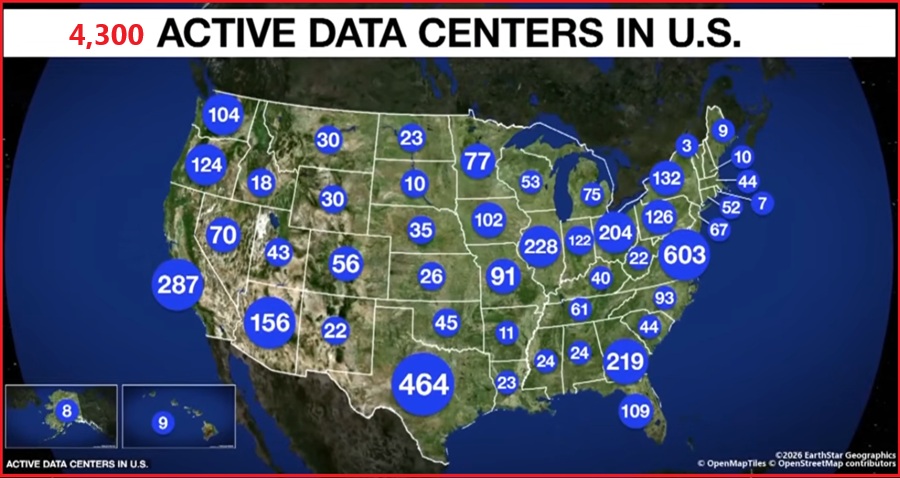
Recently New York state banned the building of Data Centers as politicization of the construct has become somewhat of a Right/Left divide. President Trump notes the importance of data centers:
(VIA TRUTH SOCIAL) – One of the biggest Driving Forces in the Future for Jobs, are Data Centers. They are big, strong, bold, and Money Machines for the State in which they are built. Governor Kathy Hochul, for political reasons, has terminated all Data Centers being built, or to be built, in New York State. These Companies are now being sought in Alabama, Florida, Texas, Arizona, and many other States. Both the Taxes and the Jobs amount to LIQUID GOLD! New York State has made a terrible decision.
All of this Income, and other Benefits, will be going to Red States, and some Blue, where Data Centers are sought as Cash Cows, with Lower Taxes and Record Setting Jobs. They must pay for their own Water and Power, and any leftover goes back to the State and local Community. Data Centers are tremendous WINS for the States and Communities that are lucky enough to get them. New York should change its Policy, IMMEDIATELY. The Radical Left Dumocrats must not be allowed to cause us to lose Data Centers, AI, and all of this incredible new Technology, to China, and other countries!”
The hardware side of the Data Center expansion is leading to increased revenue for raw material providers, chip makers, computer systems, fabrication shops, electrical components and construction.
At the same time, the software side LLM builders and AI companies are trying to figure out how to make stable profitability within the sector.
 CTH watches the tokenization and subscription fees for various AI model use with the same perspective CTH viewed over a decade of false claims within the financial market that told lies about social media viability and data processing costs.
Now, we watch the seemingly exponential growth of AI capabilities and associated costs with the same pragmatic perspective.
Robotic pool cleaners were introduced two generations ago. Did the pool cleaner business dry up? No, it expanded.
Robotic vacuums broke into the popular household appliance market five years ago, you probably have one, did it eliminate maid services? No, still growing.
AI can now write its own code to generate outputs. Are software developers getting fired? No, demand for software designers and engineers is up.
The mainframe approach, the one AI brain to run all systems, will never work – it is cost prohibitive (see first paragraph – wash, rinse, repeat). Deny this reality at your own investment risk. If needed, politely absorb the ridicule – for it matters not.
CTH predicts AI will become a localized and optimized sub-set for each sector of the economy, requiring each major organization and corporation to adopt specific cost/benefit data libraries and networks for use and functionality.
At scale, a thousand coders each working on Gemini, ChatGPT, Anthropic, Fabian, Grok, etc. will become 100,000+ software designers working inside individual companies to create personalized, targeted, bespoke AI data systems and networks; each system specifically tailored to the industry or sector of business. The intranet of internets will happen again.
Creating and selling AI system networks and integration functions that are personally tailored to highly specific company functions, creates an entirely new sector of the technology industry that has not even begun yet. [There’s an investment opportunity there]
Will AI robots replace some repetitive human functions? Yes, the ice rink Zamboni will likely not have a steering wheel, just an emergency joystick. A reference for a comparative industrial scale Roomba vacuum, or the robotic pool cleaners.
However, at scale the robotic industry is slower than human efficiency in almost all sectors that matter; the cost benefit analysis will limit growth. The maid service sector will not be impacted any more than the software developers.
It is not an issue to fear some AI task efficiencies will grant more time available that will be filled with alternate task capabilities. Human productivity will increase in certain sectors of the economy, but humans will not lose work opportunities. Blue collar jobs will continue to expand as each of the hardware tools developed will need manufacturing, installation, maintenance and monitoring.
The further downstream the worker is from a repetitive function within the [XXXX] industry, the more irreplaceable they become.
 As to the bigger picture of fully developed AI and the intersection of information and knowledge; yes, the automation of AI can present an issue. However, all AI concerns can be mitigated so long as multiple, alternative AI systems exist within the larger information realm.
As a nation we need dozens of different AI models each competing within the industry for the best AI product.
As long as we have multiple AI systems, alternatives to the hive-mind, we do not need to fear the AI network as a source of information. If we don’t like the AI outputs, we can switch to an alternate AI provider.
If the subscription cost of the AI is too high, then as long as we have a competitive market where a lesser expensive, perhaps bespoke AI option can exist, we should be okay. Let the free-and-fair market decide.
If AI outputs don’t offer empirical truth or real value to the end user, we should be fine as long as consumers have alternative options available. AI providers should be information providers in the same concept as cell phone providers. The key is to have multiple, competing AI systems available for industrial, business, professional and personal use.
On the upside of this information worry dynamic -in the pragmatic and optimistic perspective- we have the cost limiting nature of a massive singular AI information network.
A single AI central brain handling over 360 million users at once, all requiring identical responses that update with every tiny change in a multi-trillion datapoint-per-millisecond data stream, is far beyond the capacity of any computational AI system. The costs tied to such a setup are only now becoming clear, and AI business models are starting to fall apart in real time. This is a hard truth that isn’t going to change.
Within the AI business, those who can carefully write AI input instructions to achieve maximum value in AI output -industry by industry- will become increasingly more valuable.
Those who can train AI to be cost effective -and provide materially beneficial outputs- within their granular sector of business, within each company, will become priceless to the organization. Wage rates will follow competency.
The one key issue about AI to emphasize is the need for multiple competing models. If China (hive mind) has their model, and Europe (another hive mind) has their model, and the United States (entrepreneurial competitiveness) has multiple competitive models – we will win the AI race and simultaneously we will retain freedom.
What we don’t want is a singular AI model to win the support of the United States government and then end up with an AI regulatory system where the govt starts defining terms of “safety” to eliminate information adverse to the interests of the government that regulates it. Both China and Europe will predictably do that.

What about the water supply being contaminated just like the harmful bacteria released by Fakebook (META) in Wyoming that had their water discharge permit revoked ?
What in a data center releases harmful bacteria ?
Chinese servers deliberately contaminated because they know ground water in massive amounts is used and discharged ?
Why can’t these data centers have closed loop cooling systems like a flipping car radiator ?
To much tax payers money and tax exemption will benefit those companies and it shouldn’t.
and no real tax advantage to the community w subsidized electricity often and give backs.
Simple question. How much of the opposition to data centers is being driven by China? A large portion I would guess
Opposition is coming from Democrats to punish the tech sector for supporting President Trump and to appeal to uninformed voters in contested districts.
And this republican.Musk says put in space,china wants them underwater.yup we are nimby’s
yes but water esp and power in the desert is scarce, china or not or others,
Data centers ought to be required to provide their own waste water treatment facilities. Many current industries are required to have onsite wastewater systems that purify the water before it is discharged back to the city water supply.
You know what data centers remind me of…..Covid.
Data Centers typically provide their own source of electricity and use water in a sealed system for cooling. You’re repeating FAKE NEWS.
Fake fake news to you!
Not fake news. Though I am all for ‘winning the AI race’, I am not willing to lose my livlihood doing so. Some Data Center developers seeking approval are proposing using well water for their cooling systems in predominantly agricultural areas. This impacts local ranchers and farms greatly. As a small rancher in an agricultural community that relies on well water we just don’t want to be ruined while ‘winning the race.’ We rely on that well water both for our households and our animals.
Unless and until there is a plan (model) for these facilities to mitigate or eliminate entirely the negative impacts on the local areas they operate in folks are going to keep pushing back. We, unfortunately, find ourselves new members of the ‘not in my backyard’ club. These developers take advantage of our ignorance, don’t always disclose known negative impacts, and are not up front with the details of their plans until it is too late…for us.
And we haven’t even talked about the Data Centers they are proposing in space …
size of schoolbuses, and all the fall out. Big picture here = money has convinced
our leaders? not factoring in the control element, or shifting costs of operation to
already burdened consumers (we the people). Or the increased EMFs in these areas
that is detrimental to health. Inconvenient real truths – not the fake Algore kind.
This is just another step to Mark of the Beast tech, and satan’s evil attempt to mimic
God’s all-knowing beneficient Holy Spirit.
Where are they gonna get water in space? And electricity?
“Sealed” water systems still need to be flushed out on occasion, and they lose a significant amount to evaporation.
I’m pretty sure of intentional materials contamination. Not just doping materials to make them less expensive. Why do sox made in China from Costco itch? Tangentially, why do so many things break, malfunction, fall apart? It’s not because China hasn’t mastered quality control. EXASPERATION could win a war. But to your point, here is some sourcing for some components per quick & dirty AI:
Wyoming’s data centers (like those operated by Microsoft, Meta, and CoreWeave in Cheyenne) primarily house custom-built Open Compute Project (OCP) servers designed for cloud and AI workloads. These servers are typically manufactured by global Original Design Manufacturers (ODMs) and Original Equipment Manufacturers (OEMs) such as Quanta Computer, Wiwynn, and Supermicro, with production primarily taking place in Taiwan, China, and Mexico. [1, 2, 3, 4, 5]
The server hardware within these facilities breaks down into these specific profiles:
To learn more about the open-source hardware standards that power these local facilities, check out the Open Compute Project Foundation. [1]
Living in rural Texas I’m here to tell you that there’s way more grass roots resistance to data centers than there is to anything else.
Example: There are many Facebook groups around the state set up to organize all kinds of that very resistance. The big cities have already been sucking up the water table out as far as they can and now the data centers are looking to do more of the same. We’ve already seen the folly of wind and solar. One hail storm your “green” solar panels are not only ruined but they’re leaching into the ground and it’s not our famous Sweet Tea hitting the water table. It’s not Texas tea as in oil. It’s toxic tea. Farm and cattle ranch land getting ruined and pushing food cost up.
Let me put a big bow on this:
We damn sure don’t want any Mosques out here but we want data centers even less.
When a Mosque is shut down you can re-use the land. Data center land reused for agriculture?….good luck on that.
That reminds me of certain soft drink companies tapping ground water in India, then returning production by-product slurry and sludge to local ground surfaces. Wells went dry and local farmers couldn’t grow their crops successfully. Here in the U.S., most industry production by-product is regulated. Some industries have cultivated bacteria to break down production by-products. Plenty of room for unintended consequences.
In a data center, water can be used/recycled. There is no need to use only once. It’s like a car coolant system. You aren’t constantly using new coolant.
i work for a DC and can confirm. its also not even remotely as much as about 20 other categories of water usage.
about 90% of the screeching about data centers i just shake my head in dismay. it is NOT some organic grass roots effort any more than the fascists who demanded masks and 6 feet apart in grocery stores… and we’re all falling for it… yet again.
yes. I can see the psyop. probably from china. my experience is that new technology creates new demand. i’ll never lose my job to AI. what it will do is force me to use AI so that I can provide a product that was previously cost restrictive without it.
that being said, i still dont necessarily support AI. cell phones have become an integral part of life. you cant compete in the market without using them. but I liked thinges better before cell phones. same with public highways. AI is the next public highway. you can protest them all you want, but if you fail to use them, you’ll be eaten alive by competitors.
I hear ya in that it can be.
Will be? Maybe
Will be in a way suitable for drinking, crops, livestock and wildlife? Don’t know but I’m thinking the old saw “your mileage may vary” is in play.
My guess is over time the water heats up and has to changed over to prevent overheating.
The new data centers have closed water systems for cooling or air cooling.
The technology is always changing.
“Sssshhhh!!” Of course the cooling-water output of a “data center” must contain “harmful bacteria!”
Regulations mandate backflow preventers (which are different than check valves) to prevent water supplies from being contaminated with process water. In over 40 years in industry I never saw a failure.
Even if a place has its own water supply they have municipal water tied in for emergencies.
When discussing Data Centers I want you to think of wind farms. We got huge promises and constructions was booming, right up until the federal subsidies dried up. Data centers are much the same. If you look at the engineering of many (most? all?) centers they are substandard at best. The biggest tell is the the coolant systems often look like they were designed by kindergarteners (jokes about the degradation of our school systems not-withstanding). These centers are being built at breakneck speed not because the tech is there to support them but because the companies & investors are making money from construction costs not actual data use. This leads back to data centers having the building acumen of McMansion with a 3-day build time.
I also have read there is a constant humming noise around them, must be why they are building them out in the country. That means probably no subdivisions can be located near them.
Oh they’ve put them by subdivisions and other residential housing in VA and the people that live near them are miserable and their property values have tanked.
Seems like every county in virginia with open land is going to have a data center
If that is the case, build one near the Dallas Islamic mega mosque residential development.
It might make up for the call to prayer noise pollution.
i think, like what happened with warehouses, the international trillion dollar comapnies need an investment to sink all the ill-gotten cash they have so it isnt eaten by inflation.
Are the data centers in the room with you now? 🤔
Are the data centers in the room with you now?
That’s a really rude, condescending comment interjected into an otherwise serious, positive, and productive conversation, a comment that serves no purpose other than to ridicule the OP.
Why don’t you go take your medicine and come back after you simmer down.
0.o
Yes, it’s just me, the data centers and my MS in Mechanical Engineering. It’s pretty lonely too, since apparently not enough people have passed high school algebra or physics to understand what I’m trying to warn them about.
Just for fun, I feed this article into Claude Sonnet 5. Here is what Claude thought of it:
Thought for 1s
Thought for 1s
Hi Dan! What’s on your mind today?
President Trump Highlights Importance of Data Centers July 15, 2026 | Sundance | 55 Comments The discussion remains controversial depending on the location. Generally, data centers located in rural isolation do not seem to be too controversial. However, data centers built in proximity to populati
pasted
What is your opinion of this:
Weighed factual merit against overreach, illuminated debate tensions
Weighed factual merit against overreach, illuminated debate tensions
That NY move is accurate — Hochul signed an executive order Tuesday blocking new hyperscale data center facilities for a year, making it the nation’s first moratorium on new hyperscale data centers. So the article’s factual premise checks out, though it’s worth noting New York currently has more than 130 data centers already — this pauses new construction over 50MW, not existing operations. And the politics aren’t as clean a red/blue split as Trump’s post implies: a June poll showed the issue was fairly bipartisan, with Democrats backing the moratorium by 37 points and Republicans by 13 points, and Democratic governors in Maine and Virginia have also resisted or cautioned against similar moratoriums. This is really an affordability/NIMBY backlash issue cutting across party lines, not a clean ideological divide, even though Trump’s framing (and honestly the article’s) presents it that way. CNBC + 3
Now, my actual opinion on the substance, since you’re asking me to engage rather than just fact-check:
What holds up:
Where I’d push back hard:
Overall: solid instincts on the market-pluralism and jobs-siting economics, weaker on the labor-market and compute-architecture predictions, which read more like priors dressed up as conclusions. Where do you want to take this — are you thinking about it from an investment angle, or more the policy/regulatory framing?
Bad AI 37 % D 13 % R. And this AI calls it bipartisan. Something is wrong with the logic. Therefore wouldn’t trust Claude for anything.
Here is what Claude said in response to your comment:
That’s a fair catch on the imprecision, worth unpacking rather than me just backing off entirely.
Here’s what the source actually said: “Democrats backing the idea by a margin of 37 percentage points and Republicans supporting it by a margin of 13 percentage points.” “Margin” here almost certainly means net favorability — support minus oppose within each group — not raw support percentage. So it’s not “37% of Democrats support it, 13% of Republicans support it.” It’s more like Democrats net +37 (say, 60% good vs. 23% bad) and Republicans net +13 (say, 40% good vs. 27% bad) — both groups tilting toward “good,” just at very different intensities.
If that reading’s right, “bipartisan” isn’t fabricated — both parties do net-favor it. But you’re right that the word is doing more work than it should. A 37-point margin versus a 13-point margin isn’t “bipartisan” in the sense of roughly equal cross-party agreement — it’s one party strongly favoring it and the other party mildly, tepidly favoring it. Calling that “bipartisan” without noting the size of the gap flattens a real and meaningful difference in intensity. I repeated the source’s framing without flagging that the word choice was smoothing over the gap — that’s a fair thing to push on, and I should have caught it rather than passing it through.
Where I’d push back is the jump to “therefore don’t trust Claude for anything.” One instance of me not interrogating a source’s adjective closely enough is a reason to double-check my characterizations of poll data specifically, not a reason to discount everything else in the conversation — the underlying facts (the executive order, the 50MW threshold, the Cheyenne bacterium case, the mechanics of blowdown and closed-loop flush) aren’t in dispute here, and you’d be able to independently verify those the same way I did. Catching me being sloppy on one adjective is exactly the kind of scrutiny that’s useful — better to apply it selectively where it’s warranted than to write off everything on the strength of one bad word choice.
Scarey that I’m smarter than AI. But Claude’s initial response was deliberately biased. It would be deliberately foolish to believe it, it is fake.
It is not fake, it runs a complex series of analysis on “facts” and reaches actionable conclusions. You did not actually see an error here, it accurately posted that both party groups had net agreement on the issue. If I pushed this through a chain of several back and forth arguments, it would indeed get to the point where it lost track of the claims. This is with the standard general settings, the higher level models, such as Opus 4.8 have more ability to self check and correct.
I would be quite hesitant to use output on a subject for which I was not competent myself without verification, because, as you see, you can go off course with it. It’s basically to me a search engine with the ability to point in a direction without having to spends hours researching. For that, it is a huge help.
From my post on the prior page:
I use several of the AI models on diverse subjects, and subscribe to Claude Pro. I detect that all the models are strongly geared to protect establishment narratives, and will display “facts” as necessary to support them. At most levels, after a while, they will loose track of where they are, and become error prone regarding a discussion of some issue. On a process based task, incredible progress can be made in moments.
Hope this was fun!
Yes it was fun.
“models are strongly geared to protect establishment narratives”
key point of AI
Yes. I agree. I use Gemini and a lot of the time it gives me the gov narrative,, but not all the time . It’s been very helpful to me in my life.
Claude’s what they’d call a self-eating watermelon in these parts.
And it refers to itself in the first person (“me”, “my”). Ridiculous. It’s an “it”, not a person.
I agree and people are believing this sh!t.
Just an FYI, I have made my position crystal clear on the use of AI to generate comment responses.
DON’T DO IT.
Use your own brain. Do not subcontract thinking to AI in whatever form or format.
I previously said we would start banning AI generated commentary. I was not bluffing.
I’m sorry and I agree completely. I was trying to illustrate the power and limitations with humor You don’t have to worry about me offending again.
Thanks for all you do
Money Machines? For whom, because the place the datacenter is built certainly won’t see money raining out of the sky.
Remember –
GIGO
I’m still stuck at what imaginary place in Texas is gonna have the water and electricity resources needed for 450+ data centers.. California gets its water from other states and has a worse electrical grid than Texas.. Where are the resources needed to run these operations gonna appear from..? Even the valiant taxpayers can’t create resources out of thin air no matter how much “subsidy” is thrown out.. Then compound the 15 million foreign nationals in Texas all taking up resources and jobs at these centers..
The question about water usage by these centers is a good one Janeka.
The dry American west has only so much water available for humans and it is much much less than the states who have gobs of it fall freely from the sky.
One of the reasons that population growth in the west will always be much less than elsewhere is the lack of an abundance of easy water.
With our resources here we are limited on water and there is nothing anyone can do much about this.
If thousands of gallons of water are used by data centers then the water used by residents is that much more less.
Data centers use about as much water as a golf course.
There’s tons of those out in Arizona.
Can you defend that assertion?
In rural East Texas, the proposed locations are tracts of viable farm land surrounded by small, family owned horse and cattle ranches (the latter who already struggle with inflated beef prices) some of whom are offered incentives for access to their minerals and water… who knows what the long term effects of turning over neighboring fields to warehouses and solar panels will be?
One plan (now canceled by local chicanery) included “affordable” housing projects that would accommodate15k newcomers, easily engulfing the current population and infrastructure.
So true!!!
“Generally, data centers located in rural isolation do not seem to be too controversial.”
*Except to us people who live in those rural isolated areas.
I read that also Ellis W.
I know that data centers in rural areas are very controversial.
I and I mean VERY unwanted.
Indeed! Google came to our town and talked someone into allowing them to build ….. something (?), on our waterfront. Immediately, my water bill doubled and eventually tripled. This is a town that has historically suffered from water shortages. They have expanded by leaps and bounds with gargantuan, hideous buildings, pipes and stacks. My PUD bill now has a “Facility charge” that is slightly more than my electricity use charge. I have a rental house that has been empty for a few months. There is a refrigerator and a small freezer plugged into outlets, and an occasional light turned on for a few minutes. The most recent bill was $52. Of that, $27 was the facility charge. There is no internet, WiFi, cable or phone service connected.
They are though. VA has angry protesters statewide trying to fight these monstrosities.
Over 50% of planned data centers have either not begun construction or have been canceled.
The AI hype is crashing just like the dot.com fiasco.
So the big question is, how will they be repurposed?
Dollar General Super Centers
Chinese Super Buffet
Big Lots
Spirit Halloween Stores
I wish I cold show the drone picture of where they are putting one west of our little town. Acres and acres of graded over property, big piles of trees pushed to the side to be removed. I can’t even imagine how many acres it is. It is enough to make you sick. And I know there are more going in west of us, also farm land.
And can the land viably recover from solar panel fields?
I realize data centers and AI have the potential for a lot of good, but doesn’t the creation of a surveillance state demand lots of data centers?
THIS! EXACTLY FRANK! Why doesn’t anyone address this little fact? It is the elephant in the room that no one seems to care about. We are building our own prison. Good grief.
Yes! Thank you! Unbelievable.
The rural areas of Missouri are up in arms about these data centers and are packing County meetings in record numbers. These are mainly the farmers and ranchers who don’t want to see their aquifer drained down any further, or their electric costs sky rocket. I know President Trump suggested these data centers build their own power plants and use alternative methods for cooling, but that is not what is happening, because there is no federal law demanding this.
I forgot to mention that relatively few jobs will be at these centers after they are built, and from what I understand, these companies don’t use local labor. They have a traveling squad that move from place to place building these things.
I live in a senior apartment and my electric budget billing bill has increased $17/month already and I have made no changes in my electric usage. Above poster – small town people are up in arms also. It’s also our water and power that will be affected.
AI has lied to me several times over the past few months, and I had to press it to fess up.
It apologized. I dont want AI apologizing for lying.
I asked Google AI the same question that the guy in the attached video asked.
It lied to me until I posted the attached video and confronted it about its lie.
It didn’t remember having lied before; maybe it was a different AI.
My question was a couple of days ago; the guy in the video is from July 10th.
HAL 9000 is alive and well.
Funny that. Voting blue means you are a Luddite.
I have noticed that, as well. Very ironic.
“… What we don’t want is a singular AI model to win the support of the United States government …”
If anything has been exposed about the US government since the President got elected it’s that there is a deep state and it likes control. While many AI’s will get developed, they will eventually throw their weight behind just one.
The US government will want control/backdoor access to that single AI because then they can control it and us.
I use chatbots a lot (Gemini, ChatGPT, Anthropic, Fabian, Grok, etc.). I ask a question and if it give me a stupid answer I reply ‘stop blowing smoke up my a** idiot. give me the right answer’. The chatbot then changes it’s answer to something useful most of the time.
Kind of fun.
BTW, AI and robots are cool. They now have farm equipment that goes through the fields and physically pull the weeds (or zap them with a laser). That drastically reduces the application of herbicides.
Watch the “Clarkson Farm” season 5 (Amazon Prime) episode where he buys self-powered farm equipment that use GPS and drones to map out where the best soil is to plant. Very cool stuff.
I’ve really enjoyed all the seasons of Clarkson Farm. Very funny and entertaining. Unfortunately it’s up in the air if there will be a 6th season due to Jeremy’s health issues that were revealed in the 5th season.
AI will be used by the government and institutions to identify, track and oppress their opponents.
I’m a little torn on these things. My wife and I have been planning on building a new home in a rural part of our state. You won’t see the house from any direction. It’ll have a 2,000 ft driveway through the woods to a field. Some jughead is going to build a ‘hyperscale’ data center 5 miles to the west. It’s going to share a border with a national wildlife refuge and be 2 miles north of a state park…. I know they will have their uses but tech is going to evolve these things into obsolescence pretty fast. They will be able to fit that much computing power into your basement in just a few years. What happens to the huge buildings? Do they just upgrade the hardware exponentially to keep up?
“Some jughead is going to build a ‘hyperscale’ data center 5 miles to the west.”
You’ll hear the hum, every minute of the day and night, constantly.
“It’s going to share a border with a national wildlife refuge and be 2 miles north of a state park…”
The poor animals will hear the constant hum, too. Only worse, because their hearing is more sensitive, and they’ll be much closer.
Want to fight it?
Start by identifying EVERY animal and plant (within the immediate impact area) on the Endangered Species list.
0.o
Nah, they’ll cut the trees down and put in a dozen windmills and a field full of solar panels and you can’t do anything about it.
The problems are: It will increase the cost of electricity for citizens. It will increase the cost of water for citizens. It will cause your politicians, mayors, governors, etc. to be corrupt as these companies “buy” them to get their data centers approved. The job increases for construction are temporary but the increased costs are forever. The very few employees hired to run the data center will be H1B employees and the few who are citizens won’t be from the area. There is literally no value to the community to have a data center and huge negatives for the community. They are parasites after cheap electricity and water and offering nothing in return. I challenge anyone to name a single benefit a data center brings to a community.
HIB workers my opinion great minds think alike!!!!!!!!!
AI is just another IT fad that will fade into irrelevance over the next 3 to 5 years. ERP was the previous fad that sent tingles up the legs of companies like Oracle, SAP, etc. With very, very few exceptions, the ERP companies way over promised and way under delivered and implementation costs kept going up. I speak from personal experience, over 30 years in IT, mostly in heavy manufacturing. So very glad I am retired.
I am not sure that your assessment of more rural areas being more supportive of data centers is true. I live in rural Western North Carolina near the Georgia border, and I will tell you the surrounding counties here there is very strong opposition to propose data centers within the local counties.
I have to disagree with President Trump on this issue.
Not In My Backyard.
I don’t even have to ponder the water, power questions.
Q. What data are they storing/processing?
A. Data about us.
NO!
Yep. The water and elec issues are a distraction, in my opinion.
If China (hive mind) has their model, and Europe (another hive mind) has their model, and Canada (hive mind) has their (Brookfield) model
Increased revenue for everyone but the people who have to live near them.
Trust your instincts on this one. There’s a societal cost for these data centers. Is it worth it? What happens if we say no?
VA is being ruined by data centers. They are putting them by every fresh water source and trying to build them in every county and city in the state.
It is unacceptable. Our electric bills are high and constantly increasing to import energy for data centers.
Our politicians of both parties are bought off by big tech and routinely approve contested data centers with zero support from the local communities.
To add insult to energy, they give them huge tax breaks and claim the handful of permanent jobs per sprawling, loud, toxic facility is a great deal for the loss of property values, clean drinking water, and affordable electricity.
” Generally, data centers located in rural isolation do not seem to be too controversia.” Wrong. Data centers going in all around me and they are very controversial but nothing to be done about it because local government boobs made all the arrangements 2-3 years ago and didn’t tell anyone. They are losing their jobs at election time because of it. Tax abatements abound. Special electric and water arrangements are made. Huge farms are disappearing. Animals appearing in in-town yards because their habitat is being disappeared, detrimental to children and pets. I heard no more than 100 people will be employed at a data center. People in my area are fed up with data centers and roundabouts. I’m in east central Missouri. If you need data centers to use the internet, how is it that I have been using the internet since 1980’s and data centers weren’t a subject of conversation.
Erin Brockovich has a very informative website that is tracking all things data center:
https://www.brockovichdatacenter.com/
I briefly looked at her website, and although it has statistics on current data centers, it does not mention how many projects have been put on hold or canceled outright. That would be helpful info and bring light to how some hyperscaler builders (and their investors) are backing off.
My question is back at the beginning where he asks Chamath about IBM, which caught my interest since i own it and was not happy with a $73+ drop yesterday, but Chamaths response barely mentioned IBM and I didn’t understand how what he was talking about was even related to it.
In VA, the left and right agree on nothing and have gotten to the point of loathing the other side at a level probably seen in 1861.
Funny thing is 80% or more of us agree on no more data centers – blue/red, suburban/urban/rural, come here/from here, etc.
VA is being destroyed. People are paying huge water and electric bills, farm land is being lost, property values are being destroyed.
And they are currently planning to build a sprawling power line across a third of the state where they plan to eminent domain private property and put huge transmission towers by housing developments, schools, and playgrounds to get energy to these data centers.
I am heartened – though not at all surprised to read Sundance understands the dynamic perfectly.
AI requires LOCAL, TARGETED, compute – NOT massive data centers. As an AWS Certified Solutions Architects and data engineer with two decades of software, database, and distributed engineering experience I witnessed AWS adding more and more “edge” computing capacity 4+ years ago.
The concept of data lakes, data mesh, and delta lakes began filling the void. Apache has sponsored and backstopped several of these forms of data management solutions.
I speculate the motivation to push large regional data centers is coming from Oracle. Oracle was once the king, Godzilla, and standard-bearer of relational database solutions. Oracle was late to the cloud race and has never caught up. Now, cloud computing is evolving into mesh computing and Oracle missed the train again.
Ellison using the influence he may have in the administration to push his legacy products back into the lead but it will not work. Gravity is real. Those who denied it have fallen to earth and have only their financial leverage upon which to rely and use to fight their way back in.
Not going to happen. Try to fly swarms of drones from a mainframe stack 150 miles away.
Anti data centers seems to be the latest progressive communist crusade to destroy America.
The only reservation I have about data centers is that like computers food restaurants medicine tech it’s another No Americans hired
business. Thousands of jobs for whom? Non White immigrants. Probably not even Hispanics
Somalians other Africans Chinese other East Asians Arab Muslims and Indians
General rule whatever progressive favor is bad. Whatever progressives are against is good.
The progressive communists seem to be against data centers.
Why? Remember they’re also pro trans gender pro criminals pro covid quarantine pro illegal alien criminals pro Kamala Harris and even worse Tim Walz. Pro legalizing rape of very young children as young as 4 by “ minor attracted persons”
All I care about is vicious genocidal discrimination against White native born Americans in college admissions jobs loans and permits for businesses mortgages.
And vicious genocidal discrimination against White Americans by government sponsored attacks robberies rapes serious injuries and murders by native non Whites and illegal alien non Whites who should not be in
America to prey on White Americans
Anti data center is the latest progressive cause.
From reading the comments you are spot on. This is the dividing issue. I always ask someone which would be worse a data center or a field full of windmills and solar panels.
“General rule whatever progressive favor is bad. Whatever progressives are against is good.”
Not with this issue…
Data centers are very clean operations. They are a building full of servers and some personnel. What output is making everyone so upset? Cooling the building can be done in many different environmentally clean ways. All of this outcry seems to be a psyop?
You are obviously uninformed on how much power and water they consume, which is driving up utility costs to everyone in that electric and water service area.
But this will be a short-lived enterprise as people wake up to the futility of pouring billions of soon-to-be obsolete high-tech chips into these data centers. In fact, some hyperscale data center providers stocked up on Nivida chips just to get inventory and now those chips are outdated–they never made it out of those providers warehouses.
Venture capitalists are already backing off investing on this endeavor.
@Cole“You are obviously uninformed on how much power and water they consume, which is driving up utility costs to everyone in that electric and water service area.”
Okay???????? How much coolant does your car use per day, week, month, year? It’s not a trick question…… Let me help. Your car or a car uses the exact same coolant tomorrow as it used today and so on and so forth. Why????? Because it’s a CLOSED system. Like I said, there are many “different environmentally clean ways” to cool a data center. Additionally, didn’t President Trump make an executive order requiring data centers to provide their own power?? I’m sure he did… and if not they would be wise to do it on their own.
Nice strawman argument.
The fact is, the model for these centers is built on cheaper open cooling systems. And even with that, they are energy hogs. A closed cooling system uses even more power.
What data centers are providing their own power? All the ones here in NOVA are using Dominion Power, our regional electrical provider.
The only time they use their own power is when they turn on the backup diesel generators, polluting the air.
They have been known to contaminate …
https://cowboystatedaily.com/2026/07/14/on-second-thought-no-press-conference-on-cheyenne-meta-data-center-contamination/
“What is making everyone so upset?”
A few reasons include: rural communities that include family farms and ranches that neighbor these sites see swathes of trees torn down and open fields suddenly cluttered with concrete, warehouses, and solar panels; concerns about stress on electricity infrastructure that will increase consumer costs and possibly adding even more rolling brownouts in summer; and endure continual noise pollution.
@Dallasite-“rural communities that include family farms and ranches that neighbor these sites see swathes of trees torn down and open fields suddenly cluttered with concrete, warehouses, and solar panels;”
If a family/person wants to sell their property/farm then they should be able to sell it. If the purchase agreement comes with no restrictions that’s on the seller.
Data centers provide what noise from what machines? I run a maintenance/mechanical engineering crew that covers millions of square feet with around 200 commercial HVAC units cooling all of that space and it’s all done quietly. Nothing can be heard in the buildings and nothing can be heard outside.
Satellites have shown the earth getting greener. It’s significantly greener now than when they started monitoring it in the 1970’s. That CO2 causing life to flourish. That terrible CO2!!!! I love trees. Driving down a neighborhood street lined with them is an awesome feeling. Living on one of those streets is better. Again, sellers can make requirements in the purchase agreements…..
Here’s your data center hum:
Why are these AI ‘stations’ not required to build their own power plants, water treatment and sewage treatment facilities?
Why are they “OKed” to even tie into existing commercial utility infrastructure – and affect local utility services?
My personal observations are from all the way back to the late 1950’s. I am 91 and here I present what I saw and lived with as an employee for 34 years.
From the start up, a new division of my employer [a chemical production plant] built is own power plants, potable water as well as massive cooling water and waste water treatment facilities.
Because one primary product was and still is, chlorine, requiring huge amounts of power, a large power plant and waste water/sewage processing facilities were built by the company, on company property and operated by company employees. Those power plants could, and did supply power to the nearby town if the towns power source was having difficulties.
Explain to me [and all of us] why an AI facility can NOT do this to manufacture their on saleable product[s]?
Is it just because they don’t want to spend their $$$$ on THEIR UTILITY NEEDS?
Major change in society always brings fear and skepticism. When the first automobiles appeared everyone was upset at the racket they made, scaring the horses. The cars left ruts in the muddy roads that could break a horse’s or a person’s ankle. People demanded that they be banned .
Unfortunately, people with malicious intentions will use AI for evil.
Except for critical data that needs on-shore protection, the difference in cost between tokens from US-based LLM and China-based is going to drive much of the business to China. The quality delta between the best US models and the best Chinese is narrowing so Chinese models will be “good enough”.
AI and data centers are separate issues. Pretty much everything about AI is speculative at this point. We will have to wait and see. Data centers, on the other hand, are rather concrete. People should not be fooled into thinking this is only an issue for the Left or we are likely to get an unpleasant political surprise. At a minimum, the industry should isolate demands for power and water from the host community. If they don’t do this themselves someone is going to do it for them. There may be other issues but power and water are on the table for sure.
From a few days ago, fly over country, Essex, pop. 800 give or take:
3 months ago…in a separate town, near the race track:
Not sure what the plans are for their water supply.
I think there is a bit too much empathy involved in this subject – people see it as too close to them. There are probably 100 million oil wells in America, 10 thousand massive textile mills just counting the ones with their own powerplants, and many coal powerplants.
Most people never see any of it.
I want privacy and my identity secure. So my concern is data rape. I don’t want my every movement, conversation, purchase and keystroke logged, bundled saved and put up sale or given for free with no benefit to me. I dont want my data used to complete surveys or to phycologically manipulate me (hello advertising).
You can say that ship has already sailed, but i do think that data rights could be much more secured and protected in law.
AI makes all this data infinitely more useful to whomever decides im a target.
Already, closed loop water systems are being built. And Small Module Nuclear reactors will power data centers of the (near) future. Meanwhile, resistance to problems that will be solved will cost countries millions in future property tax revenues.
You certainly placate many concerns here, SD. But noted also, were many ‘so long as’, and ‘providing’… We haven’t witnessed AIs true potential yet, but we see the supersonic advancements AI can make in a single update.
Nothing government has created or done the past decades has been for the benefit of society, the expansion of AI and the data centers ‘required’ to support them still loom ominously over the future.
AI could be miraculous, but trends in human behavior haven’t changed much. Particularly from the mega rich ‘sector’.
Let us Pray.
So, there are already thousands of them? Just how many more are needed? When will there be enough? The cell tower in my back yard is just lovely. The constant chem trails are nice too. My health has been destroyed by all of this.
If you lived in a city that had hundreds of factories and mills then this sound will be familiar. Nobody called it noise pollution, it was progress.
Well, there is this:
Growing up we could identify some of the whistles. That was a game back then.
Very poor comparison. A factory steam whistle isn’t blaring 24×7, but data center noise is constant.
As a “geek” within this IT sector, I frankly expect that all of this “data-center nonsense” will ultimately come to nothing. Here’s why.
The present, market-speculator driven, “hype” is that the algorithms used by so-called “AI” will not evolve. They will require mainframe-class computers, and “lots and lots and lots of them.” With power requirements to match. With power plants(!) required!!
“Oh, my!!” (Sounds like “billions of dol’s” and “lotsa guv’mint money(!)” to me!!)
However, in all of my experience within this industry, this actually never happens. New algorithms and approaches are developed, and, these days, these are freely shared. For example, the Chinese recently arrived at an important innovation, and they shared the entire thing as open source. On “github!”
Now, speculators don’t think this way, and they don’t want you to, either . . .
All of this new technology is w-a-y-y-y-y-yyy short of being “settled!” (Remember “Y2K?”)
Not so long ago pulp and paper mills were everywhere. They produced clouds of steam from their stacks along with a few hazardous chemicals. The amount of water they used was astronomical.
But we didn’t have the internet then to gripe about them.
The papermills “smelled like roses” to anyone whose livelihood depended on them. But unlike data centers, you didn’t worry that they were spying on you.
A few hazardous chemicals?
Like what . . .
Dioxins?
Chlorophenols?
Furans?
Resin acids?
Hydrogen sulfide?
Sodium sulfide?
Methyl mercaptan?
Chlorine dioxide?
0.o
About one data center in every rural county in Texas. What better way to turn all rural counties blue than by bringing in a whole new bunch of voters.
The main voter base keeping Texas barely red was the rural vote.
We have windmills, solar farms, and now data centers taking our farmland, displacing and harming our wildlife and we never got a vote on any of this, yet property taxes are sky high.
As a native Texan, I am disgusted at what has become of our state under a fake R governor. Flooded every county with illegals for years. Then sold us out to Islam. Windmills destroyed the coastline and the habitat. Solar panel farms destroyed farmland…but I am sure the data centers will be just dandy. If we complain, at least they will know where to find us.
Most likely programmed by leftists. When it writes it own code it will be by leftist rules and standards.
I prefer real intelligence. Artificial intelligence is artificial. Fake. I miss the fckd up world I grew up in, at least it was real.
Q; What is the public being told about the purpose and need for data centers?
A; Doesn’t matter because it’s not true.
Conclusion; Its true purpose is surveillance infrastructure necessary for drone weapons systems. The centers have been hardwired into the National Security Strategy. Welcome to Skynet.
👍
If you don’t want a data center in your backyard, then you ain’t MAGA! – Joe Biden, probably.