Late last night (midnight) the House members were called back to session in order to vote on a procedural rule to facilitate a negotiated FISA(702) extension. The advancement vote failed to pass the House (200-220) collapsing the bill, which is not a bad outcome all things considered.
 House Republican leaders posted a compromise FISA amendment just before 11 p.m., and then called the House members to vote. The Amendment would have extended FISA (702) for five years and did include language that would have strengthened criminal penalties for misuse of the program, and some language that would have required warrants under certain circumstances.
However, there is strong opposition in the House to a FISA(702) extension that doesn’t contain a full warrant requirement when the FISA search targets, directly or indirectly, an American citizen. A rather eclectic group of Republicans including: Brian Fitzpatrick (Pa.), Andy Harris (Md.), Darin LaHood (Ill.), Thomas Massie (Ky.), Mariannette Miller-Meeks (Iowa), Zach Nunn (Iowa), Andy Ogles (Tenn.), Scott Perry (Pa.), John Rose (Tenn.), Keith Self (Texas), Mike Turner (Ohio) and Jeff Van Drew (N.J.) voted against the bill.
Leftists are voting against anything Trump supports, though there are some democrats who are consistent in their efforts to stop FISA (702) for many years. You can tell from the Republicans who opposed last night’s bill, that there is also a wide divergence of opinion on the issue.
My personal opinion is that most of the legislature, both parties, don’t have any honest understanding of how FISA (702) is used, has been used, and will likely continue to be used. While this effort at reauthorization may have failed, it’s not really a bad thing and more time for lawmakers to get educated on the core issue is always a good thing.
The root of the issue is the Fourth Amendment and ultimately the process that FISA (702) touches on, which is electronic surveillance.
The use of FISA (702) against a U.S. citizen has only been tested in one court case and that case wasn’t a great example {SEE HERE}. Only one case has ever pushed into the sphere of challenging this unconstitutional exploitation. A 2025 decision in the U.S. v. Hasbajrami case in Brooklyn, New York, where Eastern District Judge LaShann DeArcy Hall identified the misuse of FISA-702 “backdoor searches” regarding defendant, Agron Hasbajrami.
Politico has tried to make the FISA (702) reauthorization an issue of division between President Trump -who supports it- and Tulsi Gabbard who supports Trump’s decision. {LINK}
DNI Tulsi Gabbard appears to have just as many reservations as us about allowing the government to search an electronic database that contains our private papers and effects without a warrant. It is simply a Fourth Amendment concern.
At the same time, President Trump is told FISA (702) surveillance is critical for DHS, deportations, domestic terrorism intercepts and foreign intelligence use that relates to U.S. military application. All of which is likely true because the core of the FISA (702) search issue is warrantless real-time surveillance.
The collection of data, the database itself, as well as the search functioning therein, is part of the toolbox for FISA-702 surveillance.
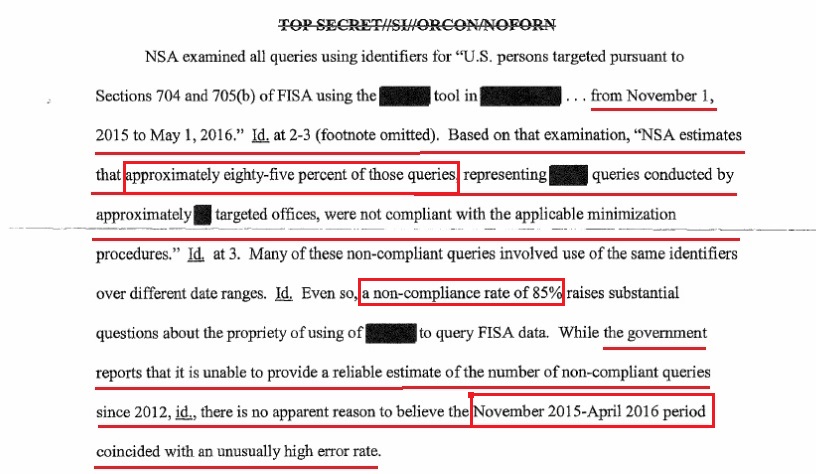 The historic problem is not that “authorities granted under FISA-702” were/are used to conduct surveillance; but rather the search of the NSA collection database was done, illegally and frequently, for non-authorized reasons.
The capability to conduct those search queries is maintained by justifying the need for FISA-702.
The historic searches and domestic surveillance were done by exploiting the NSA database, for a reason and purpose that is not authorized and has nothing to do with FISA-702. THAT’S THE PROBLEM.
The existence of the U.S. citizen data itself creates the opportunity to search it. The legal justification to search that database is done under the auspices of FISA-702; however, that’s not the issue. The issue is that searches of the NSA database are done by government officials and government contractors for reasons that have absolutely nothing to do with FISA-702.
As a consequence, it’s the collection that creates the problem. Not the legal process for searching it. As long as the database exists there will be unlawful intrusions into it for domestic and/or political surveillance.
If FISA-702 did not exist, the quasi-constitutional justification for the wholesale collection of U.S. citizen metadata no longer exists. It really is that simple.
There is ZERO justification for the capture of U.S. citizen data by the government. The capture itself violates the Fourth Amendment. The only way the government can justify the capture of U.S. Citizen data is if there is some quasi-constitutional or national security reason for it.
Take away “702”, and the data collection collapses; ANY “incidental” search of the database then loses any plausible legal justification. 702 is the camel’s nose under the tent.
If you remove FISA (702) from the toolbox you remove the legal authority to search the database when any American citizen data is involved.
It appears the House has given themselves two more weeks to continue trying to find a solution.
The whole Law about FISA is in violation of the 4th Amendment. GET RID OF IT. We have enough Deep State Spies ie. Communist Thugs, we don’t need to give them any more POWER!
SOLD OUT AT 2AM – Tier 2: The Next 16
Tier 2 Investigation: The remaining Aye voters with the most red flags in their financial records and deep dive investigation.
Leah
Apr 18, 2026
A Forensic Investigation Into Stock Trades, Late Disclosures, Defense Contracts, Earmarks, and the Conflicts They Don’t Want You to Find
“In Part 1, we profiled the nine worst offenders among the 197 members of Congress who voted Aye on Roll Call Vote 124, the procedural vote that brought the FISA Section 702 reauthorization to the floor at 2:09 AM on April 17, 2026. Those nine members had a combined $11.5 million in pro-Israel donor and lobby money, 4,000+ stock trades, offshore shell companies, sealed felonies, and federal indictments.
But the other 188 Aye voters are not clean.
This report examines the Tier 2 group: sixteen members whose financial records, ethics violations, and personal histories raise serious questions about why they voted to extend warrantless surveillance or be in Congress period, to be honest. These are not backbenchers who rubber-stamped a party vote. These are members with late stock disclosures worth hundreds of millions of dollars, defense contracts held while serving in office, insider trading investigations, real estate self-dealing schemes, and the kind of personal scandals that make them vulnerable to leverage.
The pattern from Part 1 holds; the members who pushed hardest for FISA reauthorization are the ones with the most to hide. They have the most financial entanglements with the defense and intelligence industries that profit from surveillance. They have the most reasons to want investigators looking somewhere else, and they have the most reasons to keep a surveillance program alive that could, in theory, be turned against them….”
https://open.substack.com/pub/theleahfiles/p/sold-out-at-2am-tier-2-the-next-16
SOLD OUT AT 2AM – PART 3: THE DIRTY DOZEN
Tier 3 Investigation: Fabricated Biographies, Cover-Ups, Coal Lobbyists, and the Largest AIPAC Totals Yet
Leah
Apr 20, 2026
“Parts 1 and 2 of this series profiled 25 members of Congress who voted Aye on Roll Call Vote 124, the 2:09 AM procedural vote that brought the FISA Section 702 reauthorization to the floor on April 17, 2026. Between them, those 25 members had collected approximately $20.5M in pro-Israel lobby money, thousands of late stock trades, offshore shell companies, federal indictments, and sealed felonies.
This report examines twelve more. And the pattern just continues to escalate.
Tier 3 includes a congressman who was the sole vote against banning child marriage. A coal lobbyist photographed in a limo with a man later convicted in a $60 million bribery scandal. A congresswoman who fabricated her entire biography, including claims of Jewish heritage and a Nazi grandfather that her own family disputes. A former Judiciary Committee chairman who covered up sexual abuse at Ohio State University for years. And the single largest pro-Israel lobby recipient in the entire series: nearly $3 million to one member, but her financials lean towards millions more….”
https://open.substack.com/pub/theleahfiles/p/sold-out-at-2am-part-3-the-dirty