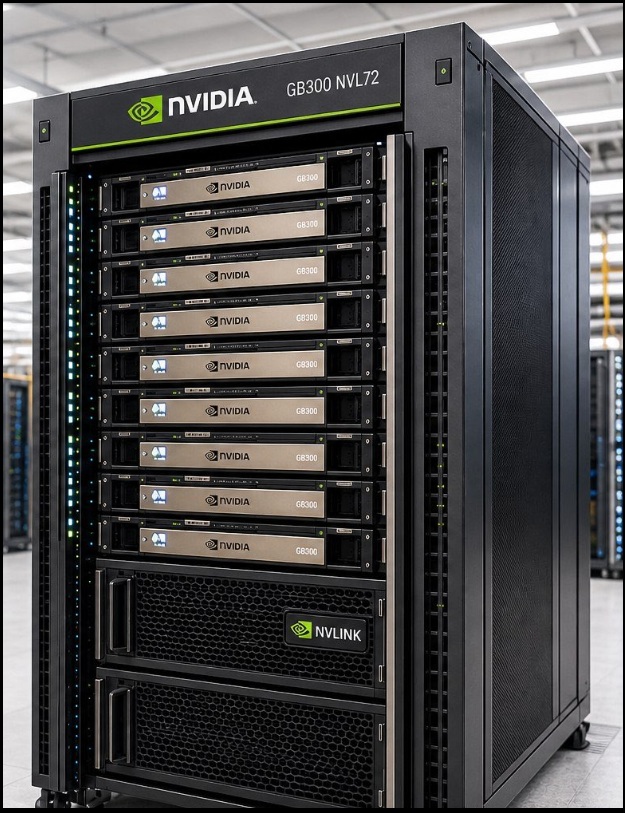
Following the claims by the New York Times surrounding Nvidia, Jensen Huang and the Singapore based Megaspeed company, Bloomberg dispatched three journalists to China to explore (ie. support the NYT narrative). Yesterday, Bloomberg, using information derived from Chinese loan documents, claimed Nvidia’s Blackwell GB300 chips were located on a server rack in a data center in Shanghai {CITATION}.
 Now, I have spent hours looking at the specifics of the claims {EXAMPLE}, and also reviewing the solid counter arguments that take apart the Bloomberg reporting {EXAMPLE} because there is just too much emphasis on innuendo and the phrase “linked to” is getting an extreme workout.
Additionally, CTH is not blind to the media motives behind the stories that seek to undermine the position of Nvidia and the larger independent AI frontier group.
In fact, there is a significant amount of evidence that media entities are actually being paid by NGO advocates of a particular inorganic control system that is positioning Anthropic AI as a big government alternative to free market, independent open-source AI. {CITATION}
The “you should be afraid of AI” group, are the same financial backers of people pushing Anthropic as the altruistic AI model that an equally magnanimous group of left-wing politicians will organize, regulate and deliver on behalf of government interests.
Unfortunately, that alignment alone tells us that Anthropic AI is the bad case scenario here. In fact, the “be afraid” messaging looks entirely constructed to assist Anthropic AI’s rush into the arms of the looming new congress regulators. Bloomberg is part of that team, and to ignore the politics of the narrative is to place a level of trust in media we should no longer possess.
That said, according to the reporting a Chinese tech company called Shanghai Shuoyao offered the Blackwell GB300 rack to Shanghai Innovation Bank as collateral for a business loan. This is according to lender filings submitted to Chinese regulators as reviewed by Bloomberg. The loan filing carried a serial number. Bloomberg entered the serial number into a public warranty database and matched it to a GB300 NVL72 rack built by Taiwan’s Gigabyte Technology.
How the server rack went from Taiwan’s Gigabyte Technology to a company called Shanghai Kezhan in China is entirely unknown. Emphasis on this part, because this is where the Bloomberg review starts making leaps of assumptions and connecting the Blackwell chips inside the server rack to Alice Huang, via this mysterious “links to” language.
Bloomberg never verified the physical location of the server rack, nor ever went to see if it is actually in China. They are operating entirely from a loan application that lists the server rack as an asset for a bank loan. No one even knows if it really contains Blackwell chips or not. There are layers of assumptions.
Bloomberg says it “does not have evidence that Megaspeed itself diverted Nvidia hardware there.” It identifies no part Alice Huang personally played in acquiring or shipping the rack, much less any part Nvidia or Jensen played.
As noted by Newman Nahas on X, “On November 13, Bloomberg reported that companies at this same Shanghai site received smuggled NVIDIA chips. In that story, Bloomberg looked at servers pledged as loan collateral in January 2025 by Shanghai Longjie. That entity happens to share a parent and lender with Shuoyao, one of the borrowers named in today’s story, which is reported to have pledged the Blackwell rack as collateral.
In that story, Bloomberg traced the Dell servers in that pledge to their original buyer, Singapore’s Aperia Cloud Services. Singapore prosecutors have charged individuals associated with Aperia, alleging they obtained servers by lying to Dell, Super Micro, and Asus about who would actually use them. Notably, those charges treat the server makers as the parties allegedly deceived and accuse NVIDIA of no wrongdoing.
So, what we know is that servers pledged by an affiliate of the borrower in today’s story were first sold to a buyer now charged with deceiving its suppliers. Today’s article mentions those same Dell and Super Micro servers. It notes that smuggled hardware is often “originally sold to parties in unrestricted areas.” And yet it feels the need to allude to Jensen’s affair. But Bloomberg’s own reporting gives every reason to ask whether Shuoyao’s obtained the blackwell rack the same way its affiliate did: through a middle-man who deceived suppliers about who would actually use it.” {citation}
If it all sounds confusing, that’s because it is. There is a lot of innuendo, suspicion and making inferences to connect Jensen Huang, Nvidia, Alice Huang and Megaspeed to a situation that may not involve any of them as it relates to Nvidia Blackwell Chips showing up in a server rack in China.
Remember, the serial number of the rack that includes the Blackwell chips actually originates with Gigabyte Technology, in Tiawan. It is just as reasonable to think that someone associated with that operation may have sold, shipped or smuggled the server rack into China; if it is actually located in China which no one is sure about. A standard GB300 NVL72 rack weighs more than 1,500 kilograms or 3,300 lbs.
Our team of Suspicious Cats, are, well, increasingly suspicious of this Bloomberg story.


Bloomberg is lying through misdirection… again.
so, we’re to believe the chynese allowed random reporters to prance around the country of chyna, unearthing intelligence at will
sorry, this is NOT how the country of chyna rolls
laughable
Hold me closer, Tiny Dancer.