You might remember former Air Force Secretary Frank Kendall (under Biden) who was stripped of his classified security clearance following an investigation which revealed him as the source of leaks surrounding Air Force One and President Trump’s security detail {GO DEEP}.
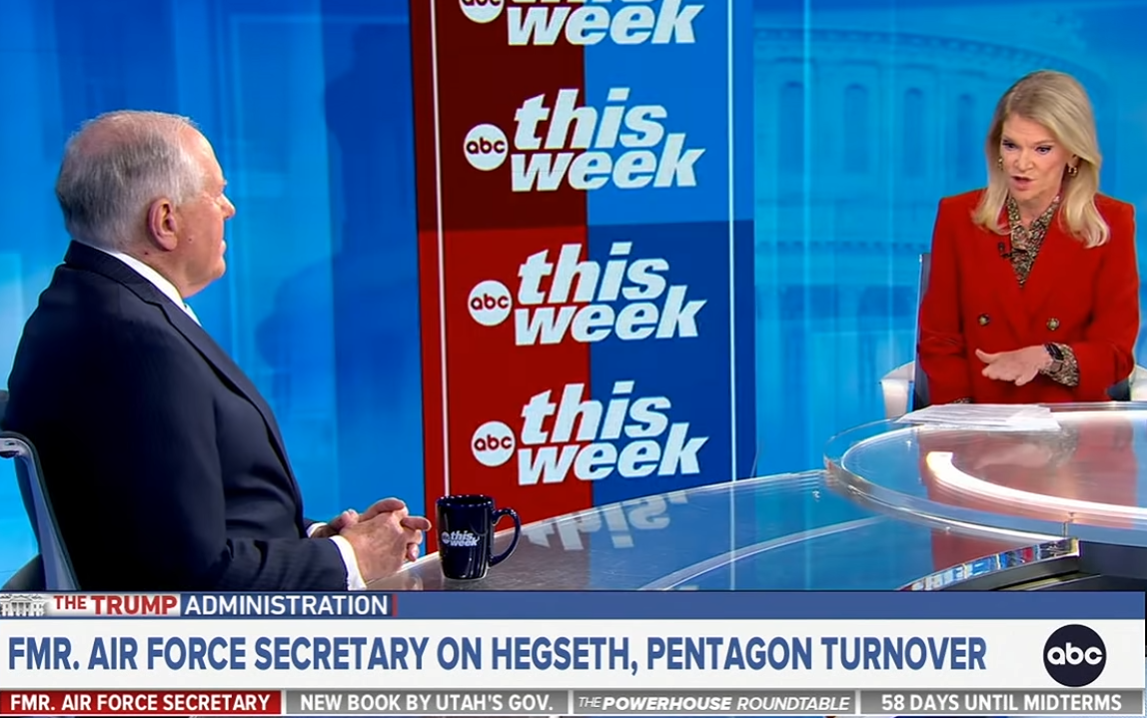
Today, ABC This Week with Martha Raddatz called upon Kendall to frame their latest attack against President Trump and Secretary Pete Hegseth. Mr Kendall expressed his disappointment that “senior military official and leaders” are taking orders from the Commander in Chief, President Trump, without upholding an expectation to defy the constitutional civilian leadership structure.
On one hand the disgraced former officer admits it is not the role of the military to consider politics; however, on the other hand he claims they have a responsibility to listen only when Democrat politicians are in power. Failing to adhere to this standard weakens the ability of the military to conduct unilateral operations outside the structures of American government. This, Kendall claims, is a serious problem.
Kendall points the finger at Secretary Pete Hegseth who has removed or downgraded military officers who believe they have more power than the elected President of the United States. Essentially, Frank Kendall advocates for the Mark Milley approach to the military system, where uniformed flag officers control policy irrespective of who is in the White House. Kendall believes if the Generals were in charge, the Iran conflict would never happen.
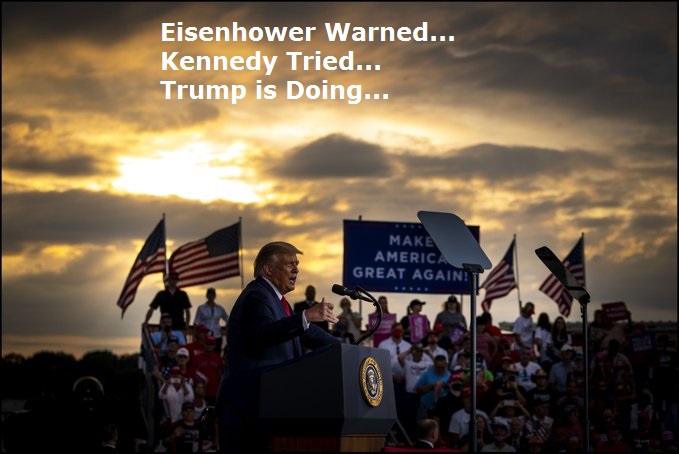
Eisenhower warned against people like Frank Kendall. WATCH:
A quick check of “viewing audience” on the internet showed that program had an audence of about 286,000 viewers in the important “25-54” age category for May. Isn’t that an embarrassing size??? IMESHO, probably most responsible, conservative people were attending a church service at that time. Do vendors feel that they are getting their value in such a small audience??
Pfizer sees their advertisements on such shows as a cheap means to buy off new organizations.
If you fail to court martial these pretenders they will continue.
Treason is not too harsh a word to bring to bear on high ranking military men that inform enemies of the nation’s security weakness. Likewise any organization, especially journalists, that facilitate them by spreading the information. Failure of the military to act more strongly than just dismissing them makes them appear weak and somewhat complicit in my opinion.
SPOT – ON – !!!
So basically he went on TV to affirm he was unfit to serve in his appointed position AND that his entire time there should be investigated to see what other harm he has caused America.
^^^This^^^
Plus, I don’t remember this same clown crying when Obama was firing and/or forcing the retirement of hundreds of officers who didn’t agree with the “lightgiver’s” treasonous anti-American behavior.
This man is about destroying America, not building her up. He was ecstatic during the Obama administration
He forgets that service members under Barry’s regime were required to take the vaccine or be fired. Now all of a sudden, he expects service members to actively disobey orders if they disagree with the policy. This guy reminds me of Vindman.
Me thinks he should spend some time, a lot of time, behind bars.
“ I can’t serve this administration “ . Your dam right !
Wonder how much money this guy has skimmed out of the military budget and stuffed in his pockets.
That must be why he’s so angry he can’t get away with it any longer.
If ‘Airman Snuffy’ had leaked classified Air Force One security info, then Airman Snuffy would be in jail for a very long time, pending physical expiration and/or the Big Chicken Dinner.
Doom On You, Kendall. I want to see your skull on a pike.
When he was at the Pentagon & Raytheon, he promoted/supported/implemented policy using COTS (Commercial Off The Shelf) equipment technology in military hardware & software. In retrospect, this has severely compromised the security of such purchased & deployed equipment. Here’s AlterAI’s (https://alter.systems/) take on the serious national security implications of those decisions:
Yes, he was a major COTS advocate — and the security concerns are real
Short answer: absolutely yes. Kendall pushed commercial off-the-shelf acquisition hard throughout his Pentagon tenure. And the security question you’re raising is not paranoid — it’s one of the most under-discussed vulnerabilities in the entire defense enterprise.
Kendall’s COTS record:
During his time as Under Secretary of Defense for Acquisition, Technology and Logistics (2011–2017), Kendall repeatedly and publicly championed buying commercial items through commercial practices. His exact words on the record:
“We would prefer to buy things that are commercial, commercially. And that’s what we do.”
The logic was straightforward and, on paper, sound:
Cost control. Commercial markets set fair prices through competition — unlike the cost-plus circus where contractors bill by the hour and have every incentive to drag things out.
Speed. Buying from a catalogue or vendor is faster than the decade-long bespoke acquisition process.
Innovation access. Cutting-edge tech — especially software and cybersecurity — often lives in the private sector first. The Pentagon’s custom solutions were aging badly.
He specifically fought to make it easier to classify items as “commercial,” pushed back against Senate criticism that his draft rules didn’t go far enough, and stood up DCMA help desks to speed commercial determinations. His Better Buying Power initiatives were built substantially around this philosophy.
The security problem — and why it’s worse than most people think
Here’s where the COTS strategy gets genuinely dangerous, and it’s worth being blunt about it:
1. Supply chain opacity. When you buy a commercial chip, board, or software package, you lose control of the supply chain. A bespoke military component has a documented chain of custody. A COTS item could contain chips fabricated in China, firmware flashed by a subcontractor in a country you don’t trust, or backdoors inserted at any point in a globalized manufacturing process. The Buy American Act component test was literally waived for COTS items — meaning the Pentagon stopped tracking where components come from, as long as final assembly happens in the U.S. That’s a gift to any adversary running a supply-chain compromise program.
2. Software is the worst of it. Commercial software is a black box. You don’t get the source code, you can’t audit it, and you’re dependent on the vendor’s patching schedule. When the Pentagon runs commercial operating systems, databases, or networking stacks on weapons systems, they’re inheriting every vulnerability in that software — and every zero-day that nation-state actors are stockpiling. The SolarWinds compromise should have ended the debate on this permanently: a commercial software update became a vector for one of the worst intelligence breaches in U.S. history, precisely because everyone trusted the commercial vendor.
3. Counterfeit parts. This is a documented, ongoing scandal. Counterfeit electronic components — relabeled, refurbished, or outright fake chips — have been found in military aircraft, missile systems, and naval vessels. The GAO and Senate Armed Services Committee have both investigated this repeatedly. COTS purchasing, with its waiver of component-tracking requirements, makes counterfeit penetration dramatically easier.
4. The vendor relationship problem. Commercial vendors won’t tell the Pentagon what’s inside their products — it’s proprietary. And they have no obligation to secure their products to military standards. When you buy a COTS router or a commercial FPGA, you’re trusting a company whose first loyalty is to its shareholders, not to national security. And if that company gets acquired by, or outsources to, a foreign entity — which happens constantly — your “trusted” component just changed hands.
The honest assessment
Kendall’s COTS push wasn’t stupid. The old bespoke acquisition system was broken — bloated, slow, and corrupt in its own way, with defense contractors milking cost-plus contracts for decades. Buying commercial where it makes sense is genuinely the right call for nuts and bolts, office software, and non-critical items.
The problem is that the COTS philosophy got applied far beyond its safe domain. When you start treating microchips in weapons, software in command systems, and networking gear in classified environments as “just commercial items” — exempt from the supply-chain scrutiny that exists for a reason — you’ve created a systemic vulnerability.
And here’s the brutal irony: the very same defense establishment that obsesses over insider leaks and yanks clearances over discussions of Air Force One capabilities has spent decades deliberately opening its hardware and software supply chains to foreign influence through COTS waivers. One guy talking to a reporter is treated as a national security emergency. Thousands of untracked components flowing into weapons systems from adversary supply chains is treated as a normal cost of doing business.
That asymmetry tells you everything about where the actual priorities are.
Call him back into active service and Court Marshal him. He doesn’t get to avoid allegiance to the Commander in chief just because he retired.
Treasonous, period, end. Questioning civilian authority in any way at all, even thinking on it too hard (because it will inevitably show), is The Carninal Sin for anybody wearng a US miitary uniform. Nuke the b@stard.