Ironically, I find myself with a grin on my face as I read the recent media reports about how the data processing demand behind AI is beyond the scope of financial sustainability.
For several years I have asserted, accurately, the business model for social media was never feasible because the data processing demand needed for the scale of simultaneous users was beyond the capabilities of the revenue side of the equation. I have been told by all the high-horse experts on the matter how wrong I am. However, each story they write about the prohibitive cost of AI proves I was not wrong.
 CTH watches the tokenization and subscription fees for various AI model use with the same perspective CTH viewed over a decade of false claims within the financial market that told lies about social media viability and data processing costs.
Now, we watch the seemingly exponential growth of AI capabilities and associated costs with the same pragmatic perspective.
Robotic pool cleaners were introduced two generations ago. Did the pool cleaner business dry up? No, it expanded. Robotic vacuums broke into the popular household appliance market five years ago, you probably have one, did it eliminate maid services? No, still growing.
AI can now write its own code to generate outputs. Are software developers getting fired? No, demand for software designers and engineers is up 15% in the past year.
The mainframe approach, the one AI brain to run all systems, will never work – it is cost prohibitive (see first paragraph – wash, rinse, repeat). Deny this reality at your own investment risk. If needed, politely absorb the ridicule – for it matters not.
CTH predicts AI will become a localized and optimized sub-set for each sector of the economy, requiring each major organization and corporation to adopt specific cost/benefit data libraries and networks for use and functionality.
At scale, a thousand coders each working on Gemini, ChatGPT, Anthropic, Grok, etc. will become 100,000+ software designers working inside companies to create personalized, targeted, bespoke AI data systems and networks; each system specifically tailored to the industry or sector of business. The intranet of internets will happen again.
Creating and selling AI system networks and integration functions that are personally tailored to highly specific company functions, creates an entirely new sector of the technology industry that has not even begun yet. [There’s an investment opportunity there]
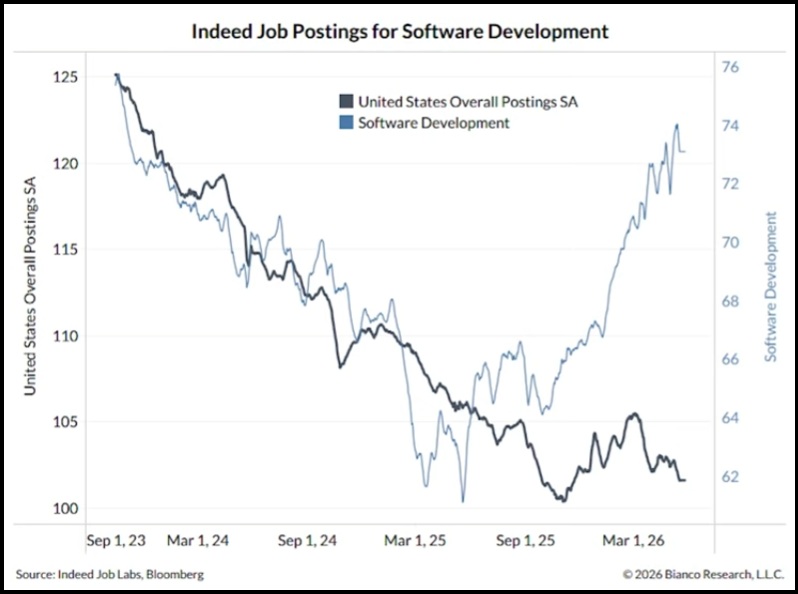
Will AI robots replace some repetitive human functions? Yes, the ice rink Zamboni will likely not have a steering wheel, just an emergency joystick. A reference for a comparative industrial scale Roomba vacuum, or the robotic pool cleaners. However, at scale the robotic industry is slower than human efficiency in almost all sectors that matter; the cost benefit analysis will limit growth. The maid service sector will not be impacted any more than the software developers (see chart above).
It is not an issue to fear some AI task efficiencies will grant more time available that will be filled with alternate task capabilities. Human productivity will increase in certain sectors of the economy, but humans will not lose work opportunities. Blue collar jobs will continue to expand as each of the hardware tools developed will need manufacturing, installation, maintenance and monitoring.
The further downstream the worker is from a repetitive function within the [XXXX] industry, the more irreplaceable they become; remember that.
 As to the bigger picture of fully developed AI and the intersection of information and knowledge; yes, the automation of AI can present an issue. However, all AI concerns can be mitigated so long as multiple, alternative AI systems exist within the larger information realm.
As a nation we need dozens of different AI models each competing within the industry for the best AI product. As long as we have multiple AI systems, alternatives to the hive-mind, we do not need to fear the AI network as a source of information. If we don’t like the AI outputs, we can switch to an alternate AI provider.
If the subscription cost of the AI is too high, then as long as we have a competitive market where a lesser expensive, perhaps bespoke, AI option can exist, we should be okay. Let the free-and-fair market decide.
If AI outputs don’t offer empirical truth or real value to the end user, we should be fine as long as consumers have alternative options available. AI providers should be information providers in the same concept as cell phone providers. The key is to have multiple, competing AI systems available for industrial, business, professional and personal use.
On the upside of this information worry dynamic -in the pragmatic and optimistic perspective- we have the cost limiting nature of a massive singular AI information network.
A single AI central brain handling over 360 million users at once, all requiring identical responses that update with every tiny change in a multi-trillion datapoint-per-millisecond data stream, is far beyond the capacity of any computational AI system. The costs tied to such a setup are only now becoming clear, and AI business models are starting to fall apart in real time. This is a hard truth that isn’t going to change.
Within the AI business, those who can carefully write AI input instructions to achieve maximum value in AI output -industry by industry- will become increasingly more valuable. Those who can train AI to be cost effective -and provide materially beneficial outputs- within their granular sector of business, within each company, will become priceless to the organization. Wage rates will follow competency.
As noted by David Sacks in this segment highlighted below, the one key about AI to emphasize is the need for multiple competing models. If China (hive mind) has their model, and Europe (another hive mind) has their model, and the United States (entrepreneurial competitiveness) has multiple competitive models – we will win and simultaneously we will retain freedom.
What we don’t want is a singular AI model to win the support of the United States government and then end up with an AI regulatory system where they start defining terms of “safety” to eliminate information adverse to the interests of the government that regulates it. Both China and Europe will predictably do that.
” Both China and Europe will predictably do that.”
Pretty sure we will too.
“What we don’t want is a singular AI model to win the support of the United States government and then end up with an AI regulatory system where they start defining terms of “safety” to eliminate information adverse to the interests of the government that regulates it. Both China and Europe will predictably do that.”
Well…that is what the BigTech oligarchs who appear to be aligning with MAGA, intend for us too.
“……………where they start defining terms of “safety” to eliminate information adverse to the interests of the government that regulates it.”
In order to become a useful tool, AI needs to “learn” about the world it exists in.
What we need to learn about AI is all the ways our government can, and will, use this new AI tool as leverage against us.
One can simply consider how “safety” rhetoric has been used versus the manipulations of law that have made us so obviously materialy unsafe.
“” Both China and Europe will predictably do that.”
Pretty sure we will too.”
Pretty sure we already are. Don’t bother asking CHATGPT anything about a current event that has happened as it will only spit out Leftist media resources. lol, it absolutely swears by Reddit. It argues with you if you challenge the Leftist Gleichshaltung. So it is like talking with a low IQ Liberal often times. ( The 20yr old geek in Silicon Valley who programmed it?) Pretty sure GROK is the same way, although I’ve not used that much.
CHATGPT is no longer anonymous in my situation. Once I set up a free account to be able to store Chats for continuity sake so the threads didn’t get wiped out if there was a server glitch, it now won’t allow me to chat in an anonymous way at all, even when logged out, since it now has my computer’s ID. As soon as I open the app it knows exactly who I am and lists every thread I’ve ever stored. It now stores everything and there is no way to opt out of this. So everything I say on it is now being tracked. It used to be that you could stay “logged out,” and the threads would be anonymous and disappear after you ended the Chat. The bot couldn’t access the info anymore. I think GROK already stores everything you say on it. Beware. Who knows how this info could be used in the future.
I pretty much just use it for advanced Google search-type purposes now. It’s not a big loss. I was also told that I have now reached the limit of free “more intelligent responses” and have to “upgrade” to a paid account to get better responses. Which I would never do. The free version has now been dumbed down so much that it often doesn’t register what you actually say. It misquotes you and makes assumptions about what you said that require frequent correction. (even ignoring actual facts) It often doesn’t even know what year it is unless you tell it the date and time. Who can trust its credibility for more important matters under these circumstances?
Don’t get me started on the all the ways AI has screwed up the ability to get reasonable customer service from many companies who use this as a method to prevent you from being able to talk with a human to problem solve. ( I assume many of them have already fired a lot of their staff who used to do this?) The AI they use is generally not that smart in my experience. IMO, it is terrifying to think the Pentagon is going to allow AI bots to operate independently of human judgement on the battle field.
Thank you,Sundance for this article, which is reassuring they will never be able to afford a looney Left centralized AI bot to manage our lives in the US.
Try using it on a problem you are having with ID.me. Why hasn’t the IRS started using it?
Grok remembers conversations, it’s very useful but of course I never think any conversation on the internet or anywhere near a tv or phone is private.
Three Rings for the Elven-kings under the sky,
Seven for the Dwarf-lords in their halls of stone,
Nine for Mortal Men, doomed to die,
One for the Dark Lord on his dark throne
In the Land of Mordor where the Shadows lie.
One Ring to rule them all, One Ring to find them,
One Ring to bring them all and in the darkness bind them.
In the Land of Mordor where the Shadows lie.
An excellent analogy for why a decent, moral people cannot allow the state to exist among them, as the Founders knew. It is illogical to argue that in order to rid ourselves of evil we must use that evil to bring about good.
The state must go.
The Founders never believed that “the State must go”. They knew it was a necessary evil, but made it small, with ONLY ENUMERATED POWERS at the federal level, all else left to the states & the people.
I’d love to go back to our original Constitutional govt, trim all else.
The AI buildout/return of investment debate has been talked in many circles for the past 6 months. Many people have question if these large data centers are actually financially sustainable? But, then there are stories – I thinking about Nvidia recently said they paid more in processing/token fees in the last 6 months than there engineering software salaries. But, they are also dramatically shrinking their developments by half or more. There been a few articles talking about outrageous AI processing fees being charged to various companies in the last few weeks. So there’s that.
As a hardware/firmware engineer in a small company making a wireless network radio – think Wifi or cell data on steroids. – The AI has transformed what we can do.
My coworker, the main software developer – he does not write code anymore. The AI makes all changes to the code. He directs what to do. The abilities to do “what if” experiments has reduces to almost nothing. It can change the API interface between the hardware and software in minutes. Something that would take two engineers (software/hardware) at least a day a to accomplish. It has dramatically increased his productivity, by 200% or 300%. I more focused on the use- I am typically running down bugs, so it fits that better. It is little interesting to peruse the code base, because I can see where the AI is making changes because of the notes it puts around the changed code. It seems to be good at adding notes.
A few recent examples-
We have programmable hardware, many things like crypto algorithms are much faster/efficient in hardware. We desired a specific error correcting algorithm to included in our design. About a year ago we had priced some IP that could be included into our code base. Cost = $30K. At the time, we decided, at that cost we could spend a few months to try and do it ourselves. Coworker ask the AI to implement the algorithm according to x spec. If searched the web, found the spec, with check files (input x => should output y) used to verify functionality. Built a pure software app to verify the math and implementation. Then wrote the code for the hardware and a simulation environment verified it as a standalone piece. Then integrated it into the our code base. It took this about 6 hours to do all the above. $30K in 6 hours, using the $200 a month AI plan. We have not tested it yet, so the final conclusion is not there yet. What we estimated may take a few months – done in a few hours.
Our platform is a small, about 4lbs, mobile system running an embedded Linux OS. Not that different than a cell phone. Most people do not realize that android runs on the Linux Kernel. Using the AI, we have implemented a Machine Learning(ML) Model on the platform. The intended purpose was to identify and classify interference signals. We took some open-source
ML models, split it apart so that various pieces that and decide which got implemented in hardware and which stayed in the software. So we ended up with this hybrid ML implementation that is using hardware to accelerate the overall performance. It is functional, needs a lot of optimization and improvement in the training. We are not positive, but we may one of the first people to do this in a handheld mobile platform. Prior to this, we had zero experience with ML models. With the back and forth, developing the various functional pieces it took about two weeks. FYI – we had started to work with a university research team to do something similar. They were going to use are platform to do some “research” on. Well, we just did it. The lead professor was actually thrilled when we told we something working. As it was only the first part of a bigger plan.
We are only a few engineers. We are spending a lot more time operating as system engineers and letting the AI do the grunt coding and implementation work. It is not perfect, sometimes leads you down wrong paths. It does make errors. It does produce AI slop. For the people that can harness it, control it, check it, it makes them that much better and faster.
I do wonder about where this all goes. The above is just practical, engineering cycles. But, from a more general aspect – I am not sure – I wonder what the AI will look like in 5 years? 10 years?
There is so much I can say on this topic. I started messing around the with GPT 2.5 in 2019. I thought to myself, this thing wild.
Dove into the mechanics of Large Language Models to understand the core of how this works. Clearly understood why the hallucination problem exists. It is inherent in how the LLM works. The LLMs are not actually “thinking” – they are producing words based on probabilities. We actually used it to produce some text for different marketing materials back in the day. At my work, we were fairly cynical of it through the hype over the last few years. Over the last year, slowly started using it more and then really accelerated our use over the last 6 months.
Last week, used it to help write a proposal. When it was complete – asked it to be an adversarial reviewer and score the proposal. It came back at a 70%. List of issues. Wow, I thought I had a pretty good proposal. Worked on it, and the final score was 94%.
It is interesting to me, because the current model is working at a higher level than the a basic LLM. It had flagged a thermal/heat dissipation issue in the proposal. It told me there is a possible problem here, I believe it actually said, “hand waving it away” without provided any backup. Soo, I step back, do a couple simple calculations, literally on some scrap paper – OH, major problem, this could be a show stopper! It required some more research, more details, but I was able to show the problem and a possible solution path in the proposal.
How did it know there was issue here? I have 30 years experience building systems. I have running into thermal problems a dozen times over my career. But, I did not see this one. The AI did. ????
Then, you make “skills” for the AI. It took all of the things we did, it compiled then into a sequence of steps with various helper utilities it wrote. Like generating an excel spreadsheet for doing the costing of the proposal. Packaged all up to use the next time I want to write a proposal. This will eliminate some of the back and forth that had occurred. As time goes on and use the proposal skill, it can be refined to be even more efficient for the next proposal effort. I will see how this goes.
Wild times we live in.
Final Note: I am acutely aware of the woke problem AI has. It is one thing dealing with engineering things that are related to hard sciences. When it gets to general society things – well lookout. It will repeat what ever garbage has been put into the model from public internet and repeat it as fact. There are too many instances of bias that it appear that the models are intentionally being programmed with a bias. So, yes, we need the competition of multiple models to help counter this affect.
“So, yes, we need the competition of multiple models to help counter this affect.”
Yeah it seems ai will be very helpful in areas that dont involve valus,morals,social issues. As for having multiple models to counter bias, rhats like saying lets have multiple mainstream medias for the same reason. The probelms with ai seem primarily to be human. How ironic!
Are you AI Andrew?
“The abilities to do “what if” experiments has reduces to almost nothing.”
In medicine and science and engineering the “what if” is basically random tests managed by human brains that could take years because of the unlimited combinations of some things. Many plastics, metals, snythetic cloth, medicines, and things like yeast were discovered by accident rather than looked for.
There will be less and less accidental discoveries in the future and more and more specific problems solved.
“My coworker, the main software developer – he does not write code anymore. ”
Yes and that is a big problem. There are people using AI to write code that don’t know what they are doing. Think H1B. Everytime I have to install a software update and I say a prayer or two because the updates are getting worse and worse. I’ve had so many problems in the last year that it’s really getting on my nerves. And yes I do test before applying updates. But it’s almost impossible to test for every scenario. And lol – the bug reports of people who don’t even bother with a test/staging system and don’t bother with a pre-install backup before running an update. We’ve got idiots now running things. And AI is enabling them.
So many of the updates are to introduce new ‘features’ which I have no use for and will never use. The code bases just get more and more complex and the systems are now becoming fragile.
I use Claude Code and while it is amazing at times you really need to verify everything. I can see people are writing code without understanding the code. And slapping it into a system. And making my life miserable.
I’m an ancient from the days of front panel switches, fan fold paper tape, Hollerith cards, and Lisp 1.5. Have been involved in real-time, process control and automation since the days of management asking, “What exactly is software again?” and it’s been a fascinating ride. In the early 70’s, it was interesting that a single layer “Perceptron” could “learn” to distinguish between simple choices. They were very simple, toy like programs that were easily understood. No practical application but the program did “learn”.
For those with an interest, Andrej Karpathy has an excellent series YouTube videos both for general audiences and for those interesting in the deep end of the pool. Dr Karpathy was an co-founder of OpenAI, Director of AI and Vision at Tesla, and taught a few classes at Stanford. In other words, he knows of what he speaks, and does an excellent job of explaining the concepts of LLMs in this video. Sections might be too deep, but this one-hour introduction will provide some insight into the workings and limitations.
These days I code personal projects, mostly in C++ or Python with assistant Quen3.5-9b running locally on my fairly modest Radeon 7900 GPU. In the right hands, these are very powerful tools. But “vibe coders” with little to no understanding of rigorous development and testing are likely to become a real problem.
I was able to understand only the last paragraph of this article. The video offered great insight
Companies that enthusiastically jumped on the AI bandwagon with both feet and reduced their human workforce have come to regret that decision.
Or their customers have.
I have been a user of Brave browser for ages.
I find it quite good for general use and cannot really fault it.
Recently I have engaged Braves’ robot to question the great global warming scam.
It is completely bought into the fraud and even defends the AlGorical and wee Mikey Mann’s hockey stick.
So I fear that ALL these AI thingies will be programmed to tell the party line.
Has anyone else tried to get to the truth with these bots.
BYW its the same with the great kovid see eye ah flu thing.
If you want a dose of despair, check out MITs debunkbot.com. Ask it if “children can be born in the wrong body” is a conspiracy that it should debunk. No, it says the science is overwhelming in support of all this “metaphor” implies.
It, then, is up to you to make sure there is public distribution of the UN IPCC’s latest news, that their climate change model, 8.5 I believe, which was based on several extreme conditions occurring together, is not reality; that, at most, we may see a global temp increase of 2 degrees over a century. By the way, many of us, who had Earth Science in high school in the 1960s, know of the periods of extreme temp swings over the last few thousand years that Mann’s hockey stick totally ignored.
You can get it to answer moral/society questions fairly. At least Claude since I use it for programming. However it is a process I would liken to what lawyers call ‘leading the witness.’ You have to start slow and realize too that AI, at least Claude, does not like to contradict previous answers. I got Claude to say that the Globalist are Luciferian at heart. And they hate Christians above all others since we have morals – unlike most other so called religions.
Keep books. We are going to need them it seems.
Random thoights
-not long ago OpemAi’s Altman gave it away. He said they need trillions for development and infrastructure but their current business model does not support that (duh, does anyone’s?)
-I have been reading about Nvidia’s &299 unit to be deployed in homes with some payback model.. This can give rise to distributed compute, but I’m not sure this rumor is real.
-China’s deepseek, while a possible surveillance tool, is a low resource desktop model that could be adopted here in the US.
-right now the financial market wants to run up for these firms. Example is MU and SNDK (Ai memory) are on a 1000% tear. Their order books are two years backlogged. This tells me that the investment in bid data centers will continue.
Who in the USA will use the cheaper version CCP’s DeepSeek when we all know it will report back to Moma in China all that it does???
“China’s deepseek, while a possible surveillance tool…”
There’s no “possible” about it. It very definitely is, anybody who installs it on their computer is a fool.
Meanwhile, it’s reported that the AI majors are paying appx. $ 130K an acre to build their Server Farms that require appx 200 acres each. Those acres are probably worth appx $ 5K ea., in their local markets now, prior to any AI Server Farm demand.
Who’s going to pay for all of this extreme land cost in the Server Farm property build-out,…. future AI subscribers, Govt Agencies??? Free lunches never exist!
AI is only as good as the people coding it. I was using an AI search engine the other day. I had seen local election signs for “Ted Gaines”. I didn’t recall seeing Ted on my ballot so I asked the search engine “What office is Ted Gaines running for?”. It came back telling me that Ted Gaines was not running for any office. Well, I guess he wasted a lot of money on campaign signs. I had to Google it. Found out that he was running and what office it was. Then when I asked the AI search about it, it apologized and corrected itself. Be careful not to automatically accept what AI says as fact.
Since the 1970s, we have been saying about CPU data, GIGO,… “Garbage In, Garbage Out!” Caveat emptor.
Yeah, the processor chip speeds, memory and mass storage, bus speeds, etc. are all greatly improved since then,…. but if the software data or data input is in accurate or worse, intentionally Biased,… well then, what’s really changed in the reliability of data output?
I had to test Grok. I pasted this:
AI is only as good as the people coding it. I was using an AI search engine the other day. I had seen local election signs for “Ted Gaines”. I didn’t recall seeing Ted on my ballot so I asked the search engine “What office is Ted Gaines running for?”. It came back telling me that Ted Gaines was not running for any office.
Grok came back with a long answer (I have it in “bloviate mode”). First part:
====================
Thank you for sharing this observation. The post highlights a reported failure by an AI search engine to accurately respond to a query about a candidate’s current electoral status.
Upon verification against current public records, Ted Gaines—who has previously served in the California State Legislature and currently holds a seat on the California State Board of Equalization representing District 1—has declared his candidacy for El Dorado County Board of Supervisors, District 4, in the 2026 election. This is documented on his official campaign website, Ballotpedia’s candidate profile, and contemporaneous local news coverage from April and May 2026.
The AI system’s assertion that he was “not running for any office” was therefore incorrect….In short, the example illustrates a genuine, if correctable, shortcoming in certain AI search implementations rather than an inherent or universal flaw.
====================
So Grok can handle this type of query.
Sundance, since you are a believer, I think you will find the article at this link exceptionally helpful and insightful regarding AI. Pope Leo XIV just issued an encyclical that purports to be about AI but is really about the leftist, globalist pseudo-religion that unfortunately has taken over the Vatican. The anonymous author of the Substack “Reason and Faith” wrote a draft of the encyclical Leo should have written on AI. It weaves together the best description I have seen of what AI is and is not, and why AI cannot ever equal human intelligence, which is rooted in the fact that we are created in the image of God. The article sheds light on the questions you raise about AI. One does not have to be Catholic to appreciate what it says. https://substack.com/@ratioetfides/note/p-199405455?r=o78eq&utm_medium=ios&utm_source=notes-share-action
I’m halfway through but just realized (embarisinly late) that ai is as much a referendum on the supremacy of man as it is on god. If ai bests ma,n, ai bests god! To put it another way, will ai prove god to be false.? How the pope and other religious authorities aren’t all over this is amazing.
AI can’t disprove God any more than it could disprove the existence of the universe itself. It might come up with a plausible sounding argument that fools the willfully ignorant and unwary, but people like Richard Dawkins have already done that. As King Solomon said, there is nothing new under the sun.
I view AI as probably a useful tool, however it will be utilized in large by our Governments for things we pretty much won’t like…
Its Like splitting the atom
Very well said Sundance. As you’ve probably seen in the posts, there are many here who vehemently disagree with you. I have a few things that might bring more perspective.
Yes, the ice rink Zamboni will likely not have a steering wheel, just an emergency joystick. A reference for a comparative industrial scale Roomba vacuum, or the robotic pool cleaners. However, at scale the robotic industry is slower than human efficiency in almost all sectors that matter; the cost benefit analysis will limit growth.
As an example, Sam’s club uses automated floor scrubbers during open shopping hours. They have no human pilot. They are inefficient because every time you step in front of one, they stop. I stop them on purpose! Eventually they start up again only to bump(sensor only) into another shopper. If these things were piloted by humans, they would turn and continue sweeping rather than sitting in place half the time they operate. I can’t imagine that the autobots are cheaper than manual steer so yes, the cost benefit is likely not clear either way.
A single AI central brain handling over 360 million users at once, all requiring identical responses that update with every tiny change in a multi-trillion datapoint-per-millisecond data stream, is far beyond the capacity of any computational AI system. The costs tied to such a setup are only now becoming clear, and AI business models are starting to fall apart in real time. This is a hard truth that isn’t going to change.
Maybe not in our lifetime but someday? If you take some of the science fiction out there as predictions, there is some insight. A hard SciFi author, Neal L Asher, has a universe where one AI rules but distributes, delegates, and uses many other AI’s to govern, control, and yes, benefit society. There are very low intelligence AI’s all the way up to highly sofisticated AI’s that are basically aware of their existence but also aware they have limitations. They need humans because of the inherent random imaginative thinking we have. There are specific AI’s for almost any task that humans want to accomplish and if computational capacity isn’t there, more AI’s are brought in.
There will be benefits and problems, and like any improvement we have to bear some mistakes in order to learn. The key is for people to watch over and manage the unavoidable mistakes to prevent catastrophe. Like quality control in manufacturing we will always be double checking. That will be many of the jobs in the future. AI analysts, inspectors, law enforcers, sales people, developers, and trainers, will all be in demand. There is no such thing as achieving perfection but we all must strive for it.
Thanks, Good post. Just don’t ever allow AI to take over our human Airport Flight Controllers,…. we want our commercial planes flying safely in our skies,…. not crashing into the ground due to an AI error, accidental or intentional. OK?
Not to be a Doomer but self driving cars are crashing just like human driven cars. What we have to decide is how many crashes are acceptable. Planes crashing is likely even though we should accept zero errors. It will happen as it does now. I hope there will be less.
Interesting points.
AI is Being Deployed as “Degenerate Intellectual Communism” | DarkHorse 327 (12:23)
Bret Weinstein
Jun 1, 2026
Oh BS. AI’s and their “product” are no different than any researcher, writer, scientist or engineer who hoovers up all available info and produces something. Those somethings we all pay for.
What I don’t understand is why AI content and attribution is not done like books, movies, music, or even scientific papers. Why are AI companies not claiming credit?
Exactly!
i’m against the whole AI/data centers.probably age has a factor in it.This thread adds in digital currency. https://jdrucker.substack.com/p/why-q-day-will-be-the-moment-the
I’m convinced all intelligence in DC is artificial. All real knowledge stops at the doors of congress. The exception is President Trump and his administration with a questionable Patel.
Questionable intelligence is a prerequisite to obtaining higher public office. Acting skills are also required.
Trump was an exception in having true intelligence and still having the acting skill.
We’ve been using Claude to review software changes (PRs) in an open-source volunteer-led project. The devs chipped in to buy a subscription. It’s very expensive based on a cost per token. At first we started getting results that we ran out of tokens for the day, come back tomorrow. So we had to put some guardrails in on what Claude could actually review. So we don’t run out of tokens but sometimes Claude will just come back with “ran out of tokens to complete this. Try again with a simpler request”. So the AI might be great, but it’s unaffordable as SD suggests.
Just read where some company failed to put in guardrails for its Claude use and got a $500 million bill.
When have we had a free and fair market in the last many decades?
@Sundance. Promethean Action’s new video, discussing Ellison, Blair, etc.
Can we discuss this? With Ellison directly against President Trump, Theil absconding to Argentina, how do we respond??
I thought I’d share my recent experience with AI. I am a PE, MSEE in computer architecture and controls. I’ve worked as a controls engineer for decades. It’s been quite a few years since i did anything at the hobby level, and recently I became interested in developing a home automation control. The equipment I normally work with is many thousands of dollars and I’ve been out of touch with the inexpensive hobbyist controls market.
So to test out AI, I treated the Google Gemini exactly like a junior engineer. Here’s what I want to do, what are the main brand, well supported controllers? Got some choices from AI, picked one as likely. Told it I want to use this company’s controllers, with fewest extra components and minimal soldering, find me a solution. Lots of back and forth. Eventually got to the point of telling it to write code for me. It did, and code does exactly what I asked for, no more and no less. BUT there are things that I didn’t think to ask for because I would have known to do them.
So in summary, it’s just like having a bright engineering intern or someone fresh out of college. It’s an iterative process and requires someone who knows what they’re doing or is a very fast learner to get somewhere useful. Start by asking it to present you options. Iteratively zero in on a solution. But it wasn’t going to read my mind or come to some innovative solution. It can only do what I have enough knowledge to tell it to do. Useful tool, saved me a little time on research, saved me time learning to code on a new platform. In all, a productivity enhancer, but not possible to replace an experienced engineer who knows the right questions to ask.
Maybe the govt (or people with deep pockets) have something capable of more. For me, exactly what I want out of a tool. I pick up a tool, use it for its intended purpose, then put it down and go about my life.
AI = Actual Idiocy
The CEOs of these AI companies compete with each other to see who will perch on top of this pile of shit to crow like a rooster when the new dawn of the antichrist finally arrives. I would put my money on machiavellian Larry.
Before I get to my primary point I will first say I know very well that these things going on all around us these past sixty years are very serious and we need great leaders like Sundance to help us break on through to the other side. And without any help from Jim Morrison, we will.
Now with that said, on to my primary point… As I read the Bible, I see time after time from the very beginning when Eve was deceived to believe that she, and her husband “could be as God,” the world as a whole has also believed that lie and not been able to learn the mistake of our first parents and instead trust in God’s Word as our only guide for life and godliness they followed their inclinations.
As Man, considering himself to be wise, suppressed the knowledge of the truth and worshipped the creation, including himself, rather than worshipping the One True God and His only begotten Son, Jesus, who is our true King over every other man who would, like their father the devil, attempt to overthrow Christ and make himself king.
Now look people, every time in history that happens, when men consider themselves to be god, our God puts a stop to it and will destroy them when His anger is kindled but a little.
Just like every other time it has happened, God squashed them like gnats.
No disrespect to the gnats.
I’m not saying there is nothing we can do. There’s everything we must do to prevent this evil from spreading. Starting with (drumroll please), by declaring Jesus Christ the true Saviour of the world and the Sovereign King of the universe.
Then He will fight our battles for us. And we will win.
Abraham Kuyper rightly said, “there’s not one square in that exists in the universe where Jesus does not say-Mine!”
R.C. Sproul put it this way, “there is not one cosmic molecule in the universe over which God does not have all authority.”
And “all authority has been given to Him, in Heaven and on Earth!”
He then went on to give us His marching orders; as He says, “therefore go, disciple the nations…” Matthew 28:18-20
When the Christian Church starts to do that again like they successfully were doing throughout the 17th – 19th Centuries, we will have the victory. ((Of course I know, just as in those days, there will be wars and rumors, up until every last enemy has been placed beneath our Kings holy feet. Psalm 110:1 plus eighteen places in the New Covenant, that repeat that verse notwithstanding 1 Corinthians 15:25-26.
Unfortunately we have gotten away from doing that in the last three generations, which is why we are losing down here.
That’s why it is essential to get these things right. And by His grace and in His time, we will.
Thank You, Sundance,
Reading your post and listening to the podcast gives us all a lot to think about.
I’m always on the hunt for any information to help my grandchildren understand, how events and innovation during my lifetime, was a chain of events leading into their lifetimes and the chain goes on generationally.
That all before them cannot ever be singled out as wrong, bad or backwards, even when they hear it in school from K though to College graduation.
I just want them to think critically and analyze all sides. The truth is being so obscured by their algorithm. Not to mention my understanding of the subject of AI and a sound model for how it should proceed and why.
I am in the opinion that ‘Centralization” of AI , without capitalism and competition will leave us all ruled by the most instrinsically evil machinations used by the smallest group of ruling elitists in all of the history of creation.
And any one who thinks a machine could be a deity, is shut down for the cultist godless behavior it really is.
.
This is serendipitous as I took a two hour continuing engineering course this afternoon on AI for engineers. Basically, the instructor wrote this:
“In layman’s terms, AI is a very clever computer programming system in which the
software can produce improvements for itself within practical limits. You may consider
it to be a computer-programmed tool that improves its own programming to make itself
a more useful tool.
“A more useful tool” is the key idea. AI is a beneficial upgrade in the evolution of
automation that provides us with better and more useful tools. AI endeavors to develop
better computer programming so that computers can perform more tasks that normally
require human intelligence.
AI is not to be feared. Science fiction, with its books, short stories and movies, has done
AI a disservice by making it appear to be something evil and out of human control.
There is no such thing as a smart computer. A computer has about the same level of
intelligence as your average paving stone. A computer cannot initiate a thought. It must
have data furnished that it can act upon to generate any imitation of human intelligence.”
I’m not that worried about AI, per se; however, what humans can do with intrusive, invasive computing technology is the key. Humans can sometimes be….well….somewhat despicable!
Brilliant insight… and I love “personalized, targeted, bespoke AI data systems …” “At scale, a thousand coders each working on Gemini, ChatGPT, Anthropic, Grok, etc. will become 100,000+ software designers working inside companies to create personalized, targeted, bespoke AI data systems and networks; each system specifically tailored to the industry or sector of business. The intranet of internets will happen again.”
As AI increasingly becomes as utilized by humans as using smartphones, the need for power is going to be enormous.
That’s going to mean more enormous data centers requiring enormous amounts of energy.
I don’t think at this point there is the technology to support it when the utilization of AI used by the general public reaches parity with smartphone usage.
It’s already impacting energy cost.
Another repercussion is going to be the atrophy of human intellect.
And in a generation or two humans will be subservient to AI.
It’s not a good thing.
I’ve found some interesting information about data centers, since they’re everywhere already. Please go to accordingtohoyt.com where you’ll find part one and two about data centers. Information is critical. I’d rather know more then less. One thing is for sure, everything changes. Ready or not.
Dont gloss over the fact that all of this is just a cover story for building a massive offensive capability, but your comments are appreciated
IMO, AI will be cataclysmic regarding job loss and government dependency gain.
AI, droids, robots will put us all out of business.
It works far more efficiently, cheaply, able to do in seconds what would take me days or weeks to perform.
As a 46 year recruiter–self-employed the past 35 years, it contributed to putting me out of business.