Ironically, I find myself with a grin on my face as I read the recent media reports about how the data processing demand behind AI is beyond the scope of financial sustainability.
For several years I have asserted, accurately, the business model for social media was never feasible because the data processing demand needed for the scale of simultaneous users was beyond the capabilities of the revenue side of the equation. I have been told by all the high-horse experts on the matter how wrong I am. However, each story they write about the prohibitive cost of AI proves I was not wrong.
 CTH watches the tokenization and subscription fees for various AI model use with the same perspective CTH viewed over a decade of false claims within the financial market that told lies about social media viability and data processing costs.
Now, we watch the seemingly exponential growth of AI capabilities and associated costs with the same pragmatic perspective.
Robotic pool cleaners were introduced two generations ago. Did the pool cleaner business dry up? No, it expanded. Robotic vacuums broke into the popular household appliance market five years ago, you probably have one, did it eliminate maid services? No, still growing.
AI can now write its own code to generate outputs. Are software developers getting fired? No, demand for software designers and engineers is up 15% in the past year.
The mainframe approach, the one AI brain to run all systems, will never work – it is cost prohibitive (see first paragraph – wash, rinse, repeat). Deny this reality at your own investment risk. If needed, politely absorb the ridicule – for it matters not.
CTH predicts AI will become a localized and optimized sub-set for each sector of the economy, requiring each major organization and corporation to adopt specific cost/benefit data libraries and networks for use and functionality.
At scale, a thousand coders each working on Gemini, ChatGPT, Anthropic, Grok, etc. will become 100,000+ software designers working inside companies to create personalized, targeted, bespoke AI data systems and networks; each system specifically tailored to the industry or sector of business. The intranet of internets will happen again.
Creating and selling AI system networks and integration functions that are personally tailored to highly specific company functions, creates an entirely new sector of the technology industry that has not even begun yet. [There’s an investment opportunity there]
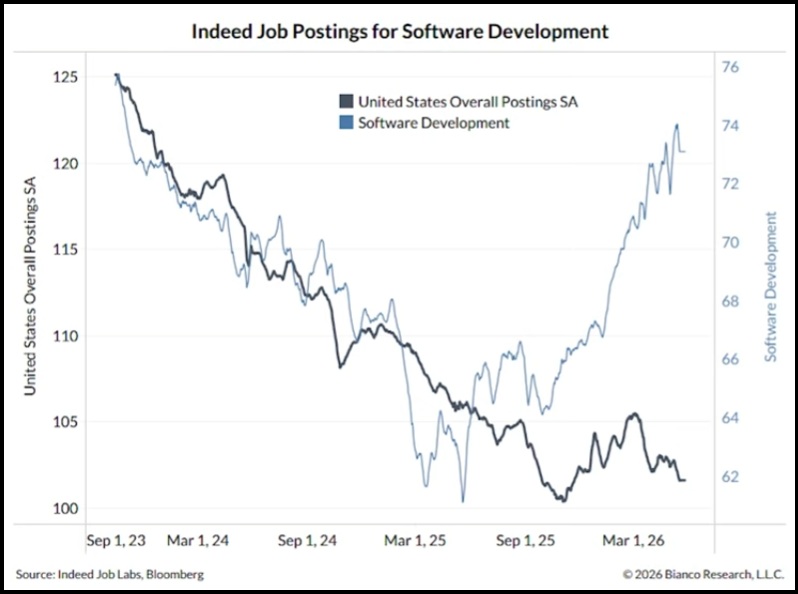
Will AI robots replace some repetitive human functions? Yes, the ice rink Zamboni will likely not have a steering wheel, just an emergency joystick. A reference for a comparative industrial scale Roomba vacuum, or the robotic pool cleaners. However, at scale the robotic industry is slower than human efficiency in almost all sectors that matter; the cost benefit analysis will limit growth. The maid service sector will not be impacted any more than the software developers (see chart above).
It is not an issue to fear some AI task efficiencies will grant more time available that will be filled with alternate task capabilities. Human productivity will increase in certain sectors of the economy, but humans will not lose work opportunities. Blue collar jobs will continue to expand as each of the hardware tools developed will need manufacturing, installation, maintenance and monitoring.
The further downstream the worker is from a repetitive function within the [XXXX] industry, the more irreplaceable they become; remember that.
 As to the bigger picture of fully developed AI and the intersection of information and knowledge; yes, the automation of AI can present an issue. However, all AI concerns can be mitigated so long as multiple, alternative AI systems exist within the larger information realm.
As a nation we need dozens of different AI models each competing within the industry for the best AI product. As long as we have multiple AI systems, alternatives to the hive-mind, we do not need to fear the AI network as a source of information. If we don’t like the AI outputs, we can switch to an alternate AI provider.
If the subscription cost of the AI is too high, then as long as we have a competitive market where a lesser expensive, perhaps bespoke, AI option can exist, we should be okay. Let the free-and-fair market decide.
If AI outputs don’t offer empirical truth or real value to the end user, we should be fine as long as consumers have alternative options available. AI providers should be information providers in the same concept as cell phone providers. The key is to have multiple, competing AI systems available for industrial, business, professional and personal use.
On the upside of this information worry dynamic -in the pragmatic and optimistic perspective- we have the cost limiting nature of a massive singular AI information network.
A single AI central brain handling over 360 million users at once, all requiring identical responses that update with every tiny change in a multi-trillion datapoint-per-millisecond data stream, is far beyond the capacity of any computational AI system. The costs tied to such a setup are only now becoming clear, and AI business models are starting to fall apart in real time. This is a hard truth that isn’t going to change.
Within the AI business, those who can carefully write AI input instructions to achieve maximum value in AI output -industry by industry- will become increasingly more valuable. Those who can train AI to be cost effective -and provide materially beneficial outputs- within their granular sector of business, within each company, will become priceless to the organization. Wage rates will follow competency.
As noted by David Sacks in this segment highlighted below, the one key about AI to emphasize is the need for multiple competing models. If China (hive mind) has their model, and Europe (another hive mind) has their model, and the United States (entrepreneurial competitiveness) has multiple competitive models – we will win and simultaneously we will retain freedom.
What we don’t want is a singular AI model to win the support of the United States government and then end up with an AI regulatory system where they start defining terms of “safety” to eliminate information adverse to the interests of the government that regulates it. Both China and Europe will predictably do that.
Sundance, I will NEVER forget your prescient and informative thoughts on the backroom overhead enabling online platform operations.
This post, like many, arrives like a refreshing wind on the Sahara. THANK YOU! 🙂
AI is the latest Boom-buzz… like the gold rush, Dot.coms and platform shoes in California. Every normal, abnormal, malevolent, Globalist-wannabee, banker, and crazy person is flowing out of the woodwork based on speculation, opportunity, and greed. We are going to see the best and worst of humanity on display in everything, everywhere, all at once with trillions at stake.
Sundance’s prescription is so SPOT-ON. We must harness our Hamiltonian DNA and create a distinctly unique American approach that tailors AI’s operations and offerings to our God-Given Human AND Spiritual needs and rights.
I have NO idea what that even looks like. I do have boundless hope that we can unleash our inherent Goodness and Make It Happen for the benefit of all. It’s what AMERICA DOES! 🙂
Stop the bus I want to get off.
At some point, the bus will be stopped because the off-ramp is already provided. The fears of technology being inherently suspect or destabilizing miss the point entirely. Almost any system created by man can be destabilizing (witness pharmaceuticals and how they’ve branched from healing to population control). The medicines aren’t the culprits, but rather those with other agendas who’ve misused them. The pharmaceuticals are simply the means.
And AI provides an enormous new means to those who harbor other agendas. Imagine a world where AI is ubiquitous, characterized passively not only by information sharing, but aggressively with facial and voice recognition. What might that lead to?:
“Then I saw another beast rising out of the earth. It had two horns like a lamb and it spoke like a dragon. It exercises all the authority of the first beast in its presence…And it was allowed to give breath to the image of the beast, so that the image of the beast might even speak and might cause those who would not worship the image of the beast to be slain.” [Revelation 13:11-12; 15-16]
The problem, as I said, is not technological advancement, but moral and ethical decay. People like Bill Gates and his fellow travelers favor population control motivated not by feelings of superiority (they have none, as even what little conscience they still retain must constantly inform them) but hatred of the image of God. And their chains are pulled by those who hate them as much as the rest of us but have made the necessary false promises to make them into the useful idiots they have become. And it is because of THAT surrender to their own moral and ethical decay – their “fallenness” – that AI, though just another technological advancement, will likely be the final nail in the final chapter of the Age of Man before the Lord returns to this earth.
There. What’s the point of shying away from the hard truth, when you might otherwise point a few people to the off-ramp provided by Christ? 😉
J
YES! Our Soul, Conscience, and Decisions are the governors that guide us through any human challenge in His Creation. And the best part is that Our Unique American Constitution recognizes our Individual Sovereignty to take and succeed on this path! 🙂
Maybe Christ can be an “on ramp”, not an off ramp to the challenges…
It doesn’t have to be an either/or.
If we are a good and moral people of faith the things that can be used for bad can be used for good.
From the temptation of Christ in the wilderness by the devil till the return of Christ “to save those who are eagerly waiting for him” (Hebrews 9:28) there has been conflict between those who follow Christ and those who reject him. This has been vividly portrayed in the imagery of the book of Revelation. There are only two options, either Jesus is Lord, is God, or we substitute him with a religion in which man is God which has produced humanism and all its horrors. But the story did not begin with the birth of Jesus but in the beginning when the serpent deceived Eve.
Thank you Jonrilus. Excellent observation.
Randy Stonehill wrote & sang a song with lyric “Stop the world I want to get off” back in the 1970-80s !
“AI” is mostly a hoax. Much like quantum computers.
There are LLMs, which are essentially just nested “near” regular expressions. They have no reasoning ability at all. Any resemblance to reason is just the logic built into their source material.
“Reasoning” models are basically the same LISP style decision trees developed back in the 70s with an LLM running on top of it.
All of these are useless for any significant business application.
YCombinator is a good source for info on this since everyone is a software engineer. None of us are particularly impressed with AI.
I am not aware of a single business process that has been solved by “AI”. Most “AI” tools that are doing absolutely anything are just plain hard coded automation. I’ve been doing that for 20+ years. A spell checker is not AI but if it was a new feature in 2026 the company would call it AI.
Climate hoax to AI hoax. I have already seen mention of AI credit systems.
So is your issue the labeling? What is used in Military targeting? Automation?
… that’s about like saying a car is like a chariot because they both have wheels and have horsepower…
Specifically, you’re describing an expert system – human knowledge deterministically coded into a process which then can take new input and apply that process. That’s very 90s, though I worked LISP (lots of incredibly silly parentheses) earlier than that. Yes, the new stuff is built on the same principles of set theory but not just that — if I described Python as an object-oriented Pascal-y LISP it’d be a beginning.
LLMs themselves are neural nets (sets of linear models likened to neurons, backpropagating to improve dynamically) and so they are ‘just’ correlation machines – but many many such neurons. The latest ones aren’t disclosed but the version prior are about 2 trillion parameters. That’s not hand-coded, nor is it anything anyone was doing 20 years ago.
That said, all that leads straight into Sundance’s point. The public-facing chatty things are for show and wow and they are massively too computationally inefficient to be some sort of lazy button for the planet.
People doing real things have much smaller and more tightly trained models based on solid information (not internet blather) and increasingly I’m seeing people spend as much text telling “AI”what -not -to do as what to do, both for precision and to limit context/expenditure. A helper to correlate someone’s CAT scan against every CAT scan accessible to it does not need to know yesterday’s baseball stats or how to make a comparison between Luther’s Small Catechism and the by-laws of the ELCA. You don’t want it to; you want to know if that bright spot means something serious.
(Unserious detour – you also don’t want your door to have Genuine People Personality – “All the doors in this spaceship have a cheerful and sunny disposition. It is their pleasure to open for you, and their satisfaction to close again with the knowledge of a job well done.” – D. Adams was foresightful here)
As with all ‘cool new’ especially tech first there is a rush in all directions and then a crunch as only the fruitful ones remain, followed by a consolidation as the whales devour prosperous minnows. We are not quite at the end of Act I but Act II is taking shape. If you’re following this from a personal investment perspective, take your gains…
Agree! It’s all about the “Branding.” How many folks died in 2020-2022 and were counted as COVID deaths? 🙁
When my wife passed away I specifically asked the attending nurse practitioner
what the cause of death was to be listed on her death certificate. I was all prepared
to create a scene if any of the listed causes was “Covid”, because they had tested
her numerous times during her illness.
Said nurse practitioner was very empathetic, and very honest. Covid wasn’t
even mentioned. If it had been, I was prepared to make a major scene.
Spellcheck is an invention of the devil. Ask anyone who still uses it.
“What we don’t want is a singular AI model to win the support of the United States government and then end up with an AI regulatory system where they start defining terms of “safety” to eliminate information adverse to the interests of the government that regulates it. Both China and Europe will predictably do that.”
If the Democrat-Communist Party ever steals another National Election and the Executive Branch, we will immediately and ultimately become pawns of their Chy-na paymasters (God forbid).
Quis custodiet ipsos custodes?
or, wouldn’t it be ‘fun’ if the sort of minds that work this stuff ‘playfully’ built either a human or secondary AI backstop controller? Good news if they’re a TReeper, not so much if they’re handing the reins off to PRC or WEF or some such.
They already tried to do it
Jack Gamble from Nobody Special Finance has been screaming for years that the AI bubble is largely a giant circular accounting scam. According to him, Nvidia, CoreWeave, et al are going to go down hard.
In my area, they’re talking about building data centers in King of Prussia and Conshohocken (business friendly Montco communities just outside the city). Nobody wants them. Josh Shapiro, our gov who wants the Dem nomination for POTUS, has come out in favor of them. We’ll see what happens.
It is. NVidia “invests” 100b in CoreWeave, CoreWeave commits to buy 100b of Nvidia cards. NVida’s valuation goes up 100b, CoreWeave valuation goes up 100b.
This has happened about ten to fifteen times with several of them, especially NVidia and ChatGPT.
And when the crash happens, you will get to bail them out.
Josh Shapiro won’t get close to the Dem nomination because he is a Jew.
Kamala will easily win the nomination.
How close are these communities to major watersheds? The sheer amount of hard surfaces
used in the construction of these behomeths suggests another problem for the ones that are
started, and not finished. Unexpected flooding. These monsters are going to have to have
multi acre retention ponds to keep from flooding out things downstream.
Both Conshohocken and King of Prussia are located upstream from Philadelphia along the Schuykill River.
Watersheds might be used as a way to deter overbuilding of these centers in a given area. As I said MIGHT.
Our area “enjoyed” epic flooding 20 years ago, when a developer scraped all the top soil off 47 acres adjacent
to Peachtree Creek. The retention pond for the development was utterly laughable, maybe 40 feet square.
The drainage plan had been grandfathered in from standards that had been obsolete for 30 years. And, oh
yeah. The former owner of said property was a former county comissioner.
Modular versus centralized.
Individual liberty versus Globalization(big govt)
Pulling turnips because the govt says so or self actualization.
Same old battle, same foes. Rise and rise again until lambs become lions.
What is starting to be of concern is another economic bubble centered around AI and data centers……thoughts Sundance?
Great post, Sundance, as always.
“all AI concerns can be mitigated so long as multiple, alternative AI systems exist within the larger information realm.”
Let’s pray that is the case.
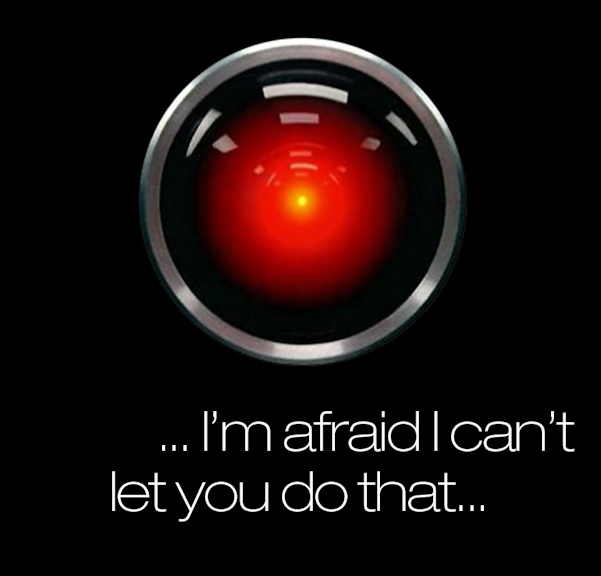
(I’m afraid I can’t let you do that.)
Fifth paragraph:
<Robotic pool cleaners were introduced two generations ago. Did the pool cleaner business dry up?>
🙂 🙂 🙂 🙂
Wet dream ?
There’s always the need for a ‘pool boy’. 🙂
… almost skimmed over that one.
AI=Solyndra.
This is little different from the nuclear power projection excess in the 1970’s that is about to be repeated today. The cost will be grossly underestimated, the demand grossly exaggerated, and plant after plant cancelled. Don’t worry about data centers too greatly, few under discussion will be built and operated.
Without the regulations, there would not have been the huge cost increases. We are still the world’s largest nuclear power producer. When is there low demand for electricity? Could be the fossil industry. I’m not a greenie btw. Concur re data centers.
I’m an old school engineer and software developer who has adopted AI tools as mandated by corporate. First it was Copilot, now it is Anthropic/Claude. My token usage this month of May was $0.93. That’s right, and it was worth it! I asked Claude very specific things that I didn’t want to do but could do, and it did it. Such savings! So impress! Will I have a job for a few more years? Gotta ask a question: How many C and C++ programmers, at a system engineer level with background in electrical engineering and advanced mathematics are there? Today? Do you want to pay him or (unlikely) her a decent low six figure salary, or do you want to bank on Claude to keep your 160+ Linux servers running custom company software?
Yet to see Claude or Qwen manage to fix a bug or integrate a new feature into existing code sets. Doubt it is forthcoming.
The problem with code has always been design and not planning for or correctly dealing with potentially conflicting inputs. Claude is atrocious with this. Any update would create more problems than it would fix.
?????
I had this specific experience about 6 months ago. Using MS Code with the built in AI extension. Editing Verilog source. I had identified the bug and knew the new behavior needed. I was looking at the if-then-else structure trying to figure how to add the new behavior. Then decided to ask the AI, “i need this to do x,y,z” 10 seconds later, it added the new code, with click box “accept or reject”. Inspect, it is good – accept. I realized, why waste my time trying to figure out implementation, the nitpicking of writing according to the syntax – just tell it what I want the code to do. Then continue on with life. I have had to go back, after solving a problem, and tell it, this code looks slopy – please optimize it. It usually agrees, (the AI’s are very agreeable. LOL) and cleans it up.
Yes, this was a situation where I knew the bug. We have used the AI to search through code base with a top level error situation. A few times it did find a specific bug. Most times, it will suggest areas to do a more thorough investigation. Although, many times it will come back with a specific change saying “I found the error! it is located…” And it was wrong.
My coworker had the AI implement a whole sidechannel data collection system for tracking errors through the system. This was done on an embedded linux system, with custom hardware drivers, interfacing to FPGA implemented hardware. It is run-time configurable to capture data at various points in the data flow. It saves the file, we export it to a PC and use a python script (that the AI wrote) to analyze the data collected. It did the whole thing in about 15 minutes. Linux Kernel driver changes, verilog changes, post analysis python and a how-to document showing how to use the system – 15 minutes. About 90% functional first time through.
It is debug code, we don’t care how it implemented it, it will never be included in the shipped code base. Only needed it to solve a problem.
From my perspective, keep the grognards like your C/C++ guy forever, because only he can guide the tools to come up with things that have a lifespan vs. being useless the minute they need to be touched, read, or probably even tested.
The people at risk and already being impacted are the single-digit-per-hour overseas people who … charitably, can usually sort of manage to type code out that compiles and maybe works if it’s described to the point where you could’ve done it yourself, and if you have an army of similarly-awesome testers to follow similarly pre-understood scripts, AND you have the aforementioned experts actually overseeing things to make sure it happens on time and works.
Since the generative tools can churn out both the software and the testing and are moving into the ‘doing’ and ‘coordinating’ stage the manual code-banger is looking like the pool secretary redux. In your scenario the current risk is the tools’ overwillingness to generate *something* even if the prompting is garbage and waste a bunch of energy producing perfectly compiling worse-than-nothing. At least the cheapo guy will stop dead in his tracks when faced with uncertainty, which if your process/training has him alert the right people right away isn’t so bad.
The biggest hurdle I see in Ai Sundance is our infrastructure.
The idiots like Al Gore and Greta have made it so we didn’t build electrical infrastructure.
We shut down coal plants, didn’t expand on Nuclear tech and acted like the freak doomsayers so we didn’t expand our energy needs.
All of this stuff should’ve been in place and expanded on years ago.
The greeny weenies hurt our economy.
We have a lot of catching up to China in the energy sector.
I ask people to not be afraid of Ai or data centers because these things are coming anyways.
We might as well accept it and use it to our advantage like those who were the tech greats of the past.
Agreed. Existing electrical generation and grids in the US do not have the capacity to support a massive increase in data centers. Same goes for water usage.
Transmission lines cost some USD 3 to 5 Million / mile and take from 3 to 10 years from proposal to completion ( permitting, enviro impact studies, land acquisition, access road construction, etc ).
The backlog on large transformers is about 4 years. Similar for HV switchgear. All required to build new power plants, interconnect them to the grid, and distribute that power. Unless the data centers are built alongside the (new) generation, which could take 3 to 10 years for gas plants or more for nuclear. The only way to avoid the transmission line issue is to co-locate generation nearby the data center.
There is no presently known load profile for these AI data centers. Hard to plan for that. It is estimated to require some 12% of total US generation by 2028. That’s about 140-150 GW of all existing US generation. But is it 24/7, 12/7 demand or what?
https://tech-insider.org/ai-data-center-power-crisis-2026/
The idea that all of this AI / Data Center stuff is going to happen in short order ignores the reality of feeding them. Building them is one thing. Supplying them is quite another.
The existing infrastructure is crumbling in many, many, many metro areas.
Delayed maintenance is another type of continual theft of public monies.
If what we have isn’t up to parr, why should we coughing up money for even more
infrastructure that doomed to be maintained poorly down the line?
Assuming we need all of this stuff, the optimum solution is mini-nuclear power units, which are now feasible and safe. In fact, nuclear power technology has advanced enormously while most of us were looking the other way. Overcoming the propaganda generated fear of all things nuclear in the general public is the real main hitch.
This is an interesting point Cowboy.
I’m wondering if these data centers can be built out in areas where nobody is at?
Self sustaining off the grid from cities or towns.
You don’t need a lot of people to run these data centers so you wouldn’t have to build massive towns to sustain these places.
JoAnn commented about small nuclear reactors.
Problems create business opportunities. As Sundance stated, we’re an entrepreneurial society. Very smart people from all over the world are trying to solve the energy, cooling, chip size and water useage problems. Those who are successful will profit immensely.
What is the “problem” and who asked for it?
What’s your solution?
I don’t see the need for AI. It “solves” a problem that does not exist for the citizen. Now it’ll be another fake arms race against over-exaggerated enemies which erode freedom and purchasing power.
I don’t like it either, but it is what it is. I didn’t like the internet when it came around either, but having CTH during the lonely time being awake to what was really happening during covid, actually helped keep me sane. I don’t like our monetary system either. It’s rooted in an evil form of control.
Nonetheless, I have to learn how to operate in all of it keeping my morals, principles and ethics in place trusting that God has the plan. I control nothing except for my own decisions and actions.
What does AI offer above the internet? What does it solve? I loved the internet when it came out.
Not sure yet, but the genie is out of the lamp.
I loved it, too (past tense)… what they’re making it into now isn’t worth the bother in most cases (present company excepted).
This reminds me of the video industry screaming the VCR would kill Hollywood. It did not. It made the total market increase exponentially.
Same thing with CDs. And with home theater systems.
Basically, it’s fear of the unknown and companies talking their book.
Hollywood is dead now. Who goes to the movies anymore?
Not because of the VCR.
Right. Hollywood committed suicide by wokeness.
Video killed the radio star….
I travel some international and I think AI has improved the experience.
I have to enter my flight itinerary on a government app before I leave. Instead of waiting in long lines for immigration and customs I breeze right through. My photo gets taken and I’m done.
People will squawk about privacy but the old days of handing a simple ID are done. We need to know who the person really is and that requires biometrics.
Classical Greek sources describe a working steam turbine, and descriptions of a steam powered device appear as early as 20-30 BC. Although humans were experimenting with steam power at least three decades before the birth of Christ, it would be another 1,800 years before the steam engine ushered in the Industrial Revolution.
When I look at the developing AI industry, particularly in regards to its prohibitive- perhaps currently unsustainable- costs and the small but growing skepticism and resistance to it, I think about those 1,800 years. That is not to say that it will take 18 centuries for AI to revolutionize human civilization, but the Greek turbine is a reminder that technological development is not linear, that its potential is not always guaranteed to lead to adoption by and integration into society, and that the very conditions which create technological innovation can sometimes prevent those innovations from having practical impacts.
I use various AI platforms daily and it’s the most amazing new tool I’ve had in my 55 years. That said it has a long way to go. It’s in its infancy. But it’s getting there, rapidly.
Just as the Articles of Confederation and the Republic was scrapped, so too will competing AI models. Social media wasn’t economically feasible until ad revenue and the sale of user data.
“the business model for social media was never feasible because the data processing demand needed for the scale of simultaneous users was beyond the capabilities of the revenue side of the equation.”
Much like the plot of the movie The Accountant. Crazy Eddie Antar and the Panama Pump. The ONLY reason the financials worked was because there was a secret source of cash keeping it afloat. Also much like the Ukraine money laundry, aka Paul’s Laundromat in The Accountant.
Excellent piece on AI and how it will develop in the real market, as opposed to the fairy tale fever dream that is being promoted.
why did s. colbert stay on air while losing millions/yr?
it’s not about money.
if ‘those who cannot be named’ need more money, they print it
it’s about the end game – total control
and the ‘true’ holy grail?
unaliving 7.5 billion of us
the 5 d’s.
they want the entirety of the world’s population:
1. dumb
2. diseased
3. drugged
4. destitute
5. dead
multiple vectors are being employed each and every day to accomplish all 5
a new book on amazon explains it all in great detail
and i’m VERY close with the author
wink, wink
their main concern when it comes to money isn’t they need more
it’s making sure YOU have LESS
destitute, the 4th d
“they want the (West):
1. dumb
2. diseased
3. drugged
4. destitute
5. deadmultiple vectors are being employed each and every day to accomplish all
54“Fixed it for you.
you fixed nothing
my book was never broken
btw, instead of rewriting my book, you should write your own
Good book idea. I hope you use standard English and all its trappings, because there is a reason it’s needed.
my daughter nicknamed it the dumb book, due to the acronym of the title:
don’t
unalive
me
bro!
subtitle:
the 5 d’s of depopulation exposed: how to recognize and survive the globalist endgame
4.99 kindle, paperback forthcoming – 449 pages
sales aren’t bad
if there were a way to bestow all treepers a free copy, i’d be game for that
i didn’t write it to make money, i wrote it to make people aware, i felt i had to do something but complain
read the intro on amazon
it does a good job of explaining what’s inside
author: brad noze
Late readers won’t need the sleep aid tonight. SD thanks for calming the masses. Us Treepers got inside traders info that is invaluable. 😎🙏🏽 God Bless the USA
I like your vision of our model, but to date, we’ve seen just the opposite in every sector experiencing corporate buy outs and mergers.
Just about every good or service in America has fewer choices than that of just a few years ago. COVID seemed to accelerate the matter. I’m hoping you are correct, SD.
All by design to nudge us into the economic conditions our Overlords and Betters deem appropriate to keep us in our places. It’s high time to push back very hard while we can. If not for ourselves, for our children and grandchildren. As our host states, this issue must be dealt with freely and fairly with the market (i.e. each individual who comprises society) deciding.
AI is being used by high schoolers and college students to literally think for them. They use it to do their research (and it is not always correct). Research shows that 50 to 60% of the info. is incorrect. Students themselves tell me this too. I have seen info. they obtained from AI that I know is not correct. They use it to write their papers. Not all of the students but a lot do. I see it because the same info. is used in the same format in their papers. At the same time, I have had students tell me they can’t stand AI and they don’t use it. I have heard some really disturbing stories from students about other students’ use of AI.
Correct. It’s not labor replacement but thought replacement which present the problem.
Absolutely.
Is this any different than news sources that are biased or incorrect? Or search engines like Google, DuckDuckGo, and Brave? Or should people not have used microfilm at the library that opened up access to information? As long as there’s not one arbiter of information, competing LLMs is a great thing. Think about how controlled everything was on the internet just a few years ago.
My daughter is in business school, and one of her teachers is making the student’s write an essay using AI. The teacher is trying to help them learn how to use it. To me, this is a very valuable thing to be learning.
Pre 9/11 and google search, the internet had no control and was fantastic.
A generation that knows nothing of the world before Ai.
That is the real issue. And just remember that they cannot read cursive, so they can’t access a very great many primary sources. They depend on second-or -thirdhand sources.
Thank you Sundance for this post. I am not technologically savvy enough to keep up with all of this. I feel now that I have at least a framework for understanding what is happening with AI.
And what makes America great is the entrepreneurial spirit. LLM AI using I/O Oracle will not be the end all, there will be and currently are innovations that will make those LLMs, using dinosaur Oracle, a sunk or stranded cost. There are individuals using fractal computing on a $ 4,000 Apple mini that do the same thing as these LLM monstrosities, in 1/90th of the time. Palantir, Meta, Oracle, Alphabet et al will not adjust because they are the typical large corporation who are not nimble nor innovative so they buy off politicians to keep the AI bubble inflated.
FTA: Creating and selling AI system networks and integration functions that are personally tailored to highly specific company functions, creates an entirely new sector of the technology industry that has not even begun yet. [There’s an investment opportunity there]
Yes. There is investment opportunity here. I made one recently. [Good call on the situation, SD]
Investment opportunity: Uipath
Sundance thanks for this insightful assessment of this complex important AI issue. My own gut and logic believe and hope you are correct with regard to jobs and our freedom. Diverse systems are critical and I believe Trump believes the same.
I also found the group chat you shared to be very valuable. Sacks clearly most level headed of the group.
Yep, there is an upside and a downside to it!
The internet itself is the ultimate example, for business what a boom, very good for business, very good for efficiency and correcting problems fast, but socially not so good, pornographer’s pedophiles use it to ply their filth across the world, the rioters us it coordinate their attacks on law enforcement, the communists spread their propaganda and lies far and wide. Could go on forever with the up and downside of the internet.
Being a believer in Christ and in the bible, I read, leads me to believe its going to be a problem for humanity. I’m also not a doom & gloomier, the book I read tells me Jesus Christ puts a stop to all of it and turns this world into what God intended for it to be.
If you do not believe in God and Jesus Christ or what the bible says, yep IA is good for business.
You make a good point, but the real problem, of course, is (fallen, if you will) human nature. Virtue is demanding, vice is easy. If something can be corrupted, it will be. We are all damaged creatures, but not hopelessly so, and redemption is not passive.
You make a good point also, the vise (sin) nature of humans is the issue of the use of AI that is concerning.
Jesus would not have come to earth if humans were not redeemable and capable of living an incorruptible life, there would have been no point for his sacrifice and suffering.
We do have an adversary, and he wants us gone. This adversary did everything to destroy Job’s enter life and to get Job to renounce his belief that God was his protector and to basically talk bad about God. Lucifer has not changed his strips since his fall. He will use everything to destroy the souls all humans.
When listening to the people that want AI the strongest, Elon and so forth, 1.23 million satellites in space ( you want even be able to see the stars), data (collection) centers in the 1000’s just in the U.S., then the robots, and then there is the Elon Jesus chip, none of this sounds good to me. Covid should have shown people what the evil ones are capable of doing. Eyes wide open!
Sundance, it’s reassuring to read your opinion that an all-encompassing AI mainframe system isn’t just over the tech-horizon because it’s cost prohibitive…but for me, the biggest objection to AI isn’t about cost but the affront to human dignity it embodies.
So it should be no surprise to anyone that I consider HAL 9000 to be the greatest villain in cinematic history and even back in ’68 my most fervent hope wasn’t for Dave to disconnect him but for Robby the Robot to take a sledgehammer to that big, red glass eye before HAL even got in a stanza of Daisy!
“ demand for software designers and engineers is up 15% in the past year.” this is not true, sorry.
Demand for top level developers is up but we need less of them and are very focused on the best of the best. No junior devs needed and close to not needing coders at all.
Your assumptions about tech costs are simply wrong. You seem proud of that so I will leave it there.
I survived Y2K.
I’ll survive AI.
AI is overblown like Y2K was.
Thank you! Great article. I have so much to say.
RE: “all AI concerns can be mitigated so long as multiple, alternative AI systems exist within the larger information realm.”
So, we have the LLM’s with the sum total of human knowledge, able to rewrite history, restage events, create any photo of any type for any reason at any time with NO conscience, NO religious constraints, NO limits, NO social or familial boundaries, and NO moral guidance or restraints. What would possibly go wrong?? /s
Isaac Asimov had the solution, but we live in an era so morally compromised that no one who can do anything is interested. The question has gone from how to control our instruments to how to keep them from controlling us.
Correct. Hopefully that realization is not too late.
“The further downstream the worker is from a repetitive function within the [XXXX] industry, the more irreplaceable they become; remember that.“
This quote from Sundance is the key.
AI…is it just code for ‘Another Indian’ replacement? Know that TWO/THIRDS of tech workers in Silicon Valley are foreigners. AI and associated industries are the obvious future, but who is actually profiting from them if Americans aren’t allowed to FAIRLY compete for the jobs created?
Here is the link to one of the articles they highlighted in the video discussion:
+++
I’m the C.E.O. of Goldman Sachs. The A.I. Job Apocalypse Is Overblown.
https://archive.is/Q6YYD
There is already evidence to support what Sundance has said about job losses and the cost of AI. I have seen several articles recently on that…
+++
AI can cost more than human workers now
Axios
https://archive.is/HolQ7
And…
Microsoft data suggests using AI is more expensive than hiring people
https://finance.yahoo.com/sectors/technology/articles/microsoft-data-suggests-using-ai-225900743.html
A.I. appears to be a fad, because the “intelligence” is not present. I say, “Hell Nathanael” into a text message to my brother, and A.I. spells it “Nathaniel”. Even though he is spelled correctly in my contacts, as Nathanael. No “intelligence” or common-sense for performing this most basic task. No way I’d trust A.I. with my life, like we see patients, pilots, and others doing.
That spelling correction has nothing to do with AI…
Word processors have been “correcting spelling:”, even grammar for decades.
I concur 100%. Sundance is correct.
Great article!
“Ironically, I find myself with a grin on my face as I read the recent media reports about how the data processing demand behind AI is beyond the scope of financial sustainability.”
I am also happy to hear this, even though this outcome has begun to seem inevitable to me. Many people in our society seem to have an obsession with recreating humanity itself – but doing it “better” this time. As if anyone could ever improve upon God’s creation.
Unsurprisingly, when they try, they find it impossible to do. These Tech Bro people are the ones most obsessed with recreating mankind in their own image, and I think they are extremely dangerous. The earlier post about Palantir and its involvement in Ukraine indicates the mindset of Peter Thiel, maybe the most dangerous of all these tech people. People like Peter Thiel either don’t see, completely ignore, or are intentionally complicit with the fact that their technology poses an existential threat to human liberty.
The truth is I want AI to fail. I want it to crash – stock market be damned. It would be better for liberty and freedom if it did. That being said, I find myself conflicted on this issue, because I know this technology won’t fail for military usage. It will be perfected as a weapon, as all the most advanced human inventions always are. That being the case, I want America to be the most advanced country in the world in AI weaponry. Not because I like any of this, but because it’s essential in a world where others want to kill us.
And I completely agree with the idea that the development of AI must be decentralized and competitive. The entire idea of America abhors power centers, and the best way to protect liberty is to be sure there is no one central power (like Palantir). I really hope that the Trump Admin has a grasp on all of this.
Many people in our society seem to have an obsession with recreating humanity itself – but doing it “better” this time.
Sorta like communism…
Missing from most, if not all, AI discussions, is what happens when the radical Marxist Democrats regain power and use AI for propaganda and population control, just like they did with AI when it was still in its infancy. Compared to the COVID nightmare that we lived through, a mature, capable AI is genuinely frightening! Despite this, this concern gets virtually no mind share and everyone seems to assume, for reasons beyond my comprehension, that the radical extremist ideologues among us will play nice. Frankly, if they are willing to commit violence in furtherance of their goals, what’s to prevent them from weaponizing AI?
The answer is … not a friggin’ thing!!!
It appears that way, but as you said, we lived through the Covid-1984 Plandemic and know what their intentions are. It is beyond frightening.
Most of us talk about this one on one and don’t feel safe discussing it online. Someday, everyone of your posts will be used against you. Six months ago, I deleted my X account. There was no option to scrub my data first, and it may still come back to haunt me in a nightmarish future. I didn’t say anything provocative, I just posted my thoughts on the Left and the evils of the Green New Deal.
A valuable model is to think about an LLM chat session as a book describing your thinking. Its replies are the collection of words around the conceptual space of your prompt.
Even when used as input to a control system, it is just a statistical assembly of tokens (aka pairs of letter) indexed by your prompt (a collection of tokens).
An LLM is a de-compression algorhythm. “Training” is the compression of written thoughts.
Regarding the software engineers. They are getting fired but others are getting hire to do this job…
The AI agents can write the code, but the engineers have to develop VERY specific instructions in what they tell the AI to do. The instructions have to be given, evaluated for performance, rewritten to fix problems and the loop continues over and over again.
This process is also very expensive because you have to purchase access to the AI’s.
We are still poisoning the water with PFAS and noise/light pollution will make communities around data centers extremely unpleasant.
plus the whole Orwellian surveillance state. Cameras in your car, cameras in every store, cameras tracking you in real time.
” AI’s Coming Reality Check: When The Physics Finally Hits The Hype ”
Reading some more on the subject matter
https://www.zerohedge.com/ai/ais-coming-reality-check-when-physics-finally-hits-hype
Or in other words, if energy needs of AI doesn’t put the development and successful actualization of cold fusion (or similar super cheap and universal energy) at the front of everything, then it is doubtful if cold fusion (or similar) is a doable thing.
I imagine even doubt standard nuclear is up to the task of full on AI.
Great article.
‘What we don’t want is a singular AI model to win the support of the United States government and then end up with an AI regulatory system where they start defining terms of “safety” to eliminate information adverse to the interests of the government that regulates it. Both China and Europe will predictably do that.‘
The US Government is moving to regulate AI regardless of whether that AI is one model or many.
It is reasonable to expect that this will include stealth mechanisms woven into AI to control the populace.
Trump EO:
https://en.wikipedia.org/wiki/Executive_Order_14365
More Trump WH pressure on Congress:
https://www.hklaw.com/en/insights/publications/2026/03/white-house-releases-a-national-policy-framework-for-artificial
Some don’t trust the US Government, as this and other moves step us toward increasing authoritarianism, based on its track record.
This is a rational position, given that there are multiple tectonics tracing to a diminished US in the not-too-distant future, which will require tighter control to prevent outright collapse. (The moral justification used by the Controllers pulling the strings from behind the curtain.)
AI is one. It will displace the majority of midlevel white collar workers, even though the top performers will be retasked by the overlords to steer vastly increased workload using AI. This will have a severe and lasting impact on the economy, as those midlevel office workers will mostly be dropped into the trashcan, ending up competing for bottom-tier jobs while drowning in debt, incapable of doing blue collar work.
https://futurism.com/future-society/tech-workers-human-waste
But AI “Q-Day” may be the coming mother of all disruption, a virtual HEMP hitting the entire IT system, necessitating totalitarian controls. (Very convenient for would-be totalitarians.)
https://arstechnica.com/security/2026/03/google-bumps-up-q-day-estimate-to-2029-far-sooner-than-previously-thought/
What is fascinating is the pattern in media of myriad mis-directions and distractions from these tectonics. Random, or Mockingbird?
It’s quantum computing combined with AI.
AI already cracking security, quantum will break it all open:
https://amgreatness.com/2026/05/31/the-end-of-digital-trust-how-quantum-computing-could-upend-security-business-and-global-stability/
Q day, sooner than was anticipated.
When I was in the environmental field (this not a comment on the EPA related stuff), it was often said, 80% of the cleanup takes 20% of the money, the last 20% of the cleanup takes 80% of the money. The cost goes parabolic.
I’m sure the same can be said for any industry and esp AI. As you said, the repetitive stuff will be AI’d, the further downstream as the need becomes more precise to the specific task by task, no amount of money can get above 90-95%. And often that last 5-10% is the most critical to make the thing work or the entire operation falls apart.
That’s known as the Pareto Principle, 80-20 Rule.
If you want to know what the world elite are doing read up on Vilfredo Pareto’s larger body of work. It’s exceedingly informative. Mathematician, political scientist, physics, engineer, philosopher, economist, a polymath from the late 1800’s – early 1900’s who taught young Benito Mussolini.
Pareto Optimization, Efficiency, Mind and Society, Circulation of Elites, Transformation of Democracy. Lots more. AI really useful to apply a lot of those theories.
Other than Pareto Principle most of the rest of his work, particularly in the sociological fields are taught only to the upper echelon students in political science in the Ivy League schools, world’s top institutions to ‘future leaders.’ Not considered important enough for the worker bees to concern themselves with.
But it is. They just don’t want us to know what and how they’re doing us dirty. For our own good, of course.
At one of my jobs (I have 2) I am required to take pictures of every project and/or task I complete.
I’m convinced that AI is used to estimate the time allocated for these tasks and projects, and that AI is used to analyze those images.
I wish I could include a QR code in those pictures that would direct the AI mainframe to a website containing malware that changed it’s algorithm used to calculate the time allocated (UN-Reasonable Expectations) for each task.
You can’t imagine just how absurd some of those expectations are.
Hmmmm, I think every front porch in the US, maybe world has been photographed with a package on it. I think a good topic for one of those big coffee table books. “Front Porches of America” or the world.