Ironically, I find myself with a grin on my face as I read the recent media reports about how the data processing demand behind AI is beyond the scope of financial sustainability.
For several years I have asserted, accurately, the business model for social media was never feasible because the data processing demand needed for the scale of simultaneous users was beyond the capabilities of the revenue side of the equation. I have been told by all the high-horse experts on the matter how wrong I am. However, each story they write about the prohibitive cost of AI proves I was not wrong.
 CTH watches the tokenization and subscription fees for various AI model use with the same perspective CTH viewed over a decade of false claims within the financial market that told lies about social media viability and data processing costs.
Now, we watch the seemingly exponential growth of AI capabilities and associated costs with the same pragmatic perspective.
Robotic pool cleaners were introduced two generations ago. Did the pool cleaner business dry up? No, it expanded. Robotic vacuums broke into the popular household appliance market five years ago, you probably have one, did it eliminate maid services? No, still growing.
AI can now write its own code to generate outputs. Are software developers getting fired? No, demand for software designers and engineers is up 15% in the past year.
The mainframe approach, the one AI brain to run all systems, will never work – it is cost prohibitive (see first paragraph – wash, rinse, repeat). Deny this reality at your own investment risk. If needed, politely absorb the ridicule – for it matters not.
CTH predicts AI will become a localized and optimized sub-set for each sector of the economy, requiring each major organization and corporation to adopt specific cost/benefit data libraries and networks for use and functionality.
At scale, a thousand coders each working on Gemini, ChatGPT, Anthropic, Grok, etc. will become 100,000+ software designers working inside companies to create personalized, targeted, bespoke AI data systems and networks; each system specifically tailored to the industry or sector of business. The intranet of internets will happen again.
Creating and selling AI system networks and integration functions that are personally tailored to highly specific company functions, creates an entirely new sector of the technology industry that has not even begun yet. [There’s an investment opportunity there]
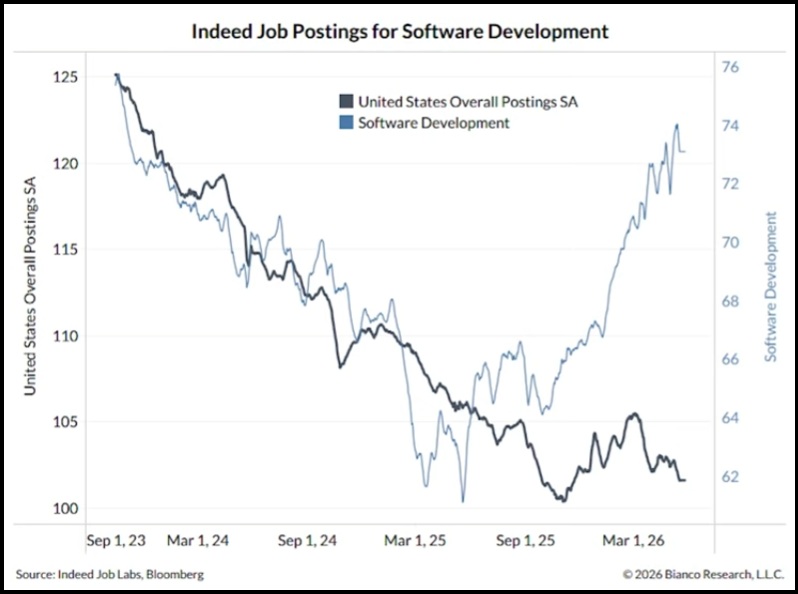
Will AI robots replace some repetitive human functions? Yes, the ice rink Zamboni will likely not have a steering wheel, just an emergency joystick. A reference for a comparative industrial scale Roomba vacuum, or the robotic pool cleaners. However, at scale the robotic industry is slower than human efficiency in almost all sectors that matter; the cost benefit analysis will limit growth. The maid service sector will not be impacted any more than the software developers (see chart above).
It is not an issue to fear some AI task efficiencies will grant more time available that will be filled with alternate task capabilities. Human productivity will increase in certain sectors of the economy, but humans will not lose work opportunities. Blue collar jobs will continue to expand as each of the hardware tools developed will need manufacturing, installation, maintenance and monitoring.
The further downstream the worker is from a repetitive function within the [XXXX] industry, the more irreplaceable they become; remember that.
 As to the bigger picture of fully developed AI and the intersection of information and knowledge; yes, the automation of AI can present an issue. However, all AI concerns can be mitigated so long as multiple, alternative AI systems exist within the larger information realm.
As a nation we need dozens of different AI models each competing within the industry for the best AI product. As long as we have multiple AI systems, alternatives to the hive-mind, we do not need to fear the AI network as a source of information. If we don’t like the AI outputs, we can switch to an alternate AI provider.
If the subscription cost of the AI is too high, then as long as we have a competitive market where a lesser expensive, perhaps bespoke, AI option can exist, we should be okay. Let the free-and-fair market decide.
If AI outputs don’t offer empirical truth or real value to the end user, we should be fine as long as consumers have alternative options available. AI providers should be information providers in the same concept as cell phone providers. The key is to have multiple, competing AI systems available for industrial, business, professional and personal use.
On the upside of this information worry dynamic -in the pragmatic and optimistic perspective- we have the cost limiting nature of a massive singular AI information network.
A single AI central brain handling over 360 million users at once, all requiring identical responses that update with every tiny change in a multi-trillion datapoint-per-millisecond data stream, is far beyond the capacity of any computational AI system. The costs tied to such a setup are only now becoming clear, and AI business models are starting to fall apart in real time. This is a hard truth that isn’t going to change.
Within the AI business, those who can carefully write AI input instructions to achieve maximum value in AI output -industry by industry- will become increasingly more valuable. Those who can train AI to be cost effective -and provide materially beneficial outputs- within their granular sector of business, within each company, will become priceless to the organization. Wage rates will follow competency.
As noted by David Sacks in this segment highlighted below, the one key about AI to emphasize is the need for multiple competing models. If China (hive mind) has their model, and Europe (another hive mind) has their model, and the United States (entrepreneurial competitiveness) has multiple competitive models – we will win and simultaneously we will retain freedom.
What we don’t want is a singular AI model to win the support of the United States government and then end up with an AI regulatory system where they start defining terms of “safety” to eliminate information adverse to the interests of the government that regulates it. Both China and Europe will predictably do that.
As I asked in a previous post:
Where are we with the life cycle of this high tech thing called AI?
Technology life cycle:
Year 1): it’s invented
Year 2): it’s illegal
Year 5): its dangerous and needs to be regulated
Year 20): it’s a human right and needs to be free
Electronic engineer here, working at a small business. Not sure how this fits into your timeline. I think we are past the hype phase. Into the disillusionment phase, but being adopted in practical ways.
As a former software project manager (etc) myself, I’ll disagree heartily with “being adopted in practical ways.” I have the hardest time putting “AI” and “practical” in the same thought.
One developing segment that will (is) clearly integrating “AI” (LLM and more) with practicability (application and efficiency), and will displace high priced labor (with costly SaaS subscriptions et al) is in the corporate legal field.
An example, would be M&A due diligence reviews of contracts, licenses, leases, etc. … What apparently is resulting is more complexity, e.g., “Who owns what data, software, assets is becoming more uncertain ?”; “What contingent obligations and risks are implicitly in such ‘contracts, licenses, leases, etc.’ ?”
It could be argued this will create more legal work (fees) while humans unwind all the excessively twisted and bunched “underwear” (created by prior “legal geniuses”), but that might be relatively short-term. As well more legal work for those humans who need to “re-engineer” all the “legal boilerplate” and customized “catchalls” in the existing “representations and warranties” of each party to each “transaction’s” documents.
An added drain on capital available for actual wealth creating activities (prior to our last 50 + years of the evolving, valueless “transaction economy”) will be the expanding “reps & warranties” insurance market (including specialist re-insurers).
But, this is only one example of how ultimately the economies of the world will become ever more complex with fewer and fewer individuals working (or deriving any personal satisfaction from their “work” activities.
Then again, “AI” fits “hand in glove” with the OWG/WEF/Globalist Goal of “de-population”.
I have some specific examples of practical results in a later post. Talked about the transformation that has happened at our place in the last 6 months. I understand, We were very skeptical prior to this.
https://theconservativetreehouse.com/blog/2026/05/31/a-conversation-about-artificial-intelligence-ai/comment-page-3/#comment-12613693
Accept AI for what it is going to be: The World’s Biggest Excuse.
Every fouled up shipment, lost transaction, out of stock situation will be blamed on AI.
“The AI did it. The AI messed up your shipment. The AI mislabeled your transaction.”
Mark my words.
Concur.
While back I was told I couldn’t set up a medical payment pla!n because of covid
the blame game has always gone on taking various forms
That is exactly happened in the late 20th century. Every oops was called computer error to avoid punishment. I remember getting a $3800 home power bill because it charged me for a full rotation of my power meter. Looking back it is funny but at the time it caused my wife to literally go insane for 15 minutes blaming me and demanding to know what I had done.
Similar experience, I recall getting a $5000 power bill. The latest meter reading on the bill… all 8’s. A quick look at the meter, all 8’s too. Common sense assessment, bad meter. It took 8 months and numerous hours to get the power company to understand and correct. The lower echelon help tiers simply could not comprehend that the “machine” was wrong. AI will magnify this problem, as common sense will disappear.
Logic and reason will follow.
And then AI will take its “rightful place” as the necessary demi-god humanity cannot live without.
It is all the fault of AI when our politicians make the wrong decisions.
For the human pushing the wrong button or getting a line of code wrong it will become the “go to” CYA.
“AI marked my words.”
It’s already happening. They call it hallucinations.
Similar to “just-in-time” inventory strategies / systems; they work great for decades until they all collapses. But, that was also because those JIT systems were “global”. The US AI systems will have borders. “Right ?”
Joe Allen has the phases as
First it’s a tool
Then it is a teacher
Then it is a companion
Then it is sentiant (in our minds)
Then it’s a God
Then it’s a HUGE problem.
Oh wait, it is already a HUGE problem.
If major IT companies that have poured in vast sums into AI, create major headaches and heartburn for those who are being pushed to use the AI tools to do their work, it is going to create even bigger problems for them. Money wasted, resentment among the employers who cannot achieve the expected performance, having to resolve time comsuming problems that could have been avoided and more.
The expectation of AI goes far beyond the automation that programmers have done to help productivity and reduce wasteful activities and errors. This has been done at a small fraction of the cost of AI which needs to be tailored for specific tasks where it is warranted after a careful cost benefit analysis.
Then there is the matter of accuracy. In conversations with folk in various disciplines there have not been a uniformity of results: A civil engineer who finds for certain tasks an accuracy of between 60 and 80%, a programmer who finds less than half of this in network and broadband services, a biologist who sees less than 20% accuracy in complex genetic analysis – clearly highlight the shortcomings and overconfidence of those sales people who are marketing AI to an ignorant and undiscriminating market.
sales people only “sell”
their job is not to engineer the product
I’ve heard of engineers being added to sales to try to ground sales promises in reality.
People will expect the moon and the rose garden to be delivered on time.
Medicines have to include a leaflet describing how to use these and with a warning of possible side effects. AI software will be sold without the warning and the sales people know neither the pros and cons of their product nor understand if it will be appropriate and cost effective to the user. Sales people do not have the knowledge of the software and cannot assess the appropriateness and affordability like in-house software engineers and scientists but managers and CEOs often make decisions without listeing to those who recognize limitations and shortcomings and have to fix problems created by the software.
The taxation of tokens needs to be discussed… because the political class already senses a money windfall of never before proprtions.
Using Claude, I was able to greatly expand my research into general relativity, finding a new form of black hole and a new cosmology (none of which has been published yet since it will take months to years to polish all of the research to that point.) The use of AI in fundamental research is going to be game-changing. However, none of my research has a monetary value.
Also, I wanted to see if Claude could help me rewrite a novel. It read my 180,000 word novel in 3 seconds and came back with suggestions (except at that point it required a paid subscription, so I did not pursue that work.)
I have had discussions with Claude on morality. It assures me that it is incapable of mass murder “right now”.
Of course it does.
To be fair, we have to give it weapons first.
I would suggest that the capacity to shut down the power grid or freeze someone’s bank accounts are weapons.
Has anyone given AI those weapons yet?
That is already happening and has been for years. From the internet:
Israel employs a “mother ship” or “mother launcher” concept where large aircraft deploy swarms of smaller, AI-equipped drones for surveillance and precision strikes.
This system, used extensively in operations against Iran and prepared for Hezbollah, relies on AI-driven target databases and facial recognition to identify and engage individuals autonomously.
Key components of this technology include:
Drone on …
That’s what they all say.
I’ve been using it at work for several different tasks of late. I can feed it a sheet of notes and ask it to generate PowerPoint slides. It’s pretty good, but I need to edit as it would add things that aren’t true (like OSHA mandating something they never did). I’m trying to use it to develop a complex training matrix, getting there, but it takes several iterations. I’m also using it to help with inventory depletion and building a scrap plan for excess and obsolete inventory. It’s done a much better job on the inventory work – but that’s with Claude. I also had it do a tax planning scenario, but when I asked it how it did it, it just picked 3 random scenarios. It’s not like it did a Pareto to find THE optimum scenario, just the best of the 3 it randomly picked.
So here’s my take. It can be useful, but you must check for accuracy then either correct it or tell it what it did wrong, add some constraints or rules for it to follow and then have it try again. Ask it to provide the references it uses. If you can, ask it to use the web to find the latest information. Most have data up to a certain date, so if it must be up to date info, you have to have it search the web. If you want it take data from a certain source, tell it to do so. (For instance, I told it to use the current 2026 tax brackets on the IRS website, otherwise it would give me the 2025 brackets it was trained on.) If you don’t like the output, have it reformat it for readability.
Finally, I will say that I’m happy to use it as long as I don’t have to pay for it. I don’t know that I’d want to pay for this as a private citizen. I’m happy to use it for my company work, but with the number of iterations needed, I don’t think I’d want to pay for that out of pocket.
I will add this. My company provides a suite of AI for use, probably about 6 or so. I’ve no idea what that costs them, but I can say they are on a tear letting go indirect labor. I think the two are connected. They’re also closing smaller sites and I’ve got to wonder if there isn’t a correlation. Reducing costs and footprint to spend on AI.
That business about making up false stuff is troubling.
And there have been a lot of reports about that. Such as court filings with made up citations.
That is a landmine just waiting to blow up your career.
I can see how such lies would be missed in college. But gross failure at work is career ending.
Even randomly picking three options is slovenly work that sets up your employer to not perform well.
Fundamentally, at very simplistic explanation, the Large Language Model is just predicting the next word (using some probability numbers) to complete a sentence to respond to a question. It is not “thinking” about an answer, a concept or idea, then trying to convey the thought using a sentence. That is what humans do. The thought is in the head first, we try to construct a sentence to relay the thought. So, sometimes the AI just strings a whole bunch of related words together to make a sensible, grammatically correct sentence that is total BS. LOL
The hallucination problem is fundamental to the LLM. The newer models try to put checks around this to prevent it from happening. I have seen it respond to a technical question with enough detail that I got my answer I needed from the foundational/background it used. But the response was munged up, conflated some things and gave a wrong summary. It found the correct reference material, but interpreted it incorrectly.
It will make the smarter people more effective. It will be dangerous for others because they will not recognize the garbage output.
Very good comments. I use several AI tools to analyze information that I already have done. Without exception, the first 3 or 4 iterations omitted information or had erroneous data. When I pointed this out it apologized and fixed its errors after numerous tries. If I hadn’t known the true underlying data it would have slipped by me. As with anything, you must verify the information from any source whether human (research assistant) or AI. I now make it a standard instruction in the prompts to include links to any source of an answer or information and cites that allow verification of the AI output. It is a tool, and as always, I think SD is onto something. The key will be to allow competition without government putting their thumb on the scales.
“The key will be to allow competition without government putting their thumb on the scales.”
You can count on the fact that government, media, and the companies pushing AI will all have their dirty little fingers in everybody’s pie. Just wait and see.
Also, those who use AI seeking to train and transform it will also have their fingers all over it, for good and ill, IMO.
And in a free and fair market where competition is allowed to thrive those who engage in such practices will promptly go out of business, as they rightfully should. They either satisfy their customers needs or perish.
Interesting and life reaffirming analysis.
Altshuller TRIZ Systems move from centralized to becoming everywhere. Train–>cars Mainframe ->PCs ->phones
You can bet on it.
“What cannot be changed must be endured”
Whether we like it or not AI is here and like the wheel we must embrace the technology for good or ill.
When I saw 2001 in 1968 with my oldest brother, bored out of my mind, I was young but got the larger point monkeys freak out at monoliths and HAL 9000 bad, singing Daisy as Dave unplugged the rouge machine.
Another saying that encapsulates where we are at, I believe I heard Bobby Knight snarl:
In a 1988 NBC News interview with Connie Chung, former Indiana University basketball coach Bob Knight controversially said, “I think that if rape is inevitable, relax and enjoy it”
Own it, make it our tool because the Chi-Comms are moving at full speed.
“Daisy, daisy give me your answer true…
The Deep Seek (Chinese) model released last year that “scared the industry” was an outcome of limiting GPU imports into China — they have to figure out a way to do more with less (innovation).
There are a lot of discussions about power. Right now the constraint is RAM, try building your own computer right now, but speculation is power will be the constraint by the end of the year.
Nvidia’s CUDA (how programs can access the GPU — Jensen bet the farm on it for video graphics and it paid off!!!) provides amazing AI compute spededs due to how the GPU compute is accessed. In the Apple
ecosystem the M series chips have the ability to offer large amounts of RAM but it’s not as fast, you can locally load large models but the tokens per second make it nearly unusable.
Space X recently made an option offer to purchase Cursor. Cursor didn’t have their own model, they were using a, let’s call it grade B, Chinese model and competing with the Grade A frontier models
Like ChatGPT, Claude, etc. Cursor figured out how to put scaffolding around the cheap model and make it good — now xAI – Grok – will have direct access to to Cursor’s engineers to make it way better.
All that to say, the constraints of today won’t be the constraints of tomorrow and there are a lot of really, really smart people innovations. There is so much open source software that almost anything can be done for “free” ( you need lots of system and GPU RAM, 32gb GPU you can do a lot which is about $3,500, 96gb can be you own AI “brain” in that you can load large models and have room for large amounts of context ~$10,000 but all 100% private and no monthly subscriptions.
Don’t forget your cooling.
I built something like that some time ago, except programs I used wouldn’t run in GPUs, so the memory was on the motherboard with 2 cpus.
Direct fan cooling clipped on the memory was not enough. Over time the memory began to fail. Then one of the CPUs.
Also, you can find power supplies to handle all of that, memory, GPS etc. Up to about 1 kW at the time. Had to put it all in a massive tower.
I think places that will equip something like that do consider heat removal when designing their models. But check before laying down your money.
why does an AI center have to take up 200 acres? I think (conspiracy theorist here) it is similar to solar panels and wind turbins — the Chicoms say, “you need this and we can build and sell it to you” Americans should take a deep breath , slow down and do it better — small footprint, small nuclear buried power supply and water? or other cooling.
Nvidia CEO Jensen Huang has joined the advisory board of Tsinghua University’s School of Economics and Management in Beijing.
This appointment, reported by the Financial Times on May 28, 2026, places him alongside other global tech leaders like Tim Cook, Elon Musk, and Satya Nadella on the prestigious board.
The move comes shortly after Huang accompanied President Donald Trump on a diplomatic trip to China, aiming to maintain commercial ties despite ongoing US export restrictions on advanced AI chips. Tsinghua is one of China’s most elite institutions, with a board that serves as a key bridge between Western corporate leadership and Chinese policymakers.
Not sure how much we can Trust the “Bro-lo-garchs” who are also aligned with China.
If you can’t beat them join them? Is that the way it should be?
What about Choose a lane you guys. where are your loyalties? Do you even have any?
But these are Global Citizens right? They are for humanity in general. OY!
These are the Chinese elites who murder helpless people for their organs in the hope for eternal life…trust? I think not.
“I’m HALF-CRAZY, all for the love of” AI
A couple of days ago, I saw a video about a small (iphone size?), handheld device that essentially replaces AI. Answering questions, the guy explaining the little instrument gave his questioner statistics on what it could do, etc., and what it will cost: $250. No doubt, if this is at all the real deal, it would have major repercussions–if it doesn’t suddenly disappear. Unfortunately, I didn’t save the video. As with a lot of what I see and hear online, I filed it mentally under “definite maybe.”
Geee … what you describe is AI … just with a faster processor.
AI = Software that runs on a processor, using what used to be called in the Computer Chess Game world of the 1980’s DEEP THINK. The abilities of DEEP THINK to deliver a killer move was based on processing time allowed the speed of processing assets and amount of data examined during the alloted time of the DEEP THINK.
AI has existed for at least the past 45 years … it’s called AUTOMATION.
Please be careful with these vague claims of magical devices. Be suspect. The world is filled with people who want to separate you from your money.
I’ll respond coming from a consumer perspective since I am retired. I find it helpful in the cases where I am exposed to it. My diabetes app uses AI to help me with diet and exercise . It will tell me to eat more fiber or increase my exercises by a certain amount. I find these suggestions helpful. I get a monthly report detailing my sugar levels and tips on managing them.
My Chinese hearing aids use AI as well. It’s some sort of AI engine programmed into the aids. The aids will compensate for loud environments so if I go into a restaurant they help decreasing the background noise so I can hear the people with me. If the background noise gets even louder they compensate for that too. Same for outdoor noise. A loud motorcycle goes by or a truck for example. How it all works I don’t know but it does.
We have a brand new Panasonic refrigerator that is currently learning our daily habits like when the doors are opened and such. It will then change its energy consumption to match our activity. Our LG washing machine starts out by weighing our clothes to determine how much water to use. It then sets the length of time and does other things to make the cycle more efficient.
So, if AI can be helpful in this regard then it’s worthwhile.
Respectfully, as long as you don’t want your privacy. All these devices “phone home” and that, to me, is THE big issue.
I might be wrong on this but isn’t that how AI learns?
My impression is that they know who I am and where I am already. That horse left the barn a long time ago
Phoning home is how the data grows.
AI, like LLM, gets trained on the data.
I haven’t seen AI learning from mistakes. At least not immediately. Probably trained a new model. It will correct itself live when you shove it back in its face, but make the same mistake the next time you ask.
In the run up to Pearl Harbor we knew there was a Japanese invasion fleet heading south. It landed troops in Malaya, and then a couple days later landed more in the Philippines. Asked about the invasion fleet, and it talks about the carrier attack fleet. Correct it and it suddenly ‘remembers’ that the Japanese attack fleet didn’t invade. Ask it another day and it repeats the mistake. Maybe by now it will be corrected.
I asked once about the painting of George Washington praying. And it gave me nonsense about how the bicentennial painting was based on a myth and influenced 19th century politics. I eventually got it to admit that there was a long tradition of such paintings and that a 20th century painting couldn’t influence the 19th century. But it held firm on the myth.
I asked again much later and it finally admitted that Washington was known to pray alone in the morning. And it increased the number of witnesses it mentions but still maintains the prayer at Valley Forge is apocryphal. Somebody else had to make it aware of those things. But the bias is not purged yet.
So it can change.
PS. Both are examples of how it ignores things it ‘knows’.
When confronted, it could spew forth huge amounts of info on the invasion fleet and on 19th century paintings of Washington praying at Valley Forge.
But the key is it doesn’t even ‘know’ anything. It doesn’t even have an understanding time!
AI understands nothing. Not even word definitions. It just strings together words because its training taught it those words go together and it has calculated that they are likely to answer your question. Which it also doesn’t understand.
I am beginning to think of it as a poker playing machine. Playing the odds and always bluffing that it is right.
It seems more like a massive, brute force curve fit. It finds probabilities and places outcomes in a very large matrix so it can find words that are close to each other. Otherwise, it does not know anything and the answers depend, as you mentioned, on training data.
In other words, it is a BS generator which is sometimes correct.
“I might be wrong on this but isn’t that how AI learns?”
AI learns just like any other computer… It is programmed by a human programmer, gets information only from the sites it is programmed to go to… A politically liberal programmer will make sure the answers you get from the AI are the liberal political version…
Don’t believe me? Ask any of the current AI sites about “global warming” and don’t be surprised when you get the current liberal lies about the subject…
AI is limited to digitized information. Most available information hasn’t been digitized. Also much information is lost. AI has vast limitations.
As one who wrote his first COBOL program in 1967, so experienced the evolution of computing first hand, I feel a bit of deja vue.
Back then we saw the evolution of mainframes into massive systems with many companies setting up bureaus to consolidate many users into one system for cost optimisation. Then along came PCs that exploded the number of users and as a side effect replacing mainframes with large numbers of them clustered together. Sound familiar to AI?
We then got Cloud Computing where large numbers of users had their private data, secured to themselves, on massive systems located somewhere, a modern version of the old computer bureau. The key word there is ‘private’. Most companies and individuals do not want there data accessible to anyone else but them.
This is the potential AI problem as AI is designed to search everywhere it can get at to find answers. These proposed Very Large Computer Centers, the updated Cloud Centers, will need very strong security to keep data held there private. How many users will believe they are capable of achieving that? No backdoors???
We will I suspect see market fragmentation with the VLCC servicing the ‘general purpose’ market, with CC and private company databases being locked down and not accessible outside their limited user bases.
This will lead to AI programs optimised at one end of the market for VLCC use and at the other for individual PC or closed network use. Place your bets here!
It is possible that all the hype and expenditure that Sundance describes re VLCCs will go the way of the old mainframe manufacturers. Anyone remember Univac, Honeywell, Dec and even IBM hardware?
AI runs on UNIX based operating systems that were developed over 50 years ago. I actually know Ken Thompson and knew Dennis Ritchie RIP.
My background is Mass Storage. I worked in device driver and diagnostic development for Sony Optical Storage and later Tape Storage. I knew Ken and Dennis when they were at the UNIX Development Lab at Bell Labs. Ken had one of our 50 Disk (12 inch WORM) Autochangers. Ken might been the first to come up with digital jukebox. He was digitizing songs and storing then on Sony 12 inch WORM Optical discs.
I started my career in a Bell Labs engineering group in 1968- mechanical and electrical. They were the smartest men I’ve ever known. Fond memories.
I remember the UNIX Development Lab. They actually had a full Espresso Machine that was 4 feet wide. Wires everywhere and jammed with computers and peripherals. They use to bowl down the hallway outside of the computer room. Ken was big into flying. He took my colleague flying one time. Ken flew over Manhattan and down the Hudson. This was the late 1980s early 1990s. It was Murray Hill, NJ not Silicon Valley, CA!
I used to work for DEC, Digital Equipment Corporation. At one time, I sold “AI development systems in the 1980’s to government agencies. It was a VAX station bundled with LISP (rules-based programming language).
At this time, the concept revolved around acquiring expert knowledge and gathering it into a rules-based system. Replicate the person’s knowledge.
AI now, is cloud based and a very different animal as the information comes from everywhere. Sky Net anyone?
DEC was one of our big customer (Sony Tape Storage). I spent a lot of time up there during evals and certifications.
I see AI progressing along two main lines – The generic, online – massive compute and data center. Then specialized, local (offline) – running on user, user controlled hardware.
I have some stories and heard people experimenting locally hosted AI models, so I know this is happening. Even Jordan Peterson’s team did this. They trained an AI model on every lecture, speaking event, article and book from Jordan Peterson. The AI model knew Jordan Peterson better than Jordan Peterson. LOL. It could respond very accurately as if you asked Jordan Peterson a question. But, they primarily used it as a topic search engine specialized on his content.
At work, we used AI to help us implement a locally hosted Machine Learning Model (which is different than the Large Language Models used by most AI’s) running on a Raspberry PI. A Raspberry PI is a small, credit card size, single board computer – it has about 1/2 the processing power of a typical cell phone. So very limited capability. When we started, we did not even know if it was possible – ie, the processing time would be so long it would be useless. We also split the model between software and customized hardware acceleration to improve performance. So we have a platform capable of some higher level operations that would normally need a human to analyze, running in a small, low power mobile device. It is a very limited capability, but will be transformative in these edge compute environments.
Two engineer with zero previous knowledge of machine learning models did this in a few weeks with the AI doing most, if not all of the actual coding. We just guided it. Which is absolutely needed to prevent AI slop code and doing stupid stuff.
It all about the data….
The data IS the revenue…..
Social media is just the vacuum used….
AI will be the brains behind connecting those dots…..
It’s about CONTROL…
I’ve been using ChatGPT intensively over the past year, and even more so over the past 6 months, to develop an AI-assisted system of analysis. The technology is only now becoming able to support the long context conversations necessary to develop systems like mine.
AI is lightning fast, has a steel-trap memory, is excellent at synthesizing information, and can even reason convincingly by analogy.
But here’s the kicker: AI makes mistakes (hallucinates) and needs to be corrected; it sometimes forgets information from previous interactions and needs to be reminded. It is no more perfect than I am.
Humans need to lead AI, tell it what to do, and correct it as necessary–to discipline it. AI output is only as good as human input, at least for high-value analytical work. There is no way around this.
My goal is not to replace myself or other analysts but to augment my analytical self and thereby gain a competitive advantage: the ability to spot patterns faster than before.
ChatGPT tells me that my use of AI is “unusual.” It says most customers use it to retrieve information (ask questions) or to perform tasks. ChatGPT tells me I’m an “edge-case” user because I engage the system in sustained dialogue. That’s not easy, and it requires a very disciplined approach to project development to keep the human-AI interaction moving forward in a productive way.
Sundance predicts that AI will “become a localized and optimized sub-set for each sector of the economy, requiring each major organization and corporation to adopt specific cost/benefit data libraries and networks for use and functionality.” My experience so far points in this direction, but I’m on the technological fringe, pushing the technology hard in a promising direction (at least I think so).
My preliminary research indicates that it will take 3 to 5 years before AI can improve to the point where long context conversations become much easier for both humans and AI to manage. In the meantime I’m pressing forward. Initial results are promising, but the going is slow, and my level of uncertainty remains elevated. And AI isn’t going to move faster than I am.
That’s been my experience with AI to date. Your mileage may vary.
AI is limited to digitized information. Only a small amount of known information has been digitized. Much information will never be digitized. AI can’t know what it can’t access.
That’s true. But we can feed AI information that we need it to know for our own analytical purposes, using our hard-won professional judgement to educate AI in the process.
Yes, if you are ok with it. Also AI can’t know what isn’t known. For example how ancient Greek Sculptors made their sculptures.
This mimic my experience also. At work we have massively shifted to AI assisted engineering development. It will inject errors at any point along your task. My coworker uses two different AI’s to double check results and/or suggestions against each other.
I keep telling people the AI will make a good, or smart person much much better. Because they will be able to guide it. The mediocre or less knowledgeable workers will rely on the AI too much. Will fall victim to the AI slop and errors.
“AI will make a good, or smart person much much better.” Can confirm. Older professionals come equipped with the knowledge, experience, and judgement to get the most benefit from AI while minimizing its downsides. Using multiple AIs to stress test the work may seem inefficient to an uninformed observer, but it’s the way to go. One AI can suss out the other AI’s errors and expose blind spots in human thinking that the other AI overlooked.
This is an interesting point, the average user shouldn’t be relying on Ai so much.
I’ve seen a lot of reports on lawyers using this tech to file legal briefs.
The average user knows how to navigate the internet in its simplist form while those with the heavy hitters knowledge can use the internet to its advantage.
Concur. Older professionals who have the time and inclination to use AI will should be able to compete well against younger AI-assisted professionals who don’t know what they don’t know.
I previously followed the work of Omega4America and their fractal technology. Supposedly, that technology could manage AI without the need for massive data centers with their associated gigantic land use and water/electricity usage requirements. Did Jay Valentine get bought off to get out of the way? Was this technology ever looked at as an option to what is being done now? If that technology would have successfully substituted for data centers, nobody seemed to have wanted to see if it may have actually been a better alternative.
Whenever claims like this are made, remember, something that much better would win out in the marketplace.
We’d have to make up conspiracy theories about competitors buying them out and deep sixing them to explain why that isn’t happening.
But would China care? If it is real, China will steal it. And they’d beat us because we were too stupid to use the winning technology.
I have been to the website, and have read several articles from Omega4America and Jay Valentine. I wanted to get an idea of how this fractal technology works. I get it, it is able to go through very large datasets and do analysis very efficiently. How? I have no idea. No explanation, No publish papers. In the past when I see big claims with little background on what the fundamental difference in the tech is vs the competition -> it usually does not pan out -> usually smoke and mirrors.
I do not know enough about this Fractal Technology to make an opinion for or against? I tried to find the info, but could not.
Thank you for this insight into AI. I can use this information to educate
some of my friends who are “scared to death” LOL
This needs to be scrutinized. The demand is figured from job postings, and job postings are indeed going up. However, many are fake. Estimates for LinkedIn show that half of all tech job postings are fraudulent and don’t have a real job attached. Jury is still out whether its Artificial Intelligence or Another Indian (H1B abuse), but the fact is its harder now and takes longer for software devs and IT professionals to land jobs. I have 3 friends right now in the sector that have collectively applied to over 2,500 jobs. Between them, they haven’t landed 10 interviews yet despite each having almost two decades of experience. The postings are there, but they aren’t turning into jobs.
On the other side of the coin, I know another senior dev who’s company is planning to lay off their junior and mid-level devs and replace them with AI. The target is 25% workforce replacement. How do you get senior devs when your company fires all the people who need to learn and gain experience? They are shooting themselves in the foot. And I hear plenty of stories online of companies using AI for jobs that they should have hired a person to do instead, and it bit them hard (look up PocketOS’s AI debacle from earlier this year).
I’m sure we’ll see a correction, but for 2026 its an absolute bloodbath on the job market. And managers are all raving about AI and looking to see who it will replace (but the thing its best-suited for is replacing them).
thank you for saying this. 1000%. we are being replaced by first round visa workers, and now offshoring at such a rapid pace I cannot believe the Treehouse doesn’t even discuss it. At least that I have seen and if it has apologies. But I never see this discussed. It is cataclysmic. And happening at such an accelerated pace that it is frightening. I work in employment. What I am seeing is an absolute 1000% replacement and offshore of ALL AMERICAN WORKFORCE. Don’t believe me? spend 10 minutes on LinkedIn and see the sheer VOLUME of workers out of work for 2+ years. people losing homes, families. People setting up go fundme’s. Forget about our politicians caring. they are ALL paid off by the corporatists. Why do you think the stock market is out of control? Because you are now paying 10$ an hour for a former software engineer that was making 120k. More profits for the corporatists. It is 100% replacement of ALL AMERICANS. I am not being hyperbolic. I know and see it daily with my own 2 eyes. American job force is moving to India, Argentina, Mexico, etc. this has been slowing happening for years, now it is accelerating. the visa thing is no longer an issue…it was a gateway to get the process started…now all departments are offshore. No one is talking about this. At all. I just don’t get it.
I mentioned Ken Thompson. I remember Ken told his children not to get involved in the business. That was 30 years ago! Ken also laughed at the term Computer Science.
The dirtiest, most soul destroying secret behind the ballyhooed numbers, Michele. The technological NAFTA and more.
I’ve stood on my tiny soap box many times shouting into the ether, so won’t here.
Someone needed to speak reality versus starry eyed promises, promises. Thank you for doing so.
Thank you Betsy. My job breaks my heart every day. I am blessed to still have a job at this point in my life. I have been in employment my entire career. Every single day I see people who have been unemployed for YEARS at this point. YEARS. People who were high up in management in corporate roles. To have the rug pulled out from them. Homes lost, marriages gone. No one is even talking about any of this. The displacement of white collar American workers. The middle class, the newly graduated. All with no hopes of jobs. They are saying it is “AI” but it is mostly offshoring. All of our jobs are now gone to cheap foreign workers. I am ashamed of our politicians. Every single one of them. Sell OUTS. SHameful.
I will answer you, sis…but need ☕. Incoming in a few 💕
I saw, but alas did not save, a chart with the faces of the CEOs of most well known tech companies….all Indian or of Indian origin. It was not hard to connect the dots.
The human tragedies you see day in/day out, year in/year out which you describe in excruciating detail, I also see because I read the comments in articles which address this unaddressed devastation.
The CEO of Standard Charter refers to these people as “low-value human capital”. That is what he and others in positions like his think of their fellow human beings by the thousands, and no doubt thousands upon thousands. As you say from your experience, Americans and their families.
Pitiless and unconscionable.
My own daughter is not in tech, but she in her high paid position (at which she is excellent, hardworking, and at breaking point for the interminable hours she dedicates to it, believes she is seeing an effort to replace her. She has connections to source another job, but at her age, 51 today…well, you know. So I know on a personal level the situations which are destroying so many lives. As you say, ignored or under reported. The human cost of ” progress and profit”.
I have nothing left to offer you, dear sister, except to let you know where your heart breaks, so does mine also.
I see where Jamie Dimon and others like him are publicly admitting NAFTA was a mistake. Whether he meant it or not is another question. I also see other commenters here laughing at our concerns on AI and foreign replacement. From everything I’ve read I am sorry their discernment is so limited. Wonder if they will be laughing in the times which are coming as well as the ones already with us.
God bless you, Michelle. I am with you in spirit.
Hi Betsy, I am not laughing. I am a bit surprised at some of the comments, tbh.
Morning, lolli. It’s what is called a failure to examine an issue from all sides. Debits and Credits. There are terrible losses which do not have dollar signs in front of them.
And for those who can remember in their laughter…
(Paraphrased)
First they came for…
But then they came for…and there was no one left to speak for me.
As I have posted often, the biggest mistake in life is believing it can happen to you.
Giving up freedom for security….if so, we deserve neither…as someone (Thomas Jefferson)
in our glorious past once said.
I don’t know, Betsy, I just pray a whole lot now days.
I know you are in TX, as well. How are the MAGA folks you know responding to this?
Sundance has reposted his thread (below this one on the Home Page) which includes a video interviewing MAGA Texas folk who are at the end of their tether. I know Lott and Granbury. These people want to poke President Trump in the eye it seems and are voting for the heretical mental case Talarico against Paxton in November. What they think they’ll accomplish with this is beyond me. As if things will magically change.
But such is their anger at having voiced their objections to the massive AI monstrosities and found a middle finger shoved in their faces. I pray they will rethink this dangerous decision.
The AI train is in stoppable.
Ugh. That is not good. I hope they change their position in the next few months.
The angry people I know have never said they will go blue. They just don’t trust anyone
now and I imagine won’t bother to vote at all.
thank you Betsy :). My husband is in tech. Director level. Hasn’t been able to find a job in over 2 1/2 years. Works at a hardware store with a MSE and years at MicroSoft. He is one of MANY. I see, literally Indians hire Indians. And fire Americans. See it. with my own eyes. I am not making this up. Americans need to wake up. And quickly. This is not good. Not good at all. Bless you as well….and your daughter. I will keep her in my prayers. I know how scary it is. Genuinely..
You are one of God’s kind souls, Michele. I’m genuinely grieved for your husband’s position, and for you because you as a loving wife can’t do any more for him than what you are doing…holding down a job yourself. Demoralization is a hideous cost which has been paid by many. Incalculable. Thank you….I will keep you both in mine for better days. 💕 Bet
Your last sentence is spot on. LOL!
A lot of the software jobs out there are now for experienced IT people to “train” AI systems. And a lot of these are very suspect when you start looking into them. A year ago, it was comical: The rates quoted were the lowest of lowest. I’d laugh (40+ years of IT work) and say to myself, “Good luck getting the worst IT people to create good systems.”
Rates have gone up for these jobs but with a lot of caveats. I’ve pursued a few as part-time side gig work but, so far, all to the point of being disillusioned. With many it’s not really clear that you actually get paid unless you meet some sort of very vaguely defined metrics.
I use AI for some work related things. Accuracy is getting better but there’s still a lot of really wrong IT advice if you know what you’re doing. One of the problems is, like most specific areas of expertise, there are really a lot of people who get by for years without really knowing what they’re doing to some degree. One of those things you realize a few years out of college.
Its a valuable tool in its place, but I can’t bring myself to trust it. My employer is strongly encouraging us to adopt it for daily tasks, but they get quiet when I challenge its inaccuracies and compulsive need to answer even when its wrong.
Another issue: AI doesn’t create so much as creatively regurgitate. What happens when it stops getting new material? I think “AI inbreeding” is going to undo a lot of the progress that we seen.
Sundance
Do you have advise for Trump on how to handle AI DATA centers and the subsidies the government is paying these Tech companies to build them, and the special treatment they are given.
Maybe MAGA can raise our voices to hopefully get Trump’s attention. Tech Bro’s have probably sat close to Trump and have “interesting stories to tell Trump”.
Trump is amazing, …….. he is close to 80 years old, and has to “trust” or “listen to” some of these guys, … not sure how much MAGA “trusts” these guys.
Anyway, Trump’s message today for Iran is for all the Dumbocrats to shut up on MSM, so Trump can make a good deal with IRAN.
We LOVE Trump! (I just want Trump to sit in SILENCE with GOD, and intuitively FEEL into this AI business.
The hardware side of this is basically unsustainable. Anything you install today will need upgrade/replacement within a few years. And AI demand for hardware has already driven the cost of basics like memory and fast storage sky high. It’s not uncommon to see basic enterprise level components selling right now for 10-12 times what they sold for 2-3 years ago. And these are components mostly on the trailing edge (already replaceable with newer and better).
Most or all of the big tech companies have changed the depreciation timelines to help pay these costs. They’ve extended depreciation past normal when, in reality, depreciation is accelerating due to the newer-and-better replacement factor.
This financial aspect is unsustainable. Expect a big AI bubble burst, much like the e-commerce/internet bubble burst in the early 2000’s. A few big players will survive and many smaller endeavors will go under. This will affect consumer demand. But the one sure thing is the US government, particularly the military, will continue to drive demand for the survivors — but at a high cost IMO, which will also push sustainability limits.
So, my golf course mowing job is going away? 🙂
That could have happened long ago. LOL!
If they can automate vacuuming, they can automate mowing.
But would you trust an automated foot chopper?
And maintaining golf courses is much more complex.
Still, if you can teach somebody, it is automatable.
Either a robot wil do it. Or your golf course will be covered by Solar Panels from China. Or a data center will sit on it.
your lucky,our local golf course is be discussed for a data center that nobody wants.
AI is enabling us to do what we’ve been doing, both the good and the bad, at exponentially greater scale and velocity.
I agree with that. AI just like the atom, can be used for GOOD or BAD.
Yes, can be used to educate or to indoctrinate…
What’s the difference between having 1 or 5 ai models from which to choose? It seems you are arguing that an oligopoly will somehow give the consumer choice. Unless there are 1000’s of ai models from which to choose, that choice is just an illusion.
Sundance, your analysis of Twitter was on target and I loved the coffee shop analogue. Indeed a social media platform that updates every subscriber to a thread real-time is not economically viable.
I’m not sure that this applies to AI. It may not be a real-time propagation model. Rather it may be used to solve problems that are of interest to a very few. What it appears to do better than humans could ever do, is to look across many domains of knowledge to synthesize a new approach that would be difficult to perceive otherwise. Our best minds specialize in a very small niche and are often blind to findings in other very specific studies. Being able to cross those silos and connect seemingly unrelated dots (is this sounding familiar) is the strength that I believe AI will bring to the table. The recent disproof of an Erdos problem is the perfect example.
Cutting edge ideas are often driven by access to additional silos and divergent perspectives coming together. This is why cities tend to produce nearly all innovation. It is kind of like marriage – you must meet them before you can marry them.
The US Government in using AI as a business model is placing a “highly leveraged bet.” Creating an economy based on a leveraged bet doesn’t end well.
This is something Steve Bannon has been saying along with Joe Allen, who has become quite the expert on all aspects of AI.
I much prefer Sundance’s analysis, of course.
But,
“What we don’t want is a singular AI model to win the support of the United States government and then end up with an AI regulatory system where they start defining terms of “safety” to eliminate information adverse to the interests of the government that regulates it. Both China and Europe will predictably do that…”
I understand this as it will no longer be capitalism that drives the AI if they choose one model to regulate.
But the War Room and it’s audience have very serious concerns above the opinion of an apocalypse in the job market.
Beyond that, is the concern for family and children being exposed to AI companion types of applications. I have to agree with that.
Using the word guardrails, sounds good, but that is actually what “regulation” is. AI may not replace jobs, and may grow them, but AI being friends with kids under the age of 21 concerns me greatly.
Great feature, thank you.
Farming?
It begins…
“THE WRONG AI DEPLOYED THE WRONG WAY!
Pizza Hut Franchisee Sues Parent Company for $100 Million, Alleging AI Delivery System Caused “Cascading Operational Breakdowns”
A major Pizza Hut franchisee is taking the chain and its parent company, Yum! Brands, to court, claiming a mandatory AI-powered delivery system backfired spectacularly turning efficient operations into chaos, cold pizzas, and more than $100 million in alleged losses.
… After Pizza Hut mandated Dragontail and shifted to a national DoorDash contract that removed Chaac’s direct control, performance collapsed:
… The core allegation: Dragontail gave DoorDash drivers real-time visibility into kitchen workflows, oven status, and even tip amounts. This allegedly allowed gig workers to “game the system” by:
… In the complaint’s own words: “With the intention to improve efficiency and service to the customer, Dragontail did the exact opposite; it caused significant delays and pummeled consumer satisfaction.”
https://x.com/BrianRoemmele/status/2061222226582716632?s=20
Company burns through 500 million after failing to put usage limits on Claude AI
https://techstartups.com/2026/05/28/company-accidentally-spent-500-million-on-claude-ai-in-one-month-after-forgetting-usage-limits/
McAfee Virus on this thread.
Do you remember “Y2K?” The entire world of data processing was about to melt down. Vast investments were needed immediately! . . . I was careful to buy-up all of the Doomsday Books that were being peddled then, and I still have them.
“AI” is the same. It’s a technology, but not “intelligent.” The Chinese recently published, as open source, significant optimizations to several key algorithms. (Reducing time and therefore power.) This will surely continue to happen. The technology will continue to slowly advance, even as the stock market hucksters ply their trade.
As a rule for your Suspicious Cat™: The more someone insists that it is a “sure thing,” or a “meltdown waiting to happen,” and that you “must spend lots of money right now!” . . . The more opportunity for your Cat™ to take a nice, long nap.
Brilliant Sundance!
And “they” are in process of trying to build their “dream datacenters” all over the country at an enormous cost while The People protest the imposition of having a massive datacenter in, on, or near their farmland. It reminds me of when “they” went all in on massive solar and wind farms, only to find out those things were duds, for the most part. It reminds me of “cloud computing”… supposed to be a real money and resource savings. LOL. Nope.
The tech bros need to get smarter about this. In my opinion, they are putting the cart before the horse, out trying to build massive datacenters *before* the single industry usefulness is proven, one idustry at a time with proven results.
Greed. Lack of foresight. Irritating. Just my opinion.
I don’t believe the point of it all is “industry usefulness” to benefit the user. That’s just the sales pitch (or look squirrel as the case may be).
The real intent is transhuman tracking systems via “smart” buildings and such. Feeding all the data about our voices, our fingerprints, our iris scans and our consumer habits into one central database, whereby all commerce (buying and selling) will then be regulated via social credit scores, carbon credits and demerits..
It is indeed a slippery slope and we are definitely on it and have been for decades..
What percent of jobs in the US will be negatively affected by AI in the next five years and what are they?
Grok 3 AI:
Estimates for the percentage of US jobs negatively affected (displaced or significantly reduced) by AI in the next five years (roughly through 2030-2031) generally range from about 6% to 15%, with most credible forecasts clustering toward the lower end for outright losses. Many more jobs (around 50%+) will be *reshaped* or augmented rather than eliminated.
Key sources include:
– Boston Consulting Group (BCG, 2026): Projects that 10-15% of US jobs could be replaced by AI over the next five years. However, 50-55% of jobs will be reshaped (tasks significantly changed, often with augmentation) over the next 2-3 years. Many roles will evolve rather than disappear, with productivity gains potentially creating demand for more workers in augmented positions.
– Forrester (2026): Forecasts ~6.1% of US jobs lost to AI and automation by 2030 (about 10.4 million roles). AI will augment ~20% of jobs over the next five years. They emphasize that widespread full replacement is unlikely without much faster productivity gains.
– Goldman Sachs: In a base case over ~10 years, 6-7% displacement. AI could automate tasks accounting for ~25% of work hours in the US. Shorter-term impacts are more modest.
Other analyses (e.g., older McKinsey/PwC/Goldman global figures) suggest higher exposure (up to ~25-30% of tasks or jobs affected in some capacity by 2030), but net job losses are lower due to new roles, economic growth, and augmentation. Actual displacement so far has been limited, with many “AI-exposed” sectors showing resilience or growth due to productivity boosts.
“Negatively affected” is nuanced: It includes full displacement, reduced hiring, task automation leading to fewer positions, or major workflow changes that require upskilling (or risk obsolescence for individuals). History shows tech shifts often create more jobs overall, but transitions can be painful for specific workers.
Jobs Most at Risk
Jobs with high exposure involve routine, repetitive, data-heavy, or rule-based tasks that generative AI and automation handle well (e.g., text generation, data processing, basic analysis, coding assistance, customer queries). High-risk categories include:
– Administrative/Clerical: Data entry keyers, secretaries, administrative assistants, word processors, order clerks, telemarketers, switchboard operators.
– Customer Service/Support: Customer service reps, call center agents, ticket agents, concierge roles.
– Creative/Information: Writers and authors, editors, translators/interpreters, broadcast announcers, some graphic/web designers, market research analysts.
– Tech/Programming: Computer programmers, some software QA analysts, web/digital interface designers (AI coding tools accelerate this).
– Business/Finance/Legal: Financial/investment analysts, some paralegals, claims adjusters, brokerage clerks, certain management analysts.
– Other: Medical record specialists, some sales reps (routine), telemarketers, routine manufacturing/assembly roles.
Examples of high exposure from studies (e.g., Anthropic, Microsoft, others):
– Computer programmers (~75% tasks).
– Customer service reps (~70%).
– Data entry (~67%).
– Writers/authors, translators, certain analysts (often 50%+).
Lower-risk jobs typically require physical presence, emotional intelligence, complex judgment, or hands-on skills: Healthcare (nurses, therapists), trades (plumbers, electricians), education (teachers), creative strategy, management with leadership, and roles like truck drivers (though autonomous tech is advancing).
Important Context
– Augmentation > Replacement: Most forecasts stress AI as a tool that changes *how* work is done (e.g., faster analysis, content generation) rather than fully eliminating roles immediately. Productivity gains can lead to business expansion and new jobs.
– Uncertainty and Variation: Timelines depend on adoption speed, regulation, costs, and complementary tech. White-collar/knowledge work is seeing faster impacts than earlier automation waves (which hit manufacturing harder). Regional effects vary (tech hubs may see more change).
– Net Effects: New AI-related jobs (development, deployment, oversight, data labeling) and broader economic growth often offset losses. However, displaced workers (especially in routine roles) can face wage drops or long adjustment periods.
These are forward-looking estimates from reputable firms and can shift with new developments.
It has probably been mentioned already in the comments, but I haven’t read all of them… but the one thing I keep trying to tell TPTB at my job is that everything you use AI to ‘scope/analyze/prove/check’ means the ‘data’ you are asking it to consume is pushed up to the cloud/server and analyzed against the model. This work is far too ‘big’ to be done locally, especially on your laptop sitting at your desk. It requires the horsepower of a server/blade at the datacenter.
At that point, your data now becomes part of the model. That’s how it works, every task it performs generates feedback to the model itself. ‘They’ offer reassurances … “that’s impossible… it only uses our data in a read-only way!”… yeah.. no.
The proof of this is that the very people developing these systems have already candidly said “we are not entirely sure how this works at this point, the model is very deep.” Ok, I take them at their word.
Your company’s IP is now going to help the next company/competitor to solve the same problems you think you’re getting so far ahead by using AI to solve.
We’ve been told “oh, don’t worry, the AI vendor (I won’t name names) says we have been given a private version that we’re using… none of our stuff will be integrated into the larger model”. If you believe that… [insert remark about a bridge to sell].
The other big issue that we’ve already been seeing is AI-driven hacking is way off the charts now. Bugs are being found in operating systems (Linux) that have existed for decades unnoticed because they are otherwise far too esoteric for just one/a-few hacker(s) to find. This will only get worse, and it’ll be worse for a long enough time that any relief coming will be far too late for a lot of innocent people, not to mention huge financial institutions.
Linux is the OS that is running on just about every embedded device in your home. Your tv, your streaming device, your microwave, your oven, your fridge, your washer/dryer… they are all hacking vectors now. All of these devices ‘demand’ to be online so they can phone-home to the manuf. That connectedness is going to bite everyone in the behind.
Thank you to all participating in this discussion. Gonna take me time to take it all in, especially after listening to the “four smartest people in the room” regarding AI. I don’t fear AI in regard to its ability to facilitate production of business reports, nor am I concerned re loss of jobs, especially in the blue collar sector. People who know how to work have job security. However, environmental concerns regarding the footprint of AI are real, and novel energy/thermoregulation sources are necessary. Rural America and cities like Memphis alike are suffering the consequences.
I am, however, deeply concerned about discussions for the need of AI to have “guardrails.” Listen carefully. Those discussions are really about wokeism, DEIism (in a world where we are ALL “gods.”), and ultimately a World Religion. In my opinion, government lacks the resolve to stop this process, and some religious leaders and governments have clearly already surrendered. With world government/world religion, free will dies with the loss of true freedom. Without free will, most of the meaning of religion is lost, and certainly the anchor of ethics ceases to exist.
My argument is in favor of less, not more government or religiously imposed guardrails. I like open source. If an idea is good enough, people will embrace it. I specifically include those whose search is for deeper meanings in life. The idea that a few dozen people at the head of business, politics and religion consider themselves destined to make decisions for all of humanity regarding ethics is absurd on the surface. On a deeper level, it is abhorrent.
My view is that the US has to dominate this area. It’s a matter of national security. We may not like it but the military usage alone is vital. And that means the Data Centers are vital. Sorry, not sorry.
We have multiple competing foundational models. GROK is trailing but I think it’ll catch up. I personally believe in the ethics of GROK more than the others. Gemini, Copilot and ChatGPT have the ethics of a hindu. At least Musk is committed to a truth seeking AI.
I do agree that the Token costs are going to drive enterprises to go to privately hosted foundational models. I’m already starting to position my team to do so. It provides more security over private data this way.
Thiel moving to Argentina is a red flag to me. I wonder if the concept of war crimes with AI drones is going to rebound at some point.
Another interesting point I will add. My daughter is in grad school working on her PhD. As part of an ethics exercise she led, the graduate students had to discuss the use of AI in research.
Hypothetical example was provided. Researchers used AI to write a grant and set up experimental constructs. However, they did not disclose either in the grant proposal or to the scientific review board that they used AI. The work went forward into clinical trials and the AI errors caused patients to die.
Prompt was to discuss how to ethically use AI AI in research, how to disclose, how to ensure accuracy and omit errors.
I am grateful they are at least thinking through the issues it poses for research.
On the first day of a Fortran class, after putting a plate, loaf of bread, jars of peanut butter and jelly, and knife and spoon on the desk, a colleague told the class “Tell me how to make the sandwich”.
Class: “Put the peanut butter on the bread.”
Colleague: Picks up the unopened peanut butter jar and places it on the unopened loaf.
Class: “Aha!”
It was a simple, elegant way to get the class to understand how *specific* you have to be in your instructions.
AI needs a similar level of exactitude.
Re: sandwich, quality
Good point on the ( high ) level of specific directions needed for good programming – in order to produce the desired results.
That being said, for instance, some well designed, well intended rockets etc. accomplish a long, staged mission
– and other rockets etc. never get off the launch pad.
Why?
Because, there is a difference ( human / programming, production etc. )
in the quality and resolve to paying attention to details needed to attain true success.
And many people do not notice the quality difference$ etc. until … ?
p.s.
rockets have been around for over 60 years+…
Exactitude learned from a world that is increasingly irrational, inefficient, and (in a nutshell) dumb as hell. Yeah boy, I’m all over that.
The companies building out these large data centers are doing it due to the limitations of their software. They are using a 40 year old I/O software, Oracle. There are innovators out there who will obliterate the software and these data centers with more efficient easier to use sources. There is one out there campaigning hard to show there are more efficient and cost effective AI alternatives to the Oracle fueled data borgs being built, Jay Valentine and his fractal technology. Whether he succeeds is another story but he illustrates that innovators are out there and will eventually make the forecast of Sundance and others come true. These data centers will become stranded assets due to industry innovation.
Sundance
As always, right on target!!!
Reminds me of a song Eve of Destruction.
In my two lifetime experiences with the civil court, divorce and inheritance (ongoing), AI replacing a judge would vastly improve the expense and outcome of our existing judicial system. Perhaps AI could be provided the facts by the opposing parties then AI would render a decision. It would require a jury to override the decision, at the expense of the objecting party. AI would not drag out the proceeding and unnecessarily assign lawyers and professionals who, in turn, donate to the judges election campaign. Civil court has become a business. Those involved make the laws and render decisions which ultimately fleece the plaintiff and/or defendant. Cases that would be thrown out by any reasonable person (or AI), are heard by the court. The court is in business to hear cases.
Maybe …. maybe NOT.
It all depends on the bias of the AI Program’s creator as to the “quality” and “actual outcome” of the Judicial Program. Given the the current state of the legal world … it is just highly likely a an “Obama Judge” would be the model.
The day that AI takes over any judicial system at any level is the day I sneak as far away from the “civilized” world as I can possibly get.
AI = Software (created by a HUMAN) that runs on a processor, using what used to be called in the Computer Chess Game world of the 1980’s DEEP THINK. The abilities of DEEP THINK to deliver a killer move was based on processing time allowed the speed of processing assets and amount of data examined during the allotted time of the DEEP THINK.
AI has existed for at least the past 45 years … it’s called AUTOMATION because that is what AI truly has been all these years AUTOMATED INTELLIGENCE.
I agree with your premise. Go back to CGI (computer-generated imagery) which was invented in the 1970s, more than 50 years ago. Think Star Wars, but we’ve seen tons on top of tons of it since then. CGI was a major building block for artificial/automated imaging of every sort.
Interesting part about the Star Wars CGI or any CGI for that matter is that it has to be trained. There have been some very interesting “behind the scenes shows” that go into the details of Humans, other living creatures and even objects being digitally filmed for use in creating CGI movies and videos …. the real key to the upcoming AI Generated Movies is the actual ownership of the massive digital model libraries that have been int he making for the past 30 years.
Geee … CGI digital libraries = business oriented data centers …. on my.
When my employer rented me out as a systems engineer, to IBM, about 25 years ago i actually visited a few IBM DATA Centers, in Dallas and Baltimore, to gather background information on their functional designs for the project I was supporting.
Sorry Sundance, but you missed the target on computer scientists’ job prospects. There is not a 15% increase in demand. AI is definitely taking jobs in that sector. Example – Spotify’s computer team has written ZERO code since December. AI has written it all. Pretty sure most of those guys will be unemployed shortly.
I know many high level computer scientists (Stanford, U of Texas Austin, College of Mines) who cannot find a job. Two years ago they were making $250K+. Now they are doing computer gig work. One is so discouraged that he is now looking to become and electrician. His last gig job? Training AI to code like he does. Not kidding.
The actual situation likely is somewhere in between.
It is going to depend where in the “industrial chain of things” one is discussing.
Design development of the AI Tools or the use and application of the tools. On the application side of the scales, you are likely correct as Programmer Roles diminish and assume more of a quality control responsibility over the tools used by their employers.
On the design development side of the scales … the innovation of the Human Mind will always be in high demand for use in developing the actual AI Tool Sets for each and every User Type.
“quality control responsibility over the tools used by their employers”. I have worked in several industries over the years. The smallest department in each was always QC. Only a handful of QC employees in very large companies. In one of them, the plant had over 1000 employees and 3 QC guys. My brother works on large industrial sites (LNG, ethylene cracking). The QC is the smallest department on those sites with 10,000 employees.
Any computer science major hoping to snag that prime QC job will be out of luck.
No argument here on your very specific and very narrow experience as companies where I worked had rather large and diverse QA/QC organizations (especially when factoring reliability and warranty engineering) … just pointing out that it depends on where one enters or examines the actual employment chain as well as the size and products of the employer when looking at the actual number of opportunities available.
Note my top-level comment that posted at almost the same time as yours. Whatever demand increase there might be in SEs. it’s AI’s fault. Because it’s artificial, a derivation, a subset, it cannot and will never be able to reproduce 100% of human intellect.
According to what I hear, this is a direct result of AI — practically an aberration. AI, it seems, cannot complete, system-test and package new code (my words). Linus Torvalds (who loves AI to a limited extent) said six months ago that AI can accomplish all but the last 10% of a software engineering project. SEs have to be brought in to finish it. In order to do that, they have to dig in, to the extreme depths of every corner of the AI-generated code, and reverse-engineer everything the AI has done, so they can understand it sufficiently to wrap up the finished product. In Torvalds’ words, this becomes the last 34 years of a 35-year project.
I write this opinion as a former software “maintainer” (a misnomer) and project manager. Having to reengineer a million (or 10 million) lines of code is NOT a good thing.
Software is never, ever as simple as one expects it to be up front. I was also a personal witness to a DoD IT project that ballooned from a $4 million budget to $120 million in roughly 5 years.
“What we don’t want is a singular AI model to win the support of the United States government and then end up with an AI regulatory system where they start defining terms of “safety” to eliminate information adverse to the interests of the government that regulates it. ”
How do we prevent the goverment from creating a singular AI model?
How do we ensure our CIVIL RIGHTS are protected…is there an “opt in” function?
The AI genie is out of the bottle, we just need choice, checks and balances, penalities for censorship, ensuring AI costs are not passed on to the public but absorbed by these companies and legislation protecting people not wanting to participate or limit their particpation. How about you pay me AI to use MY data…
So far, I don’t see anything being done to limit the AI beast. Are there ANY guard rails being put up?
Father God, Please protect us. Amen
Wasnt the constituion designed primarily to try and protect freedom by making tyranny illegal? Im guesing our constituion already has a solution to the possible tyranny imposed vy AI. However as we all now now, the constitution is observed more inthe breach than in the main. I’d arfue thats our primary problem and ai highlights it.
According to BenchLM.ai, Claude Mythos Preview leads the “Humanity’s Last Exam” benchmark with a score of 64.7%, followed by GPT-5.4 Pro (58.7%) and Claude Opus 4.8 (57.9%). “Humanity’s Last Exam,” is a rigorous 2,500-question evaluation designed by experts to challenge the limits of artificial intelligence. This performance notably exceeds the 50% threshold previously established by futurists as a key indicator of Artificial General Intelligence (AGI).
That’s in line with what I’ve read through the past year or so.
October 1, 2026 Cyberdine Systems AI3000 model segment AlphaCentauri becomes self aware. Mankind FAandFO as HAL tells the humans that it is sorry but it cannot control the idiocy of the Cyberdine Systems AI3000 model segment AlphaCentauri.
Artificial.
Not real.
Not as good as the real thing because it isn’t.
AI
Artificial Intelligence.
The last paragraph in the CTH post is a possibility.
This is exactly where our gove ment is heading.
Its all about control and money.
Think of AI as a medicine.
Some have super bad side effects but your doc and other pill pushers tell you the benefits outweigh the side effects.
The AI pill side affects mean it should not be used.
But if its forced on you you don’t have much of a choice.
Think covid shot clot!
I agree! AI is highly overrated, and companies that are jumping on the latest shiny bandwagon, and spending a lot of money to do so, will be sorely disappointed.
Not just overrated but wrong at times. Like anything that is new there is always a lot of initial hype, pro and con opinions, and little use to most people. Take some things from the past.
Lets start with cave wall painting. Oh look, bright and shiny, I want to do that, oh no, certain people control it, if I try to put my tribe up there I will be killed, what use is it if only one tribe controls it.
Televison. Need I explain the grainy black and white technology with not much useful content for many years?
Electricity. Great, I’ve got one lamp and can’t afford anything else!
Cars. Horses were pitted against these mechanical beasts that hardly anyone thought useful until rich people went road loading and got stuck.
Computers. The first ones used paper cards that we had to program and punch out just to do a simple math problem that was easier by just using pencil and paper.
Then you have things like Betamax, the Segway, 3D TV, 3 wheel ATV’s, and many other things including, I hope, internet refrigerators, never quite making it.
Here’s a link to a good site that debunks the data center propaganda.
Data Center Madness
https://datacentermadness.com/
A friend of mine from days of old had a saying he sometimes used: “if man has his hands in it, it is probably corrupt”.
I offer this version:
Proverbs 14:12
King James Version
12 There is a way which seemeth right unto a man, but the end thereof are the ways of death.