The ‘context’ of Ian was shared previously {Go Deep}. Here we outline things to consider if you are prepping for a hurricane impact and/or deciding whether to stay in your home or evacuate. Standard hurricane preparations should always be followed. Protect your family, secure your property and belongings, and prepare for the aftermath.
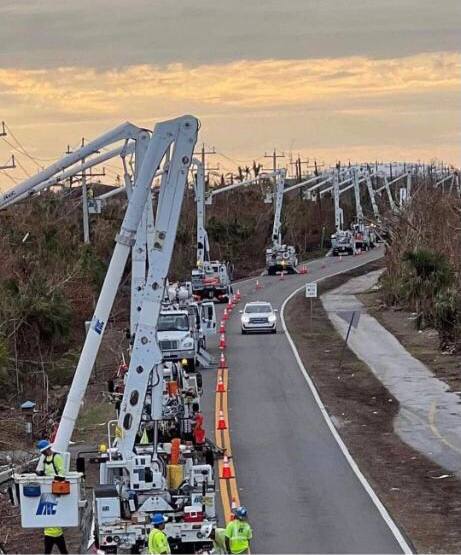 What you do before the hurricane hits is going to determine where you are in the recovery phase.
Additionally, and this should be emphasized and discussed within your family, if you cannot be self-sufficient in the aftermath – for any reason, then you should evacuate.
Self-sufficiency in this context requires being able to cope for up to several weeks:
(1) potentially without power; (2) potentially without potable running water (3) potentially without internet service; (4) potentially without communication outside the region; and (5) with limited municipal and private sector assistance. If you decide you cannot deal with these outcomes, you should evacuate.
Additionally, as a family or individual, you should also honestly evaluate:
(1) your physical abilities; (2) your emotional and psychological ability to withstand extreme pressures; and (3) your comfort in losing daily routines, familiar schedules and often overlooked things you might take for granted. Post hurricane recovery is fraught with stress, frustration and unforeseeable challenges.
I saw a video presented by a structural engineer who was sharing his experience with Hurricane Ian. I am going to use his video for a few references because even with professional credentials, some of the common mistakes people make are highlighted in his experience. Keep in mind his video is taken about 30 miles inland from where the majority impact area (coastal region) is located.
The video below was shot from the soft side (western side) of the storm, and if we were to scale the difference between his experience and a person who was located in/around Fort Myers Beach, Sanibel, Pine Island or Cape Coral, he would be around a “5” on a ten-point impact scale.
Meaning the severity of conditions 30 miles southeast of him was twice as severe as his inland experience.
Key Points – At the 21: 35 moment (prompted), notice how his #2 vehicle is parked outside. Also, at the 22:00 minute moment, notice what he is describing and showing with his garage door and how his #1 vehicle (a pickup truck) is positioned inside the garage. WATCH:
.
♦ This is exactly what I was talking about in hurricane preparation when discussing the garage door. If that videographer was located 30 miles southeast, and/or his house was positioned facing West, instead of North, his garage door would have failed. If you lose the garage door, YOU COULD LOSE YOUR ROOF.
You can always tell those people who have been through direct hurricane impacts by how they parked their cars. I have never included this in the hurricane advice before so it’s worth a mention. If you lose your Florida garage door you will more than likely lose your roof. That’s just the reality of having a massive opening in your structure to 150 mph winds that will lift the trusses.
If you have two vehicles, put one vehicle inside the garage with the front bumper against the door to help stop the flex (do this carefully). Put the other vehicle outside blocking the garage door facing down the driveway or facing parallel to the garage. The goal is to use the aero dynamics of the car to push the wind away from the door and provide protection.
Purchase a cheap car cover to protect the outside vehicle and/or use old blankets (cable ties, bungee cords) to stop the outside vehicle from getting sandblasted and destroyed. Place double folded corrugated cardboard in front of the radiator to protect it from storm debris.
Additionally, if you live in a flood zone, or if you are concerned about storm surge, the day before impact take your #1 car to the nearest airport or hotel with a parking garage and park in the upper levels. Take an uber back home if you don’t have a friend or partner to help you. This way you know you will have one workable vehicle, just in case.
♦ Another lesson from Ian, if you drive an electric vehicle and sustain saltwater intrusion (of any level) your car is not safe. Saltwater makes the vehicle batteries extremely dangerous, and they could spark or catch fire. Multiple homes survived Hurricane Ian only to have the electric car catch fire in the garage and burn the house to the ground. Hurricane rain is saltwater rain. The fire department was begging people to put their ev’s outside and not to plug them in. Dozens of ev’s also erupted in flames while driving down the streets after the storm.
Back to the video above…
♦ Notice at 24:30 of the video this professional structural engineer is standing and physically supporting his glass patio doors, with his wife, trying to keep them from breaking in due to wind and pressure changes. DO NOT DO THIS ! That is beyond dangerous. Any small item of debris (even a small twig or branch) could hit that window and shatter it, turning flying glass into instant flying blades.
Put 3/4-inch plywood or steel bolted hurricane shutters over all your windows and doors. Period. This is not an option. My steel bolted hurricane shutters were hit with debris so hard – whatever it was physically dented the steel. Every window and door need to be covered and protected, especially glass patio doors (even if tempered). Do not think you can stand there and protect glass doors. It’s beyond dangerous.
♦ Hardening your home is a matter of careful thought and physical work. However, every opening into your structure must be protected, leaving yourself with one small exit opportunity just in case. Hopefully you have a bolted door with no glass windows you can use as an emergency exit. If not, select a small window and leave only enough room uncovered for you to get out in case of emergency or structural collapse.
Beyond the ordinary supplies like drinking water, batteries, flashlights, battery or hand-crank radio, generators, gasoline, etc. Evaluate the scale of what you have against the likelihood of weeks without power or water. A few pro tips below:
♦ Put three 30-gallon trash cans in the shower and fill them with water before the storm. This will give you 90 gallons of water for cooking and personal hygiene. You will also need water to manually flush your toilets. Bottled water is great for drinking, hydrating and toothbrushing, but you will need much more potable water if the municipal supply is compromised or broken.
♦ A standard 6,500-to-8,500-watt generator will run for approximately 8 hours on five gallons of gasoline. Do not run it all the time. Turn it on, chill the fridge, make coffee, use the microwave or charge stuff, then turn it off. Do this in 4-hour shifts and the fridge will be ok and your gasoline will last longer. Gasoline is a scarce and rare commodity in the aftermath of a hurricane. Gas stations don’t work without power. Check the oil in the generator every few days. Also, have a can of quick start or butane available in case the generator starts acting up.
♦ Extension cords. If you are purchasing them buy at least one 100 to 150′ extension cord with a triple ponytail. This way you can use one cord into a central location to charge up your electronic devices. Establish a central recharging station for phones, pads, laptops, and rechargeable stuff.
♦ Purchase a box of “contractor garbage bags” and just keep them in the garage. These are large, thick, industrial trash bags that fit 40-gallon drums. They can be used for trash, or even cut open for tarps in the aftermath of a storm. These thick mil contractor bags have multiple uses following a hurricane.
♦ Do all of your laundry before the hurricane hits. You will likely not have the ability again for a few weeks.
♦ Cook a week’s worth of meals in advance of the hurricane. Store in fridge so you can microwave for a meal. Eating a constant diet of sandwiches gets old after the first week. Dinty Moore canned beef stew and or Chef-boy-ardee raviolis can make a nice break…. anything, except another sandwich.
♦ Have bleach for use in disinfecting stuff before and after a hurricane. Also have antibiotics and antiseptics for use. Hygiene and not getting simple infections after a hurricane is critical and often forgotten. Again, this is where the extra potable water becomes important. Simple cuts and scrapes become big deals when clean potable water is not regularly available. Keep your scrapes and abrasions clean and use antiseptic creams immediately.
♦ Do not forget sunscreen and things to relieve muscle aches and pains. Hurricane recovery involves physical effort. You will be sore and/or exposed to the elements. Remember, it’s all about self-sufficiency because the normal services are not available. A well-equipped first aid kit is a must have.
♦ Buy a small camping stove. Nothing big or expensive, just something you can cook on outside in case of emergency. It will be a luxury when you are 2+ weeks without power and all the stores and restaurants are closed for miles.
♦ Those small flashlights that you can strap around your head that take a few AAA batteries? Yup, GOLD. Those types of handsfree flashlights are lifesavers inside and outside when you need to see your way around. Nighttime is especially dark without electricity in the entire town. Doing stuff like filling a generator with gasoline in the middle of the night is much easier with one of those head strap flashlights. Strongly advise getting a few, they’re inexpensive too.
♦ Cash. You will need it. Without power anything you may need to purchase will require cash, especially gasoline. Additionally, anyone you hire to help or support your immediate efforts will need to be paid. Cash is critical. How much, depends on your individual situation, but your cash burn rate will likely go into the thousands in the first few days. Also keep in mind, you may or may not be able to work and without internet access even getting funds into place could be challenging.
♦ Hardware. A box of self-tapping sheet metal screws (short and long) is important, along with a box or two of various wood screws or Tyvex screws. A battery drill or screw gun is another necessity. Check all of this stuff during hurricane prep.
♦ ADD. I forget my #1 personal nemesis in the aftermath (pictured below):
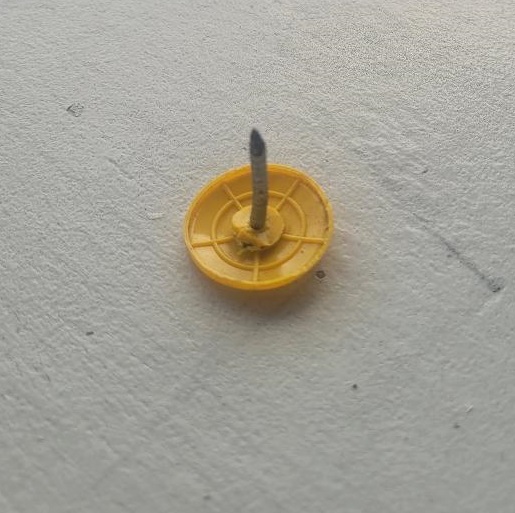
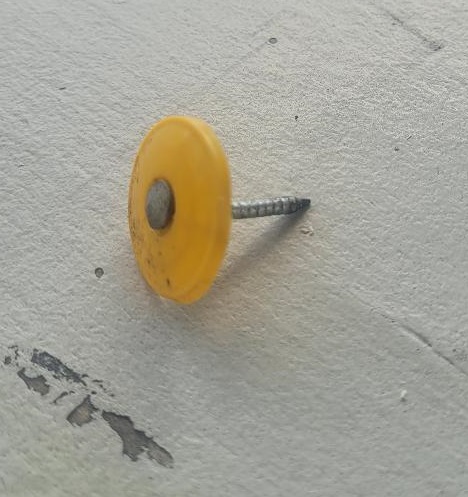
Roofing nails. The pesky roofing nails. Thousands of em’, all over. Those buggers are everywhere, and they will go through a flip-flop, sneaker sole or car tire perfectly. Most of them are black (not yellow) like the ones above. Some of them have square of flat tops to help them stand up just perfect to find your tires.
I happen to believe roofing nails are actually tire magnets with some sort of automatic triggering system to jump in front of your car at the worst possible moments. On the positive side, I think my neighborhood is safe because my tires have picked up every one of em’. LOL and Grrrr…
More later…. but I hope this is useful. [Lie to me, even if it ain’t. lol.]
Love to all,
~ Sundance
Excellent advice once again!!!
Always!
Or live in Montana like I do after a hurricane hit your house decades ago in Florida and once was enough.
Being on the north side of “Charlie” in Clearwater, FL was stressful enough and it was only tropical force with electricty out for 3 days. I moved to the mountains of GA. in 2014. All I really miss of FL is the Dec.Jan, Feb “winters”.
….and get chased out by forest fires. Been there, done that. There are natural risks no matter where you live.
Every location has it’s concerns.
I’ll pay high taxes. I’ll take a socialist governor. I’ll take a complete lockdown in a pandemic. But, I won’t take a hurricane like Ian, ever!
I’m intrigued with your knowledge, SD. Thank you. I’m in California but found parts of this useful to me and mine.
Keep in mind that if a major disruption hits, only those who have full tanks and leave in the first two hours after the event will be able to get out of the area.
Gas tank = miles. Gas station there = x # of cars before empty. The cars more than that # park.
Gas supplies on the West coast ship out from the coast. If highways are blocked with cars, no gas.
Consider also that the Southwest to the Missouri / Mississippi River is near desert.
Small cities with not much more water than they need. Lots of refugees = thirst.
John in Indy, ex SoCal in 73
Look at your local and national risks, and prepare as you can for such perils as you consider reasonable.
Have told our nieces and nephews with kids that when the SHTF in the Twin Cities to head north to our house. They mostly laugh, thinking I’m a nut-job, but I always include that they will have only 24 hours to get out of the city.
Seems like when I give them information, instead of feelings, they suddenly realize they probably better make a mental note about what they just heard.
I suspect it will be much less than 24 hours. I fear the plan will be to close all major routes out of the 494/694 loop. Kungflu wellness stop points or some such lie will be used to keep the victims packed in for the thugs to get at.
They need to plan how to get past those checkpoints to break clear of the loop, then stay off major highways.
Take the back roads. Get maps, make sure the young adults have one and know how to actually use it.
I think this is a risk, but being unable to evacuate has only occurred in the Houston/Galveston area once in my nearly 6 decades of life. That was Hurricane Rita, which came on the heels of Katrina. Everyone panicked and left at first evacuation order of the coastal areas, creating the parking lot for 100’s of miles.
I was able to evacuate a typical 2 hr drive distance in about 3 hrs by using side roads and maps). With GPS and Google/Waze dependency, most young drivers have no clue how to use side roads to avoid congestion if the navigation s/w doesn’t tell them. Back in those days, no mobile internet so… screen snapshots and an old school Key Map. Felt like a boss on that one.
My cousin is very high up in TXDOT, the Texas Dept of Transportation. She’s a civil engineer, and has teams of engineers working emergency evacuation designs all across Texas. The evacuation process takes about 3 days, but varies by location, population, and road construction details. If the leaders follow the known duration requirements for each zone to evacuate, everyone that wants to leave can. Most of the time… if a storm takes a sharp turn and is moving very rapidly toward shore, time may be insufficient.
What I’ve seen happen beyond the Hurricane Rita Run (as I call it), is that the storm turns and accelerates… not enough time to get out at full speeds. Nothing to do with traffic congestion – just not enough time to leave.
Moral of the story is, if you’re going to evacuate, be ready to go as soon as your zone is directed to go. Don’t wait to get gas, tell your kids they need to come home soon so we can leave now, etc. Plan and be ready.
I participated in a “Weapons of Mass Destruction” seminar in 2000.(They really do tell us what they are planning to do to us!) 9-11 followed. I learned they stocked up on body bags cause they knew there would not be enough time or places for evacuation. Also, the lady st of undertakers was continuously updated. All of the post storm recovery items like food and water-are staged inland. Thus, if bridges are wiped out-like to Sanibel and Pine Island-access post storm is only by boat or helicopter with those unknown but predictable hazards-downed wires, broken cables, submerged docks and debris. Moreover, the local evacuation plans are not really effective. Some local officials have already established their idiocy and are largely ignored. Those who have seen the damage or ridden out past storms know the time to evacuate the west coast (and the entire State, if you have children or elderly) of Florida is when the storm is going over Cuba. Otherwise, one will be stuck on the I-75, I-4, I-95 parking lots.
Also, if one chooses to stay know the other critters that will make their presence known and prepare accordingly:
https://www.foxnews.com/us/florida-sheriff-announces-arrest-seven-men-allegedly-looting-hurricane-ian-lowest-form-scum
And, understand there are other weather factors to consider:
Good ideas especially the garbage cans.
If you don’t have garbage cans, just fill up the tubs.
I am inland somewhat, but that hint about the garage door is a great idea since my garage faces south southwest. I am going to make a list of your suggestions and be sure to have some things I haven’t thought about like a head-light, big garbage bags, and a camping stove. Lots of good ideas, thank you.
Any suggestions about what to do with firewood out in the yard? I’ve just realized that this could provide missiles to damage things.
Firewood should be kept off the ground anyways, so if using nice oak pallets to stack it on I imagine one could tarp and strap it, attaching to the pallets.
Probably the best you can do it to tie it down as best you can.
We put pillows between the cars and the garage door and backed them up to the garage door for both Irma in 2017 and Ian this time. Fortunately, we did not get the surge here, like they did farther north this time as we are south of Naples. This will be the last hurricane I will stick around for. Winds are one thing, but storm surge is the killer.
Fruit Trees such as avocados, orange, grapefruit, pine cones, roof tiles and coconuts makeup most of the missiles. Pool equipment can also do a great amount of damage. Sundances 3/4 (1/2 inch will break) plywood is ideal for missile prevention. The weak points that you fail to realize except in Eyewall storm winds is the fact that your construction contractor used 1/4 inch bolts to install your window frame units that are unable to hold up to clay roof tiles at 125+ mile winds with micro Burst eyewall tornadoes.
TX Gulf Coast has hurricane building codes in most areas that will get 75+ mph winds. When storms come through, you can easily identify non-conforming homes… they’re the ones with the blue tarps on top. On the newer homes, most of the roof damage is from trees and flying objects, not raw wind.
Very helpful. I have lived through Hugo, Charley, Frances, Wilma, Rita, Matthew, Florence, Isaias and Ian. You gave several tips I’d not heard or thought of. Notably the 30-gallon trash cans. Thank you.
I have two of these. Life saver after Ike and the Texas freeze.
Gas One Butane Gas Stove with 4 Fuel Canister Catridge – Gray https://a.co/2aDMWwr
You can get the stoves and butane from restaurant supply stores.
I was able to run the washing machine off the generator for a couple of loads. Unwashed, wet, sweaty clothes get stinky real fast. Hung them to dry.
I remember how fortunate we felt after Ike with no power for 2 weeks, that we had a gas stove. And we were prepared with extra propane tanks for our gas grill if we had need.
I am 60 now, but I can still remember my mama suggesting (when I was a young newlywed and going through Alicia, that we fill up milk jugs and 2 liter bottles with water and squeezing them into our freezer, on every shelf. They become large ice blocks to keep things cold. Now after Ike, even that wasn’t enough to keep our Bluebell ice cream frozen for that long, but our meat stayed good.
We also kept 2 liters filled with water beside every toilet. We ended up not losing our water, but it was another great idea for being prepared.
This looks better:
Speaking as a retired sailor who was on the shoring team for damage control, it would seem to me that shoring up the garage door would be a good prep thing to do. Concrete anchors in the floor and a fitting in the (reinforced rafters, with pre-cut shoring members you can rig up in minutes. You can do the same for the outside, if you can’t park a car there. Build an aerodynamic cover anchored to the driveway with concrete anchors.
A car parked up against the door has some give to it, and you risk damage to the bumper.
I’ve been thinking of something similar since Sundance brought this to our attention.
A nice sleeved hole in the concrete and a substantial steel assembly on the laminated beam header could accept a steel pole to reinforce the door.
If the door panels were fitted with brackets creating open hooks facing to one side the pole could be slid into those before dropping into the hole and engaging the attachment at the top. This would prevent it from flexing in either direction.
If I lived there and wasn’t broken I’d be designing these right now.
These systems to reinforce garage doors already exist. Very similar to what you described.
Lowes has a how to for making one out of lumber.
https://www.lowes.com/n/how-to/how-to-install-garage-door-storm-braces
I think I would go with 2 x 6 for the vertical brace parts, but otherwise, is pretty similar to what I had in mind. Do it on the hinge line so you can attach metal brackets to the inside of the door using the hinge bolt, and you can prevent bowing out due to low pressure as well.
I could see a metal one that remains attached at the top and is pivoted down and pinned into place in a matter of seconds.
Good to know this is a thing, clearly it needs to be disseminated and popularized.
I’ll most likely never be in a hurricane but found this very interesting and passed on to friends who live in hurricane prone areas.
Thank you. I hope I never need to use it but I’m happy to have this guidance.
TY for for stating the obvious! I watched the video and found myself yelling ”get away from the glass you fool! Why is it uncovered???!!” And he says he is structural engineer? smh
IKR?
Not only should that glass be covered from the outside with steel shutters, the glass itself, if not an expensive laminated safety glass, should at least have a safety film applied inside so the hazards produced by breakage are massively reduced.
For a structural engineer he seems to seriously underestimate the fragility of the human body.
Similar to the great suggestions above, regarding building in systems to reinforce garage doors, why not make all windows so you can remove them, store inside and replace with steel or plywood inserts?
Just remove the glass, all together. I’m thinking yhe glass in some kind of frame, of coarse not just the pane of glass.
If the window frame was built double the size of the opening, either up or down, or even to the side, it could accommodate a steel barrier hidden under the siding to slide into place without compromise or hassle.
Still, there is merit in a swap out system as you suggest, where sliding bolts disengage the window assembly to be swapped out with a steel panel using identical sliding bolts; this would be much easier and less expensive to incorporate into existing structures.
I’ve always wanted to build a house to survive crazy weather and crazy people, but both can be remarkably persistent.
There are solutions for hardening windows without removing panes and such. Hurricane clips, retractable steel covers, etc. It comes down to effort, costs, physical labor, storage… and money. 3/4″ plywood is great, but you have to cut and fit it before, plus store it. And 3/4″ plywood is heavy.
Young?
This is great info Sundance. We live just 8 mi. inland from where there was massive destruction from Ian and miraculously had no damage. This time. Your info is invaluable. Some of it we knew but it always bears repeating. And we had a false sense of security with window protection, never really thinking of the soft underbelly that the garage door represents. I know our hurricane preparedness list just grew by some of your pro tips. Thank you!
I’m saving both of today’s “Lessons” posts and will post as needed to a condo community on the east coast of FL, as needed.
Thank you for this practical information.
It’s not only practical information. It could save a life – your own and your loved ones.
Thank you, Sundance.
We fill a new plastic trash can with water to use for non drinking applications such as cleanup or flushing toilets when our electric well water pump has no electricity. One thing to note, DO NOT USE A PROPANE CAMPING STOVE INDOORS. It may kill you with its deadly carbon monoxide fumes. use them ONLY in well ventilated areas such as on an open air porch.
No hurricaines, yet, here on the Oregon Coast. Have had really big blows, Columbus Day storm was one. We are close to the Cascadia subduction zone and worry about earthquake (no earthquake insurance available). Have to be a really high tsunami to reach us at home, but if we are eating at Georgies and see the water pull way back we won’t wait to pay but try to get out of town before everybody else tries.
God blesses you, Sundance, and those blessing spill over onto us treepers.
Everyone on the I5 corridor should be thinking earthquakes, volcanic eruptions and tsunami. Mt Rainier is really majestic but just the snow and ice from it would probably impact well over a million people. Years ago was part of a Northwest Emergency Preparedness taskforce. Back then, we were making plans for the medical evacuation of all those downtown Seattle hospitals to the east of the Cascades. Seemed somewhat impractical then. Not sure what the current plans are for natural disasters in the northern I5 corridor. It would seem that just the sheer number of people in that area would create 100s of thousands of casualties.
I remember back in the seventies, Their was worry of Mt Baker eruption . Had a scale model at the Seattle science center, showing snow melt routs.Don’t hear about Mt Baker anymore.
Sundance, thank you very much for your practical ideas.
I’m looking for ways to bathe and to wash my hair, without using any water. Does anyone have any experience in products that get you clean without water?
I want products that actually remove the dirt, not just remove odors.
For bathing – I’ve seen web pages for “wash gloves” like https://www.caregiverproducts.com/aqua-wash-gloves.html , but I’ve never used any products like that.
For washing my hair – I’ve seen this web page: https://www.walgreens.com/store/c/walgreens-rinse-free-shampoo-cap/ID=prod6293401-product , but I’ve never used the product. (If you click on the “Show More” link, the web page will tell you how to use the cap.)
Does anyone have any recommendations? Thank you.
A bucket and water.
Can use a 2 or 5 gallon Garden Pressure Sprayer
with little shower head attached to end of sprayer
hose.
Did that Island hopping in that area, and beyond for a few days
a few years ago on Pontoon.
Of course we took a 25 gallon plastic barrel with water
too.
Those Black contractor Bags make Great solar collectors in Florida for warm water baths and hair rinses.
Please note that more and more such plastic bags are being saturated with froufrou scents for some idiotic reason, I may be among the few to be near incapacitated by such chemical warfare, but it’s a real pain for me, and I doubt it’s good for anyone.
Yeah yeah, I know, shut up and die, the VA’s been telling me that for years.
I hear you – and HATE that crap.
Some of them actually have insect killers in them. Be careful about ingesting the water in them.
We stored water in 2 and 3 liter bottles for storms. Set a bottle in the sun for a while, and voila it’s enough warm water for a quick (navy) shower. We were without power for 2 weeks after Fran.
You could get a camp shower. Some of them will provide warm showers if you put it in the sun. But seriously, if not having the finer things in life for 2-3 weeks is not for you, or if camping for you is more like glamping for me, the maybe sit this one out… it’s more rough camping than normal living.
The shampoo cap you found at Walgreens is a viable option. I’ve known people who used them.
Thank you. Where I live, we might lose water for a long time. So I don’t want to use a drop that I don’t have to use.
Used regular spray dry shampoo quite a bit when homeless. Works decently well.
Thank you. I’ll check it out.
Sea showers. Turn the water on to get wet, turn it off. Soap up, scrub down, rinse quickly. Get out for the next guy. I was a professional sailor w/the USCG for 20 years.
Fulltime RVers use the same method.
Tree Climber is right. Try: TRESemme Freshstart Dry Shampoo. Less is more.
In women’s cosmetic section or hygiene for men and women section: 5″ x 5″ self sealing packets of pre moistened sheets of facial cleanser with skin softeners! Meant for skin for everyday or travel. Very safe. CVS pharmacy has their own excellent brand; cheap, top ingredients, to scrub down a full body you’ll use a few so buy plenty.
Adding a Tbl. , of bottled water will distribute the cleansers better to dissolve the salt accumulation occurring from not drinking much water, and allowing your skin to breathe again. Fewer sores later, faster healing of minor scrapes, cooler in heat, warmer in cold.
In same size packets, likely same section, find various brands of Wipes; adult version of baby wipes, with a safe disinfectant, also for travel, also pre moistened.
Try a poor mans Bidet. No toilet tissue used but always be very concerned where all personal bacteria winds up.
#1 crisis rule Prevent Cholera. First decide where the water will wind up before you wash.
It’s about the squeeze and the cap and the fit in your hand, it’s fast and cheap, light weight and portable.
1) 4 – 6 oz of clean water per wash 2) a squeezable bottle of liquid dish washing soap with their classic screw on top with a flip lid. Be sure to buy an organic or skin safe brand. Likely not Dawn for grease. 3) You’ll need a second empty container: not glass, but tightly lidded container of the same number of ounces. 4) Transfer the liquid dish soap into the spare empty container. 5) add clean water to the emptied liquid dish soap bottle plus 2 drops organic liquid dish soap, cap back on, squeeze the bottle to clean
May God provide for the needs and safety of the distressed and homeless, removing the trauma and despair, bringing hope and generosity, unity and sharing. As God wills; looters and the malcontent, thieves and the deceptive, be exposed and placed under the law, by God’s Justice for the injured, displaced, depressed and weary.
They use those wash mitts and self contained hair wash caps in some rehab facilities. My spouse was in one and couldn’t shower for awhile and that was what was used. Seemed to work well enough under those conditions.
We were on Treasure Island (St Pete[ish]) beginning 9/24 – 10/8. We did evacuate on 9/28 to Ocala for two nights then returned to the beaches for the duration of our stay. It was surreal and scary before and after the storm. Being from New England, I had never been that close to such a storm. These are all great tips and directions. I have good friends in Punta Gorda who rode it out and did okay but are still coping with power and availability issues (nothing open). Godspeed to you SD
Lots of good ideas even for those of us here forever. We have always left as flooding was always the biggie, now that we moved not so much. But a storm like Ian I am not sure we would have ridden that one out. Yes, love what you are writing!
Thank you. Again. Even in the midst of the destruction and trauma, you offer the benefits and guidance of your experience to others. Invaluable. It will be passed on, just like part 1.
With the advanced warning before Ian I can not figure out why so many with huge boats did not head north like most of the bigger boats do.
Many of the smaller boats could have been removed from the area days before Ian even arrived.
It’s beyond time to start running power systems below the ground surface like many communities do.
Maybe some folks figure they’ll get a new boat out of the deal?
Or just out of the payments?
1) the area hit wasn’t the area forecasted.
2) moving a boat is a time thing-large boats that can’t be trailered are not fast. Let’s assume a top speed of 30 knots =34 mph…imagine driving at a grandma pace from Naples to Tallahassee (430 miles-that’s 12hours and 38 minutes with no stops)
3) then you have to figure how much time you must spend moving the boat, securing it, and getting back home to secure your home/property before the storm.
Frankly most people chose to deal with their homes and wrote off their boats beforehand.
I was in the CG and I’m from Tampa and rode out all kinds of hurricanes since the 70s..in the CG we would take small boats (trailerable) inside, larger boats were doubled or tripled up on mooring lines, or larger cutters got underway to ports hundreds of miles away or rode it out at sea (that ain’t fun)- remember fuel is expensive now with diesel running $4.50-$6.00. Boats are not fuel efficient either. The 41 foot Utility Boat we used at CGStation Yankeetown, FL had a range of 300nm and held 480 gallons(480x$5=$2400) you do the return of interest….
Note to self: Shoveling out after a typical Nor’easter doesn’t look so bad after all (remember to bend your knees, take it slow, and distribute the weight).
I’ve done both. Hurricane recovery is not really over for a long, long time. Even after cleanup, you have to rebuild. Many elderly people NEVER finish restoring their house… living on slabs for decades.
Yes. **Extra** 20lb pre-filled propane tanks. Propane doesn’t go bad. Gas does even with StaBil. (For those with confused looks…relatively few places in SWFL have natural gas piped in) Propane for cooking and heating and bath water etc. (Three gallons near boiling water heated with a camp stove in a large water canning pot + 10 gallons room temp water will give you a decent bath)
You WILL get skanky after the blow.
If you want to extrapolate using a battery back-up system, a plastic garbage can with a very large aquarium heater run off a DC/AC inverter will get the water warm enough for baths. Add in a 12V camping shower pump and hand spray wand with the heated garbage can water and, viola.
And, a propane refrig/freezer 110v/12VDC for critical stuff like insulin and ice etc. Those refrigs units are all over ebay.
That’s why I have a main solar backup system to relieve the gas generators, and I showed the portable room battery systems on CTH during the run up to Ian. Basically, an egg crate on wheels with two high capacity lawn tractor batteries and a 600w pure sine wave inverter plus 12v accessory and USB ports.
Good point on the propane. I have 2 30#, and 2 20# tanks that I keep full. They would last a long time for just cooking. There are also generators that use both gasoline and propane which would extend powering your home for many weeks.
FYI, related but unrelated fact – propane generators are difficult or impossible to start in extreme cold. Unable to get one to start on propane in TX freeze a couple years ago. Started fine with gasoline.
FYI, related but unrelated fact – propane generators are difficult or impossible to start in extreme cold. Unable to get one to start on propane in TX freeze a couple years ago. Started fine with gasoline.
Good to know, Thank you for sharing.
Me and several of my friends have a little formula we have all put into place for Hurricane prep. Back when we did it it was under $1,000. Might be a little more now. Pick the room in your house you would hunker down in after the storm. Buy a small generator. Test fire it, clean out the gasoline, make sure it has oil, and put it back in the box. By the smallest wallbanger AC unit you can. Build a wooden frame that inserts into one of the windows in the room and can be held in place with just a few screws. Make sure you have those screws. Test mount your AC unit in that frame. The things you are going to want to run off that generator are, AC, microwave, refrigerator, a light, a TV or radio, and chargers for your phone or headlamps. Have an electrician wire a plug-in for the generator into your main fuse box. Make sure you have a way to run a power cord from the generator outside into your fuse box. The idea is, after the storm, you turn off your main breaker, which is also critical for the safety of the lineman coming to repair stuff, turn off all the rooms except for the room you were going to stay in and the one that powers the refrigerator. You and your family can be fairly comfortable in the one room. As long as you have air conditioning, the ability to heat food, and some connections to the outside world, things will be tolerable. Those black rubber shower bags you set in the sun are awesome also
The parts of the essay were Sundance recommends whether to evacuate or not are critical. My father was one of the original Hurricane Hunters and retired as the chief administrative officer. The only storm he ever advised me to evacuate from was Floyd in 1998. It was a monster category 4 or 5 barreling straight at Broward County, but expected to turn north at the last minute. They were based out of MacDill in Tampa at that time, and he told me he would call me at 5:00 in the morning when they knew more about the track. He advised us to be all packed up and ready to go before we went to bed the night before. And if Floyd did not turn, to just get in the cars and drive north. If there’s jammed up traffic, drive on the shoulder. If you can’t drive on the shoulder, drive on the grass next to the shoulder. You don’t want to be there if that thing hits. And he described a scenario much like Sundance’s little graphic with Charley and Ian size wise using Andrew as a comparison. He said that if the bottom edge of Floyd hit where the bottom edge of Andrew hit, the top edge of Floyd would be in West Palm Beach, it was that big. And Andrew was about 6 hours, and that after 6 hours of Floyd you would have about 18 to go. Luckily Floyd turned. It would have been a civilization changing event for the lower East Coast
I forgot one little piece of advice. They sell 5 gallon gas cans at Home Depot shrink wrapped five or six in one pack. Get one of those, you can store it in the crawl space of your house. If the storm is coming you will already have the cans, just go fill them up in advance
Floyd hammered eastern North Carolina. The flooding was catastrophic.
ABSOLUTELY NOT!!!
Have an electrician wire a plug-in for the generator into your main fuse box. Make sure you have a way to run a power cord from the generator outside into your fuse box. The idea is, after the storm, you turn off your main breaker, which is also critical for the safety of the lineman coming to repair stuff
This is NOT how you connect a generator into your system. Yes, have an electrician wire FOR the generator, which will involve a proper TRANSFER SWITCH that will positively disconnect the utility before the generator will connect.
Perhaps that is what you meant, but the way your suggestion is worded is not clear on that point. There must be no room for human error (stupidity) when it comes to the possibility of back-feeding the power lines from your generator. Good intentions to shut off this switch before turning on that one are not enough.
Most transfer switches cost more than the generator. In real life if you can get people to turn OFF the Main Breakers and then use what they have common sense for 12/3 or 14/3 extension cords available at most Home supply stores plugged directly in generator to run Refrigerator, a light, and maybe a coffee pot or microwave is the best that has a chance of being used. If you have the $5,000 -10,000 standby home system you will have the Standby switch included. If you located that standby system generator high enough above the ground in Storm Surge likely areas it may bring you some relief if you have 500 gallons of propane also located above surge water heights. In surge likely areas standby generators in your basement, ground level or garage are useless. In Andrew Propane tanks were floating down the waterways and 40 ft Morgans were in my side yard.
Yes, if you are looking for the budget way to do it then just run the cord to the generator. But do not power up the house wiring without the proper transfer switch.
Safety experts will tell you that the real danger occurs when people begin to decide cutting a corner on a safety rule is still safe. Like driving the wrong way in a parking garage. What they will also tell you is that it becomes dangerous when everyone else is following the rules and not worrying about someone else breaking the rules. Everyone draws the line on what’s too far away from the rule to risk. I might speed +5 mph in a residential neighborhood. You might go +25 mph. If I’m making safety-impacting decisions based on my rule set, you could easily be going way, way faster than I expected and hit me if I turn left in front of you.
Yes, that’s an exaggerated, probably unlikely example. But I promise you, assumptions are ignored and people make mistakes. If someone makes a mistake with feeding power into your house from a generator, it’s a strong possibility that a life is in danger. Not worth it…
Manual transfer switch for small gen’s is about $350. An electrician will wire it for $200-$300. If you want to do that, do it right.
This is true! I’m an electrical engineer with MUCH DIY experience over my 50+ yrs as an adult. I had a setup to back-feed my gen into my dryer plug and some manual steps to follow. And I could do it safely, no problem.
But here’s the problem: doing things of that sort breaks with electrical code. And that can kill people. Example: I had a male-to-male extension cord. That means I could have exposed hot connectors sitting out somewhere if I don’t do everything in the correct order. And that could kill.
And what if the expert is unavailable to handle it? Or what if someone that doesn’t understand the safety risks thinks it looks normal and just starts to unplug or plug it? Even using lock out/tag out rules for electricity safety might not be sufficient. Electricity safety is not obvious to 99% of people, especially if you have something non-standard in use. Don’t take the risk.
Pay an electrician to install the proper connector and a transfer switch. It costs about $400 total, including parts. Your life and everyone you know that might touch any of this is worth $400, am I right?
The exposed Male dryer plug on both ends of the wire are a definite concern if someone other than the person that made it try to make it work. Even taping the exposed end as a reminder is a problem if anyone other than the person that made it uses it. Extension cords from the generator is best for inexperienced in electrical connections people to use safely.
I think I can post this here. Another thing ,don’t go cheap on extension cords. I seen what happens to cheap under sized cords. You will have a melted gooey mess.
While you are correct, I had a setup like starfcker described in my last house. It had a separate box and one wire each to my 2 main electrical boxes…I had 400 amp service.
The breaker that led to the generator was a 50 amp to a 50 amp receptacle in my garage.
I wrote out a checklist that I religiously followed. I taped it over what I called my generator box.
In 24 years, no matter how well I knew my protocol, I went thru the checklist without fail. Every time.
When power was restored, I had a reverse checklist.
I knew the risks and always remembered there were life threatening consequences if I took shortcuts.
I retired and moved 4 years ago. I took out the connecting wires when I sold the place.
These days, with my much smaller house and simpler needs, not to mention outside electrical boxes as there are no basements in Florida lol I bought a generlink from the power company. It’s a good foolproof alternative.
I suspect everyone would be screaming at you for wiring into the main fuse box. Make sure you disconnect via the main breaker and leave it disconnected from the main feed until your neighbors have their power restored. Why wouldn’t wiring to plug into an AC outlet or dryer plug work?
Just wondering.
If the A/C and dryer are 220v plugs it would power up your panel the same as tapping in at the panel to both Line connections. If your Main Breakers are not turned OFF in either case you could harm yourself or your neighbor as electricity from your generator went out into street lines. Turn OFF the MAIN BREAKER!!!
This is also great emergency prep for other weather disasters or when the SHTF. Great info.
My thoughts exactly!! I’ve shared with my family as “has applicability in other events where power is lost for a week or more”. Could be a tornado, winter storm event, etc.
I have a catport. I parked my car in the driveway. When half my drywall ceiling collapsed my car was unscathed. I lost the other half of the drywall ceiling to Irma.
If you have a garage door, have it reinforced if it is not.
And above all if the thought of a hurricane strikes you frozen with fear, do not live where they are common yearly occurrances.
If my local area was levelled as Fort Myers Beach was I would certainly be making other living arrangements. The week after the hurricane without power flew by.
I made mistakes before and after but none of them were fatal, just aggravating.
As to cash, it was useless and the reason it was useless was the only businesses open were running on generators. And these businesses refused cash transactions.
One thing I would add is a telescoping magnet to pick up nails and screws in the yard and street.
There are large ones a yard wide on wheels, like a broom, you’d be the neighborhood’s best friend with one of those!
Harbor Freight, about $20.
They make magnetic pickups, that roll in various widths up to 30″, IIRC.
has wheels at each end, a long magnet in between, and a handle. You roll it along, it picks up nails and screws, etc .
Might be helpful? Wood screws and fix-a-flat.
Pull the nail out, screw the hole by quickly screwing the woodscrew in the hole, fill tire with fix a flat, and drive.
Harbor Freight, about $20.
Don’t forget about aluminum nails.
Pretty detailed advice and obviously from someone that’s been there and done that. Thank you. Although here in Ontario we tend to only get the aftermath of hurricanes we do have summer tornadoes quite frequently so of a similar mindset. I have a lot of similar preps as such outlined.
bverwey
Here’s a great time-lapse video that clarifies what is meant by “15′ storm surge”…
| FT. MYERS BEACH, FL: HURRICANE IAN’S 15FT STORM SURGE WASHES AWAY HOMES |
https://www.bitchute.com/video/kqwOqFD1YrqG/
wow.. far out man.. the ocean is so fck’n powerful..
before the storm I warned about keeping a life jacket handy..
probably the most important video every land lubber needs to see..
the storm surge.. a hurricane in two minutes..
Holy f00king dookey!
I would suggest getting a utility bicycle. Something that can get you around 10-20 miles with some load. If a route is passable at all you can get a bike through it, and you have some range. If nothing else save a powered vehicle for bigger / more distant use.
Yes! My preferred mode of travel is on my bike. I also have a Burley trailer. It came in handy when I needed to get a new car battery in the aftermath of Ian.
I have a mountain bike and a trailer normally used to pull kids behind the bike. Stripped out the tent covering, added a base, got a little tool I can use…
I love contractor bags, they are awesome. I definitely would use them for water storage.
I would think that having plenty of pairs of clean socks w/a pair of good solid work boots would be a must w/all the debris. In one of the videos I saw a lady walking around cleaning up in flip flops, ya gotta protect your feet. I am not there, maybe her shoes got washed away. It would be extremely frustrating to have all your prepping gear and supplies lost to the storm.
Anyway, glad for the information update, good stuff, and good story telling. I continue to pray for all concerned.
One of the most impsctful, and therefore challenging key decisions is “bug out, or hunker down”.
An alternative lifestyle some who live in hurricane zones may consider, resolves the question.
The emotional issue for many, is in deciding to bug out, they are “leaving everything behind, and hoping it will be there when they come back”.
And, this may influence them to stay, when they should go.
The alternative is you go, because your alternative lifestyle enables you to “take your stuff with you” and so plan from the beginning, to go not stay, and no agonising or delaying, in making the decision.
I speak, of coarse of “the R.V. lifestyle. If you live in an RV, there is no question; if a hurricanes coming, you “take yer sh*t, and git!”
If a forest fire gets close, go.
Tornados have short notice, so do tsunamis, but hurricanes, forest fires,…generally have plenty of notice, and because you CAN take everything, no REASON not to go.
The RV lifestyle is not for everyone, but it does change the dynamics.
Best to do your homework, on the RV lifestyle, before jumping in to 24/7/365.
When we went into Punta Gorda an hour after Charley in 2004, the first thing we noticed were long strips of white aluminum wrapped around every tree stump and pole stump. Took us a little while to realize they were the remains of mobile homes. I had to be in Daytona the following day, which as it turns out also got hit by Charley. Other than the Hilton, there was no power in the whole town. All the satellite dishes had blown off the roof of the Hilton, and there was no newspaper. All weekend long we were sick to our stomachs thinking how many lives might have been lost in mobile home parks in Punta Gorda. Thankfully the death toll was very low
Fella remarked to me after my little run in with a down-burst at my all-too-mobile-home while stationed in California, spoken with the drawl of one who knows:
“Gawd hates trailer parks!”
I am not an RVer, but if I was I would also have straps in it should it ever need to be tied down.
Some blew over and some did not.
Make bug out bags.
Dutchman…. You reminded me of watching the exodus from New Orleans before Katrina hit. The interstate heading north was jammed with vehicles, among them RVs. Motels and hotels quickly filled up for several miles. No doubt the RVers were glad to have a home-on-wheels, packed with all they needed.
Prayers to all. Much love from Canada.
As to the small camping stove, you are better off having a propane gas grill with a side burner that you have at least two propane tanks for. I have more than two tanks, just in case. If all the stores are still closed two weeks after power is lost, no stove is going to make a difference and you need to plan on evacuating the area.
Of course, if you live in an apartment complex and gas grills are prohibited, a camping stove would get you by. You might consider a small portable charcoal grill and have a bag of charcoal and a chimney.
As for cooking off your frozen food in anticipation of the world ending before a storm, I would suggest having some MRE’s on hand for the immediate aftermath and you evaluate the risk of losing the food. Without a generator you won’t be microwaving anything.
I kept my both compartments of my refridge off limits except for a few seconds a couple of times a day when I knew what I needed.
With no ice purchases I gave up on perishables after five days.
This advice is biblical good! Read it twice; memorize it. Thank You!
..
Excellent experience-supported advice here. I know a few east coastal residents to whom I’l be sending links.
Lots of great advice.
The tip about quick start for the generator will have me off to the store tomorrow.
Take note that 3 – 30 gallon cans of water is 700+ pounds in one spot. In older homes (any house old enough to have been “improved”) it is not uncommon to find that the plumber did some carpentry to relocate drains and in the process left very little to hold up the floor. Anyone who works on older homes has run into the situation where the floor joists, particularly under the tub, have been cut – often completely removed or cut through.
Consider floor load and who did the remodeling when situating large cans of water.
Yes, you can keep your collected water supplies outside and use a hand pump to draw out the water into buckets.
After storing water several times without ever needing it, this time I did not. I am on well and septic. I had plenty of potable water and a neighbor’s pool provided me with toilet water using a hand pump.
I’ve a pair of 260 gallon tanks to put in my basement, will cut out a window to get them in, only problem I’m having is how to avoid my Commie neighbors seeing me do it!
Patriot Supply has a water bank 65 gallon plastic container/bag that fits in the bathtub. Currently around 20 bucks made by Alexapure.
One’s hotwater tank, no longer serving hot water, is generally an available 30 gallons in most instances as well.
This is so, so right.
I have 55 gallon drums and rain barrels to collect rain water. I put one of them on my patio temporarily to catch water where it leaves the roof and didn’t need a gutter. First time it filled up, it cracked the concrete. Water is heavy. Pay attention to what you set large containers of it on…
Just clean and fill the tub.
Most tubs won’t hold water for long
Terrific information. Not just for hurricane prep but for flooding and government failures of many types. Thank you.
Great advice.
What’s been going on if anything wrt looting and other bad actors looking to take advantage of the situation?
Doesn’t seem to much reporting in the news (fwiw) on this.
As a pro-2A state with good stand-your-ground and self-defense laws, hopefully the usual suspects are thinking twice before doing anything that could result in a case lead poisoning for them.
After 5+ decades in TX hurricane areas, my observation is looting and other such things do not happen in the suburbs. Ever. What I have experienced is roving gangs of helpful citizens that will do a single thing if you need it. One has sandwiches, another drinks, some have chain saws, some have tools to remove sheetrock or cabinets.
In the vast majority of places, you will see the best of humanity every day for months on end.
Good information; as always ~whatever the topic, Sundance.
~Thank you.
I cannot really even imagine living through what you have and still are.
~You are such a blessing… 💖
Dang!
God bless you Sundance once again for this awesome post of Storm/ hurricane preparedness. I still pray you & family are getting through this.
Add to the med kit several cans of the strongest mosquito repellent your skin can tolerate.
Add life jackets.
Good information, SD, and these points can apply to several natural cause situations as well as non natural ones. The only things I will add are firearms for obvious reasons when the authorities are up to their eyeballs busy. They can also come in handy if your food supply dwindles, and the outside food supply runs short. For those who are unable to purchase a firearm for legal reasons, there are some very powerful air rifles out there that dont require a background check. They can easily take down small and medium sized game.
Sundance,
I am in Central Indiana – far away from hurricanes, however my daughter’s school bus driver has a daughter who was trapped in SWFL during Hurricane Ian. She had gone there with girlfriends for a bachelorette party. I was grateful to share your information and instructions (especially about the potable water) with her – so she could in turn tell her daughter. I prayed with her Mom here as we anxiously awaited news.
Thank you for your analysis, journalistic integrity, and desire to empower your readers. You, no doubt, have saved… and will save… many lives.
Our love and prayers to you and yours, dear friend.
Sundance ,nothing but admiration and respect for your dedication,advice and desire to help others. I would add a lesson 3. The unpredictability of these hurricanes as to where and the damage they can cause is not taken seriously enough. For days the emphasis on evacuations was more focused on sarasota to tampa areas. Where I work is across the street from the gulf in Naples. For 2 weeks I have watched endless cars being transported out on flatbeds most totaled by the surge.Most of these cars would of gladly been moved had it been suggested a couple of days earlier . I know they are just cars. My point is the devastation caused by the storm surge was greatly under estimated and the predictions were off. These massive condos did not sustain much physical damage. Sadly,it was mainly individual homes and businesses that suffered the majority of the damage in the areas you mentioned. My heart goes out to all effected by this devastating storm. Pray and help others.
SD can you comment on cash in small denominations? Husband has a firefighter friend who went to help after hurricane Katrina and he observed if all you had was a $100 bill that’s what you’re paying. This was in reference to buying a case of water or something inexpensive. Really got our attention!
Oh no, it’s ALL….very relevant and useful.
I rode out Ian from Englewood, and while this isn’t my first – it was certainly the worst Hurricane experience so far.
I was here for Andrew, Irma and Charley, also Hugo/S. Carolina
My preps weren’t bad at all, but living thru it and the aftermath – has definitely shown me where the holes are in those preps and what needs addressing/solutions before the next threat. Reading these articles is giving me some good ideas going forward – so THANK YOU SUNDANCE, and I look forward to your next missive as always.
God bless!
The garage door braces that came with our house were a pain to put up for Irma and Ian. After seeing this video I will never complain about or hesitate to put them up.
I thought I did pretty good with our prep (we live in Venice, thought we were going to get the direct hit), but this video and the information provided was very enlightening and I will definitely keep it for future reference!
Thanks so much Sundance
Can confirm… Venice was very lucky! 😉
Extraordinary! TY, SD.