Politico (EU) puts the spin on the actual ask by saying, “NATO’s Supreme Allied Commander Europe U.S. Gen. Alexus Grynkewich wants more information on escalating hybrid threats.” However, if you pull back the NATO wording and current position, what it really looks like is U.S NATO leaders telling Europe to prove all of these “hybrid attacks” they keep speaking about.
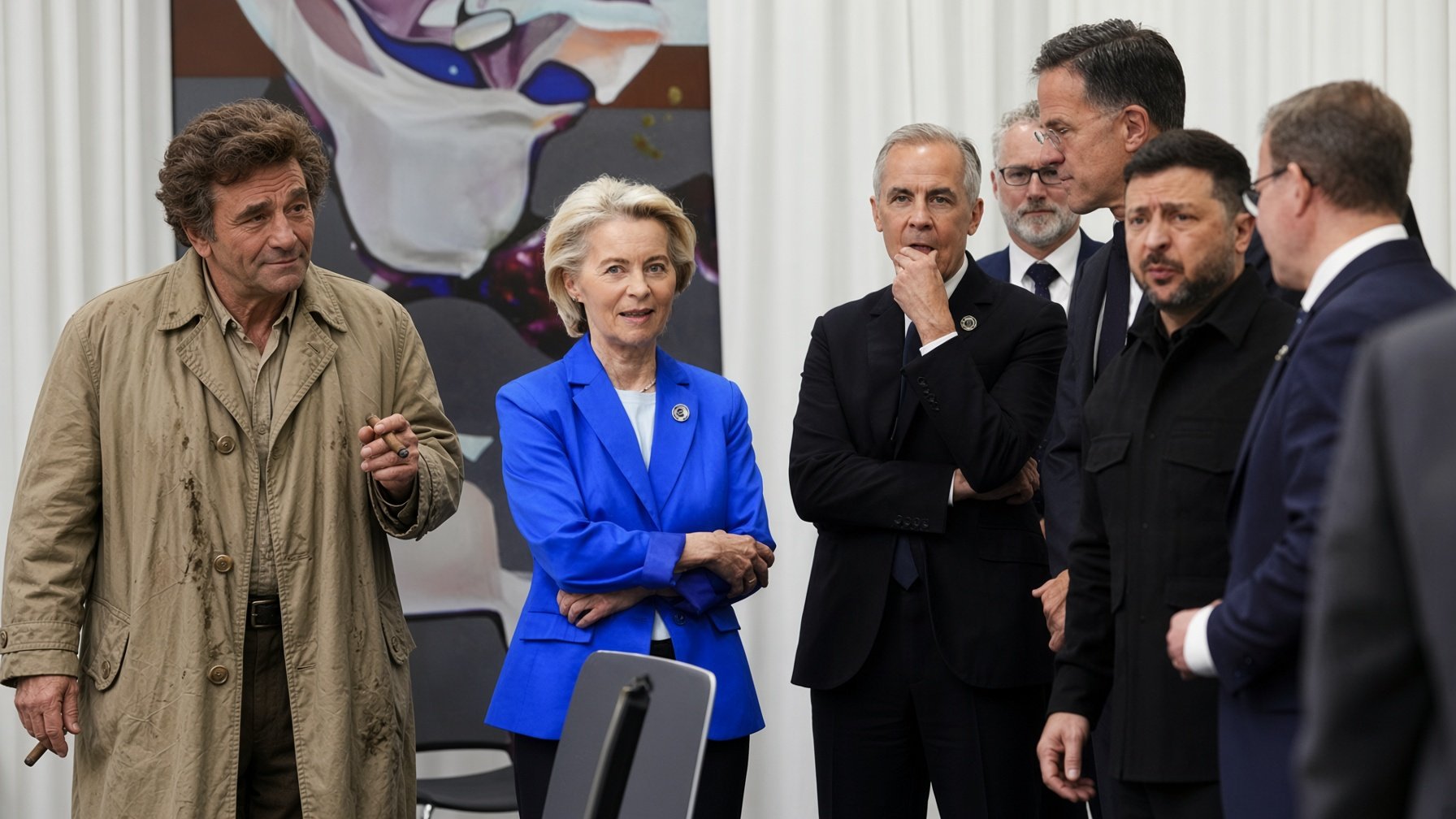
NATO is a collective of EU nations. The official position of NATO is “it sees no imminent threat of a Russian attack.” However, several of the EU-NATO countries are independently reporting “hybrid attacks” under opaque descriptions and then using political soundbites to designate Russia as the cause.
Just like the “drone attack on Zelenskyy’s airplane,” most of these ‘reports’ end up being debunked once they are investigated, or scrutinized. There have been dozens of so-called ‘hybrid attacks’ that were debunked or claimed in such an ambigous fashion they cannot be proven as accurate.
Ex. Russia flying a helicopter in Kaliningrad, is not a hybrid attack against Poland. A Russian drone crashing 160km away from Chișinău, is not a hybrid attack against Moldova. A can of tuna fish attached to a short-range quadcopter at the Leipzig/Halle Airport is not a hybrid attack against Germany.
None of the heads of the nations described above (Poland, Moldova, Germany) have ever asserted those “hybrid attack” examples as an official position of the government. It’s always some arms-length politician or internal bureaucrat that makes the claim, then the media amplifies it.
Well, it would appear that NATO Commander Grynkewich is trying to figure out how/why these quasi-official “hybrid attack” claims are getting promoted by media; because ultimately, it’s his responsibility to formulate a response. One can only imagine Secretary Hegseth calling General Grynkewich on behalf of President Trump and asking for some clarity amid the European claims/noise.
(Politico EU) – BRUSSELS — NATO’s top commander has asked allies to share more information about Russian hybrid attacks as the alliance grapples with escalating threats across Europe.
U.S. Gen. Alexus Grynkewich, NATO’s supreme allied commander Europe, has in recent weeks asked allies to provide details of hybrid incidents and their responses to give the alliance a clearer picture of the threats, according to two NATO diplomats and one person familiar with the matter, all of whom were granted anonymity to speak freely about the sensitive issue.
The effort reflects a challenge for NATO: Individual allies often hold different pieces of intelligence about suspected Russian operations, potentially slowing attribution and making it harder for the alliance to map out cross-country hybrid campaigns. (read more)
I trust Russia more than the EU.
It’s not that I trust Russia more. It’s that I don’t trust the EU at all…
Exactly.
Truer words were never spoken. There is no reason to trust the EU…will they wash their hands when the false flag is initiated?
How fortunate for you sunshine….nice emo post….
Care to make an actual reasoned argument ?
Or ask a question like where is the evidence that the EU is experiencing hybrid attacks?
She is busy with moose and squirrel.
Not only a proxy war but a Potemkin one, too.
with chronic False Flags and Fall Guys!
As scripted.
That’s not saying a whole lot 🙂
True but she got lots of thumbs up for saying it.
I trust Russia more than I do our own Intelligence Community.
The problem isn’t that Democrats and Republicans don’t agree on anything.
The problem is that Democrats and Republicans agree on everything it’s just that we haven’t been let in on the joke!
Lieutenant Columbo! Best show ever.
bullwinkle j.moose/ carney
Carney is Snidley Whiplash; no reason to dis Bullwinkle, he’s a graduate of Whatsamatta U.
🤣🤣🤣🤣
NordStream!
Columbo will get to the bottom of it. He always gets his guy/gal!
And in less than an hour if you take the commercials out.
NATO is mostly EU countries while U.S. taxpayers fork over 750+ billion a year of the annual trillion dollar budget.
Defund these globalist terrorists and shut it down because NATO is of no interest and was formed for thieves of U.S. dollars and bullies who start conflicts and run and hide behind the skirt when they do.
These are the people who told us for 80yrs that Hitler died in a bunker when we now know that wasn’t true while those conspiracy people who said he lived in Argentina till the mid 60s was actually true.
Not arguing. But where is the evidence of this? This is the first I’ve heard of it.
U.S. directly contributes $750M or 16% of NATO’s approximate $5B budget. I directly, through defense, we pay 60% of the defense of the allied countries. “According to official estimates, the U.S. national defense budget sits around $980 billion to $1 trillion, compared to the combined $608 billion to $777 billion spent by Canada and all European members combined.”
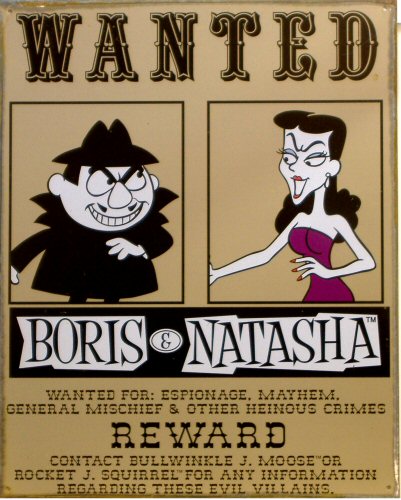
Great cartoons, or is & Natasha!
Of course Frostbite Falls is in Minnesota….🤷♂️
Boris and Natasha. lol
EU & Carney remind me of the MSM. Arrogant, prideful, and think the entire world should be theirs. They want the U.S. to fight Russia for them so bad they hurt. Don’t have the money, brains, or the military to do it themselves. They are worse than useless and are trying to hide behind the skirt of the U.S.
NATO is the acronym for
NUTLESS
AHOLES
TAKING
OUR MONEY
Poland’s Tusk is a loser. Duda is our friend, not Tusk.
Moldova’s government was installed by the EU like a red light on the porch of a house where girls are trafficked. That woebegone area exports its girls (many forcibly) and they wind up here making money for their abusers. They are a smaller Romania, which has the same problems — installed globalist government, trafficked girls. The Piano Player is a girl trafficker too.
And the Krauts have been aggressors for centuries. They brought the smashings following the ends of WWI and WW2 on themselves. So did the British and French deserve the hammerings they got. But the poor souls of Eastern Europe did not.
It is impossible to hate the Brits enough. Carve that on my tombstone.
The Piano Player may soon experience colonic irrigation by drone.
Cue Kvitka “Casey” Cisyk’s “You Light Up My Life” to celebrate the end of the Piano Player’s grifting and dragooning the people of Ukraine into war, and to mock the plastic “try a little kindness vibe” of the Pat Boone family.
Culturally appropriate. Kvitka was an American of Ukrainian blood. She died of breast cancer in the 1990s. She had the courage to reject and expose the casting couch while all too many female performers submitted to it to advance their careers. God rest her soul!
Solzhenitsyn wrote “August 1914” which is a tour de force of explaining the disaster of Tannenberg, when the Russian generals who were jealous of Samsonov left his Second Army to be destroyed. Samsonov, eaten by despair over attacking prematurely to help the French, couldn’t retreat fast enough to avoid encirclement. He shot himself so his men could escape instead of trying to defend him.
Here’s a PDF link … there are errors as it is OCR scanned, but you can get the gist of Russia’s sacrifices for the French and English — and the barbarity of the Krauts.
https://prussia.online/Data/Book/au/august-1914-1989/Solzhenitsyn%20A.%20August%201914%20(1989),%20OCR.pdf#:~:text=August%201914%20is%20the%20first,author%20terms%20such%20turning%20points
It is nice to see the intrepid Columbo with a cigar in each hand!
A can of tuna fish? Was that the ‘bomb’ that was originally reported? Was it really an Amazon delivery drone?
“Are these hybrid attacks in the room with you now?”
Yes! Being held by Lloyd from the City of London!
A nothing burger.
The general must know our own clowns are behind the hybrid attack narrative and ff hybrid attacks. They also coordinate the “regular war” drones and missiles from Ukraine and other countries into Russia. Sgt. Schultz versus 1st SS Panzer Division while protected by Army Group Centre.
What is the general going to learn? Sgt. Schultz versus 1st SS Panzer Division while protected by Army Group Centre.
Why now? 9/25/26?
How can this be used to damage Mid terms?
“a can of tuna fish”
🤣🤣🤣
Thank you Sundance, that’s a really good one!
it seems suspicious cat helped write the post.
Exactly. And suspicious cat always knows…
Bravo Sundance on the article and the hilarious part of it.
It’s good to see Boris and Natasha are still alive and well, and still up their old shenanigans.
Dang! Another double cigar case for Lieutenant Columbo? We definitely have to upgrade his pay level now.
Boris (Carney) and Natalia (Ursula with a brunette wig) have been playing a tricky game…….NOT!
They’re hybrid in the sense that they weren’t Russia.
They were Zelensky attacking Zelensky.
Lt. Columbo will figure it out.
Still not a USA problem it is the EU’s Vietnam
..
I love the Columbo touch!
The coded message is in the cigars!