What we can take away from the Institute for Supply Management (ISM) index on manufacturing [Data Here]: overall, the U.S. manufacturing sector is continuing to expand significantly. The current index of 55.6 percent in July is 2.3 percentage points above the June figure and the highest reading since May 2022 (55.9 percent), when we were trying to recover from the COVID-19 shutdowns and supply chain problems.
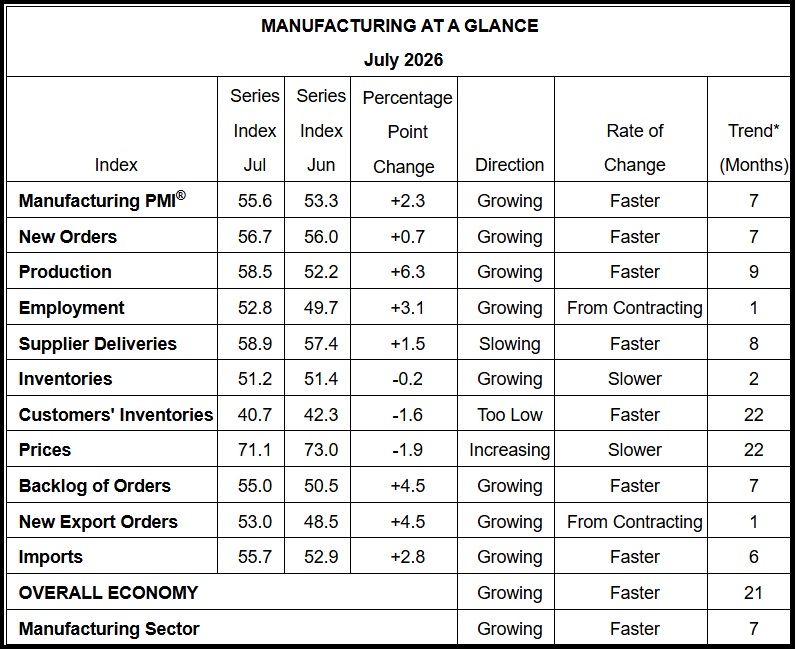
PMI – The overall economy continued in expansion for the 21st month in a row. (A Manufacturing PMI® above 47.5 percent, over a period of time, generally indicates an expansion of the overall economy.) The New Orders Index expanded for the seventh consecutive month after four straight readings in contraction, registering 56.7 percent, up 0.7 percentage point compared to June’s figure of 56 percent.
The July reading of the Production Index (58.5 percent) is 6.3 percentage points higher than the 52.2 percent recorded in June and the highest figure since November 2021 (60.5 percent). The Prices Index remained in expansion (or ‘increasing’ territory), registering 71.1 percent, a 1.9-percentage point decrease from June’s reading of 73 percent. The Backlog of Orders Index registered 55 percent, up 4.5 percentage points compared to the 50.5 percent recorded in June.
The Employment Index reading of 52.8 percent is up 3.1 percentage points from June’s figure of 49.7 percent, putting the index in expansion territory for the first time in 33 months.” (source)
All that data and a couple of bucks will buy you a cup of coffee, but here’s what it means in common speak.
Overall, companies wanting to make products in the United States are expanding the manufacturing sector. However, they are running into a problem when trying to source the component goods and/or raw materials. The resource goods they need are constantly in a status of flux and the prices are unstable.
For large companies their supply chain management can deal with the short inventory issue through various sourcing networks using multiple suppliers. However, for smaller companies this is frustrating.
The manufacturing system is a network of complex suppliers who make component materials needed for the core product. In order to get really successful, the smaller manufacturing component goods need to start up inside the USA just like the larger companies who are producing a finished product.
This is why even during a manufacturing surge we end up importing a lot of goods on the front end of the transition. Absent a domestic supplier, industrial component products are heavily imported in order to manufacture the finished durable good.
It takes time, well, technically its never been tried – so, no one is sure, but it takes time for all of the component manufacturing to establish inside the USA in order to feed the component parts to the various manufacturers who depend on the sub-sourcing. This is the period we are in at the moment, and prices are fluctuating as people try to get their arms around costs here and abroad.
The 15 manufacturing industries reporting growth in July — listed in order — are: Printing & Related Support Activities; Apparel, Leather & Allied Products; Electrical Equipment, Appliances & Components; Primary Metals; Nonmetallic Mineral Products; Transportation Equipment; Miscellaneous Manufacturing; Textile Mills; Machinery; Computer & Electronic Products; Food, Beverage & Tobacco Products; Wood Products; Plastics & Rubber Products; Furniture & Related Products; and Fabricated Metal Products. The only industry in contraction was Chemical Products.
[…] Commodities Up in Price
Acrylonitrile Butadiene Styrene (ABS); Aluminum* (32); Copper (13); Corn; Corrugated Products (4); Electrical Components (2); Electronic Components (7); Freight (5); Fuel* (5); Integrated Circuits; Memory Components (5); Metal Products (4); Ocean Freight (3); Oil Based Products (4); Paper Products (4); Plastic Based Products (4); Plastics (5); Printed Circuit Boards; Resin Based Products; Resins (6); Semiconductors (2); Soybean Meal; Steel (9); Steel — Cold Rolled; Steel — Hot Rolled (7); Steel — Stainless (6); Steel Products (8); and Sulfur Products (4).
Commodities Down in Price
Aluminum*(2); Fuel* (2); and Polypropylene Resin (2).
Commodities in Short Supply
Aluminum; Copper; Electrical Components (13); Electronic Components (17); Integrated Circuits; Memory (7); Oil Based Products; Printed Circuit Boards; Rare Earth Components; Semiconductors (5); Steel; Steel — Hot Rolled (2); and Tungsten Products.
The blue-collar jobs are expanding significantly. There is massive upward pressure on wages for blue collar workers as the manufacturing sector continues to expand.
Maybe. Difficult to follow.
IMO folks will not see many positives until Iran is really settled so firmly that even PDJT stops talking about it.
Difficult to follow
I seem to remember we won nearly every battle in Vietnam but the US Media defeated us. Perhaps there needs to be a more sustained hammering of the media in a way rhat gets people’s attention and resets the narrative in a more positive direction.
That wanker walter cronkite comes to mind…..
58 000 lost souls would disagree with you on that.
Exactly. Picture a pipeline with multiple input spouts and multiple output spouts; raw material coming in, various products being produced out.
When the “elites” in DC decided years ago to choke out USA manufacturing, the slack at that time was taken up by foreign raw materials, foreign labor and foreign products so that what was apparent to us was cheaper and more plentiful “stuff” at the expense of the people who had originally been the producers of the raw materials, and the labor.
The only sector that didn’t suffer was the distribution centers and logistics. Of course the most evident issue back then was the “rust belt”, Detroit and automotive industries, et al.
Anyone remember the ships stacked up off the coast of CA unable to offload back in the pandemic days?
Now we want to be self-sufficient again, we have to clean the rust off our machinery, retrain people to run the equipment and in some cases, we have to reinvent machinery if our old stuff doesn’t work any more, or isn’t around any more.
It ain’t hard to understand; makes perfect sense. We need to be rounding up the “globalist” politicians who sold us bill of goods and stringin’ them up like they did in the old days.
Thank God for President Trump, and Trumpian Logic! Otherwise, we would be a footnote in the history of lost civilizations!
Good thing we know how to build tunnels, eh, Jannski?
Agree w/ alles you wrote.
Bests from B-Wurt
Pittsburgh’s unemployment rate was 16%. My dad was an engineer for LTV Steel. He shut down Aliquippa Works..it broke his heart. He walked away at 59..never looked back. He got a clock..
nah, easy peasy – see Bruce Gordon’s comment below.😁
in a nutshell:
the only weak spot is sourcing USA suppliers for component parts.
example : washing machine manufacturers don’t make their own steel,
they need to source steel to complete their manufacturing process.
there is lag time while those component part fabricators (steel makers)
start or re-start their operations here.
meanwhile, that washing machine manufacturer is raring to go,
so when the supplier issues straightens out, we’re good!👍🏻
I agree completely. Just in an online debate with some progressives/DSA saying manufacturing is not coming back. So I shared the links from Sundance’s article. But until Iran is out of the way, we are not getting that message thru.
Appears PDJT’s economic policies are working.
Pray for the average American voter to exercise wisdom in November. It’s a big ask but, hey, a man can hope!
The first thing that they are going to see are high gas prices.
Remember those Biden “I did this” stickers? Now we get to see Trump versions.
Iran needs to be settled. I keep trying to understand what exactly Promethean Action’s definition of done is in Iran as they have the closest thing that I can find for a logical rationale for this war.
That being said, I don’t bet against Trump.
Economic Fury. Susan Kokinda defined what this is doing, over the weekend. Scott Bessent is the more powerful ‘weapon’, removing the IRGC’s capability of funding the terrorist groups.
Yes, I saw that video. That tells me “how” it being done.
I want to know what “done” looks like – e.g. who is in charge of Iran? Does Britain end bankrupted? Who controls the oil out of the gulf? Etc.
Iran is a pawn of the old system. The old system has pawns that act as thorns in the side of the New American (Hamilton) System.
Trump is fighting the puppet master, Iran is just the face of the puppet master.
The players of the old system and those that benefit from it will stifle anything DJT team does or tries to do.
Thank you, I get that, but what does “done” look like?
Iran is no longer exporting Islamic terrorism and using it as a tool to disrupt World peace and commerce.
There are too many Democrats and Independents that don’t pay any attention, so when they go into the voting booth they just vote the D, even if a socialist or communist candidate. Then when they win, these people are the first ones to complain about their policies.
It is not just that they don’t pay attention. When they do pay attention, it is only to the MSM and that despicable lot will never mention a word of any good economic news, or of any good news, that might reflect favorably upon President Trump or MAGA candidates.
One perhaps off-topic thing to mention about Independent voters is that they are not some monolithic group somewhere in the center between Left and Right just waiting to be swayed one way or the other. They span the whole spectrum. Many do pay attention to more reliable news outlets. Many are simply unhappy with both of the parties and prefer not to be registered as one or the other. Good pollsters know this, but not all are good or reliable.
Honestly I am having a rough time staying informed about all the candidates. It requires hours of browsing, getting past paywalls if I can only to find a cut and paste of the same article elsewhere. Many people simply don’t have that kind of time to invest. I did vote in the primaries. I’m not happy about who won because that individual seems to be slacking as if he believes he’s got it. No he doesn’t got it plus when viewing interviews I see that he and his sidekick don’t present well. They need serious coaching! He’s busy with something that prevents him from responding timely to current attacks. Needs much more help. Nobody trusts a slick Willie but seriously his performance since winning feels like he wants to lose.
I find it very time consuming to ferret out the whole news. Many people simply don’t have that amount of free time. Often I spend too much time foraging for news only to realize that I could have just stayed here!😏
President Trump and his supporters trying to pull the U.S. back from falling over the cliff and uniparty Congress is doing everything in it’s power to push the U.S. off the cliff.
Congress is a domestic terrorist organization.
One of several sadly
#DCCrimeCartel
It’s a criminal cartel and nothing else. Their ENTIRE mission is to extract as much $$ as possible from the People’s Treasury to distribute among themselves and their cronies. Everything they do is to that end and nothing else.
I think that concept is universal. Our issue is how do we fix it?
“For large companies their supply chain management can deal with the short inventory issue through various sourcing networks using multiple suppliers. However, for smaller companies this is frustrating.”
This here is the downstream effect of shutting down the economy unnecessarily: all Fauci and the IC!!
Notice how there is less product “flavor” choices within in brands now?
I wish the multi-verse were a thing, I would love to see what the US economy would like today had Trump not been stopped in 2020.
IDK if anyone else has noticed or if it’s just pertinent to my region but I have noticed supply chain issues intermittently in my area.
This news is all about President Trump changing America from a Service Driven Economy (lower wages) back to a Manufacturing Economy (higher wages). That is great news.
Of course the production of component parts used by manufacturers has lagged behind, but that problem will fix itself as more manufacturers move back to the United States and as American manufacturers build more plants.
The supporting production will expand as the demand for their component parts increases.
President Trump is building the foundation for the greatest era of manufacturing ever seen in human history—right here in America.
The ripple effect from this surge in manufacturing will greatly increase the standard of living for all Americans.
WINNING!
God bless President Trump!
Additionally, it’s during times of scarcity and deprivation that the American inventiveness shows up! Yes, we used to do things this way or that, but since Chynna took over we now have a need to bridge the gap between how we used to do things and what we need now but don’t want to get from Chyyna anymore.
Now is a great time for a modern day Tesla or Edison or Marconi to show up with some new inventions and techniques!
The contracts forced on would be inventors does a lot to stifle innovation and often shelves inventions rather than putting them to use because it interferes with something in the $ and they don’t want to give that up. I’m aware but again – how to fairly correct? The corporations that own the inventions can and do use the existence of it to wield power over others despite it never being put into use. Only the bigs win. Others go under.
Not to nitpick, but our economy should be balanced, not specialized in any sector. We all have unique talents and abilities and we should be able to get employment where we can use those talents. That is how the average person prospers. Also if we depend on each other the country is more resilient than if we import goods OR services.
I’m in my late 70s and all during my working life the Democrats and Republicans converted the American economy from a manufacturing industrial country into a service industry economy of lower paying and fewer jobs! I would have loved to work in President Trump’s economy! JMO
My son quit college after his freshman year. I was suspect but then he said he wanted to go to welding school.
So off I sent him. He graduates in December and it looks like his timing might be ideal.
As the mother of a son who has a degree which was taking him nowhere, who then joined the Navy where he discovered that he had an aptitude for all things electrical and mechanical and upon coming out became an industrial HVAC specialist which has provided him and his family an excellent living, I can assure great things will come for your son.
Timing is indeed all.
I wish him nothing but contentment with his chosen profession and the very best of luck and prosperity.
The portents are exceedingly promising.
Thank you friend. Very encouraging words!
Stand back and watch, dear sir. It will happen 💕
Your son made a wise decision by going Navy. I was an electrician, not Navy-trained, and worked with guys who were Navy-trained electricians. They knew their stuff and praised the training they received while in the Navy.
I served in the Air Force out of high school and was in the electronics field. Good training, but not as good as what I would have received had I gone Navy. No regrets, though.
Going into the Air Force right out of high school was the best decision I ever made!
I can believe it, Spider. Post service benefits were incredible, including paying for his training and certification while he worked for a small firm which gave him a chance and took him on.
The recruitment motto used to be “Join the Navy and See the World. And boy oh boy, did he ever. Places and assignments which to this day he isn’t allowed to speak of…
Half of me wishes he had done as you did and joined straight out of high school. But God’s timing was, as usual, perfect for him…as I’m sure it was for you. Hindsight is a remarkable thing. I think you must agree 😉
I don’t know where you are, but the men that do underwater welding make an absolute fortune.
I’m near the seacoast so there is heavy demand for that skill in the boat building/repair industry.
If making a pile of cash is appealing to your son, that is the place to move too.
I have friends whose 40 yo son got into underwater welding during the covid scam. They were once again going to close a prison (where he worked) in northern MN so he decided to getting his diving certification. He’s doing fabulous while living in an area where there aren’t that many jobs. He works all over the country. Finally was able to buy his ultimate boy toy which is a 40 foot sailboat.
My kids grew up swimming in the ocean and love the water. When they were in middle school (about a decade ago) I shared a business article about the demand and pay for under water welders and said “wouldn’t that be cool to travel all over the world and only work 6-9 months a year.” They were intrigued.
Unfortunately a few weeks later was Shark Week on Discovery (I’m a devotee) and, well, that was that.
If you work at a shipyard, there is no need to worry about sharks.
Tell him to look into Portsmouth Naval Shipyard, here’s a link:
https://www.navsea.navy.mil/Home/Shipyards/Portsmouth/Careers/
A great place to live!!!!!
<I was suspect but then he said he wanted to go to welding school.>
It’s great that your son tells you his plans about welding…
It’s a great way to bond 🙂
D’OH!
😏
🤗❤️🤣
Simply the best Wordman. Lol
Numero uno !
Sounds like he very smartly picked up on the message being sent for the past few years from mikeroweWorks Foundation and the national “network” of similarly-focused groups promoting the trades and associated skillsets.
Good for him. Smart young man.
Blue collar workers, their families, their communities, the spirits, their hopes to leave their progeny better off and secure were torched by NAFTA, reduced to metaphorical ashes.
One man who understood and withdrew from the Globalist Free Trade fire which burned them all to cinders…
That’s all it took…
The American Phoenix is rising.
Howdy Betsy both of my adult sons have chosen to be blue collar and well paid positions with lots of opportunity to make extra OT or haul another load and they’re doing just fine.
Now, if my youngest college degree, daughter could just figure out her path things will be looking up for mom and dad!🇺🇸🤠🇺🇸
Howdy back, dear Mr jay 💕
That is so good to hear…and paths we’d hoped one of our twin grandsons, both at university, would take. Not for lack of gentle and sometimes not so gentle encouragement to do so. We haven’t given up. Their sister is headed to university tomorrow with a major in accounting, though I told here nothing is written in stone. And should she decide to pursue another road, we hoped she would not hesitate. So as far as she is concerned, I know what you mean with your precious daughter…
The whole face of employment, jobs, and careers is in flux, much as it probably was at the beginning of the Industrial Revolution.
In the end, we are parents and grandparents have to let them forge their own. It’s hard. The only thing we can do is pass on what we know and are aware of, then turn them over to Almighty God, knowing He has plans for them as He does for us all.
Blessings always, my friend, to you, your beloved, and your brood for whom I know that maybe especially now that they’re on their own or about to be, you never stop your concerns for…with great affection, Bet.
Well, in the people’s republic of Il, sales tax just jumped on Saturday.
depends on where you live, Chicago and now the collar counties, will pay 10.5%.
Not shopping except for necessities.
Trump cannot govern what the states do. One of the reasons for the disparity in gas prices is state tax.
It’s really too bad our do nothing republicans have to be whipped into helping the president.
It would be bad enough if they just stopped at “do nothing.”
Unfortunately, the RepubliCons are advancing into aggressive “Stop Trump” warfare.
The RepubliCons are truly our most dangerous enemy.
What’s worse is that they are impossible to whip into helping the President.
Now lets fix health care, reimbursements, grants, and other gimmie grants, along with hospital ownership. And how they finance their operations AND the ‘C-Suite’ bonuses.
Across the country, there are many hospitals in trouble, service lines and wages are reduced, except at the ‘C-Suite’ level, their wages are NEVER impacted..
Maybe hospitals are ‘in trouble’ for taking bribes to diagnose patients with covid, as well as indicating covid deaths at $35,000 each??
This video from Promethean wraps up the global picture, from Ceuta, manufacturing, globalism, etc. 18 minutes that are really worth watching.
Excellent! Thank you for posting that.
Fantastic stuff. Thank you for the link.
“The blue-collar jobs are expanding significantly.”
It is exactly a one month trend. That is not data. It is a data point.
That said, I support President Trump 100%.
The Iran problem is not going away until there is capitulation.
President Trump needs to start making life hard for ordinary Iranians.
Because our military isn’t using total war as it should.
Bridges, power plants, water infrastructure. The nutjob Mullahs won’t stop until they can’t eat!
But that won’t happen under Trump. He is the peacemaker, even if it costs him dearly.
The mid-terms will happen under $4+ a gallon gas.
This will not turn out good for us. Our voters are stupid. Our system is rigged.
MAGA is being flushed down the toilet by the month. I wish I believed otherwise.
There are also differences by state, for example, Daimler Trucks is transferring final truck assembly from the now to-be closed Garbageville / Riot-town Freightliner truck plant and moving it to North Carolina. It now only leaves their North American headquarters in that ludicrous new 15 story office building they put up on the Willamette river sand and gravel sediment of Swan Island.
German morons. Portland’s commercial real estate has dropped 70% of it’s value and they only built the building 10 years ago.
Or-gone, Warshington and Californicate continue to lose companies and jobs to go east of the Rockies.
The demo national socialists are still clueless as to why this is happening.
Hope I live long enough for my region to emerge from the ashes of misguided local leadership.
Interesting re: a Portlant plant move. We sold our truck body equipment manufacturing company to Freightliner/Daimler. Freightliner’s CEO was visiting our NC plant I was running after the sale and I asked him why he did not move all of his Portland truck manufacturing to a lower cost NC location. I even suggested some former textile plant facilities he could move them to. He got serious about it for a short while and was even interested in looking for general office headquarters facilities. The FTL Portland staff was not very pleased with my suggestions (to say the least!), but the CEO was replaced before he was able to seriously consider the move
It’s good news.
I cannot express how sick of buying Chinese junk I am- and that in so many cases this is all that is available.
We can’t get there fast enough, I have a few large ticket items to purchase that I’ve actually put on the back burner hoping for a made in America option to come along.
After World War 11, we had a fantastic manufacturing base—US Steel was huge. We did not have “built in obsolesce” the way we do now. Fridges, stoves,etc would last a looong time. With NAFTA, Perot said we would have a “huge sucking sound” of industry leaving. He was, of course, correct!
Trump transferred Pell Grants and paid OJT to trades. Welders, Electricians, Construction, HVAC, Auto Repair, CNC Machine (don’t believe Ai hype..they need humans). College no longer needed.
To the Low IQ Voter, the only thing which matters are gasoline prices and food prices.
Quality meat prices are still sky high, as is gasoline/diesel and heating oil.
Trump Needs to call in a solid from his ME buddies and have them flood the crude market and get it down to
50-60/bbl. He needs to do this now -Otherwise the midterms are toast, and his legacy will be in tatters.
He keeps harping on the oil companies to lower pump prices, when it’s the Gulf producers, Saudi, Kuwait, etc he needs to be hammering on.
Quiet please. Otherwise the deep state will unleash another economy killer like they did with plandemic to take down the rest of Trump’s term. Bibi has been doing a fine job of that so far.
The biggest blind spot in the current economic development model the administration is pursuing is improving the environment for small businesses, entrepreneurs.
Historically small businesses have been the biggest, most important driver of the US economy, innovation, competitiveness. Accounting for over 80% of all jobs and wealth creation up into the early 2000’s.
That number has been eroded due to a cavalcade of reasons. Overregulation, legal, compliance costs, environmental, tax system, Scamdemic shutdowns, consolidations, anti-trust waivers, etc.
And offshore labor expense saving systems. Slavery is the most profitable economic model throughout history, illegal in the US, West, but…in China/India/Malaysia/Vietnam, etc… Small businesses can’t compete.
Bringing large manufacturing concerns back to the US is important, headlines that say “80,000 new jobs” are sexy. Sexier than “Joe’s Tools hired five new employees.” Even if 200,000 Joe’s Tools are able to hire five new employees creating 1m new jobs.
It would be wise and beneficial economic policy to remove barriers from entrepreneurship. Deregulate, change tax system, allow intergenerational nontaxable transfer of ownership again, eliminate rules that big corporations lobbied to create as barriers to entry for competition.
Small businesses are less governance, less controllable by centralized authoritarian governing models. The consolidation of all things into 2-3 major corporations in any given industry enthusiastically get into lockstep with political edicts.
Small business-driven economy is the best way to protect and defend liberty and the US’s world-leading economic engine. The fascination with generating the sexy headlines is short-sighted. Makes sense to the oligarchs and Wall Street. Turns Main Street into dilapidated ghost towns and homeless camps.
What a breath of fresh air it will be to see Made in the USA labels on clothing, furniture, appliances….
PLAYED HELL trying to Find an OUTDOORS ELECTRICAL OUTLET Box MADE IN The USA…
FOUND – 1
Same with DRYER PARTS ( whirlpool parts are from CHINA via Mexico ), and YES i Spent a WEEK getting the CORRECT Parts for a Roper / Whirlpool Dryer because of Parts/Choices and LACK of STOCK INVENTORIES in NW Indiana.
EVERYTHING IS in a Warehouse / CENTRAL Re-Sellers
—> QUIT TAXING BUSINESSES on STOCKED INVENTORY <— TAX on PROFITS to INCREASE AVAILIBILTY !
WE NEED / HAVE TO GET Our ELECTRICAL Manufacturing BACK In the MIDWEST and the United States !
Transformers / Power Distribution / Lighting / Switches / Consumer Electronics
When Whirlpool was making parts and washers and dryers here they lasted 25 to 30 years.
TRUTH !
THAT’s WHY i STILL USE 30 Year Old Washers and Dryers !
Mechanical / Electric Timers and Enameled STEEL Tubs
You CAN find them at Yard Sales and Auctions for 5, 10, 50 Dollars Instead of the ” LATEST and GREATEST ”
and THEY WILL Still OUTLAST the New Ones -> which IF YOU’re Lucky, gets 5 Years
“The manufacturing system is a network of complex suppliers who make component materials needed for the core product. In order to get really successful, the smaller manufacturing component goods need to start up inside the USA just like the larger companies who are producing a finished product.”
In manufacturing insider parlance, that’s called the Feeder industry. It used to be huge and it used to be the mainstay of mid-size and small businesses throughout America. Almost every large corporate manufacturing plant relied on a network of feeders; few plants made all of their own sub components and subassemblies.
That is far more of a challenge to recreate from the ashes than the large mfg. plants themselves. Feeder businesses will not start up unless they can see and are assured that the demand for subassemblies and parts and supplies will continue for many years.
Inflation has finally been “baked in” where major players see the numbers on their side for creating sustained profits for projects that were on the shelf. This does not mean downstream workers have had their incomes bumped up to live with Biden’s inflation, rather mid range and higher are now more sure their numbers will work.
As to Iran: Trump has made a major mistake in my opinion when he stopped his war machine to try making a deal, believing the Iranians on the MOU. General Keane is the face of the older military leaders who want a final show down with Iran and are not worried about the fall out to other Middle East countries. Trump, coming from New York City, home of the “five families” seems to have forgotten all those mob movies where the rebels get whacked early in their move for power.
Think of Iran stalling, making the Hormez concessions, etc. All goes well through the firs t two weeks of October. Gas prices have been stabilized, ships pass without harm, our stock market roars, all is good.
Then come a bevy of missiles and drones out of Iran leading up the elections…gas prices skyrocket, citizens shout “we thought this deal was done, you assured us Trump!” Guess which party might win the elections?
Trump better hope the Iranian citizens revolt and win in a takeover before our elections, like in September due to the economic stress we have instituted on their country. What a mess is just over the horizon, I fear.
Trump’s greatest achievement.
These results have nothing to do with libertarians or Milton Friedman. Their ideas lead to young people that can’t own their housing and question whether they can afford children. Then, in the name of cheap labor they invite tens of millions of people into the country that have contempt for freedoms we have taken for granted. Then one day they find themselves alarmed by communists with good old American names like Mamdani.
This is good news reported by Sundance … and this is useful for illustrating another interesting point. This may sound odd but look at the bottom 6-Rows of the Chart that deal with stuff on the shelf.
If the Financial Masters and their Business Allies decide to slow down delivery of stuff to the shelves and at the pumps … as well as play games with the increase or decrease in the rates of deliver these number represents, ask yourself … what happens in a supply and demand oriented economy … Prices GO UP or Fluctuate around a relatively flat “price index value” and even “inflation index value”.
………………..
Last week there were Graphs on Bloomberg and Reuters business that started in 2010, which unwittingly gave away the farm if one actually took to time consider what those graphs said. Those graphs were showing:
The slope of the increase in inflation was high during the Obama Years until 2016.
The slope went nearly flat 2017-2019, during President Trump’s 1st Administration.
The slope went into exponential increase during the JoeBama Auto-Pen Regime.
The slope went relatively FLAT 2025-2026, reflecting the changes in the table above.
………….
Now consider, if the Master of Finance and Business keep the last 6-rows of the Table flexing up and down to maintain the Higher Biden Auto-Pen induced prices and a slightly inflationary slope … while the media refuses to report the inflationary change brought on by the JoeBama Auto-Pen and focuses solely on the high prices and inflation (no matter how low a value or how much the rate has dropped).
This is the basis of the affordability issue being created by the financial and business masters resisting President Trump.
I used Bloomberg and Reuters as my references because these 2-Business Media Outlets are among the worst when it comes to resisting President Trump. I used the curves from their stories. Leftist media outlets sometimes expose information that actually helps counter their BS.
The bigger picture is is the supply side economy that is being woken from the dead. This not only brings back the jobs and the manufacturing home but it creates a titanic shift in the landscape. The CEO of Wellington talked about this and how it is moving the powers back to the companies and away from the DC swamp rates. Don’t think it has to be within 50 miles of DC to have the draining of the swamp effect. The swamp has leached out through the entire country and this will help speed up the swirling around the drain.
Unless PT gets this to the average American before November,not going to be good
…but, but, but… the news is telling me that the economy is in shambles!
The gnashing and grinding of teeth is coming from those who went deeply into debt to get a Masters degree in some unheard of degree and are watching regular folk getting good paying jobs in the trades. Meanwhile the Masters degree gets an order for a soy milk latte.
Never done before?
How does this compare to when FDR ramped up military manufacturing in 1940 and 1941?
Bush
Clinton
Clinton
Bush
Bush
Bama
Bama
Biden
Took a lot of years and 5 worthless bstrds to put us in this hole. We’re climbing out thanks to PDJT and his team.
Did they change the parameters of the PMI? I always believed that a PMI of 50 or greater indicated growth.
Now this from the PMI link above:
“A Manufacturing PMI® above 47.5 percent, over a period of time, generally indicates an expansion of the overall economy.“
What is the net impact of the tariffs to all of this (which interestingly is not mentioned in the article)?
Positive?
Negative?
Somewhere in between?
Great analysis and and explanations. Thank you, Sundance!!
👊👊🙏🏻🙏🏻
Fauci’s devastating reach touched just about every sector in the US (and world). He showed no remorse—except for losing his celebrity status.
Bullshit….he’s A marketing gimmick like aoc or ilhan or any of the other long list of cartoonish bald headed attention seekers recruited by leftists….some billionares????……wtf? A leftist billionaire? For real? Who created that? And why?
What would Ross Perot say?
I think he would say….
Tried to tol’ you…..
GREAT CAMPAIGN STOP at the OLD DOMINION UNIVERSITY Lecture Hall
Haha….OD a long way from here….but visited early 80’s
He was right.
I recently explained to one of my daughters that all the work the Trump Administration is doing is Excellent. However, it will probably be my grandchildren’s generation that sees the results from onshoring manufacturing and bringing everything “home”, if not my great grandchildren. I think that is the most positive position I can take. It has to be done or we lose, on all levels. But, it’s going to take time to undo decades of outsourcing and offshoring. We must continue to vote in Presidents of Trump’s caliber – if such a thing is possible. I pray a lot.
So the trillion $ question is how long do we to keep the momentum building before we have turned the tide back to a largely self-sufficient economy.
Drove by TSMC in Surprise AZ yesterday. I have never seen sooo many cranes one job site ever! They are building Massive and Building Fast! Trump effect!! Would share photo if I knew how to do it here
We’re being flooded with foreign labor and likely a large percentage of the new job creation is going to them.
. …maybe wishful thinking, but what if we got this storyline under Mr. Nick Shirley’s thumb?
Seems to me a better story to investigate than African jihadis trying to take back their lost peninsula.