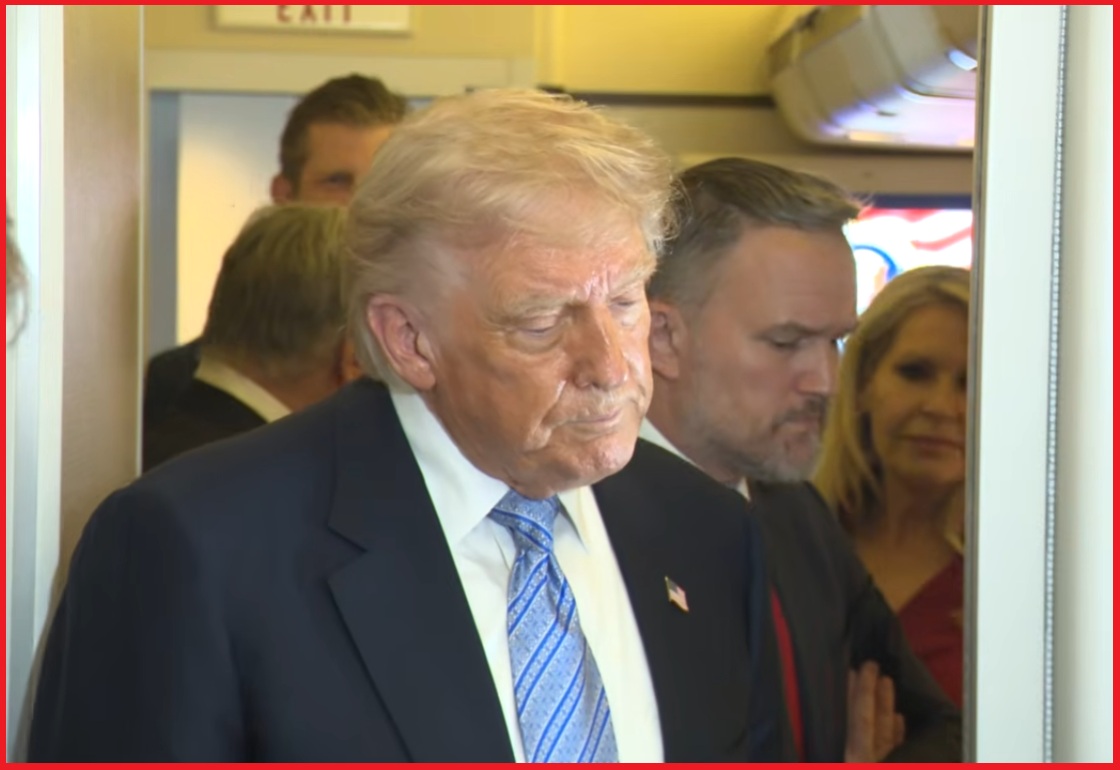
President Trump holds an impromptu press conference aboard Air Force One as he returns from Beijing, China and a historic visit with Chinese Chairman Xi Jinping. WATCH:
.
China/Taiwan is a sensitive issue, particularly when we consider the current U.S/Cuba dynamic.
Posted in Beijing Summit 2026, China, Donald Trump, Economy, President Trump, Press Secretary - Trump
Was that Hannitus Interruptus photo bombing in the background?
What an insufferable tool!
Did you know he once washed dishes and knows karate?
And was an altar boy.
He went to 12 years of Catholic schools. He knows better. Sister did not smack him enough with her pointer stick.
A dear nun used to tell us, that “you have manners, but they are bad”….
Our Sister didn’t use a pointer stick – she used a draftsmen’s triangular ruler – across the palm.
You remember that.
She was known as
‘Sister Bang-Bang’.
I grew up with one of those things in the house. An unbending, unforgiving weapon.
My dad had one of those rulers. I’d forgotten about it until you mentioned it. Now I’ll have nightmares for a week! 🙂
I went to Catholic School in Brooklyn for 8 years and was an altar boy, too, but I always had very good manners! 😎
And worked construction. He’s just a salt of the earth regular working guy.
Or so he says.
Michael Savage calls Vannity Wallbanger.
And, boy howdy, does he love the FBI. He had relatives there that he idolized.
“The Honorable Rank and File.”
That ridiculous phrase should be trademarked by Hannitus and the UniParty.
And all their children are above average.
Yes “…and thuh HMMENH and HWIMMEN of the FBI”
He was a carpenter and fell off a roof too!
On his Head
That explains a lot.
Boy, I’m late on this reply. I couldn’t watch the video because of Hannity. moving into camera range. Disgusting.
🤣🤣🤣🤣
…. and busted his teeth!
If only he’d bitten his tongue off…
and he’s a “marksman”
With a Henry Reaping Arms
That man. His voice alone keeps me from listening to him. That little whistle after each word just… really bugs me.
Too bad he doesn’t know when top keep his yap shut and let the guest talk….
and his father was a mail man? Oops, wrong RINO.
…also a roofer…
Dear Lord, Praise and Thanks to you for your guidance and protection of President Trump and his group during this trip. Please see everyone safely home. In Jesus name we pray. Amen
Let me stop you right there.
😂😂😂
The jokes just write themselves don’t they 😂
Yep
That smell of self importance will be back in the air here shortly.
Luckily the wind has been from the east (ocean) lately, I think BS is good fertilizer, we’ll see how the crops in Belle Glade and Pahokee respond.
<The jokes just write themselves don’t they 🙂 >
Not always…
He was a great tennis player. Could have gone pro.
Bet he looked great in that little skirt
Hannity likes little skirts.
Bruce Gordon, that’s what I said when I saw the video, “Is that Hannity?” WTH.
Tik, tok, who gonna tik, tok?
Tool or fool?
I honestly don’t know much about the Taiwan situation, I’m not informed so I hate to make a suggestion, but,
If we expect to exert our authority here in the Western Hemosphere (Cuba, Venezuela, South America) without interference from China or Russia, how can on the other hand we get involved in Ukraine and Taiwan? I think common sense tells me Trump will have to make a decision one for the other.
We aren’t trying to take over and absorb Cuba, and we’ve never declared the island a part of our republic. Same with Venezuela, Trump’s 51st state memes aside. Taiwan’s government hasn’t run the country, and their economy, into the ground. The intention is to restore some level of dignity to their respective countries and their citizens, while inviting them to participate in an economy of their choosing…not one that is forced upon them. Don’t think that the boot heel of the CCP won’t come pressing hard on the neck of the people of Taiwan should Xi and the CCP roll through the island.
The End of Taiwan for a long time Is what would happen.
The US did take Cuba from Spain in the Spanish American war and governed it as a territory for a while. When we gave Cuba its independence we inserted a clause in its constitution (The Platt Amendment) that granted the US access to a number of bases and the right to intervene in Cuban affairs. That’s how we got Guantanamo Bay.
BTW Taiwan was only considered to be a province of China for about one ten-year span, from 1885 until the island was ceded to Japan in 1895. For most of history, Taiwan was always an independent kingdom with its own culture, language and demographics different from the mainland.
Having key computer chips etc and rare earths needed from China is the result of inept past players or traitorous ones.
The chips are in Taiwan, and their electronics has made them exceedingly prosperous, and a target of China’s greed.
Greed maybe. Just the need to control everything is most likely.. The CCP keeps harrassing the Philippines and they have no Chips to sell.
100% true.
I expect that as soon as Taiwan Semiconductor shifts enough know-how and capability to the new facilities in Arizona, they will have to contend with China with more support from Asian neighbors like S Korea and Japan and less from the USA.
Taiwan Semiconductor Manufacturing Corporation (TMSC) building and operating a fab in Arizona is a smart move.
It diversifies their supply chains and makes them more resilient as the helium shortage in East Asia from the conflict in Iran has shown. TMSC can locally source helium for their Arizona fab from US production.
It also puts some of their production closer to some of their biggest US industrial customers saving on transportation costs.
Unfortunately, the AZ production gets shipped to Taiwan for finishing. still, it’s good to do the work in AZ.
TSMC facilities it Taiwan are rigged to be instantly scuttled in the event of an invasion
Agree. However, the U.S. does provide arms to Taiwan and is legally committed to maintaining the capability to resist force against Taiwan.
Intel, AMD, Micron, Samsung, and others are in Taiwan, and they all have fabs in the US or South Korea.
Forget Ukraine. That is a lengthy, involved topic that Sundance has discussed in depth many times.
Let’s talk Taiwan. It was known as Formosa back in the day that Chairman Mao was fighting the Nationalist Chinese Chinese government. When Mao and his murderous Red Army defeated the Nationalist government whose head was Chiang Kai-Shek, an ardent anti-Communist, he fled to Formosa and relocated the Nationalist government to that island.
Chiang Kai-shek had a multi-faceted and storied life well before his fighting Mao and the communists which deserves more time than I will give it. During the Sino-Japanese War, the Allies (the US) fought the Japanese who were murdering tens of thousands of Chinese. It was at this time that he became and ally of the US.
After fleeing to Formosa, now Taiwan, and setting up the Nationalist government again he and his government received promises of security from the threat of the Communist main land. The US and Taiwan have had a mutually beneficial relationship for more than seventy years. For decades, the motherboards of most computer manufacturers were made in Taiwan, and now the top four chip manufacturers are there though motherboards moved to China by companies looking for cheaper labor.
Time and again the US has promised to defend Taiwan and the Formosa Straight against the mainland communists. The Straight is a busy trade route on the east coast of China between the two countries with Japan and the Philippines on either end. It is a strategic position worth defending from the heavy arm of China.
That is an exceedingly abbreviated history of Formosa/Taiwan and Chiang Kai-shek.
Our promise to defend Taiwan extends to the supply of arms. Not physical participation or intervention. See: Taiwan Relations Act (TRA).
Very true, and I wasn’t suggesting such, but understand how that could be assumed. Thanks for pointing that out.
A pact more honourably sustained than the one the UK had with Hong Kong, handed over to the Chinese with great hand washing ceremony.
Promises were made by both countries, promises abjectedly swept aside by both.
Taiwan/Formosa was no doubt paying very close attention.
If it were the United Kingdom which Taiwan had trusted with their safety, independence, and sovereignty, it would now be under the rule of China and all which that means.
I can’t help but draw comparisons.
Hong Kong showed the way 💀
The loss of free Hong Kong was a travesty. I knew many businessmen who visited for suits with expert tailoring at good prices. China killed the golden goose, and now they’re hoping we back away from another.
We knew as we watched the handover that night that it was a gross, unforgivable betrayal. And that promises made would turn to “promises” abandoned.
Felt the same on the night Europe celebrated its legally binding (no get out clauses) union.
And so it was…
“It is the immediate task of China to regain all our lost territories, not merely to defend our sovereignty below the Great Wall. This means that Manchuria must be regained. We do not, however, include Korea, formerly a Chinese colony, but when we have re-established the independence of the lost territories of China, and if the Koreans wish to break away from the chains of Japanese imperialism, we will extend them our enthusiastic help in their struggle for independence. The same things applies to Formosa.” (Mao Zedong, in a 1936 interview.)
Communist China did not become interested in Taiwan (Formosa) until after Chiang fled there with the remnants of his Nationalist army.
Boundless energy which comes from the deep, abiding love of America and Americans.
We hired him, and he never forgets he works for us….for no pay.
I remain agog at his indefatigable endurance.
🇺🇸 🇺🇸 🇺🇸 🇺🇸 🇺🇸
Illinois is suffering, “bigly”.
I still don’t have a doctor via Medicare….I am gonna die before the midterms…!
and then….
Will vote Democrat in Chicagoland.
Will vote Democrat in Chicagoland.
Let’s see…Illinois and Chicago pretty good odds you already do. /s not /s
ARE there Republican candidates in Chicago? Hah!
Have friends that have Aetna policies, they were just informed that as of June 1 they will not be covered in Martin and St Lucie counties as in network. Have to go to Palm Beach hospitals that are 3rd world staffed.
Can’t change plans until end of year then goes into effect Jan 1. To say they are unhappy is really putting nice.
They are forcing people to get healthy.
Sadly, we just changed from Aetna to Humana. Hard to get honest answers to questions , and then find out the reps mostly lie. Am realizing that it seems almost everyone lies!!! Frustrating. First 20 minutes seem to get taken up by AI, then transferred to out of country reps. Aetna reps were better than Humana. We are down in Collier county. Not as bad down here.
Pray and help others.
.
Don’t you dare, sis!!!!!
If you’re voting in Chicago chances are you’re already dead!
I both smile and weep at the gift we’ve been given.
Because every day with President Trump and the First Lady is an incredible blessing for this Republic and those of us who desperately wish to preserve it against the treachery and hideous forces which continue to work to destroy it..both reprehensible parties…I make what I call “mental cocktails” to sip in the years after.
He has set a patriotic template to follow for presidents who come after him.
He is a magnificent “One Of”…
And I am certain there isn’t a resident of this unique Tree who isn’t grateful.
Something we now take for granted with Trump, but has never been the case before, especially with Biden but also others…..is Trump making himself available for regular, frequent “Open/Unscripted In-Depth Press Conferences”! It seems normal, even expected now, but this has never been the case with other politicians. And especially not @ the open, straight, direct level of communication Trump gives and provides. Whether formal or informal, he needs no handlers or script.
From his first day in office Trump has always provided access and made himself available, with ample time, for questions/answers/explanations to the press & public. And he often takes even more questions from “enemy media, journalists”.
It’s unprecedented and is unique with Trump. It’s up front, honest and actually normal (the way it should be always) and is what people want! Trump is setting a bar or standard, which no other leaders will ever be able to meet, but will hopefully condition the public to now “expect” and demand this from Presidents/Political Leaders going forward!
3D chess… no one is better than Trump in world diplomacy!
This goes without saying, however when you just sit back & listen to these pressers, PDJT has a very keen understanding & knowledge of everything that is going on. It’s absolutely astonishing & baffling to hear media talking heads & politico’s publicly declare, with a straight face, that he needs to be removed from office for mental incapacity to hold the office?! These people are absolute nut jobs with deeply rooted psychological issues!
We have a president who’s really on top of his game!
Psychological issues or evil liars?
Can they be both?
ABSOLUTELY, they’re not mutually exclusive.
Formosa is a historical Western name for the island of Taiwan (meaning “Beautiful Island” in Portuguese), not a modern sovereign country. It was widely used in European languages from the 16th century onward and persisted into the mid-20th century, especially in English-speaking contexts. Today, the island is governed by the Republic of China (ROC), commonly known as Taiwan. 
Early History and Indigenous Peoples
Taiwan’s indigenous Austronesian peoples have inhabited the island for thousands of years, with distinct languages, cultures, and tribal societies. Archaeological evidence shows human presence dating back tens of thousands of years. Limited contact with mainland China occurred over centuries (e.g., Chinese fishermen and traders visited, and there were references in Chinese records as early as the 6th–12th centuries), but large-scale Han Chinese settlement was limited until later periods. 
European Contact and Colonial Period (16th–17th Centuries)
• In 1544 (or around 1542–1517 in some accounts), Portuguese sailors sighted the island and named it Ilha Formosa (“Beautiful Island”) on their maps. They did not colonize it. 
• Dutch Formosa (1624–1662): The Dutch East India Company established a base in southern Taiwan (Fort Zeelandia in modern Tainan), using it as a trading post. They encouraged Chinese immigration for agriculture and clashed with indigenous groups and Spanish settlers. 
• Spanish Formosa (1626–1642): The Spanish established a presence in northern Taiwan (around Keelung) to counter the Dutch but were driven out. 
In 1662, the Ming loyalist Zheng Chenggong (Koxinga) defeated the Dutch and established the Kingdom of Tungning (or Kingdom of Formosa), a short-lived base for anti-Qing resistance. It fell to Qing forces in 1683. 
Qing Dynasty Rule (1683–1895)
Taiwan became a prefecture and later a province of Qing China. Han Chinese immigration increased significantly, leading to sinicization, agricultural development (especially rice and sugar), and conflicts with indigenous peoples. It remained a frontier region with periods of unrest. 
Japanese Rule (1895–1945)
After defeating China in the First Sino-Japanese War, Japan acquired Taiwan via the Treaty of Shimonoseki (1895). In response, local leaders (including Qing officials who stayed behind) declared the short-lived Republic of Formosa on May 23, 1895—the first republic in Asia. It was unrecognized internationally and lasted only about 151 days until Japanese forces occupied the island by late October 1895. 
Japan modernized Taiwan as a colony: infrastructure, education, industry (sugar, camphor, rice), and public health improved, raising living standards, though under authoritarian rule with cultural assimilation policies. Taiwan served as a base for further Japanese expansion. 
Post-WWII and Republic of China Era (1945–Present)
• Japan surrendered in 1945; Taiwan was returned to the Republic of China (then under the Kuomintang/KMT) per Allied agreements like the Cairo Declaration. 
• The Chinese Civil War led to the KMT’s defeat on the mainland. In 1949, Chiang Kai-shek’s government retreated to Taiwan, which became the base for the ROC. Martial law was imposed (the “White Terror” period), and the island industrialized rapidly.
• Democratization accelerated in the late 20th century. Taiwan (ROC) is now a vibrant democracy with a high-tech economy, though its international status remains disputed due to the People’s Republic of China’s (PRC) claims. 
Summary Timeline
• Pre-1624: Indigenous societies; limited external contact.
• 1624–1662: Dutch (and brief Spanish) colonial outposts.
• 1662–1683: Kingdom of Tungning.
• 1683–1895: Qing rule.
• 1895: Brief Republic of Formosa.
• 1895–1945: Japanese colonial rule.
• 1945–present: Under ROC control; transition to democracy and economic powerhouse.
The name “Formosa” evokes Taiwan’s scenic beauty and colonial past but is less commonly used today in favor of “Taiwan.” There has never been a long-standing independent country called Formosa beyond the 1895 episode. For deeper reading, sources like the Wikipedia pages on the History of Taiwan and the Republic of Formosa provide detailed accounts.
I would like to note, that Taiwan (as the Republic of China) was seated in the United Nations until 1971, when it was ousted in favor of the PRC (People’s Republic of China).
What a difference! Now I get the news directly from Our President.
Who is the reporter the President calls David and regularly calls “Fake News?” Sounds like he’s NY Times.
He is NYT. It was so funny watching him denigrate him right to his face over and over, dead on straight face. Comedy gold! 😂President Trump is an absolute national treasure. ❤️🇺🇸
PDJT to “media hack”…
Note that this is the second time he’s used the “this was an amazing period of time” line. He did it yesterday in China. Not “we had a great day together” or “it’s been an amazing 24 hours”. Instead, an amazing period of time. He seems to be referring to a much longer time than just the trip, and seems quite satisfied with it. If you wonder whether the China trip was the cap on this period of time…note that while in China he said “has been an amazing”, and here on the plane back said “was an amazing”.
Always revert to his policies instead of words.
I believe his words have meaning. He can’t help himself and drops hints everywhere. But he’s cultivated a mistrust in his words so he can slip messages in that are heard by some and dismissed by others as bluffing, chaos, egotism, ignorance, you name it. What I heard yesterday was “It’s in the bag.”
As he’s always hinted…”We’ll see what happens”!
Everything went well. Accommodation, good food, the meetings and then more personal time with Xi at the Temple of Heaven and his private garden.
It was a very successful visit by all accounts
Do these reporters practice looking as if they do not hear a criticism when it is spoken to them a foot away?
I would be mortified if I was often hearing the President tell me I am fake news and telling lies. I think I would feel the need to apologize or respond in some way.
It find it disturbing to see them completely ignore words being said directly to them.
Is ignoring what they may not want to hear taught in journalism training? The MSM is pitiful and do not deserve to have a seat on AF1.
Taiwan, peace with not piece of China.
Good presser. Hit a lot of subjects. President Trump set the tone and, for once, I didn’t hear the screaming of bangees.
Looked to me like every one from President Trump and his group, to President Xi and his group with Chinese staff were having an enjoyable time during President Trump’s visit to China.
“China/Taiwan is a sensitive issue, particularly when we consider the current U.S/Cuba dynamic.”
Sensitive, yes. Differences, substantial.
China wants absolute control over Taiwan
The US wants Cuba to be a free country.
The press is desperate to turn this successful trip into a negative. Just look at their headlines.
Was President Trump drinking alcohol at the banquet? 😱
Kash Patel was snorkeling at Pearl Harbor. 😱
Trump’s polls just passed a historic low. 😱
All these are squirrel headlines and meaningless.
Cheee ina. Great place, great food. Very communist
Great news…. But, IMHO, she should be released TODAY!!!
“Released on parole”….that is so wrong…just release her and be done….
Am wondering what “the conditions of her parole”, are?
Expunge her conviction and charge the Judge. Today
The “judge” should be sent to Siberia for slave-labor in the taiga!
Amen! Why torture the INNOCENT prisoner for another two weeks?
What are they up to?
And …..
https://www.thegatewaypundit.com/2026/05/breaking-supreme-court-denies-virginia-democrats-bid-block/
Dimocrat gerrymander fails.
Linked from our friends at CFP, worth the minute read, at least we are thinking:
https://x.com/Osint613/status/2055326839560679662
So much for ‘trust’….LOL and SARC!
Prayers answered Tina peters is going to be released June 1 thank you Lord for for answering our prayers
As much as President Trump knocked the FAKE NEWS New York Times he acknowledged the NYT reporter as he turned to leave and then shook his hand. 😎
Hannitus Drywallerix Ninetyninepercenticus
Does my President Trump ever sleep?? I am his age & cannot keep up with him. May God Bless you President Trump with good health going forward.
He’s the most accessible president in recent history!
Actually, I’d go out on a limb and state….EVER!
Thanks be to God!
Colorado Gov. Jared Polis commutes sentence of ex-Mesa County Clerk Tina Peters, to be freed in June.
Interesting how Jamieson Greer kept listening intently whenever the questioning focused on Iran.