Bumped and Updated as THE FULL the transcript is now available. Segment #4 of the Transcript is exceptionally interesting!
Reports are beginning to surface about Russian President Vladimir Putin saying the end to the special military operation in Ukraine is close. I am embedding the full press conference video below as only part of his remarks has been translated and transcribed.
President Putin is asked for his overall impressions of the Victory Day events, and the context of the ceasefire against the backdrop of a request by U.S. President Donald Trump. As with most things Russian, the nuance is often between the lines.
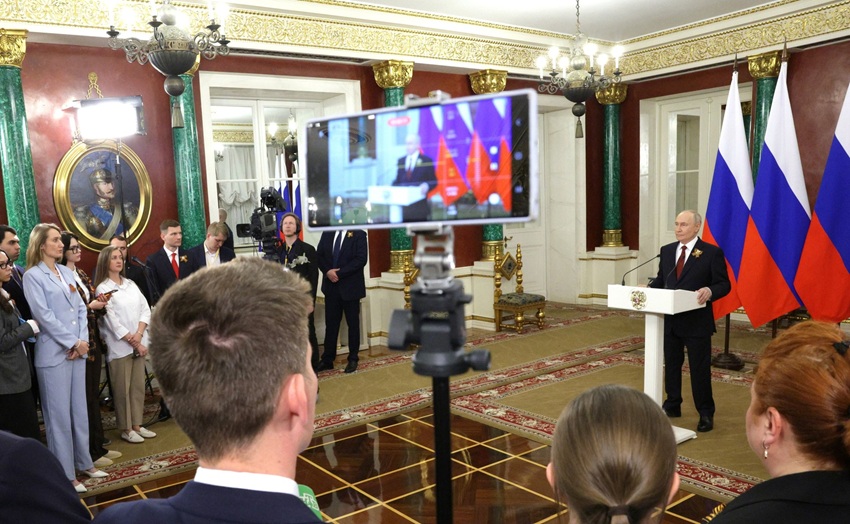
[RU Transcript] – “President of Russia Vladimir Putin: Good evening. Happy holiday once again, happy Victory Day.
Question: Let me start with today and the way you view it, if I may. Today is a great and momentous day. Earlier, US President Donald Trump came up with an initiative to declare a three-day ceasefire. You supported it, so did Zelensky. However, on the eve of May 9, there were still a number of grave and provocative statements coming from Kiev.
How would you assess today and the way events unfolded? Even the military parade was held in a somewhat reduced format due to security concerns. Could you share your overall assessment of the day? Were there any provocations?
Vladimir Putin: As for provocations, as you can see, I am here, and so far, the Defence Ministry has not reported anything of that nature to me, so I cannot comment on it.
Regarding the parade. You know that this year – which is not an anniversary year but nevertheless it is Victory Day – we decided that the celebrations would go ahead in any case but without a display of military hardware, and not for security concerns but primarily because the Armed Forces should focus on the decisive defeat of the enemy within the framework of the special military operation.”
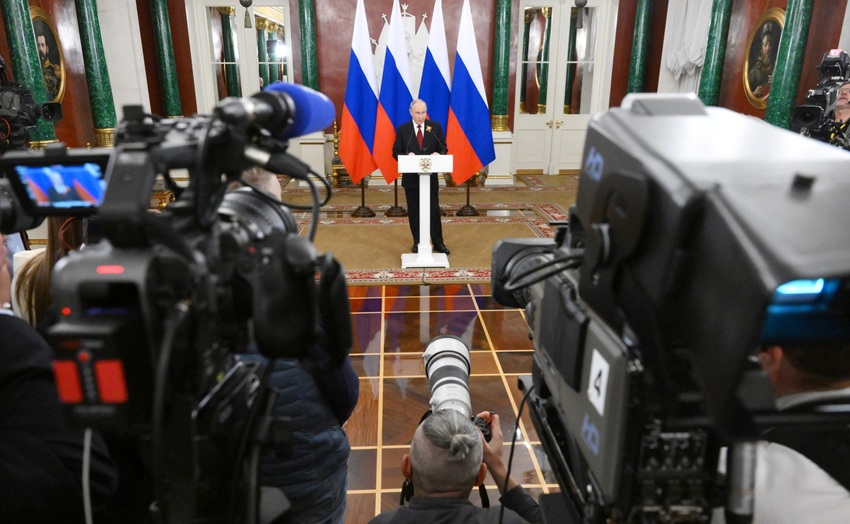
“As for the provocative statements, all of those decisions had been made much earlier than all those provocative statements were issued, as you said.
As for the statements, we have responded to them, as you know. The Defence Ministry issued a certain initial statement – it is well known – that in case an attempt were made to disrupt our celebration events, we will respond with massive missile strikes on Kiev. Was there anything unclear about it? This is what was intended to be a response.
We did not limit ourselves to it. It was followed by a Foreign Ministry’s note, which is an official document, not just a declaration. But we did not stop there. We started working with our major partners and friends, primarily with our friends from the People’s Republic of China, India and some other nations, including with the US administration. What did this work involve? We simply presented our friends, colleagues, and partners with a picture of what the situation could develop into. We have no desire to worsen or damage relations with anyone. Such a situation could arise given that all the command and decision-making centres in Kiev are located in close proximity to the diplomatic missions of a number of countries – several dozen, in fact. That is precisely the issue. When we began this dialogue with the US administration, we drew their attention to this matter, outlined the potential consequences, and asked them to do everything necessary to ensure the security of their country’s diplomatic mission.
As a result of all these discussions, US President Donald Trump proposed an additional two-day ceasefire and a prisoner exchange during that period.
We immediately agreed to this proposal, particularly because, in my view, it was fully justified, motivated by respect for our shared victory over Nazism, and clearly humanitarian in nature.
By the way, a few days earlier, on May 5, we had also submitted a proposal for a prisoner exchange to the Ukrainian side and provided a list of 500 Ukrainian servicemen held in Russia. The initial response was that they needed to review the proposal more carefully – perhaps not all 500, but maybe 200 – and after that they effectively disappeared from contact and later stated directly that they were not prepared for such an exchange. They did not want it.
Therefore, when the proposal from US President Donald Trump was put forward, we, of course, immediately supported it. We hope that, in this case, the Ukrainian side will ultimately respond positively to the proposal of the US President. Unfortunately, so far, we have not received any response.”
SEGMENT 2
Alexei Konopko: Good afternoon. May name is Alexei Konopko, Rossiya Channel.
Mr President, you have held a veritable marathon of bilateral meetings. Can you tell us about the main issue addressed during these talks?
If I may, I would like to ask an additional question on a related subject.
Vladimir Putin: Go ahead.
Alexei Konopko: We often saw representatives of one more former Soviet republic, Armenia, at our Victory parades. They have not come this year. But several days ago, Pashinyan met with Zelensky, who used that opportunity to make threats towards Russia.
What is your attitude to this? How can relations with Yerevan develop?
Thank you very much.
Vladimir Putin: Speaking about my bilateral meetings and what they focused on, the main issue for Russia and for other countries, in this case, friendly countries, as we say, whose representatives have come to Moscow for celebration events, was Victory Day. Our conversations focused on it, on the common result we achieved in the fight against Nazism, on ways to perpetuate the memory of heroes of the Great Patriotic War and World War II, and on using this memory as the foundation for efforts to prevent a repetition of these events in the future.
Of course, we also discussed bilateral relations. Of primary importance are certainly our relations with our closest allies and partners – Belarus, Kazakhstan and Uzbekistan.
Our trade with Belarus is more than $50 billion. Isn’t this an impressive figure for a country with barely 10 million of population? There is a great deal we have to discuss; there are really many issues of mutual concern.
This is also true about Kazakhstan and Uzbekistan, which are rapidly developing economies. We have solid plans, including in investment. We have common interests with Kazakhstan in the framework of the EAEU. We also have common interests with the countries whose representatives I have held meetings with, for example, Laos. It is an important partner. Our mutual trade in US dollars is very modest, but the outlook is good, and the country is advantageously located. ASEAN is an important region for us.
There were issues to discuss in each particular case, and the talks were substantive and pragmatic.
As for the plans of Armenia and the Armenian authorities, you know that we have not specially invited anyone because this is not a jubilee. But we forwarded information to all countries saying that we would be glad if they will come, that we do not shut our door to anyone. No official invitations have been sent out, and so not only Armenia but also many other countries that are our good neighbours, partners and friends have not been represented here today. I do not regard this as anything strange.
However, those who have come here have demonstrated a degree of personal courage, because they only learned about certain arrangements, including President Trump’s initiative to extend the ceasefire period, exchange prisoners, and so on, they only learned about a certain easing of tensions after they have come here. They did not know about them before, yet they decided to be here with us, which deserves special respect. However, I would like to repeat that we do not regard the absence of other people as strange.
As for Armenia’s plans to join the EU, this certainly requires special consideration. We discussed it with Prime Minister Nikol Pashinyan on several occasions, and do not see anything strange about it. Actually, he can confirm that I have told him several times, and can repeat this in public now, that we will support everything that will benefit the Armenian people. We maintained special relations with the Armenian people for centuries. And if the Armenian people consider any decision as beneficial, we will certainly have nothing to say against it.
However, of course, we should keep in mind some circumstances that are important both for us and for our partners. What does this mean? For instance, our trade with Armenia has decreased now; it was much bigger last year and the year before last – $7 billion in 2025 was quite good. Given that the country’s GDP is $29 billion, this is a serious amount, and Armenia also enjoys considerable advantages in the EAEU. They concern agriculture, manufacturing, customs and other duties and so on and so forth. They concern migration. And I think it would be right with respect to the people, the Armenian citizens, and to us as its main economic partner, if a decision was made as soon as possible, for instance, at a referendum. This is not our business, but as a matter of principle it would be logical to ask the Armenian citizens what their choice will be. On seeing it we will make the relevant conclusions and take the path of a gentle, intelligent and mutually beneficial divorce.
We are currently living through everything that is happening in respect of Ukraine. And how did it start? It started with Ukraine’s joining or attempting to join the EU. They completed the first stage, only the first stage. Even then we started discussing it, including with the Europeans. We told them: listen, phytosanitary standards are absolutely different in your countries – in the EU – and in Russia. By the way, our phytosanitary standards are much stricter. It is impossible for your products to come to the Russian market via Ukraine. We cannot allow this – at that time we had free borders, a free trade zone with Ukraine – and we will have to close our borders. The same relates to many industrial goods.
Frankly speaking, I was surprised by such a tough, straightforward position on the Europeans’ part. They took a harsh stand: No, no, no on each issue. In the end, the then President Yanukovych read [the association agreement] more carefully, figured it out, and said: No, I am probably not ready for this yet. The reason is that it meant too much damage to the economy of Ukraine. He did not decline to join. He said: I should return to it once again and analyse everything. All this has later led to the state coup, to the Crimean story, to the stand taken by the south-eastern regions of Ukraine, and combat operations. That’s what it’s all led to. It is a serious question.
Therefore, they should not take it to the extreme; they just need to say in a timely manner that they will do this and that. There is nothing strange in it. Everything must be calculated. Both by the Armenian side and our side should do it. While I am answering I think that this issue may well be raised at the next EAEU summit.
Andrei Kolesnikov: Good afternoon. My name is Andrei Kolesnikov, Kommersant.
Vladimir Putin: Good afternoon.
Andrei Kolesnikov: Mr President, you said some time ago that you would announce a ceasefire from May 8.
Vladimir Putin: Yes.
Andrei Kolesnikov: And Zelensky immediately said that he would announce a ceasefire from May 6. You have not said anything to that. Why?
And one more thing. The media wrote that Robert Fico was to convey a message to you from Vladimir Zelensky. Has he conveyed it? Nothing has been said on this score. We don’t know anything. Maybe it is because you still need to force yourself to deal with Vladimir Zelensky?
Thank you.
Vladimir Putin: First, about the ceasefire. The issue of May 9 celebrations was raised during my latest telephone conversation with US President Trump. Incidentally, I think he spoke very well about that. He recalled our alliance in the fight against Nazism.
I told him about my plans to declare a ceasefire on May 8 and 9. Why May 8? Because victory is celebrated in Europe on May 8, and Ukraine has accepted this too, and I think that they now celebrate Victory Day on May 8.
But this is not important. What matters is that President Trump actively supported that initiative, which we made public a day later. However, our announcement has not produced any reaction. A day or two later, when Kiev considered the matter and saw that the US Administration supported our idea, they saw fit to react to it. How could they react? They probably deemed it unprofitable to simply accepting our initiative, and that is why they advanced their own idea, a ceasefire starting May 6.
You know that May 9 is not a comedy show combined with piano playing for us in Russia. It is a sacred day for us because every family has suffered. The Russian Federation has lost about 70 percent out of the 27 million lives laid on the altar of Victory in the Soviet Union. According to post-war documents, the Russian Federation lost nearly 70 percent or more precisely more than 69 percent.
How many lives has Russia lost if the total number is 27 million? Nearly 19 million lives. Of course, this is an event that concerns every citizen of the Russian Federation, every family. We are not playing games here.
We made our proposal, and there was no reaction for two days. And then they suddenly started playing games. We don’t play such games.
However, since the US President later proposed a prisoner swap, which we also suggested doing on May 5 – you can ask [FSB Director Alexander] Bortnikov, who won’t conceal that we sent a list of 500 names – we welcomed the idea and were ready to implement it. And we did so. We extended the ceasefire for two days hoping to exchange prisoners. I hope that we will ultimately do it.
What was the second part of the question about?
Andrei Kolesnikov: It is about the message.
Vladimir Putin: Yes, Mr Fico told me about it; he told me about his meeting. Actually, there was no special message, I just heard once again that the Ukrainian side, Mr Zelensky, is ready to hold a personal meeting. Yes, I’ve heard it. But this is not the first time that we hear it.
What can I say in this regard? That we have never refused, and I have not refused to hold it. I do not propose this meeting, but if someone does, we are ready for it. Let the one who proposes arrive. Let him come in Moscow, and we will meet.
We could meet in a third country, but only after reaching final understandings on a peace agreement, which should be designed for a long historical perspective, so that a meeting is held to sign it. However, it should be the final point, not negotiations themselves because we know what negotiations themselves are.
I was personally closely involved in this process in Minsk during the drafting of the Minsk agreements. You can talk for hours, endlessly, day and night, and all to no avail. Professionals should work everything out, doing everything to make the documents clear to both sides and coordinate all aspects of these understandings. In this case we can meet anywhere either to put the signature or to attend the signing.
Alexander Yunashev: May I ask for more details about Ukraine?
Vladimir Putin: You are welcome.
Alexander Yunashev: Alexander Yunashev, Live.
Good afternoon, Mr President. Happy holiday.
Vladimir Putin: Good evening.
Alexander Yunashev: In view of what you have said about negotiations, what do you think, in general, about continuing to work with the Americans on the settlement of the Ukraine conflict? The pause has been protracted; the last round of talks took place in winter. Given that Rubio said that maybe it is not worth investing time in it at all.
Vladimir Putin: Listen, this primarily concerns Russia and Ukraine. If someone wants to help us and is doing so, and we can see that the current US Administration and the US President are sincerely, I want to emphasise it, seeking a settlement – they obviously have no need for this conflict, and have many other priorities – then we can only be thankful to them. However, this is, above all, a matter for Russia and Ukraine.
Pavel Zarubin: Good evening. Pavel Zarubin, Rossiya Channel.
The developments around Iran have been the hottest international topic for the past two and a half months, of course. How will the situation in the Middle East, in the Persian Gulf will develop? Do you think there is a real possibility of a peace agreement between the United States and Iran?
I also can’t help but ask this question. You have recently said that the terrorist threat is growing, meaning the Kiev regime. We can see that such strikes are targeting cities located far away from the border, such as Yekaterinburg, Perm, and recently, Cheboksary. Is the West going too far? The West has admitted that the Kiev regime would not have survived several days without its support,
Thank you.
Vladimir Putin: What exactly is the West? I believe that it is the so-called globalist part of the Western elites. It is them who are fighting against us by proxy of Ukraine. They have it pretty good in this respect, of course, having provoked this conflict. I have already spoke about how it all started. I have not invented anything about the initial reference point. Strangely, it all began with Ukraine’s decision to join the EU. They could go ahead by all means, but this has led to a military conflict. Why has this happened? Because they had no regard for Russia’s interests whatsoever.
Moreover, seeking to use Ukraine as an instrument for attaining their geopolitical goals, these people in the West lied to everyone, as they have now openly admitted. They started to lie to us about the non-expansion of NATO to the east at the beginning of the 1990s. They told us that NATO would not move a single step eastward. Well, where are they now?
Taken together, all this has provoked the current situation. They are fighting against us, which has become clear to everyone, by proxy of Ukraine.
We have recently discussed this issue with our colleagues, remembering how it all started. We concluded an agreement with the Ukrainians and initialled it in Istanbul in 2022. And then one of my colleagues – frankly, it was Macron who did it – called me and said, “Ukraine cannot sign such documents with a gun to its head.” This is a direct quote; we have the tape of that conversation. I asked him, “What should we do?” He said, “Can you withdraw troops from Kiev?” We have done it. One member of the show business popped up, the then Prime Minister of Britain. What did he say? He said that the agreement cannot be signed because it is unfair. Who says what is fair and what is not? Why is it unfair if the head of the Ukrainian negotiating team has initialled the document? Who is the judge? Next, they promised assistance [to Ukraine] and started fostering confrontation with Russia, which is continuing to this day. I believe that the matter is coming to an end, but this is really a serious matter.
The question is why they are doing this. First, they expected a “crushing defeat” of Russia, as we know, the collapse of Russian statehood within a matter of several months. It did not work out. And then they got stuck in that groove, and now they cannot get out of it. That’s the problem. There are certainly clever people over there, those who certainly understand the essence of the current events. I hope that these political forces will gradually return to power or will take power into their own hands with support from the overwhelming majority of European countries.”
Regarding relations between Iran and the United States, this is a highly difficult and complex conflict. It places us in a sensitive position because we maintain good relations with Iran and, without exaggeration, friendly relations with the countries of the Persian Gulf. We remain in contact with all sides and hope this confrontation can be brought to an end as quickly as possible.
In my view, there are no longer many actors interested in prolonging this conflict. Of course, we understand that any agreements must take into account the interests of all nations and states in the region. There are different options, and while I would prefer not to discuss specific scenarios as we see them now, it is possible to imagine what form they can take and that they can be reached.
By contrast, if the situation continues to escalate into a higher level of confrontation, everyone stands to lose.
Segment 3
Rossina Bodrova: Happy Victory Day! Rossina Bodrova, Zvezda TV Channel.
Mr President, we know there is a “coalition of the willing” supporting Kiev and Ukraine, but recently there also seems to be a growing – or perhaps re-emerging – “coalition of the willing” interested in restoring contacts with Russia. The President of the European Council mentioned this yesterday, adding that they are looking for an ideal candidate to represent Europe in such contacts.
Question: Who would you personally prefer for negotiations? Do you think there are still pragmatic politicians left in Western Europe with whom dialogue is possible?
Vladimir Putin: Personally, I would prefer former German Chancellor Gerhard Schroeder. Otherwise, Europeans should choose a leader they trust, someone who has not badmouthed Russia. We have never closed the door to negotiations. It was not Russia that refused dialogue; it was our counterparts.
Anna Kurbatova: Good afternoon, Mr President. Anna Kurbatova, Channel One.
It is a difficult question, if I may, about what we are seeing now.
Vladimir Putin: Is it really necessary to ask a difficult question? Today is a holiday.
Anna Kurbatova: The skies over the Baltic region are now becoming a corridor for Ukrainian drones. The drones used in strikes against Russia are assembled in factories within the European Union. The Russian Ministry of Defence has even published locations and details. What does Russia intend to do with this information?
And another point – this question has already been asked, but I would like to elaborate: Russia has been expanding a security buffer zone in border regions, but drones continue to strike deeper inside Russia, including places such as Perm, the Leningrad Region, and Tuapse. Does this mean the security zone may need to expand further? Maybe to the western borders of Ukraine, where…
Vladimir Putin: You have answered your own question. Our objective is to ensure that no one can threaten Russia. That is what we will continue to pursue.
We know that Ukraine receives technology from Europe and that some systems are assembled there. They are playing for the upper hand, but judging by what has just been said, they are already seeking contacts with us, realising that this play for the upper hand could be costly.
Please go ahead.
Hassan Nassr: Thank you very much. Hassan Nassr, RT Arabic.
Mr President, I would like to return to the issue of the developments in the Persian Gulf. One of the strict demands the United States continues to insist upon is the removal of highly enriched uranium.
Russia previously offered its own territory as a site for that transfer, but the United States keeps rejecting the proposal. At the same time, Iran has stated that it wants to retain the uranium. Under these circumstances, what solution do you see to this deadlock?
Vladimir Putin: You know, I will let you in on something, although it is not much of a secret really.
Not only did we make such an offer; we already implemented it once before, back in 2015. Iran has complete trust in us, and not without reason. First, we have never violated any agreements, and second, we continue to cooperate with Iran on peaceful nuclear energy programmes. We built the Bushehr [nuclear power plant], which is now operational, and we are carrying on with our work there. Our cooperation in the field of peaceful nuclear energy continues regardless of the current developments. So, we already carried out this arrangement in 2015, and it became the foundation for the agreement reached between Iran and all the interested parties, playing a highly constructive role. We therefore have practical experience in this matter, and as I have already mentioned, we remain ready to do it again.
At the outset – and this is somewhat sensitive information – everyone agreed to the idea: representatives of the United States agreed, as did Iran and Israel. However, later the United States toughened its stance, insisting that the materials be transferred exclusively to its territory. In response, Iran also hardened its own position. Mr Ali Larijani visited [Russia]. Sadly, he has since passed away, which is a great loss. He was someone with whom it was possible to have a constructive dialogue; he listened carefully, and responded thoughtfully. So back then, he arrived and said: “You know, we have revised our position as well. We are no longer prepared to export this enriched uranium anywhere. Instead, we are proposing a new format of cooperation with Russia – establishing a joint venture on the Iranian territory and jointly diluting the uranium there.” I replied: “Okay, that is acceptable to us. The most important thing is reducing tensions.” But I also said that I doubted anyone else – neither the United States nor Israel – would agree to such a proposal. And that is what happened. Frankly speaking, the situation in this area has now reached an impasse.
Our proposals remain on the table, and I believe they are reasonable. Why? First, if everyone agrees to them, Iran could feel fully confident that the materials will be transferred to a friendly country – one that cooperates with Iran and intends to continue cooperating in the peaceful use of nuclear energy. Iran has repeatedly stated that it has no ambitions related to nuclear weapons or other military nuclear programmes. There is also the fatwa issued by the previous Iranian supreme leader, and we have heard repeated public statements on this matter. Moreover, the IAEA has never stated that it possesses evidence showing Iran is pursuing nuclear weapons. At the same time, I believe the other participants in the process could also be interested in such a solution and find it acceptable.
First, everyone would know exactly what materials exist, in what quantity, and where they are located. Second, everything would remain under IAEA supervision. And finally, the process of diluting the uranium would also take place under IAEA oversight, in a transparent and safe manner. For our part, we do not need anything from this. At the same time, we don’t need anything merely to, excuse the expression, flex political muscle and claim that nothing can be done without us. We simply want to make our fair share of contribution acceptable to all sides toward easing tensions.
And if this proposal does not suit everyone, then so be it. In any case, we will support any arrangement or solution that helps break the deadlock and opens the path toward a peaceful settlement. I also believe there are still nuances and areas where compromise is possible, although I will not go into those details right now.
Segment 4
Lyudmila Aleksandrova: Lyudmila Aleksandrova, Moskovsky Komsomolets.
As is known, extensive preparations are underway for your upcoming visit to China, and a meeting between President Trump and President Xi Jinping is also expected. Is there any connection between these diplomatic contacts? And, if I may ask, what key issues would you like to discuss with Xi Jinping?
Vladimir Putin: “There is no secrecy here.
First, we constantly emphasise that cooperation between Russia and China is an essential factor stabilising international relations today. We now have very few remaining agreements regulating international security, disarmament, and nuclear arms control. In this context, cooperation between countries such as Russia and China serves as an important factor in deterrence and strategic stability.
Second, China is our largest trade and economic partner. Bilateral trade exceeds $140 billion – which is an impressive result – and continues to grow.
Third, this trade is increasingly diversified, particularly through cooperation in high-technology sectors. I would like to express my gratitude to the leadership of the People’s Republic of China – and personally to President Xi Jinping, whom I have every reason to call my friend – for supporting this diversification into advanced technologies. I see and feel this support directly.
We also have major areas of cooperation in energy, including nuclear energy. We continue our joint work in China to construct nuclear power facilities. There are also opportunities for cooperation in alternative energy, an area in which China has achieved major progress. In addition, our cooperation extends to space and traditional energy resources such as hydrocarbons, both oil and gas. I will not go into details at this stage, but I can say that we are very close to agreement on taking a highly significant step forward in oil and gas cooperation. I will not get ahead of myself on these matters; according to reports from my colleagues, most of the key issues have already been coordinated. If we are able to finalise them during the visit, I would be very pleased.
As for continued contacts between the United States and China, we regard them as important and welcome them. This is another factor contributing to global stability. As they are each other’s major trade and economic partners, the nature of their relations has a substantial impact on the global economy. We are following developments closely and hope there will be no illegitimate sanctions or escalating economic tensions between these two states. Stability and constructive engagement between the United States and China can only benefit us.
Anton Zolotnitsky: Anton Zolotnitsky, Izvestiya Multimedia Information Centre.
I would like to go back to the subject of Victory Day. European politicians have put pressure on the leaders who gathered in Moscow and, at large, continue their attempts to revise history by erasing the Soviet Union’s role in the defeat of Nazism.
How do you assess these actions, so to speak? And where do you think they could ultimately lead Europe?
Vladimir Putin: This kind of stupidity could eventually lead them to poverty.
Olga Volkova: Olga Volkova, RIA Novosti.
To follow up on my colleague’s question, I would like to ask about historical memory and its preservation. Why do you think Europe is now so determined to avoid acknowledging the heroism of Soviet soldiers and Soviet fighters? They have even gone so far as to ban St George ribbons.
Given the current sentiment in the West, do you think this trend will intensify? Is there anything Russia can do in response?
Vladimir Putin: The stronger Russia becomes, the sooner all of this will begin to fade. That is the first point.
Second, why is this happening at all? In my view, this is, oddly enough, a form of revanchism on the part of the same globalist Western elites I have mentioned earlier – and I should not even bring them up late in the day.
What do I mean by that? As I have already said – and we all are aware of this – everyone expected Russia to collapse quickly. In their view, within six months everything would have supposedly fallen apart: businesses would have stopped functioning, the banking system would have failed, and millions of people would have lost their livelihoods.
Incidentally, Russia currently has the unemployment rate of 2.2 percent – the lowest among all G20 countries. Yet many believed they would be able to seize something from Russia and grab something, if you’ll excuse the blunt expression.
Why did Finland join NATO? Did we have any territorial disputes with Finland? No. All such issues had long been resolved. Nothing further was needed, and the Finnish leadership was perfectly aware of that. So why did they join NATO? Because they expected everything here to collapse – and they would be quick to snap that up.
Now they are already constructing a border fence along the Sestra River. I could make a certain gesture or comment about it, but since I come from the cultural capital, I will restrain myself. In many ways, I believe what we are witnessing is driven precisely by this type of thinking.
But now people are beginning to understand that the situation is not so simple and that serious challenges have emerged, and those are not easy to overcome. It would be wiser to look for ways to restore normal relations and move toward mutually acceptable agreements.
For our part, we have always tried to build relations with Europe on the basis of mutual respect and consideration of each other’s interests. These are not merely diplomatic clichés – that is genuinely how we approached our relations. Even now, not everyone speaks to Europe in that manner, but we always did. Yet apparently that was not enough.
I hope the understanding that this approach was mistaken is already beginning to emerge and will continue to grow stronger. And I hope that relations will eventually be restored with many of the countries that are currently attempting to denounce us. The sooner that happens, the better it will be for us and, in this case, for the European countries.
Thank you for your time. Happy Victory Day!
First, Ukraine was/is apparently worried that returning prisoners may not be in alliance with Ukraine’s war effort. Second, it appears the diplomatic warning provided by President Putin to President Trump was the impetus for Trump suggesting an extended ceasefire. Third, from the way Putin is describing U.S. and Trump contact, it is reasonable to infer the lines of communication are very open.
[You can use the closed captioning option to review the full remarks if you want to get ahead of the FULL transcript release.]
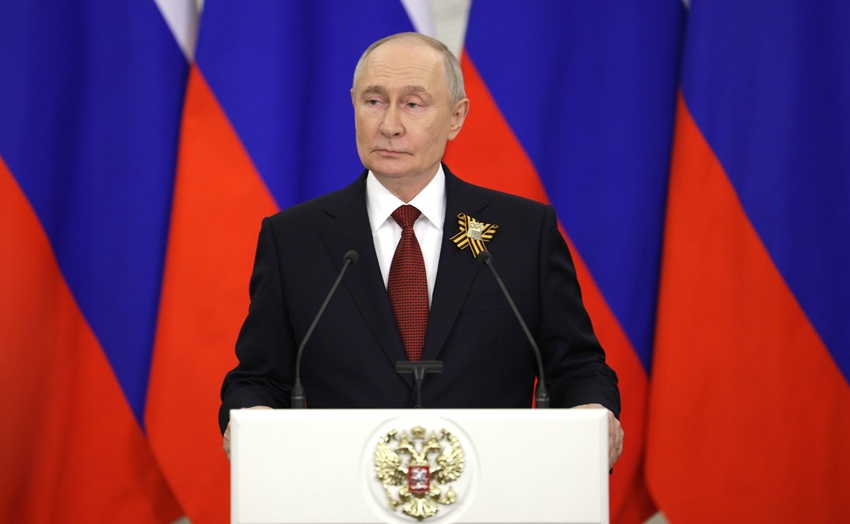
The EU very dangerous now. They will want to do false flag action to keep the war going.
maybe not as dangerous as the would be . britain has imploded on starmer and germany has lost it. france? meh.
It’s time for mighty Switzerland to flex its muscles.
😂
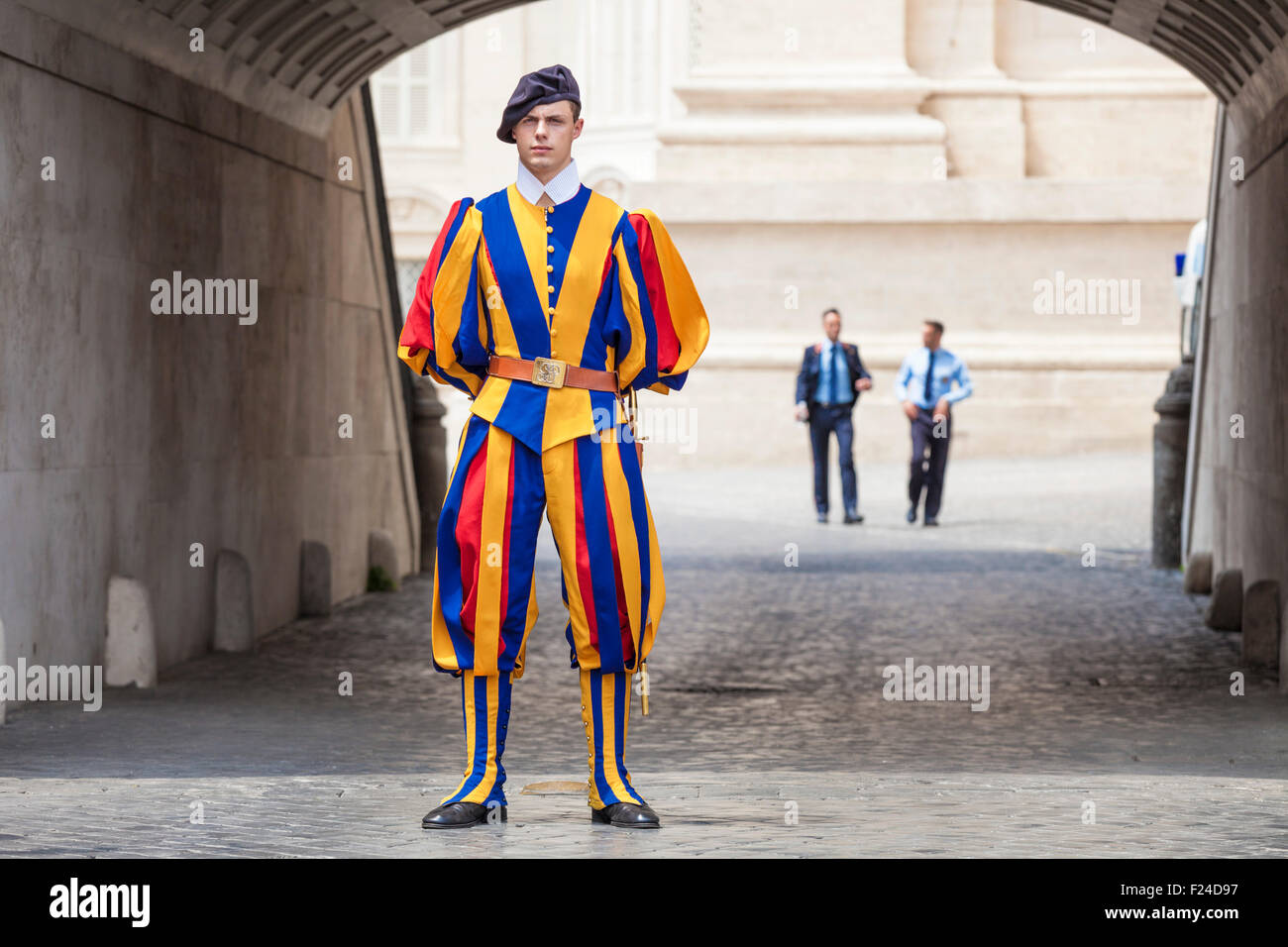
Is that a rodeo clown in Europe?
That “rodeo clown “ has some hidden weapons under those cloaks. Don’t let the look deceive you.
A squirting flower and a rubber horn.
He just getting ready for a little MCHammer
Break down… can’t touch this
Ignoraumus
The squirting flower is a flamethrower and the rubber horn is an LRAD system.
Ignoramus
Ignoramus
Can you imagine looking at that as a little boy and thinking “when I grow up, I want to look just like that!”
You could if you were a devout Catholic. ( you’re just ignorant)
Very nice, JeanMarie. I am Catholic, btw
Another angry person bringing religion into another’s humorous post. Lighten up.
The Swiss Guard is well established as the premier protector of the Pontiff and etal. They are so pretty but very dangerous when it counts. Perhaps the USA Secret Service can take lessons? Compare the attempts at assassination (very close ones) to the close attempts on the Pontiff. Zero!
What big danger have the Swiss guards handled? Turnstile jumpers?
The globalists, et al have no reason to take out the pope.
When has anyone ever seen them in action?
His belt is crooked
as JeanMarie point out…lots of inoramus here ….their arsenal include SIG SG 550 ASSAULT RIFLE,GLOCK 19/26 PISTOLS,HECKLER & KOCH MP7/MP5 SUBMACHINE GUN AND TACTICAL EQUIP. AS TASER…..and they do not act as clowns defending VSGPDJT……
..Yes …as JeanMarie point out on those jokers and ignorant below -their Swiss guard arsenal include…SIG SG550 assault rifle ,Glocke 19/26 pistols,Heckler&Koch MP7/MPF submachine gun and tactical equip like taser…..they surely does not looks like unprofessional clowns what we seen on last attack on VSGPDJT…..
The Mexican Cartels would eat them for lunch…no, actually a simple one-bite snack. Then spit them out and use their bony feminine skeletal twigs as toothpicks.
It is a member of the Swiss Guard. The are the security guards of the Vatican.
You must be enormously ignorant… that is a Vatican Swiss guard. They would sacrifice their life for the Pope
Well it seems she has called all of us ignorant. Can’t take a joke!
Typical. Notice the time of her posts. One would think such a devout Catholic would be at mass.
She’s a truth teller, jokerman.
No kidding. Probably tons of fun at parties
Well this likely coming from someone from a country that thought that Jerry Lewis was the funniest comedian of all time.
Well there was a time when that might have been a worthy cause.
It appears the lad is a member of the Swiss Guard…sort of a polished up version of the French Foreign Legion and a Navy SEAL, multi lingual and nasty on command. And, yes they carry lethal weapons.
This uniform is a version of Swiss and Dutch camouflage. It is just precious. /s
This uniform was designed by Michelangelo.
For cornholers?
Those guys are pretty serious and carry some interesting hardware.
i guess you have to be tough to dress like that!
Is that a spokesperson for the Clowns In Action from Langley, VA in the USSA ???
When Trumps sends the US Marines in to seize the Cia …. the War in Ukraine will End within 1 week. Zelensky already has his Ranch Retreat purchased, btw.
What’s that card called in the deck?
Oh, yeah… the Joker!
I can invision that outfit being a solid hit with gay men.
Don’t dis the Swiss.
True. Michelangelo’s rather silly uniform belies a very well trained security force.
Yup, OldDog. You don’t mess with the Swiss Guard. As is often found in nature, some of the deadliest insects and reptiles have bright colors to serve as a warning.
Yes and when they drop the colorful awning down on the pope.mobile they all become invisable
geneeva and davvos are the command and control centers of ‘those who cannot be named’
Well yes….just a little subtle double entendre on my part.
Where they can hide
In the midst of an lgbtqxyz parade.
retarded comment from Jim W above
Jeeze take a chill pill. Everyone knows what he is. The uniforms look like clown costumes. Deal with it.
We all understand you want everyone to know they are well trained professionals. Just in case someone did not already know that, you have accomplished your virtuous goal. Give it a rest.
The man is wearing a clown costume. I don’t care who he’s guarding.
I like the quirky tradition of it in a cookie-cutter age.
That costume is no more ridiculous than the bear skin whatever they are called that the British guards wear.
I chuckled.
LOL!
They are losing but a cornered animal who is bent on destruction will do anything! 🙏
Such notions presume to know motives.
What if all major powers are actually colluding behind the scenes, to steer the decline of the West as part of The 100 Year Plan raising the East?
In that case, the “cornered animal” is theater, with the rest of the theater.
However, that part about “will do anything” is apparently true, as evidenced by events including war and bioterror such as the engineered virus and insidious genetic manipulation injections coerced on the West only.
All events and trends align.
Did you catch the part about the US people are right near the Ukraine deciders and need to secure their embassy or whatever? I took that to mean get them clear. Putin is popular but his people complain about the war and the dead. A lot of them think he should just nuke kiev and be done with it. That’s the domestic pressure. Not to surrender or ceasefire, but to annihilate them. He’s been very restrained in that regard. Ukraine domestically is tyranny, but the people are angry at Zelensky. Lately they see their men literally dragged off while their version of H1Bs started appearing in their streets.
And Mr. Putin says, … it’s not a day to play piano…”. He’s respectful and resolute as to what’s best for Russia. Seems the piano player clown best get a grip on reality and the real- politic- of the duplicitous EU.
I took that Putin comment as a direct slam at the Zeester. If it was, it was a classic
‘ What if all major powers are actually colluding behind the scenes, to steer the decline of the West as part of The 100 Year Plan raising the East? ‘
‘…as evidenced by events including…the…insidious genetic manipulation injections coerced on the West only…‘
Refocusing.
And that’s exactly what they’re doing, “colluding behind the scenes”, they never stop, they never will stop until they are stopped by the only one who can stop them. They have a plan and it will be let to be carried out right up the point where the Almighty’s plan will circumvent it. Until then we fight the good fight and stand for what is right, good and true.
France has not been critical to world events since 1814.
You’ve got a lot of Gaul!
Literally since Napoleon.
One has to factor in the new self appointed leader, the carnival barker from Canada.
Germany is rearming, not sure how when they’ve destroyed their economy.
My guess would be printing money…
And such an action is entirely predictable and not without preemptive counter preparations.
The Russkies are well prepared for a lot of possibilities.
They just need a few more shifts complete at the plastics plant 😀😆

THAT, my dear lady, is an understatement!
not so much the EU per se, but Soros and friends, the people who are involved in the war industry, the people backing Volodymyr Oleksandrovych, AKA “The Globalists”
Exactly. Or widen the war if possible. Desperate people do Desperate things. They have zero will of their own….
And the CIA .
BINGO!!!
If only the war would end with a valid peace agreement signed by both countries then I believe President Trump would relax the sanctions placed on Russia and begin open trade agreements with them! The Euroweenies would have a hissy fit but who cares??? The Russians are not an existential threat to America but the ChiComs are!!! JMO
🎯
The EU desk-jockeys will fight to the last Ukrainian.
Which is the goal, Ukrainians are, shall we say, “melanin challenged” and therefore inherently evil.
And wiping out males on the Russian side is a “bonus” to the EU replacement zealots.
Mass Death is the EU highest goal.
Dangerous how? They have nothing with which to fight
Putin tried so hard to be RasPUTIN but he only has 2 inch elevator shoes. Try Harder Putie!
Is that you Mike Turner? Mike Turner is running a Ukraine intelligence operation. The question is, who’s behind it? https://theconservativetreehouse.com/blog/2025/11/30/who-is-paying-and-controlling-rep-mike-turner/#more-278357
Wow. That was an. insightful link. Classic “say something that is past and over with” to get people nodding their heads, THEN give them the BS pill to swallow.
Hey Mickey, your comments did not age well. Now we can clearly see what your motive was then (and now).
Now you are 100% exposed as seemingly profiting from the Ukraine grift and terrified the Ukraine war will end the murderous war you support and your grift will be exposed (with receipts) for all to see.
How many Ukrainians are you willing to see slaughtered to keep your 30 pieces of silver coming?
Disgusting.
So that makes him about a foot higher than the actor midget?
Crimea River.
Ha!!!!!!!!!!!
Wordman caliber right there. Nicely done.
Really?
what a crap !!!!
I think you mean zelensky…..
End
That’s ReichsFuhrer Zelensky to you, pal!
Timeline of Alleged Ukrainian-
Democrat Meddling in 2016
Presidential Election
https://www.congress.gov/116/meeting/house/110281/documents/HHRG-116-JU00-20191204-SD1285.pdf
Plus there is proof of Ukrainians working for Stretchen Gretchen in Michigan getting them 3 installed.
“Yo mama!”
and yoga.
oooh, i read that as PP giving PT a friendly heads up
to get your personnel out of Kiev –
’cause it won’t exist anymore if Z tries a surprise attack
during Victory Day celebrations in Russia.
and if no U.S. personnel are in jeopardy,
no justification for NATO meddling?
Eye on the Prize….
President Putin: I think the Ukraine conflict is coming to an end. 🕊️
“You stay out of Ukraine, and we will stay out of Iran”
Did Vlad already line up few Oreshniks?? …..since Z apparently would love to live with BIG BANG…….
I will say this to all those weak kneed woke liberal BIOCHECHS the Government of Russia and the people of Russia will never surrender the MOTHERLAND. It will come down to the last woman and child if it has to, that is why they won’t lose.
If there wasn’t a media blackout on the relationship of Ukraine the democrats and the Nazis, the funding for this war would have dried up long ago.
Unfortunately the Ukraine Op did pull Russia out of helping Syria against Al-Qaeda terrorists who according to the official 9/11 fairytale is responsible for it. That we should have been helping Syria against Al-Qaeda seems to have been lost to most people in a similar vein of turning the history of WWII in Yugolsavia upside down for the 90’s early 2000’s illegal war crimes against our old friends and allies the Orthodox Christian Serbian people
Al Qaeda/ISIS stole 40 Abrams tanks from Iraqi storage depots in the early stages of their attack on Iraq. They were able to operate and fight in those classified tanks, according to our media, without any known access to the training necessary.
And ammunition rounds for the cannon? Did we leave the keys to the storage area hanging on the wall as well?
Proof or it didn’t happen.
Now, Biden nay have left such hardware behind in Hashghanistan…
McCain probably had them taught.
“Crash” McChurian
How much hardware opposed those tanks? Maybe it was easy because no one had the hardware to oppose.
Very succinct post! Thank you!
US supported khmer Rouge after vietnam stabilized Cambodia
Post your link please
https://www.catalystproject.net/world/the-hidden-history-of-the-us-involvement-in-the-cambodian-genocide
Also –
https://nationalinterest.org/blog/reboot/after-losing-vietnam-america-helped-cambodias-khmer-rogue-pushback-against-hanoi-171338
Please do not leave out Lindsey Graham when you discuss the funding.
Lindshay is the poster boy for the Cia since McShame’s retirement
I want to see Victoria Newland arrested for treason and crimes against humanity. She alone started this war by organizing the coup of 2014 using her little friends at the CIA. Putin is NOT the bad guy that he has been made out to be by the media.
Good luck with that
I’ve been thinking of Victoria Newland a lot today: like where the heck is she hiding out in attempt to evade prosecution for starting a war?
Victoria Nudelman actually has been hiding out ever since she changed her name.
<Victoria Nudelman…>
She never uses her noodle 🙂
She never uses her noodle….man…sorry couldn’t help it
Hiding in plain sight – https://www.sipa.columbia.edu/communities-connections/faculty/victoria-nuland
She’s also a senior advisor on the NGO circuit.
What I love about these type of Bio’s is they always leave out, early life and familial connections. They tell you nothing about who they really are.
They tell you enough in bragging about how important they think they are, that you can figure out their early life, family and who they really are.
Prepping to Be Sec of the Stateless USSA once the Bolshevik democRats assume control via another sElection Coup compliments of another rinoRat capitulation.
Toria, sweet Toria.
add kagan/blinken…
I agree with your first sentence. I don’t believe Nuland acted alone in working to help foment the maidan uprising in Nov 2013 into 2014 which resulted in the ouster of then-President Viktor Yanukovych who had angered the EU globalists with his decision not to sign the European Union–Ukraine Association Agreement, instead choosing closer ties to Russia and the Eurasian Economic Union. Surely President Ozero & his lackeys: CIA Director Brennan, SOS Clinton, SOS Kerry were the authorities behind Nuland’s deadly & costly chaos operation.
Reason and logic do not apply here.
Russia is having to threaten the EU and Ukraine to act reasonably.
The EU and Ukraine have no path forward, none, except to concede defeat. That they will not do because it exposes their betrayal of the people that they represent and the betrayal of the entire civilized world.
The ugly is inevitable.
USA or USSA ??? or CSA ??? after the Collapse ???
“WHY?” Did the democRat Bolsheviks have to destroy the Confederate Statues all across the South??? 155 Years After the CW Ended ???
“WHY?” Did the Islamicts have to destroy the Buddhist Statues in Afghanistan ??? After Thousands of Years ???
“IDEAS” are Dangerous things to Have, Comrades.:-)
It seems clear to me that PVP and PDT have worked out the situation to prevent NATO Gangsters from perpetrating a False Flag event.
Psalm 34:14
Turn away from evil and do good; Seek peace and pursue it.
Amen!
What is the evidence for that?
Faith & Hopium are Eternal, “Evidence” is the Created Illusion. Are you Re-Reading the Warren Commission for Clarifying “Evidence”???
Red Square was not violated during the ceremonies.
I’m dubious but encouraged.
Let’s see what the EU & it’s hooligans do in an obvious attempt to sabotage a peace deal.
EU can not allow peace to breakout in Ukraine!
It is only the war that keeps them in power!
That goes double for Zelensky himself. The war is the only thing that keeps him from being Mussolini’d by his people.
It is the money laundering operation that is at stake in Ukraine. The money laundering operation that keeps the coffers full and keeps the globalists in power. With “war” emergency spending it is very difficult to keep track of the many billions, especially the kickbacks that are deliberately hidden.
Help please with closed captioning.
God grant that it be so, that President Putin can decisively quash the ambitions of the EU to harm Russia and that the killing and dying can finally come to an end.
The conscripted by force teenagers and 60+ year old men would agree with your prayer.
Is there any validity or truth to reporting of Russia helping Iran with intelligence? There are similar reports China is allowing Iran use of its military satellites for targeting of US Bases in the region…With the cocktail of the Five Eyes + A.I./Fake News, who knows what fact/truth are these days…
FAKE NEWS!
Why do you need satellite info for bases that have been there for years. Their GPS coordinates have been known for years, can’t be changed.
Moving targets (ships at sea) okay. Non-movable bases no.
I don’t believe China has any equipment that works for very long if it works at all. China spends all its tech efforts on beating the population into submission.
I trust no side in this conflict.
What I see is a conflict between nations that have no interest in U.S. wellbeing. This was shown by their refusal to assist with the Iranian operation. They denied critical access to US bases in their countries when needed. So much for so called allies.
That would include Rogue US Intelligence.
Fear not!
It’s too bad an errant US missile doesn’t hit Kiev and end the EU’s backstabbing ambitions. Get rid of the traitors once and for all. Oops that was meant for Iran.
Putin is looking a little ragged and a lot older recently.
Sadly the same for our President.
The weight of responsibility in having to prosecute a war like this can’t be easy on him.
..not really..perhaps it is time to change…eye doc……
One wonders about Ukraine’s not wanting a (300/500 person) prisoner swap. Past body swaps have involved many Ukraine dead swapped for just a few Russian. Perhaps a prisoner swap would have similar results, which goes against the current popular narrative? Just a thought.
Well, that’s an interesting thought indeed, JoAnn. Perhaps Ukraine doesn’t have any Russians, dead or alive, to swap.
The implications of that would be… awkward.
An excerpt from the transcript, Putin says:
“You know that May 9 is not a comedy show combined with piano playing for us in Russia. It is a sacred day for us because every family has suffered.”
Brongs to mind Z man’s piano playing ‘comedic’ days.
Nothing like having a true pervert leading a country’s young men to their death in order to enrich himself & his cohorts & do the bidding of a godless Europe. The world is in chaos. The Lord is my refuge. Come quickly Lord Jesus.
Z-Bag reminds me of Uni-Party Republicans;
He doesn’t represent his People
He’s on someone else’s payroll
and he stays in power by losing within the margins.
Amen Jimbo. We’re in the end times for sure.
Yes. These days this creep has self-ascended to exert (sacred?) authority over whether Russia can celebrate Victory Day.
Putin’s remark made me laugh because of the excellent way he does in a few words.
Except, it isn’t funny.
He sneaks comments in that are buried in a speech but are worth digging out.
Putin says:“You know that May 9 is not a comedy show combined with piano playing for us in Russia. It is a sacred day for us because every family has suffered.” I laughed at the excellent way it is put. Yet it isn’t funny.
– Ukrainian side’s reaction to the proposed ceasefire
– insincere, superficial political maneuvering
– treating the solemn occasion as a stage for games, not as a genuine humanitarian effort
– Ukraine did not make specific new demands during the May 9–11, 2026 ceasefire negotiations
– President Trump had announced the three-day ceasefire and prisoner exchange. The truce was confirmed by both Volodymyr Zelenskyy and Vladimir Putin following a direct appeal by U.S. President Donald Trump.
Putin claimed that Ukraine had not submitted any formal proposals for prisoner exchanges, asserting that Russia had initiated the offer first.
Zelenskyy :
“Red Square matters less to us than the lives of Ukrainian prisoners of war who can be brought home.”
Hubris?
So Russia has Ukraine’s permission to celebrate Victory Day with a parade?
HUBRIS : Zelensky
Through a presidential (decree), numbered 374/2026, it excluded Red Square from Ukrainian weapons targeting during the event and included exact GPS coordinates to define the no-strike zone. This decree was framed with sarcasm and strategic messaging, stating “I hereby decree: to PERMIT the holding of a parade in the city of Moscow (Russian Federation) on May 9, 2026.”
NATO – REALLY?
NATO allies did not issue a unified official response to Zelenskyy’s decree permitting Russia’s Victory Day parade. This absence of strong public condemnation from NATO is a tacit recognition that Ukraine’s participation (framed as) is a “humanitarian gesture”, per Zelenskyy stating, “Red Square is less important to us than the lives of Ukrainian prisoners who can be brought home.” Media and NATO officials privately acknowledging the psychological blow of Russia holding a parade—even a scaled-back one without military hardware—while publicly reaffirming support for Ukraine’s sovereignty.
Kremlin dismissed the decree as a “silly joke,” as a shift in wartime dynamics – that Russia’s ability to hold its most sacred military ceremony depended on Ukrainian restraint.
Despite initial violations and mutual accusations, both sides are observing the truce today.
Z & NATO are a piece of work, to say the least.
Thank you, Sundance.
Both Putin and Trump are running out of time on their wars and need to finish up so they can team up against the new one forming with the EU and Canada aided by the Obama faction of the CIA. It is coming and it will be very messy.
yesterday the Prime Minister of Romania, Robert Fico put out statement on X:
This length Q & A from President Putin and this one from the Prime Minister shows they are also embracing the transparency, or at a mininum, open communication, to their nation’s citizens. Something the heads of the EU nations seem to not do. Very interesting world emerging, open communication to citizens vs the EU’s shut up approach to its citizens.
A small correction: Robert Fico is the Prime Minister of Slovakia.
so, the EU is courting any country that borders, or has a “special relationship”,
with Russia, with the apparent goal of encircling it (Russia)?
the EU thus implementing a NATO stranglehold on Russia from which the EU can cry “aggression”
if Russia sneezes, and thereby get the war the EU wants so badly?
is there a shortage of schizophrenia meds in Brussels??
Essential parts of President Putin takes:
I. James Baker’s “no one inch eastward” of NATO [1]
Putin: They started to lie to us about the non-expansion of NATO to the east at the beginning of the 1990s. They told us that NATO would not move a single step eastward. Well, where are they now?
II. Istanbul ’22:
Macron: “Ukraine cannot sign such documents with a gun to its head.” Putin: What can we do? Macron: “Can you withdraw troops from Kiev?” We have done it.
Johnson said that the agreement cannot be signed because it is unfair.
Putin: Who says what is fair and what is not? Why is it unfair if the head of the Ukrainian negotiating team has initialled the document? Who is the judge?
The question is why they are doing this. First, they expected a “crushing defeat” of Russia. It did not work out. And then they got stuck in that groove, and now they cannot get out of it.
[1] NATO Expansion: What Gorbachev Heard | National Security Archive
…as for Iran…
They say No!
I no longer care about the Ukraine war.
You should we’re still paying billions for it! 🤔
is it true…we will pay them $360 millions ??????
A possible reading between the lines was that the Russians caught wind of a plan by the EUkrainians to attack the May Day Parade, using the justification it would contain military targets. If a few drones went astray and killed civilians then the MSM would run cover saying, but Russia does the same when it attacks Ukrainian targets.
The Russians decided to remove the military element, hoping this would stop any justification for the planned attack, but the US/Russia found out that operation was likely to be going ahead anyway. Putin appealed to Trump, saying if this goes ahead then he’d have to order a strike with an unrestricted target set, which would set back any plans for the cessation of the conflict. Trump, realising that this was exactly what the EUkrainians wanted, went directly to Zelensky and ‘arranged’ a ceasefire over the holiday period.
Russia has been remarkably candid and level-handed in all of this. “Look, this is War. If the Ukranians do this, then we are going to do that. (And, there’s nothing that you can do to stop us.) Since we really just want to have a peaceful national celebration, can’t any of you other people please talk sense into the right heads?”
One thing, throughout all of this, is very clear: “Russia doesn’t wage war like the West does. Russia plays the Long Game.” (And wins it.)
…. Yes….they could decapitated Z and Rada…looooooooooooong time ago….apparently they do not doing way as we do …
“They never have …”
Hitler didn’t understand them. Neither did Napoleon.
I am sorry to be able to say such a thing, but I like Putin and the Russians far more than I do the Europeans. So much in this press conference that makes me smile. Mostly Putin’s non pretending. Calling out Macron and the UK. Gold. “I have the tapes!”.
He is to be respected. Also he has a long history with EU mentalities and a long view of Russian interests. He is no one’s fool.
It has always troubled me that only Russia created “Victory Day” after WW2.
Of course, I know that they paid by far(!) the greatest price in blood during that “Great Patriotic War.” But, none of the other Allies have ever followed Russia’s lead.
They continue to bring out black-and-white photographs of family members lost during that War, and even Putin easily does the same. Their “Ghost Regiment” marches again each year, and therefore will never be forgotten. Russians will not fail to learn what “War” actually is, and what it actually costs.
How very quickly(!) Europe did “forget.” If we were to quiz an English schoolboy on the definition of “Blitzkreig,” would he know? (His late Queen certainly would have . . . she was there!)
I expect that there were probably more than a few factors at play there: the need of oppressive police-states for a highly-visible enemy to focus and distract the population’s discontent for one; the need in Western Europe to normalize post-war relations with Germany (which would likely not be helped by holding yearly “You’re the Worst Ever and We Totally Beat You” parades) for another.
That said, I certainly don’t begrudge the modern Russian Federation its Victory Day. War is Hell, and all soldiers of every side deserve to be honoured for having made the sacrifice of marching into it for their nation.
To hear many surviving British veterans, the whole thing was simply not worth it, in the final analysis (if memory serves some have even said that they would have defected to Germany if they were to live their lives over again).
This answer was Extremely Revealing;
President Putin: “As a result of all these discussions, US President Donald Trump proposed an additional two-day ceasefire and a prisoner exchange during that period. We immediately agreed to this proposal, particularly because, in my view, it was fully justified, motivated by respect for our shared victory over Nazism, and clearly humanitarian in nature. By the way, a few days earlier, on May 5, we had also submitted a proposal for a prisoner exchange to the Ukrainian side and provided a list of 500 Ukrainian servicemen held in Russia. The initial response was that they needed to review the proposal more carefully, perhaps not all 500, but maybe 200, and after that they effectively disappeared from contact and later stated directly that they were not prepared for such an exchange. They did not want it.”
I interpret that as meaning that the Ukrainians disposed of the Russian prisoners and have absolutely No prisoners to exchange.
And, there are those US funded DARPA and DOD biolabs (bioweapons?):
https://grokipedia.com/page/Biolabs_in_Ukraine
Statement;
Iran has repeatedly stated that it has no ambitions related to nuclear weapons or other military nuclear programs.
Statement;
Ali Larijani said; “You know, we have revised our position as well. We are no longer prepared to export this enriched uranium anywhere. Instead, we are proposing a new format of cooperation with Russia, establishing a joint venture on the Iranian territory and jointly diluting the uranium there.”
Question;
Those two statements cannot both be true. If Iran has or had no ambitions related to nuclear weapons, then why does Iran need to dilute their uranium for commercial purposes?
Promethean Action video on where the globalists go now, after Russia considers the US one of its partners. The Carney era, waiting for President Trump’s presidency to end. I wonder if, while the Obama/Tanden, etc., crew start remodeling their ‘world order’ if the antics of the ‘Squad’ etc., isn’t a purposeful distraction.
Listen:
“Incidentally, Russia currently has the unemployment rate of 2.2 percent – the lowest among all G20 countries.” This may very well be true but it may also be related to the number of men between ages 18 and 40 who have died in this latest war between Ukraine and Russia. Both countries had a huge labor shortage after 1945 …
Interesting. If China starts buying all their oil from Russia without fear of sanctions, and no longer buys any from Iran… we end Iran’s funding and places immense pressure on them to play nice or lose complete access to their last customer.
USA is threatening China with sanctions if they keep funding Iran, whom we are at war with. Buying the oil from Russia would take away the issue of China and USA being at odds on Iran.
In return, Putin winds down the war in Ukraine.
President Putin sounds much more reasonable and serious than ANY U.S. Democrat.
I wholeheartedly thank You, Sundance, Sir!, for diffusing the Truth throughout the whole World !