Recently I went to the supermarket to pick up some general provisions. Given the nature of previously predicted food price increases, and proactive measures to mitigate the predictable prices, I haven’t needed to purchase basic foodstuffs in a while. Yikes! The prices… Wow.
 Since we originally warned in ’21 about the waves of food price inflation that were coming, the prices have more than tripled on many food commodities. That part is not as surprising in current review; however, the prices of processed foodstuffs is, well, quite frankly astounding.
I am left to wonder how working-class people are able to afford the jaw dropping price increases in highly processed food products like condiments (mayo, ketchup, mustard, etc), and even coffee and milk. I knew the processing costs would drive those prices, but the scale is just astounding.
Beyond the foodstuff, what was truly stunning was the current price of non-food items at the store. Items like chemical cleaners, soaps, aluminum foil, trash bags, Styrofoam products, ziploc bags, paper goods, etc. I mean seriously, $8 for a box of trash bags, good grief.
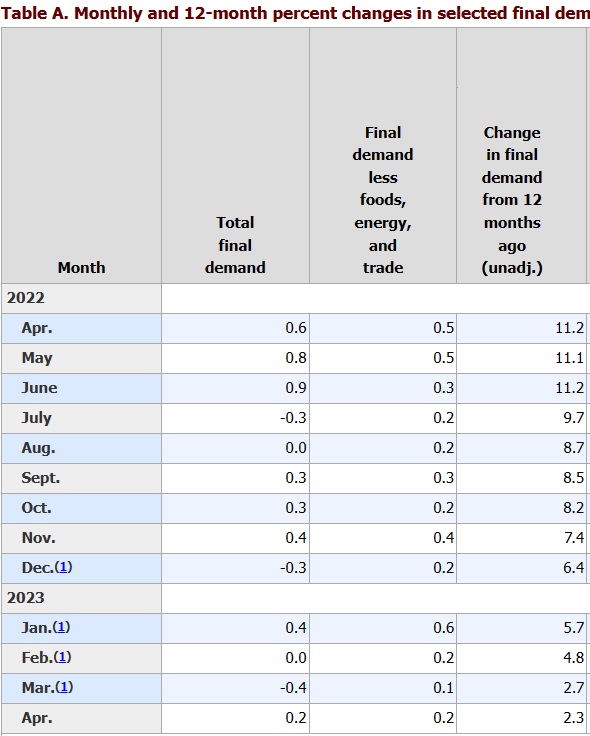
After a review of the non-food item prices, I went back to the recent BLS report [DATA HERE] to look at the producer price index to see if the data reflected the scale of the processing cost that I was reviewing across a broad spectrum of goods.
Are consumers getting gouged by manufacturers who are taking advantage of the price shock inside the ongoing inflation?
Or are the processing costs, mostly driven by energy price increases, really that big a factor in the end product as it is generated?
In the topline final demand Producer Price Index [Table A above] you can see how we are cycling through the second wave of inflation that hit in the spring of 2022. The rate of price increase is lower, but the prices are still rising. That means the prior massive price increase is now baked into the product, and the current price will never decline. Instead, it will just increase at a slower rate than before.
However, that’s not the full story… and that is not the data I was most curious about.
The intermediate product costs are really where the story is found.
 Table B [DATA HERE] Tells us a remarkable story.
Raw materials (unprocessed goods) are essentially in a deflationary status [-19.2% in April]. Meaning demand for the raw material has dropped well below the available supply. However, look at how much of the deflationary price is consumed in the processing of the raw materials.
A full 16% is consumed by processing cost increases [energy, physical plant, transit, production costs etc]. That is remarkable.
A random example might be citric acid. The price of the citrus base drops 19.2%, but the processing of the base into the intermediate good phase chews up 16% of the drop in raw material price and exits processing only 3.2% lower in price than a year prior.
Another example might be found in plastics. The petroleum base, and/or a combination of each material additive, might be 19.2% lower than prior year, but processing negates the lower raw material price, and exits into intermediate essentially even -.04, and then toward the ending +2.3% final demand change in the rate of price increase.
The PPI data is essentially showing the flow of costs of production as reflected in the impact during processing. We can assume mostly increases in energy, transport and distribution costs to bring the raw material forward to final good status.
Key takeaway, the demand side of the raw material is diminished. There is less raw material demand. However, processing costs are continuing to drive the final production price of goods that head into the hands of wholesalers who then bring the product to market.
The outcome of this are the prices of processed goods as noted in the products on the shelves.
QUESTION: Are you noticing rather remarkable price increases in non-food goods during your store visits?

I stopped using a kitchen sized trash can in my kitchen. I use a bucket with a grocery bag for waste. When it’s full I tie it up and dump it in the bin the next time I go out.
I used to give the bags away to dog owners, but not anymore, especially since a number of stores banned them.
I still use the occasional trash bag, but a box lasts forever.
excellent idea
Funny, I use a bathroom sized trash can with a grocery store bag liner. It makes me take out the trash every night, which is good because in FL the palmetto bugs are a constant problem. You don’t want food scraps sitting around to attract bugs.
Where I live, they banned plastic bags. Went to Costco and bought 3,000. 😉
Yes….they call them “single use” bags up here in Canuckistan, but the “government” has never heard of the ‘reuse’ principle. And the “single use” bags for the kitchen are thinner than before as well.
Hmmmmm
Maine did the same thing. I live near NH border and they have not banned those bags, so a convenient trip for me to get them shopping in a no sales tax state.
I miss plastic grocery bags –so many uses, but in NY that’s long gone. At Wegmans the meat dept no longer offers plastic bags. Seems unhygenic. So I grab an extra bag or two from the produce dept where plastic bags are still available and bring them w me to the meat dept.
I’ve considered buying a box of similar type plastic bags w the handles, but not sure if they would be as strong as the old grocery bags. The produce bags have no handles and rip easily, so not reusable.
But but but the city requires the trash to be in plastic bags!
When I shop, I request paper bags. They hold a lot more groceries, and I use them for trash bags.
Caution re paper bags. Roaches are attracted to the glue and lay their eggs there. Bring the bags into the house, the eggs hatch, and then the “fun” begins!
— former GA resident
Yuck, but I store them in the garage.
“I used to give the [plastic grocery] bags away to dog owners, but not anymore, especially since a number of stores banned them.”
More STUPID, worse than pointless, virtue signaling:
Reusable Grocery Bags and Norovirus Transmission
University of Hawaii
Department of Tropical Plant and Soil Sciences
June 2012
https://scholarspace.manoa.hawaii.edu/server/api/core/bitstreams/ba79ef2d-f59e-49c6-b5e6-fe457015491c/content
———-
RESEARCH PAPER NO. 13-2
Grocery Bag Bans and Foodborne Illness
University of Pennsylvania Law School
https://blogs.berkeley.edu/wp-content/uploads/2013/02/SSRN-id2196481.pdf
Abstract
Recently, many jurisdictions have implemented bans or imposed taxes upon plastic grocery bags on environmental grounds. San Francisco County was the first major US jurisdiction to enact such a regulation, implementing a ban in 2007. There is evidence, however, that reusable grocery bags, a common substitute for plastic bags, contain potentially harmful bacteria. We examine emergency room admissions related to these bacteria in the wake of the San Francisco ban. We find that ER visits spiked when the ban went into effect. Relative to other counties, ER admissions increase by at least one fourth, and deaths exhibit a similar increase.
The Spread of a Norovirus Surrogate via Reusable Grocery Bags in a Grocery Supermarket
https://www.biodeg.org/wp-content/uploads/2020/05/california-study-jun-20181-1-1.pdf
Abstract
The conventional supermarket represents an important public access to a wide variety of food that is vital for healthy families. The supermarket is also a location where food, the public, and pathogens can meet. The purpose of this study was to develop and test a hypothesized norovirus transmission pathway via reusable grocery bags (RGBs) within a conventional grocery supermarket. An RGB was inoculated with a surrogate virus to assess potential transport of pathogens within a grocery store. Volunteer shoppers were given an RGB sprayed with a surrogate (bacteriophage MS2) upon entry to a grocery store. A surrogate is defined in this study as an organism, particle, or substance that is used to study the fate and transport of a pathogen in a specifi c environment (Sinclair, Rose, Hashsham, Gerba, & Haas, 2012). The study personnel swabbed all surfaces touched by the volunteer shopper to recover the MS2 surrogate. The data show that MS2 spread to all surfaces touched by the shopper; the highest concentration occurred on the shopper’s hands, the checkout stand, and the clerk’s hands. The high concentration of MS2 on hands justify a recommendation for in-store hand hygiene as a primary preventive measure against transmission of infectious pathogens. The high concentrations on the checkout stand justify a secondary recommendation for surface disinfection and public education about washing RGBs.
———-
November 8, 2011
Plastic Bag Bans Are Bad for the Environment
https://cei.org/sites/default/files/Angela%20Logomasini%20-%20Plastic%20Bag%20Bans%20are%20Bad%20for%20the%20Environment%20-%20WebMemo.pdf
Here in Eastern PA several towns have banned plastic bags. I totally agree with you on disease and their use.
We shop a lot of Amish stores and reuse those bags in more local stores.
I’m anal about not reusing bags that had meat, they become trash bags. I do have a couple to cloth bags I use for cans and bottles, but never meat.
Oh lookie! Here we go! You read it here first! Reusable grocery bags (RGB) are the new evil, horrible, devils.
Let’s examine this logic, shall we?
Eliminating RGB’s saves global corporations billions…..
But, the same “logic” that demonizes RGBs could be FAR better served forcing all stores to sanitize EVERY door handle, stair rail, refrigerator door, and piece of touched clothing between each customer.
Oh, but wait! That would COST the global corporations trillions.
Sheesh!
Soooo??? Are masks out and gloves in? Maybe I should invest in disposable glove manufacturers!
LOL, Way ahead of you on this one, we have been doing this since the day those pesky plastic grocery bags came out. Those bags were a bit heavier and bigger back in those days as you probably know as well.
I think people are taking them from my airbnb properties..I’m always short..
I’m definitely noticing rather remarkable price increases in non-food goods here on the north Olympic Peninsula in Washington State. I usually purchase these items from Costco or on sale. I’m retired and have time to find good deals but I would be in trouble if I had to purchase non-food products at local supermarkets.
One example is the recent price for bleach at the local QFC (Kroger). Name-brand Clorox was more than $7 / gallon. Store brand half gallons were available for half that price. Our transportation costs here are VERY high which may account for higher prices on heavy items like bleach. Regular gas was $4.78 gallon this week at the local station. Costco is less but 80 miles away.
I’m a few hours south of you, but north of vancouveristan, and have the same conditions, the average price increase month to month has been 12 percent for food and non food, for the last 9 months, and most likely over a year, as I started comparing the receipts just 9 months ago. Costco is better, yes, but they are still affected by the failing economy.
We’re in Italy for the next 2 weeks. I was surprised at the little store a block from our room , close to Trevino fountain in Rome. 1 large bottle of water, two package of cookies, less than 6 euro. The water was .58, thenoeros 10 packe was .99 and a pack of fancier cookies was a bit more.
it would have been closer to $10 at home in Tennessee.
I was just in Spain and France and noticed the same. Many items were less than at home at the quality was better. No “purified water”, only spring water. And the prices for beer and wine were dirt cheap compared to us. I went into a Spanish Aldi’s. Wow, it was amazing. Much larger, lots of gourmet foodstuffs and cheap prices.
Mothers day and the forecast is that mothers will have to work harder and have less free time.
Convenience…..you pay for it. Greatest savings is avoiding convenience items. All non food items are increased price here in Virginia. Processed foods are out of the question or rather beyond a prudent man’s budget. It’s not whether or not you can purchase an item but is it reasonably priced?
Peoples of some countries would be laughing at what we’re complaining about and having to adjust to here in the USA.
We’re being forced back in time, using wash rags, slop buckets and maybe junk mail for toilet paper if times get really tough.
The slops make good compost and so should energy policy!
HA!
Shrinkflation, shrinkflation, shrinkflation. Like many here, I’ve definitely noticed the package sizes going down while the prices remain the same.
Also, pet food prices seems to increase every time I try to purchase some.
The usual canned dog food I buy is 2.3 times higher than it was pre-plandemic.
I make my own. It’s work but healthier and cheaper. I still can get a 10 lb bag of chicken for $6.
I usually buy shaved parmesan cheese for my spaghetti from Fred Meyer at $5.99 (much higher than three years ago). I bought another package last week for the same price. I thought the container looked a little different. When I got home I compared it to my last package. The writing was yellow instead of green and it was a 4 ounce container, instead of the usual 6 ounce.
What do you think pets ate 100 or so years ago?
The vet says only organ meat but I don’t believe her. They used to get stale bread but other than that – good question. Just saw an article about longest living dog only eats people food.
A year before the Chinese Communists succeeded in having completely “fundamental changed” China in 1949, they stirred up and caused currency inflation in China. People could be easily manipulated when they have financial problems.
The American Communists are just following the same book. Calling global warming the No.1 enemy to jacking up the energy cost (the fundamental cost of every other thing), plus excessive expenditures, etc. are all meant to cause enormous permanent inflation so as to help to fundamentally change America.
DJT made America self sufficient in fuel oil and to have low gas prices. The American Communists plots are entirely opposite to DJT MAGA
ABSOLUTELY. More than a few times I have left the store without buying toilet paper ($15!!!), foil, bleach, trash bags, laundry detergent, pita chips, hummus, good packaged bread, my favorite low calorie ice cream bars, candles, etc. because I wasINFURIATED at the prices. And this is at Wal-Mart. I have the money to buy it, it just makes me so repulsed that I cannot physically do it.
FJBFJBFJBFJB
I’m lucky to not have to shop at Wal-Mart. I have 3 chain grocery stores within a mile of my home and within 7 miles are another 40+ including specialty, ethnic, warehouse stores and one
Wal-Mart. That’s not counting mini markets.
To get to numerous salvage/discount and restaurant stores I have to go 30 miles.
I routinely look at 5 fliers a week and several more on line if I’m going to be near them.
We still purchase TP, but have found purchasing baby wipes (Amazon) in bulk is much cheaper. And they do a quicker and better job of getting that dirty work accomplished. A bidet toilet seat also helped in cutting costs. I also bought the restaurant bar towels, the white ones with the blue stripe from a wholesaler. We still use paper towel, but not as much since the addition of the towels. Also bought an extra freezer, an upright Frigidaire model when I catch a sale on meat or poultry. Mayo, I make my own, one egg, a few cups of oil and seasoning. Whip it up with a stick blender. We also manually control the HVAC by simply turning it off when we get comfortable. That alone saved us over $100+ a month in utilities. Also installed sheer curtains over the large bay windows in the house, that also helps with keeping the heat from the sun warming the house. You can still see a bit through them, and they did help.
I have two sky lights over my kitchen. Lovely in winter, brutal in summer (AZ). Late spring I cover them and it makes a tremendous difference in comfort and utility cost for the following 4 months.
I did that and added bubble wrap. Still see through but more energy savings.
Depending on what type of candles you’re looking for, estate sales and resale stores are a great source of candles, although sometimes partially used.
Try Sundance’s homemade laundry detergent . It is great ! And so cheap. Made with borax, washing soda and napta-fels soap shavings. Perhaps someone can link to the recipe?? I have used it and nothing else for about a year.
Also I use dryer balls instead of fabric softener and hang towels, etc on a clothes rack outdoors. No dishwasher either except me. Low lights at night and use candles- which I buy at thrift/second hand stores.
I even use handmade face cream and body lotion I make from a recipe I found online with frankincense. That’s another expensive item that is cheaper to make at home.
Shrinkflation. Lower Alabama all paper products are higher with less in the package. I have started doing more shopping at $tree. I don’t drink milk but cook with it. It is $1.25 a quart and packaged to sit on the shelf so it doesn’t have to be refrigerated. Refrigerate after it has been opened.
Kleenex same thing. I did notice the Puffs product has shrunk . Dry Pinto beans and canned goods are $1.25 where they are much higher in Walmart, etc. I cook from scratch and freeze leftovers in portions or can it. I doubled my garden size this year and will be canning a lot of it. I bought most of my plants from the local Votec school at great prices. Started composting this year also.
I shop the dollar aisle at Dollar General for shampoo, body wash, tissue and cleaning products..Dollar Tree raised prices a quarter and it really makes a difference.
I was a Executive Chef for 38 years working mostly in hotels and country clubs. Now I’m retired but I was involved with purchasing food for a long time. Besides energy costs one of the major drivers of food inflation has been labor. Food industry jobs have traditionally been lower paying, but that has changed.
In the production of food, every time someone touches a food product the price goes up. The more processed a food item is the higher the price becomes because of labor. Processed foods have always had a higher mark up. The highest percent mark up is on spices.
Grocery stores and restaurants usually do not run high net profit margins. Manufacturers on the other hand do have high profit margins of around 28%. More than likely, most of the pricing pressure is coming from the suppliers or manufacturers.
It is quite obvious that restaurants of all types are currently failing. My local favorite haunt raised their menu price on a nice beef tenderloin meal from $24 a few years ago to now $34. The result is that their customer traffic has slowed to a crawl. I know the owner personally and it is sad.
We had a “tradition” of going out to eat with grandchildren and their parents once a week. Dinner for 4 adults and 2 kids at a basic local barbecue joint hit $100 last week. Absolutely basic food and nothing fancy in any regard. The bill in past has been in the $60-70 range. Place was half empty. I will be adding 6 empty seats to the total.
There are several restaurants in the process of opening here . Some are chains, some are local independents. I have no idea what they are thinking.
The national average to have a mechanic work on your car is $135 per hour. So for about $22 per adult you had someone smoke meats for hours, make sides, serve it you, clean up after you and maintain the building you ate dinner in. Everything costs more because of inflation did you think the restaurant would some how be immune to this?
The average restaurant has a net profit of only 5-7%. Selling a beef tenderloin dinner at $24 would mean that you would have over 50% food cost in the dinner for the restaurant. Out of the remaining 10-12 dollars the restaurant has to pay for labor, rent, utilities, insurance and taxes. If the owner did not raise prices he/she would have gone bankrupt.
Remember when ‘health’ insurance costs skyrocketed post Obamacare. Insurers blamed the new law. There was a small amount of truth to that. But not much. The rest of the increases were insurer’s raising prices because they could. And with relatively inelastic demand profits soared. We are getting ripped off on food in the same way today.
5lb bag of peanuts for my bluejays used to be $4.99 and now it’s $7.99.
Sunflower seeds for my cardinals has gone from $13 to $24 for 40 pounds.
Not only humans are affected by price increases. Wild birds around here used to get a wonderful birdseed mix at my house. Now it’s cracked corn from 50 lb. bag. Take it or leave it, my feathered friends.
Just clicked on your name (https://rvsueandcrew.net/) Love your blog! Your stories of living the simple life with your canine crew made me smile. Hope you can get back to posting again. In the meantime, I’ll savor the archives.
I have a family member who is gluten free, a box of GF Chicken
nuggets is like $9.00. Most all the GF things are really expensive
That is where cooking from scratch can save you. Even making your on mixes from assorted flours.
Another possibility is salvage grocery stores for special diet prepackaged items. I always see gluten free pasta and cake mixes.
I am noticing with coupons now that a lot of them are now
requiring you to buy TWO of whatever item to get the discount.
For me? Simple. I don’t eat processed food. No judgment but it’s very terrible for health. So I buy from local organic farmers collective.
Cheaper still is to garden. I have a big garden out back, but I have tomatoes in my front flower bed. I also have herbs and celery in pots on my front porch for easy picking.
We also stay away from processed foods, but they are messing with non processed food now. Look for sticker on your avocados, cucumbers and soon apples with the word apeel on it. We have noticed for about the last 18 months that fresh produce turns bad in 24 to 48 hours. It has been really bizarre. Apeel is a product from Bill Gates. Stay away from anything with apeel on it.
Small cattle and bison farms were also just told they are required to vaccinate cattle with the mRNA vaccine effective April 2023.
DG, all the fruit and vegetables are borderline rotten. The onions look like they’ve been kicked down a flight of stairs.
What’s scary is we will have no way of knowing if the beef has the mRNA “vaccine” in it, because the FDA no longer protects us.
I have noticed produce spoiling very quickly — can’t wait for our garden!
It isn’t only shrinkflation…the QUALITY of goods now found in the stores is garbage. I’m hosting a large party this Mother’s Day and made a trip to the grocery for fresh products to augment my garden supply. A container of organic spinach cost $5, nearly double a year ago.
It was full of bugs, white slime, and was wilted by the day after purchase.
I’ve noticed the same issue with canned goods, deli items, etc. Nothing is the quality of even six months ago and most cost more.
nailed it, svfl & M.
at these prices, it would be nice to be able to actually eat what you bring home
instead of having to pare down or trim off 1/2 of it; or even worse,
find out your produce item is wormy or rotted at it’s core.
our formerly best-in-the- world american produce
seems to be going anywhere but america these days.
(try finding an actual Hawaiian pineapple.)
what is being substituted now is not acceptable.
tell me how produce transportation costs from honduras, chile, costa rica, guatamala, etc.
are advantageous to the global food giants – easy answer is that the product is so substandard
and produced so cheaply that it offsets those costs.
best one to date was Friday at local grocery.
decided to splurge on some fries and picked up a bag of “idaho brand” steak fries.
turned it over to check the label and there it was….
“product of belgium”.
For Cinco de Mayo I always go overboard with a special dinner featuring tequila…why not!!!! The cost of limes, lemons, mangos and avocados were at least double from last year, especially organic ones. No chance of growing them local in the northeast.
Co-opt with neighbors, friends, and family to buy in bulk, wholesale if possible. While it doesn’t work for everything you consume, every little bit really helps.
Prices for non-food products are through the roof. I’m learning to re-use and make do. Things I’ve changed:
I don’t buy professional cleaners any more – I stocked up on white vinegar, baking soda, and Dawn for cleaning just about everything in the house, sans wood furniture.
I make my own laundry detergent.
I re-use aluminum foil – just like grandma used to.
The price of bleach has doubled, for example, so I buy large quantities at Costco to get it cheaper per ounce.
I still buy paper towels, toilet paper, and trash bags at Costco – watch for sales, and it’s cheaper.
I don’t buy processed foods, everything is purchased in bulk and cooked from scratch.
I have a huge garden, but have gotten to know a neighboring farmer who I purchase produce from.
I own dairy cows, raise my own meat (beef, pork, chicken).
Many in our community barter – we don’t have an egg shortage here.
Basically, a family with children needs to think differently now. You can’t just go grocery shopping once a week and stay on any kind of budget. You have to buy in bulk, barter, cook from scratch, and help one another out. Lots of people do clothing swaps now for their children. No such thing as eating out, shopping in malls, expensive entertainment, etc. I think people have adjusted well from what I can see.
Rural communities are better off because food is plentiful.
Some years back I had a bad reaction to laundry detergent (I pulled on a turtleneck and my face promptly swelled up like a Klingon’s!) so now we wash everything with baking soda, buying the big bags at BJ’s.
Sundance’s recipe for homemade laundry detergent is a Godsend! It costs 30 CENTS per jug to make. Making it takes 10 minutes. I make 2 jugs at a time, funneling the mix into old laundry detergent jugs. Fels Naptha, Washing soda (not baking sode) and 20 Mule Team Borax, plus water. No scent unless you want to add your own.
are you required to vaccinate the steers? is there a way around it?
Membership clubs may be the way to go. WholeCows.com supposedly will not use mRNA vaccines according to JD Rucker of AmericaFirstReport.com I have not investigated it myself to confirm though.
Everything I looked into only stops the pharmaceuticals for the last 6months prior to slaughter. So if you make bone broth like I do I figure there’s bad stuff still in there so all I can do is 🙏.
YES!
However, I’ve been monitoring upstream costs myself and wondering why it has not reflected a mild to modest deflationary outcome to retail.
Could it be that it takes a while to cycle back down to the consumer, ie burn through inventory that was produced before costs decreased?
I sure hope so.
Eggs are down.
Potato chips, electricity prices and property taxes are 3 of my reference points.
Generic chips now cost $3+ / lb in our local stores. Gourmet chips typically cost $5+. That is almost certainly 3x the cost several years ago. In contrast, $0.40 / lb is about what we paid last fall for a 50 lb bag of raw spuds.
Electricity: Our cost per kWh is now 1.7x the cost in Nov. 2021. The increase can be blamed entirely on “clean energy” policies.
The 2023 property tax bill is 1.16x the 2022 bill.
25 oz cans of Natty Daddy now cost almost 1.5x what they did prior to C19. Box wines are about 1.3x more costly. WORSE: Both are frequently MISSING from store shelves!!! So, working stiffs can no longer drown their sorrows.
I love potato chips. I only buy on sale. The last time was $1 a bag (8 oz). We stretch it. I’m hoping for Memorial or Independence day sales to restock for the summer.
I got 50 pounds of potatoes at an Amish farm for $15 last fall, up from $12. I find 2 bags are too many because some go bad.
However 2 half bushels of apples is just right unless I’m canning. I get the seconds from bins you select yourself and make sure one bag is longer keeping. we actually just finished them off.
I’m old, I remember how my grandparents disposed of trash before plastic bags became available. I grab a handful of the free newspapers and ads near the exit door at Kroger and wrap my trash in it. I seal it with tape I buy at the Dollar Tree. I can then throw it in the trash can outside.
I buy toilet paper and paper towels at Costco, bleach and dish soap at Dollar Tree. I wash the floors with just warm water and vinegar. I buy rubbing alcohol and baking soda at the Dollar Tree for cleaning. I buy laundry soap at Big Lots. I have always lived this way even though I can afford more. I use the extra money for organic food for myself and are able to afford to feed my dog an appropriate diet. However, his grooming was $140 (!) every 6 weeks, so I bought a set of dog clippers, a dog blow drier and watched grooming videos. He doesn’t look perfect, but he doesn’t care.
I’m cautious with natural gas and electricity use. I keep my house at 60 degrees in the winter and seldom use my clothes dryer. My neighbors laugh at my close line, they say it’s for poor people. I hang wet clothes in the garage in the winter and then hang them by the furnace the next day. The only items I dry in the dryer are towels, washcloths, sock and underwear. I wash dishes by hand and seldom use the dishwasher.
My gas budget is $65/month, electricity is $55. I only use one light at a time. My water budget is $50. I have the largest front load washer made and do 4 loads/week for 2 people.
Even though I’m old, I ride a bike to most stores with a basket on the front and back until it snows. I use less than 1/4 tank of gas on a monthly basis. I can sew, so I repair clothes rather than buying new. I make throw rugs by cutting up, sewing and braiding (really) old clothes. They’re beautiful, family brings their old clothes to me to make rugs for them. Denim and fleece last the longest.
My neighbor has chickens and I buy eggs from her for $2/dozen. I’d have my own chickens, but I have a bird dog.
I have always lived poor. I realize not everyone can do what I do. I’m lucky my husband is frugal as well, he’s one of 10 children from a poor family. He’s a journeyman master carpenter with plumbing and electrical skills, so we seldom pay for house repairs or maintenance.
Get to know your neighbors and trade skills. You’re going to need them. This spring, we’ve helped several neighbors set up veggie gardens, they’ve plowed and shoveled our drive and walks for years, we owe them. They can also see what’s coming.
I hang towels to dry and throw them in the one drier load I do a week. I used to do all my wash on the weekend. I spread it out now so I can use drying racks
Not sure which reality this reflects, but in the small town I’ve moved to there is an Ollie’s Bargain Outlet. Ollie’s sells a broad assortment of closeout merchandise, including food.
In the city, a year ago, I found Ollie’s prices to be about 20-40% cheaper than WalMart’s prices.
Today, that’s seldom true. They seem to be almost the same–even on a massive closeout of M&M candies, where the impending Sell By date is looming.
Maybe this is another example of the distribution costs erasing the decrease in acquisition costs.
I think it may be because more people are shipping at Ollie’s.
We shop at Giant and Shop Rite stores in the Yardley, Pa., area. A piece of chuck steak runs between 15 to 20 dollars depending on how old it is. A small of fruit runs between 1.99 and 3.19 depending on the brand. Kleenex is about 5 dollars for 4 boxes. Everything is up. Weekly groceries cost 200 as compared to 100 after the installed occupant of the White House was installed.
There is a growing surge of small outlets selling things people need in the area. Many are shifting to this alternative – mostly in food but it’s not cheap.
I’ve always had a stocked pantry with backups of backups, but stocked up even more with Sundance’s warning. I’ve been blessed with a couple of other things during this inflation catastrophe that have protected my pocketbook.. 1. I found 2 different local outlet grocery stores that are WAY cheaper than standard grocery stores. I can buy both processed foods and raw meats at great discounts and sometimes at a steal. 2. I live within driving distance of a farming community and I can buy bushels of produce for very cheap to freeze/process. I have been keeping my pantry/freezers full with the deals I find at these places.
(If you live in TN/AL find a United Grocery Outlet which is one of the stores that has helped me and if you live in VA look for Sharp Shopper/John Henry stores-I watch YT’er who gets great deals there)
I stocked up on non-food items when we were talking awhile ago —maybe 18mo ago?- about the facilities in Louisiana and another place that were destroyed that supplied chemicals for fertilizer and it was mentioned an ingredient for soap was also in short supply. And I knew oil was used to mfg plastic. So I stocked up on cleaners and plastic items and bought some backup garden fertilizers (organic). I am only now starting to run out of some cleaners. I will probably use a homemade substitutes until I can find a decent deal.
All of the above has insulated me from the inflation catastrophe. But every once in a while, I venture into regular stores and am flabbergasted at the prices. I have walked away from store without item I went in for b/c I just couldn’t pay that price.
Paper napkins have gone from .99 at Aldi to 1.99. I will probably at some point switch over to cloth napkins
In Aug 2019 I purchased 64oz Method hardwood cleaner on sale for 4.66.. Today it is over $13 and $11.63 with Amazon S&S.
I was hosting a get together of women yesterday and when planning the meal thought I would go with an old standby- chicken salad on croissants. At Walmart a 4 pack of croissants is $5–so a homemade sandwich is 1.25 before you even add the meat! That’s crazy! So we had them on Aldi Hawaiian rolls which was 2.76 a pkg.
The other sad thing I’ve noticed is removing regular checkout lines and replacing them with self checkout machines and those aren’t accepting cash. I’m now trying to pay for everything with cash so I go to the lone cashier.
I am really sick of these self checkout places. I don’t understand why they have 5-6 people standing around watching the self checkouts. Sure they are getting paid. I am wasting more time checking myself out at every store I go to. I know I am not as fast as a cashier is and I am not getting paid to do so. It does not seem to be lowering the cost of the merchandise
“It does not seem to be lowering the cost of the merchandise”
It was never intended to do so. The goal is reduced labor costs and thus higher profit margins (and to hell with the customers’ time or convenience)
This is my current pet peeve. Why are they paying all these young people with fake eyelashes and fancy manicures to stand around and watch their customers check themselves out??
theft
I actively avoid self-checkout. I’ll wait for the checkout person, or if there is none, shop somewhere else. I don’t want to encourage the spread of this massive inconvenience + “nudging” us toward CBDC’s.
I am working on growing coffee plants/trees under an oak tree canopy because Florida sun is too hot, inspired by David The Good, a fellow Florida survival farmer, who’s webpage is actually really informative. I have started using sand from the yard for the cat’s garage litterboxes.
Best saving information I can suggest is to NOT throw out food based on dates on the products. They DO NOT mean the food will be unusable by those dates. Search the internet for articles on the date systems and meaning.
My A2 half and half carton is today……15 days past the package date. I sniffed it before I poured into my coffee this morning……still fine to use. ( By the way you should be only drinking A2 milk). Yesterday I used a can do tomato paste over a year past the date on the can. Passed the sniff/sight test.
Consumers have been conditioned to think food will be bad after the dates on the product. This is NOT the case.
The smell test is an oft deployed tactic in this household. Dinners are made with the idea of eating the left overs from the week as one or two nights dinner, sometimes to the chagrin of whoever shows up to the table.
Baking mixes lose their umph… but that can be fixed with adding some baking powder or soda if they are over a year past their BB date.
Yes!! A YT’er (She’s In Her Apron) is a homemaker with a pantry/stockpile and she recently shared video where she is feature on 20/20 ? Or some such show and they took some of her expired cans and they were sent to a lab to be test—and all were perfectly fine and taste was same as fresh can. One was a can of peaches that expired in 2018.
He’s great and I need a coffee tree under my oaks. Avid drinker and I use the grounds to start seedlings and feed the worms.
Lemons at Kroger are still $.99 each and have been for at least 5 years.
I think Sundance underestimates the processing costs and profits. About 10 years ago I was looking for large quantities of split peas. All I could find was running $1.12- $1.20/lb until I found some for $.14/lb, but the small print said 40,000 lbs minimum. Those split peas now cost $1.59/lb
And bananas have been holding steady at $.59/lb for years. (Does anyone else remember when there was a huge jump in banana prices? They had sold for around $.39/lb for years.)
But the canned catfood my cats prefer has gone up about 75% since 2020, and the dry catfood is up almost 100%.
Milk locally is at around $3.69/gallon, but a pint of cream is over $6, if you can find it on the shelf.
A friend of mine recently opened a restaurant, a new venture for her. She had been an accountant and project manager for her husband’s contracting business. She put together a business plan and secured the lease on a building. It took 6 months to get her restaurant license. At the soft opening she told me that food prices had gone up considerably in 6 months. She was losing money and would be raising prices for the grand opening. She’s a great cook, but I would have a hard time regularly shelling out $60 for a family of 4 to have extraordinarily good tacos at a carry out.
I have a couple of trees I started from local farmers market lemons that started to go bad. I put fresh potting soil into a 3 gallon buckets, broke open the half rancid lemons and sprinkled rooting powder on the innards. I buried each of the whole lemons about an inch under the surface of the potting soil. To be honest I almost forgot about them until I notied saplings. They are now a foot and a half tall. I have more than fifty pineapple plants going, 3 with actual fruit forming.
Yes, prices are an issue, but the one that really bothers me is the continuing loss of grocery stores which are being replaced by Dollar Generals.. As a result, our town and the next closest one no longer have grocery stores, and I am seeing this trend everytime I travel.
Yup… across Southern Minnesota, too
I don’t eat Velveeta but the plant that makes it is near me…they have been on a four day work week since the Super Bowl… they make some real cheese too… I don’t recall them not pulling a five-day work schedule
It could be that they are working 4, 10 hr days.
That saves everyone money.
They run three 8’s… have for years
Absolutely! I told my husband yesterday that I feel sticker shock every time I buy groceries. I find myself looking around the cart looking for the expensive items I accidentally put in my cart, only to realize that I only bought the things on my list and used the store coupons. My bill is 2-3 times higher than it was two years ago. I wish I had started taking pictures of the items I routinely buy.
Lately I learned that my grocery store of choice is forcing employees to wear attire that supports LGBTQ. I need to find another option, even though my prices will likely go up for doing so. I won’t get the same coupons or cheaper gas. I’m going to check out some local co-op options.
My son loves popcorn. I buy it at Costco. It used to be 6.99 for a large box. Today it is 14.99! Dog food (I buy the expensive stuff) used to be $80 for a bag. Now it’s $110.
Pet food of all descriptions has gone through the roof. One of our cats was put on prescription dry food in 2021 @$54 a bag. Received an order this week and the same bag is now $72. Canned cat food went from $.62 to $.89 a can. It’s no wonder that animal shelters are over run with pets that people can no longer afford.
Good luck on your search. Every option here does that virtue signaling BS.
It’s like trying to find a cell phone provider or internet provider. All options suck.
Health care is the same way anymore. All providers are now corporate employees.
I hate not having real options
Patriot Mobile? I don’t have personal experience with it (I am pondering the notion). It advertises as a Conservative / Christian-friendly alternative.
I just want to make sure that the quality / coverage reliability is there before I leave the Verizon monster.
Patriot Mobile customer here. Works well for us. And the customer service has been great, too.
Lots of great cell phone and health options here, plus much more:
https://www.fundamentalfamilies.com/resources/
It’s the communist way!
Who comes up with these ideas to wear LGBTQ stuff or put up signs? Does it really sell more products? It’s not marketing, says me, it’s indoctrination. Within the corporation who is pushing this indoctrination? Why? What happens to a company that refuses to go along with the LGBTQ agenda?
Eventually it comes in the form of government harassment. Visits from EEOC, OSHA, IRS, ad nauseum.
“Nice little business you have here, it would be a shame if anything happened to it.” Legal gangsterism.
Just like the IRS engages in legal extortion
It’s for their DEI (Diversity Equity Index) and ESG scores…it’s pushed by HRC (Human Rights Council). These scores are what determine the company’s access to financing/money.
So, the lending institutions call the shots. How does LGBTQ ultimately benefit them? Are they trying to put religious institutions out of business to acquire their properties? Are they trying to reduce the population? I assume it’s about power or wealth, but what really drives this agenda?
It’s purposed to undermine the value system that has girded Western society. At an abstract level, when values are “socialized” by the tribe, when right and wrong are functions of the prevailing power structure….everything becomes palatable. Everything is relative and flexible.
Inflation or price gouging? Really not sure. Often you can find the identical item at several different price levels. I was pretty shocked when roadside farm vendors raised their prices to grocery store rates. We find those items cheaper and better in store now…?
For our part, we are trying to grow more food (hampered by the on again, off again spring), only buying things at genuine need, and doing without.
Now that I am older, I realize that growing up poor was one the great blessings in my life.
I learned to do much with little.
Same here, Uncle. Not only did I learn to do much with little, I’m able to be happy and content with what I have.
I buy all non essentials at Walmart. I have noticed price increase last 6=8 weeks. Some products are Walmart brands others are not. Prices still cheaper then Shop Rite. Buy meats and Fish at Costco, even their prices are up. I do what I can to find a good price that I will accept.
I have a wonky stomach so I have to buy what I know doesn’t irritate it. Eggs went from 3.99 to 8.99. Chicken from 2.99 to 7.99 a pound. Now I buy from the reduced section on it.
Cleaning products went way up. Now I use vinegar. Two years ago we stored up on foil, trash bags, baggies, saran wrap. Only buy these now when on sale. TP buy only on sale. Have stored up on this and paper towels.
In general all junk foods gone up. Nabisco crackers are 5.99 a box. 🙄 We buy store no name brand of can goods .69¢ a can.
Our local store always has a BOGO for 1¢ sale. We stock up more so.
Water is outrageous. Case of waters 5.99 for store brand. Catch it on sale for 3 for 9.00. You’ve got to take your time and shop wisely.
We bought food grade 5 gal containers and use for water. Use the “watermill” places. $0.35/gal. We reused our 1 gal for over a year to save for the 5 gal containers. 4ea-5gal containers with spouts was just over $100, but had already seen the savings. We only buy the large (50+) individual drinking water bottles once a year right before hurricane season to have them on hand (jic).
North Mountain Supply 5 Gallon Vented Plastic Hedpak/Carboy https://a.co/d/1p4Vgei
Vented Faucet for Hedpack https://a.co/d/2YtpRvv
Gosh,! NEVEr pay for food grade buckets. The deli and bakery dept of grocery stores get icing and salad bar and other bulk items in food grade buckets of varying size. They throw them out. You can ask for them. You usually have to wash out the residue but you would wash them anyway, right? My place overflows in free buckets
My wife and I invested in a Berkey filter system. Pricey initially for the equipment / filters, but better water and cheaper over the long run.
Also, perhaps a lifesaver in case you later find that you live in a targeted area like, e.g., East Palestine, OH.
That site also sells refillable glass water bottles in aluminum sleeves, that one can use instead of throwaway plastics.
Aluminum is bad for you. Berkey’s are excellent.
My husband and I got in a huge argument the other day over the grocery bills.
After I told him bacon was now $9 a 14 oz, an 8-pack of soda was $8, 4-pack of chicken breasts was $16, etc, etc….he backed down.
Eggs have gone down some. Two cheap pizzas are $9, which I usually doctor anyway, but they are putting hardly anything on the pizza, right down to sauce A bag of chicken nuggets is $8 (small). I have one child in college that’s at home that I buy these for. I usually make my own chicken tenders; so much better. Have quit buying Velveeta shells and cheese, number one because of price and number two because the pasta was old and turned to mush when you’d boil it.
Publix has some pretty decent BOGOS. Is it still overpriced? Yes. But if it’s mayo and ketchup, and the buy-by date is 2024, it will keep.
Tennessee has passed a food sales tax holiday from August 1 to October 31st. Our sales tax is almost 10%; so this will help. This doesn’t apply to the sandwich they make for you at the deli or to fast-food places.
For most items the “sell by” date is quite different than the “eat by” date.
We cross the border into Missouri and save about 5% on the sales tax.
As a bulk shopper, I’ve been somewhat insulated by the huge price increases. I’ve definitely been helped by the warnings from Sundance though as I’ve got more supplies than I would otherwise have had.
Here in Philadelphia, groceries have gotten ridiculous. I’ve noticed a huge surge in store brands in the amount of shelf space they take up. I predict that people will begin losing weight as chips, bread, and soda have gotten ridiculous.
Up til last month, when we ran out of a container of something, I’d replace it with another item so my stockpile wouldn’t go down. These last two months I have drawn down tin foil, toilet paper, laundry detergent, and paper towels as the replacement costs were too high. I’m officially waiting on deflation.
On the bright side, eggs are way down.
I’m in suburban Philly so get out to Lancaster county about once a month to go to Bulk and Salvage grocery stores. They have really helped our budget.
Yes same thing happened to me. Bought a bunch of stuff before but it is running out. Wish I would have bought more stuff a year ago.
I didn’t know how much to buy of which things. I tried to guess, but without knowing what yearly usage would be, some things are running out while others will last for years.
Central PA – Prices are up about 30% from 2 years ago. Not all prices went up at once, so its been a steady climb.
I sure did notice price increases on almost everything. $11 for 6 bagels and a 1/2 lb lb cream cheese.
another $11 for a half gallon on milk and a ltr of 1/2 n 1/2.
$6 for a bag of Fritos.
Joe Biden built this.
Enlightening article in Zerohedge about where things stand now, “… Card Data Reveals First Drop In Household Spending In Two Years As Upper Income Wages Tumble, Unemployment Benefits Soar.” A gathering of Black Swans.
Eggs have stabilized around $2.50-$3, but I have been buying from an Amish neighbor for $2.50 and they are larger eggs. Gas is still around $3.20. Amish strawberries are around $13 a gallon and there is a bumper crop. The price on condiment is quite high. Hard to find Hellmann’s mayo under $6.
Canned soft drinks used to be about $5 a 12-pack with occasional sales as low as $2.50. Now, $5 is the sale.
All meats are higher. We are a mostly chicken family anyway and stock up when sale priced thighs are $.99 a pound and breasts are $2. I have noticed that seafood prices, particularly shrimp, have not gone up like beef and pork.
Strawberries $26 per gallon, $13 per 1/2.
We switched to 2 liter bottles of soda, $1.18 at Walmart. I buy whole chickens now and cut them up, because it’s $1.24 lb, sometimes $1 lb when on sale.
Yes non food items are beyond ridiculous. Paper towels are almost $30 for the large pack, toilet paper, the cheapest on the shelf is over $11, trash bags are around $15 for the large box of kitchen bags at WalMart. Fortunately I over stocked when Sundance began to warn about price increases. I rarely buy these items now but I will have to eventually. I have noticed Home Depot has trash bags cheaper now than some places so that may be where I go when my stock runs out. Another thing we’ve noticed recently is canned tomatoes. We really like the San Marzano canned tomatoes but not for $7.48 a can. Also frozen onion rings are almost $6 a bag. Some things just aren’t worth it any more. I don’t know how families do it. Kids get hungry and there is always mountains of laundry to do. Never thought the USA would turn into this.
Nothing to worry about. Our so called fake President and administration said they are doing a great job and will do much more with their Build Back Better plan. Hope they all rot in he!!
My wife came home from shopping yesterday talking about a young man flaming out in the store over the price of potatoes.
Can’t tell- if the intent is a complete causal analysis. The problem space is more complex. That retail prices on average have increased year over year is certain for a broad spectrum of food items and conforms to what most of us are seeing at the store. The issue is why.
Minor terminology point: if the rate of price increase drops month over month but the price is still higher year over year, the correct term is disinflation…not deflation.
Price increases have to be viewed in the context of wage patterns. Wages have been increasing year over year – this is sector dependent however and has not (on average) matched inflation rates. However, for the beneficiaries (in current tight labor markets), it lessens the overall real impact.
Retail prices are significantly impacted by cost structure. The huge retailers (e.g., Kroger) have significant costs like pension plans, healthcare, etc., that factor into final prices. Point being that analysis is more complicated.
In some industries (e.g., chickens, cows) cost structure has been significantly impacted by the seemingly non-random/continual incidence of processing plant damages/fires or large raw material cuts (e.g., bird flu, huge cattle herd deaths in Kansas). Again, point being that analysis is more complicated.
I have observed what many are seeing – inflation instrumented through cuts in material input while prices remain relatively stable. Especially seeing this at restaurants (as well as the grocery store).
An interesting sidebar, were one (as I did at a small level) to have purchased stocks over the last year and a half at the back end (e.g., potash, fertilizers, etc.) one would have witnessed volatile but declining/flat per share prices. At the front end (e.g., Kroger, Proctor and Gamble) one would have observed highly volatile but increasing stock prices for the last five years. Again, more analysis needed – in particular, how much did Pandemic lockdowns, global supply chain adjustments, global transportation system adjustments, bullwhip inventory miscalculations, increased demand (post Pandemic), speculation, gov’t energy policies, money printing, etc., impact what we see at the retail level?
Perhaps, the impending recession we are barreling into next year will provide some relief. Hard to tell since mis-management across the board makes stagflation a more likely outcome. TPTB have done an excellent job creating confusion while distorting fundamental market processes.
We are in a recession already, they changed the definition last year to prop up the Biden regime. We are headed for a worldwide depression, famine, and hyperinflation. Better get ready. Get your soul right with God.
No relief is coming. The world is deglobalizing. The supply chains will be haphazardly addressed, some will be fixed, most won’t. They are ratcheting down commerce everywhere at every level. They are corralling people into huge behemoth monopolies for goods that the elites can control more easily. They can’t kick the can much longer on the US$.
Southeast Tennessee generalized increase in one year:-
dairy +50-75%
meat/meat products +100%
baked goods +50%
frozen goods +50%
processed items (chips/cookies etc) +50%
cleaning products +100%
a lot of packaged goods have “shrunk” with little visible increase in cost
we are now buying the cheap bulk and/or reduced for quick sale rather than perceived quality (“organic” etc)
a food shopping run to Walmart now costs more than it did at the “fancy” stores, also Walmart don’t reduce close to date items more than 5-10% they used to reduce by at least 25%
our local food lion does still do big reductions on close to date items, that determines what’s for dinner, so as a family of six, it’s difficult but we are still above water. At the moment.
Our retail business ( non essential goods) is drying up, March -25% April another -10% May is looking worse still. I don’t know how long we can keep going, however we moving 50% space to thrift store in an attempt to “save” it
The lockdowns broke America in more ways than one. First, they caused shortages across the board in almost every conceivable item. Supermarket shelves are only just now becoming fully stocked again along with the new, much higher price stickers under each SKU (stock keeping unit). The reason for the shortages are obvious, from reduced production to reduced levels of transportation to reduced warehousing and logistics. Low supply and high demand -> higher and higher prices.
Second, through government handouts (direct payments + easy unemployment) the lower skilled workers made much more money staying home than they did when they were working. Even now, those people have not returned to the workforce and likely can’t because while they are expected to return at their old low pay, the prices of basic goods have halved their real take-home pay and so they stay out by either continuing government handouts by the way of welfare programs, working under the table or both. So, shortages in goods and services continue causing prices to continue to increase.
America remains broken. Fundamentally broken by the disastrous lockdowns. Until some considered action is taken to repair the damage and fix the system things will continue in the current death spiral and we will see another great depression.
This is why we see so many people going postal over what seems like minor problems be it at the airport or at the drive through window. Every transaction many of us engage in that were once considered mundane so often now get messed up. After 3 or 4 headaches trying to accomplish routine tasks happen every week, people become irritable and have very short fuses.
PS Howie Carr of the Boston Herald has a few articles you’ll find at howiecarrshow.com where he recounts the texts he gets from callers to his talk show about how much the prices have increased on everyday items. Worth a read.
Example of what I am talking about comes courtesy of today’s Boston Herald. As many as 400,000 people about to lose their masshealth (Medicare):
MassHealth assessing who qualifies for first time since pandemic Hundreds of thousands of people expected to lose coverage
State officials recently offered a first glimpse into efforts to redetermine MassHealth members’ eligibility… Hundreds of thousands people are expected to lose MassHealth coverage over the next year as federal coverage requirements in place since March 2020 expired on March 31.
As the state redetermines eligibility for the first time since the pandemic began, those who lose coverage will need to find new health insurance plans…
About 50% of MassHealth members will be automatically renewed. The other half of the 2.3 million people enrolled in the program will be receiving a blue envelope containing forms to fill out with their current information, which MassHealth will use to determine if they still qualify.
The number of people that the state expects to be pushed off the plan has been a moving target. Estimates range from 300,000 people to more than 400,000
MassHealth is Medicaid and Medicare.
I am strongly opposed to able-bodied people who refuse to work, homeless non-veterans, and illegal aliens getting “free” healthcare benefits paid by people who do work and pay taxes. I am strongly opposed to grifters who have hidden actual income to make them eligible for “free” healthcare.
I think these people should be completely removed from eligibility for any free anything. Go to work.
Sundance
I love all of your threads and deep analysis. Next year’s news today!
These kind of threads are among my favorites
BKC
What was $100 in the basket is now $200
The increases are highest ever
EBT cards have no expiration date.
Shopping is not a problem especially if you have at least two in your household.
What if your perceived “white privilege” from the purse string holders means that you do not qualify for an Eatin’ Better Tonight card even though you have been unable to work for 2.5 years??
As a dairy farmer I find this interesting, Our milk Coop statements (Organic Valley is very transparent) show that energy primarily and labor have eaten up any profits since this started. As farmers we have seen no increase in the price we are paid in several years, finally got 50 cent increase this spring. Sure isn’t covering increased costs on the farm!
Organic has fairly stable pricing year around, conventional market has been a roller coaster, but if you average it out about the same thing. Biggest problem is when conventional dairy hits a high farmer pay price that makes the news but when it craters a month later, crickets. All in all crop farmers are fairing slightly better but their price hasn’t kept up either.
So Don’t blame the farmers, Please
And I don’t blame the oil companies either, some demented a–hat and his puppet masters destroyed a pipeline and throttled production and refining capacity, wonder who????
green nude eel
Interesting feedback!
As for O&G, one still has to ask why discovery and development CAPEX initiated a severe decline from 2013 to the present. Why did equity holders go along with this?
Your summary thought on this is not only funny but accurate IMO. Only, there were likely many a-hats involved in applying the social and direct pressure.
Can’t give exact figures, but when looking at the prices of items I haven’t bought for three years, I saw prices MUCH higher than I recall.