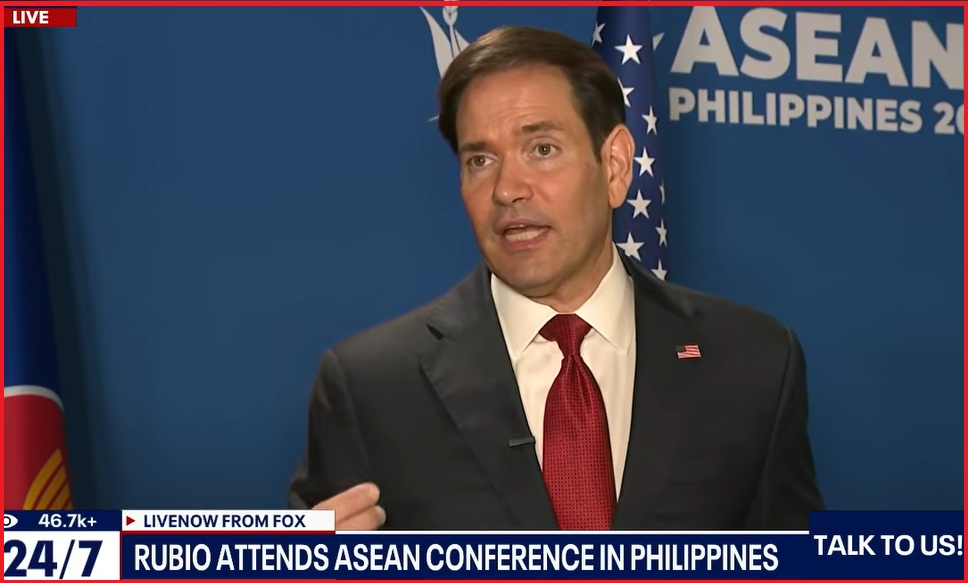
Secretary of State Marco Rubio held an extensive press availability on the sidelines of the ASEAN summit in Manilla. During the questions the meeting with Russian Foreign Minister Sergey Lavrov was one of the key areas of focus.
Rubio noted the U.S. was still willing to play a positive and constructive role toward a ceasefire in Ukraine, with the intention of bringing an end to the hostilities and bloodshed. However, Rubio was not willing to discuss details of the private conversation with Lavrov. WATCH:
[Transcript] – SECRETARY RUBIO: All right, what’s up?
QUESTION: Have you made any progress on Ukraine today? Is Russia serious about peace this time?
SECRETARY RUBIO: I mean, you think we settled the war in Ukraine in our 30 minutes here in Asia? That’s not the way it works. Look, we had a good conversation, a frank conversation. I’m not going to tell you what we talked about, because these – diplomacy doesn’t work well when you run to the microphones afterwards. Suffice it to say – I’ll tell you what I told you yesterday. The United States, the President’s been clear that we want – if we can, we are prepared to play a constructive role in bringing about an end to a senseless war. And we’re ready to do that, and we of course expressed that, and we’ve expressed it in other meetings. So we talked about other things as well.
QUESTION: Did you talk to him about Russia sharing information with Iran targeting U.S. troops?
SECRETARY RUBIO: Well, who says that they are?
QUESTION: Are they not?
SECRETARY RUBIO: Who says they are?
QUESTION: Hegseth acknowledged that Russia was enabling in some ways, both Russia and China.
SECRETARY RUBIO: Yeah, but that’s a different question from what you just asked me. Who said that they were – they’re doing that?
QUESTION: There’s been reporting that there’s – are you —
SECRETARY RUBIO: Reporting in the media?
QUESTION: Yeah.
SECRETARY RUBIO: Oh, then it must be true.
QUESTION: So is it not true?
SECRETARY RUBIO: If it’s in the media, it’s a leaker. I’m not going to – let me say – let’s imagine that were true. I certainly wouldn’t discuss it in the press. I’ve already told you guys yesterday something and I was very clear about it. Nothing that Iran is doing – nothing that anyone’s doing to help Iran is in any way increasing their ability to target Americans.
What you need to all understand – because we’ve explained this repeatedly – is Iran has spent the better part of 20 years not just sponsoring terrorism but building long-range rockets, short-range missiles, and drones. And they were intending to build them a lot more. They were intending to double their stockpile. The stuff you’re seeing them use now, they were going to double that. And they were going to use that and hide behind that to say, we’re untouchable, we can now do a nuclear weapon, and you guys can’t touch us or we’ll overwhelm your air defenses, which is why the President had to address this threat.
And he did, and he should have. Another President should have done it earlier. The world will be a safer place because we addressed it. Unfortunately, in the short term it creates disruptions, but you know what’s really disruptive? A nuclear weapon in the hands of these radicals.
QUESTION: In Ukraine, do you sense that the momentum is shifting a little bit in the conflict? And if so, does that manifest itself in these diplomatic discussions?
SECRETARY RUBIO: I think it’s a bloody war. I think it’s a very bloody war. I think Russia is now suffering strikes deep in their territory. That’s something you didn’t see. At the end of the year, the winter’s still going to hit Ukraine, and they’re obviously going to have to defend their airspace. People suffering every day, the – I think it’s the only conflict – I’ve been told it’s the only conflict that anyone in the military can recall where the killed-in-action rate is higher than the casualty rate. That’s how bloody it is. The Russians, I believe, are losing upwards of five to six thousand soldiers a week. That’s a staggering number.
QUESTION: Can you feel that with Lavrov? Does Lavrov sort of express that or acknowledge that in any —
SECRETARY RUBIO: Well, look, guys, I mean, when I have these talks, these things don’t work well unless I come out here and characterize what the other side is saying. Suffice it to say that I think it’s obvious to everyone that this war is very bloody. And look, Ukraine’s paid a tremendous price as well. I mean, we’ve seen civilian deaths, strikes in Kyiv. We’ve seen some of that increase. Certainly, I mean, this war has not been good for Ukraine either.
So I think both sides should have an incentive to bring it to an end. That’s been the challenge is an end that both sides can accept. And we’ve tried and we’ll continue to try to see if we can find a middle ground that brings this about, and we’re prepared to play that role if the opportunity presents itself. We expressed that today and we’ve expressed it in the past.
QUESTION: China today —
QUESTION: Mr. Secretary, the Russian —
QUESTION: China today launched —
QUESTION: The Russian —
QUESTION: — live-fire drills in the Taiwan Strait —
SECRETARY RUBIO: Yeah.
QUESTION: — and apparently used water cannon on Philippine vessels near Scarborough Shoal.
SECRETARY RUBIO: Yeah, those are two separate instances, but yeah —
QUESTION: Two separate instances right as your Chinese (inaudible) —
SECRETARY RUBIO: Yeah, look, I mean, on the – well, look, I mean, they know where we feel about those issues. Obviously, we publicly expressed ourselves on the missile launch. It’s a destabilizing event. And what’s happened with the Philippines, obviously we saw that, too. The whole world saw it, and it’s disturbing. And these challenges and these claims of sovereignty over territory are a growing challenge. It’s why we continue to reiterate our commitment to our treaty partners but also our commitment to freedom of navigation and respect for territorial rights in the region. And it’s one of the cornerstones of our engagement in the Indo-Pacific and especially via ASEAN, and I made that point in every forum that we’ve had here.
QUESTION: Sir, President Trump, he said on Truth Social that the U.S. is going to bomb and destroy a bridge or power plant every time that Iran targets a ship in the strait. Is he talking about civilian infrastructure there? And do you think that is an effective strategy?
SECRETARY RUBIO: He’s – this is what he’s talking about. Iran is begging us, okay, both directly and indirectly, let’s do a deal, let’s talk, let’s talk. Iran is begging every day. The problem with Iran is every time they make a deal, the people that are in charge there, they either break it or they want to change it. So it looks like they’re not ready to make a deal, so they’re going to continue to pay a price. And they’re – every night the price gets higher and higher and higher. And that’s what’s happening now. And until – maybe in a few days, they’ll be ready to make a deal once they realize that this is not a winning proposition for them.
And that’s what the President is outlining, the idea that this is going to continue. It’s not going to continue this way – the price will continue to get higher every single night until they come to their senses. Right now, apparently they haven’t come to their senses, and so the President doesn’t see a lot of utility in responding to their overtures at this point because, frankly, Iran is clearly not ready to make a deal, at least not one they’re willing to live by.
QUESTION: But is he talking about civilian infrastructure, bridges?
QUESTION: Mr. Secretary, yesterday you were saying – you were hoping to – that there would be de-escalation in the Red Sea, and the Houthis now attacked two – two Saudi ships. What is your reaction to that?
SECRETARY RUBIO: Yeah, look, I hope that they’ll stop. They shouldn’t really do that. They got suckered into this by the Iranians. The Houthis largely were smart and stayed out of all this throughout the conflict, but they now apparently have gotten themselves suckered into this, going after Saudi Arabia and their ships.
And by the way, that’s – I was reading reports a few hours ago that there was actually a Saudi fuel ship that’s flagged Chinese. It’s A Chinese ship. Are they going to blow up the Chinese ship? And this becomes a problem for China, this will become a problem for the whole world. But I hope that will de-escalate, because I think the Houthis frankly got snookered into this thing by the Iranians. And they were smart to stay out of it and they should stay out of it and they should stop. We’ll see what happens there. Obviously, it’s not a positive development. We’ll see what happens.
QUESTION: Secretary, what prompted the easing of —
SECRETARY RUBIO: I’m sorry, man. I love the real court reporter thing. It’s cool. Why don’t the rest of you guys have this? This guy’s the smartest guy here.
QUESTION: He’s a trendsetter. We’re catching up to him.
SECRETARY RUBIO: I know, he is. You better catch up. All right, go ahead. I’m sorry.
QUESTION: Yes, what prompted the easing of sanctions on Hong Kong last week in terms of letting the executive order expire on lifting sanctions —
SECRETARY RUBIO: Yeah – no, it wasn’t easing of sanctions. The executive order expired. The conditions underlying some of those elements no longer existed. But there remain other individuals that remain sanctioned nonetheless, despite – the executive order is a partial expiration on certain individuals, but not on others. It just depends on the light of it. And the justification and rationale behind that original executive order had sort of – the circumstances had changed in the President’s judgment.
But there are individuals – there’s still a significant number of individuals in Hong Kong that remain sanctioned that were not covered by the executive order. And that remains in place and, obviously, that was raised with us yesterday, but we don’t see a change anytime in the near future on that.
QUESTION: Mr. Secretary, Russian readout of your meeting also once again mentions Anchorage proposals. Can you describe what those proposals are and how relevant are they today?
SECRETARY RUBIO: Yeah, I mean, there was no – I mean, proposals, we know they’ve been reported – they call it 3+2, they’re (inaudible), but those failed. The – you can’t have a peace deal unless both sides agree to it, and the Ukrainians would not agree to it, and so that’s why that effort didn’t work. So we’ll have to find new suggestions and new ideas, because certainly that one, it was not acceptable in Ukraine at the time, and I don’t think it’s acceptable to them now either. In fact, it’s probably less acceptable to them.
So if – when peace comes, it’ll be because of some new idea and some new concepts, and we’re prepared to offer some of those in the right setting and forum. If the opportunity presents itself and the conditions are right, we’re prepared to play that role in a positive way.
QUESTION: (Off-mike.)
QUESTION: Will the President – will the President meet with —
QUESTION: Is the U.S. looking to step up its strategy to assisting Manila in terms of putting more strategy in terms of the (inaudible), in terms of freedom of navigation operations, will you be conducting more of that soon in the —
SECRETARY RUBIO: Yeah, I mean, look, we’re a treaty ally. I mean, the United States and the Philippines have a treaty, and so we will live by that treaty. We’re committed to supporting our treaty partners, and obviously we’ve already done quite a bit. In fact, there was a U.S. Coast Guard vessel in the region at the time that this happened and actually helped stand between the two sides and allowed the individual who was injured to be rescued and brought back for medical treatment. So we’re already here, we’re already present, we have a role, and we’re not going to abandon our allies. We’ve made that abundantly clear.
We’re going to have a – a relationship with China. Okay? These are the two most powerful economies in the world, two large militaries, two nuclear powers. We have to have a relationship with China and we want it to be as positive as it possibly can be. But that won’t come at the expense of our allies and our partners in the region or our presence here either.
QUESTION: Sir, it’s been a day since we asked you about the Saudi nuclear agreement.
SECRETARY RUBIO: Yeah.
QUESTION: Have you had chance to look further on that?
SECRETARY RUBIO: Well, let me – no, but let refer – I know that was in the press the last few days —
QUESTION: Yeah.
SECRETARY RUBIO: — but let me refer you back – I think it was in November of last year —
QUESTION: Right.
SECRETARY RUBIO: — when the Energy Department entered into this agreement, so the details are there. Obviously, even when the official announcement is made, it will have to go through a congressional notification process, and then we can talk more in depth about it. But suffice it to say that the U.S. is always looking for cooperation agreements with allies. I mean, Saudi Arabia is a strategic partner of the United States.
And I think, without speaking in specificity about that deal, but in general, we’re not the only country in the world that offers nuclear technology. And when countries decide that they want to pursue a peaceful civil nuclear program, we’d prefer them do it with us than do it with some other country. It allows us to have influence over the direction that it goes. It allows us to make sure that there are safeguards in place, things of this nature.
And in the case of Saudi Arabia, they’ve been an important strategic partner for us, so it would make sense for us to enter into such an agreement. But obviously the details of it, once it’s released, you’ll see it, you’ll be able to understand it, and more importantly, it’ll go through its congressional review process, which is a key part of this. And so there’ll be a lot more questions answered at that time.
QUESTION: Would you be comfortable with Saudi Arabia enriching and reprocessing uranium?
SECRETARY RUBIO: I’ll let the agreement speak for itself. Suffice it to say that any agreement that we’re going to make with any country in the world on civil nuclear energy is going to be one that will have safeguards in place to ensure that it can’t be turned into a weapons program. And one of the best safeguards is to make sure that American technology and American companies are the ones that are involved in doing it. If, on the other hand, a country pursues nuclear technology with another country, well then we don’t really control those safeguards.
So again, Saudi Arabia is – seeks to have a peaceful, civil nuclear program. Other countries do as well. We have a similar agreement in place now with the UAE, and U.S. companies are the world standard in providing that. And so we are always looking for opportunities, by the way, not just in conventional reactors but in small modular reactors, which is an area that we are increasingly around signing MOUs all over the world to help do as well.
To countries that are exploring civil, peaceful nuclear energy, the United States wants to be their partner of choice, and we’re always looking for opportunities to be able to make sure that our technology and our companies are the ones that are providing that.
Does anybody over here have questions, because this side is – really lopsided.
QUESTION: Yes. Will the U.S. —
SECRETARY RUBIO: Go ahead.
QUESTION: Will the U.S. put sanctions on China’s Moonshot AI for apparently distilling U.S. technology?
SECRETARY RUBIO: I don’t have any announcement on that today.
QUESTION: Shouldn’t the Saudis agree to the additional protocol? It’s sort of the gold standard. And if the administration is trying to stand up to say that nonproliferation is a problem in the Middle East, shouldn’t that be the —
SECRETARY RUBIO: Any agreement that we would make on civil and nuclear energy with Saudi Arabia or any other country is going to have safeguards in place to ensure that those cannot ever be turned into a weapons program. I mean, that’s the gold standard. And obviously, we live in a new era. There are competitors that we face, so we’ll have to adjust individual deals to that reality. We’re not the only show in town but we’re the best show in town. But we want to be – we want to make sure that it’s our companies they’re picking.
So again, we understand any deal we enter into with any country will have to go through a congressional review process. And so we will ensure that, in order to get congressional approval, we’re going to need to have those safeguards in place. Whether they’re structured differently, how they —
QUESTION: Mr. Secretary —
SECRETARY RUBIO: — (inaudible) deals in the past or not will depend on the individual deal.
QUESTION: On Cuba policy, you’ve said in recent —
SECRETARY RUBIO: I’m in Asia and you’re asking me about Cuba. (Laughter.)
QUESTION: Right. But you said yesterday you’re the main guy in Cuba policy, so we should ask you.
SECRETARY RUBIO: No, I said I’m most – you guys were – someone asked me a question about people that are involved in Cuba policy —
QUESTION: Right.
SECRETARY RUBIO: — so no one’s more involved in it than me, so go ahead.
QUESTION: Yeah, so – so this is a good question for you. So you said in recent months that the economic system can’t improve unless there’s a change in the political system. But you – you’ve been very vague about what that change in the political system would entail. Can you give us some more details? Would the Communist Party stay in power but have different leadership? Would the Castros still be in power? Would —
SECRETARY RUBIO: You want me to give you details on our plan?
QUESTION: Yeah, just —
SECRETARY RUBIO: Okay, not today. No, I’m not going to do that.
QUESTION: But what do you mean when you say there needs to be political change —
SECRETARY RUBIO: No, no, here’s what I told you, and this is the truth. The people who are in charge of the country don’t know what they’re doing. They don’t know. They don’t know how to fix their economy. They don’t know – they don’t understand basic concepts. And I think the challenge that Cuba has faced for the last 15 years is they want to somewhat improve their economy, but they’re afraid that if they improve it too much they’ll lose political control over people. That’s the challenge that they face.
QUESTION: Secretary —
SECRETARY RUBIO: So I think for us, we are looking for an opportunity to influence the direction that that goes, because it’s 90 miles from our shores. And we want Cuba to be prosperous; we want Cuba to be free. But in that sense, on the level of detail you’re asking me, suffice it to say that as long as the people that are in charge think the way these people think and act the way these people act, it’s going to be difficult for them to make the changes that need to be made in order for Cuba to have a better future.
Because they just really – they either – they don’t understand. Some of them are incompetent and some of them just basically don’t understand, and others are just so recalcitrant that they’d rather destroy the country than ever walk away from a failed ideology, although I think the number of people in that category is less than it’s ever been. But for the most part, it’s just people that don’t know what an economy is supposed to look like. They really don’t, because they’ve always relied on foreign sponsors. That regime has survived on subsidies from the Soviet Union and then from Chavez. This is the first time they don’t have a sponsor that’s giving them subsidies for free, and they don’t know what to do with themselves, because all they’ve done is freeload off these countries for all these years. The people of Cuba deserve better than that.
QUESTION: On Venezuela —
QUESTION: (Off-mike.)
QUESTION: What are your thoughts on the appropriate defense spending for allies like Japan and the Philippines?
SECRETARY RUBIO: What is my opinion on —
QUESTION: Defense spending – appropriate defense spending.
SECRETARY RUBIO: Well, we’ve communicated that to them. But look, at the end of the day, I still think that these are partners and allies, but we want countries to assume more responsibility for their own security. And for the most part, I think the countries in this region agree. And so the U.S. will continue to do its part, but by the same token, we’re now, in many cases, dealing with advanced and wealthy economies who have the ability to spend more on their own defense, and they should. I think the primary responsibility of any government is the national security of their country. So – but I wouldn’t – I don’t think it’s a point of conflict between us and the regime.
QUESTION: On Venezuela —
QUESTION: Secretary, back on my other question —
SECRETARY RUBIO: Yes.
QUESTION: Secretary, on South China Sea, are you looking to at least step up this support that you’ve mentioned, especially (inaudible) U.S.-commissioned (inaudible)?
SECRETARY RUBIO: Yeah, look, again, we have a treaty agreement with the Philippines that we intend to keep, we have a treaty agreement that we intend to live by, and we have had a long-standing defense partnership. We don’t view that as a hostile act towards anybody. We view it as keeping our commitments to long-term allies with whom we have many shared values, shared history, and, we hope, a shared future.
QUESTION: Mr. Secretary —
QUESTION: On Venezuela, you said that next month, I think, they’re going to start this transition task.
SECRETARY RUBIO: First week of August, yeah.
QUESTION: Yeah, between the interim government and —
SECRETARY RUBIO: The 2015 Assembly.
QUESTION: — and the 2015 Assembly. Is there going to be a direct role for Maria Corina Machado and her opposition movement that won the last election?
SECRETARY RUBIO: Well, that’s up to the Venezuelans to decide. I’m sure she can play a role if they allow her – if they want her to. The 2015 National Assembly is the government that we recognized up – that’s the government we had recognized up until these changes when we have these interim authorities, but we think it’s a really good development.
In the end, I would say that in order for Venezuela to have the reconciliation that that country requires to move forward on all these other projects, every element of Venezuelan society needs to be represented. And obviously, Maria Corina represents an important element of that. I mean, she’s got supporters there and people that are supportive of her. And there are others as well.
But a reconciliation process, we are there to facilitate it, not to dictate it, and we will certainly provide guidance and support in the direction that it moves forward. We think it’s important for the country to do that, and there’s a lot to work on. I mean, if you think about in a country like that that’s been under a regime now for 20 to 25 years, political parties have to transition from being street protest movements to electoral forces.
You have to have a free and open press so you can communicate it. You have to have an electoral council that’ll actually accurately count the votes. You have to have enough security in the streets to ensure that the ballot box is safe and people aren’t being intimidated. There’s a lot that goes into an election, then creating the infrastructure for an election. That really was not invested in for a very long time and, in some cases, they were hostile towards.
So there’s a lot of change to happen, but what it requires is patience, persistence. We have to stay on top of it, because these transitions do take some time. They don’t need to take a decade, or even five or seven years, but they take more than a few weeks, especially when you’re dealing with something that’s been in place for 25 years, unfortunately.
QUESTION: Mr. Secretary, there’s some prominent Republicans who have said they want you to take over the Iran negotiations. They trust you. They think that you will prioritize Israel’s interests. And they’re attacking Vice President Vance.
SECRETARY RUBIO: Who are these prominent Republicans?
QUESTION: Well, Senator Sheehy, The Wall Street Journal opinion page. There’s people —
SECRETARY RUBIO: Well, that’s not a Republican; that’s a newspaper.
QUESTION: Well, they —
SECRETARY RUBIO: You’re a troublemaker with these questions. No —
QUESTION: I think you know it leans – it leans right of center. (Laughter.)
SECRETARY RUBIO: No, no, look, guys, listen, here’s the bottom – here’s – you know who the lead negotiator is? His name is Donald J. Trump, the President of the United States. That’s who dictates our policy. He has a team of people that work together on this. We all have a role to play, depending on what the topic is. We have very good negotiators in Steve Witkoff and Jared Kushner. We have the Vice President of the United States, which is the second highest-ranking official, which tells you how – the importance we’ve given in this file. Obviously I have a role to play; the Department of War has had a role to play. That’s how we approach it. This doesn’t – I mean, it’s a combined effort, and it always should be.
QUESTION: Do you wish people didn’t endorse you to take over the talks yourself?
SECRETARY RUBIO: I mean, you’re telling me about that, but that’s not how our system works; that’s not how this administration works. It starts at the top. The President is in charge, and he has a team of people that provide counsel, provide advice, but ultimately whose job it is to execute on the President’s directive. We have a great team that works very well together on that topic, we – to work well together on a number of topics. We’ve worked together as a team on Lebanon; we’ve worked together as a team on Venezuela. We’ve worked together as a team on the Thailand-Cambodia peace agreement that was put together. We’ve worked together as a team – we have a really good core team that works on foreign policy and national security.
And oftentimes it’s a multi-agency effort, because there’s a role for Treasury to play, sometimes there’s a role for Energy to play. That’s how these things work. It’s not one person. It’s all these different elements of our government that have to work in conjunction and in concert to execute on the President’s directive and on the direction that he’s giving us.
QUESTION: Mr. Secretary, can I —
QUESTION: Secretary, you’ve argued that the ICC threatens —
QUESTION: Graham did call him the architect of the deal.
QUESTION: Secretary, you’ve argued that the ICC threatens the sovereignty of the United States and its allies. How do you reconcile that position with the need for an international mechanism for – to hold perpetrators of war crimes and crimes against humanity accountable?
SECRETARY RUBIO: Well, here’s how I reconcile it. We’re not members of the ICC. We never signed that treaty; we never joined it. And they somehow claim that they have a right nonetheless to go after non-treaty members and put heads of state and others in jail. We’ve long had quarrels with them, and we have lunatics and crazies involved in the ICC that are talking about charging members of the U.S. military, maybe even the President or a future president, with crimes. And it’s not going to happen; it’s just not going to happen.
We are not members of that court; we never signed on to that treaty. They need to understand that. If people want to sign and be a part of that stupid organization, they can. But we’re not going to be a part of it, and they’re not going to apply their jurisdiction to Americans. That’s just not going to happen. We’re not going to tolerate it now or in the future, and we’ve warned them about it repeatedly. And now they’re going to see the consequences of ignoring us.
QUESTION: Mr. Secretary, can I come back to Ukraine, please?
QUESTION: (Inaudible) administration rule out striking civilian infrastructure?
SECRETARY RUBIO: You want to go back to Ukraine? Oh, that’s a question. Yeah.
QUESTION: As a – yeah – and your meeting with Mr. Lavrov. The Russian Foreign Ministry issued a statement saying that Mr. Lavrov told you or asked you or said to you that the U.S. needs to stop arming Ukraine. What was your reaction? And – there’s a statement. They said that, that Mr. Lavrov —
SECRETARY RUBIO: Yeah, I – I mean, I don’t know what those statements – I know what happened in our meeting. At the end of the day —
QUESTION: Yeah, but what did you say?
SECRETARY RUBIO: Well, first of all, the U.S. position on it is we don’t – we sell arms.
QUESTION: Yeah.
SECRETARY RUBIO: We sell arms via PURL, which is an initiative we have through NATO. And that’s what we’re involved in. There’s been no change to our policy in that regard. But we want a peace deal; we want the war to end. We’re prepared to play whatever positive role we can to end the war. And that – in order to end this war will require something that both Russia and Ukraine can agree to. That’s not going to happen at a press conference. That’s not going to happen at one meeting here in the Philippines. That’s going to require a lot of work.
We’ve invested in the past in it. It was unsuccessful or at least unfruitful at the time. If conditions and factors have changed to make that possible, we’re ready to go. The President’s committed to that. And every single day – if we identify an opportunity to make a difference in that, we will. Because in the end, what the President most cares about is not the stuff people are – well, here’s what he most cares about: that people stop dying, that people stop being slaughtered, that Ukraine no – can go on and live in peace and Ukrainians can move back to their country and rebuild it, that young Russians aren’t being killed at the tune of 5,000 a week in the battlefield.
He thinks it’s a stupid war; he thinks it’s a senseless war. And if we can play a role in bringing it to an end, we’re going to use the power and influence of the United States to do so. And we’re prepared to do that as the opportunity presents itself, and I hope it has and I hope it does. And that’s what we’ve communicated consistently to both sides, by the way.
QUESTION: On that line, Mr. Secretary, you said that you are open for new ideas. Now that you’ve met with Lavrov, are you and the President prepared to sit down with your counterparts – Ukrainian counterparts – if they visit Washington next week for the funeral?
SECRETARY RUBIO: Well – well, I don’t know if they’re coming next week or not. I think President Zelenskyy had expressed an interest in coming. We’ve met – I mean, we just saw – we’ll meet with them. We’ve met with them often; we talk to them often. In fact, we saw them two weeks ago in Türkiye. I would argue we’ve probably met with the Ukrainians far more times than we’ve met with the Russian side, and I’m sure we’ll meet again in the future, whenever that is. We’re always open to meeting with them.
QUESTION: Did you —
QUESTION: On Trump’s statement about the bridges and the power plants, just want some clarification. Do you rule out striking civilian infrastructure?
SECRETARY RUBIO: I think —
QUESTION: Because he’s talking about that.
SECRETARY RUBIO: Guys, I saw Araghchi, their foreign minister, who the other day say – or something about their policy is an eye for an eye. The President’s policy is a head for an eye. I mean, honestly, that’s what it’s going to be. I mean, they will pay a very heavy price for the things they’re doing. They’re already paying a very heavy price. You guys don’t know it because you don’t cover it. You’re not in Iran; you’re not in the street. They don’t have a free media. But they’re going to continue to pay a very heavy price.
Their industrial base has been decimated. Their defense industrial base has been decimated. They’re losing launchers; they’re losing radars every single night. They are suffering billions of dollars in damage, and their economy is a disaster. But despite all that, okay, these people who are calling us every day begging, let’s do a deal, they send us messages through other countries, third countries. I mean, they’re running out of countries to send – even I had countries here coming up to me, oh, I just spoke to the Iranians, they want to do a deal. The problem is, every time these people do a deal, they either break it or, after they make it, they want to change the deal.
So they’re probably not ready to do a deal yet, but they will be soon because the price they’re paying is very high despite their tough talk and their flowery language and their stupid Lego videos they put out – I’ve never seen them but they put these things out on social media. Despite all that bravado, they are suffering tremendously, and they’re going to suffer more until they come to their senses. They’re not there yet, unfortunately.
QUESTION: Which countries came to you?
SECRETARY RUBIO: Oh, I can’t tell you who told me that.
QUESTION: (Off-mike.)
QUESTION: There’s 11 here.
SECRETARY RUBIO: I mean, I’d be betraying their confidences. There’s some of them that are here, yeah, and every day I get a text or a call or a Signal message from a foreign minister: oh, so-and-so called me, the Iranians want to talk. The Iranians want to talk, but the problem with these guys, in addition to the fact that they’re probably fighting with each other, is they make a deal, they agree to something, and then they decide, oh, let’s change it after they made it, or they agree – or they decide, oh, I know we made a deal, but we’re going to violate it. I mean, these people unfortunately just – they aren’t ready for a deal. I think they’ll be ready soon, though.
QUESTION: Do you think there’s going to be a big escalation by the United States in the coming days?
SECRETARY RUBIO: That’s the President’s decision to make. They’re going to pay a price. They’re already paying a price every single night. I mean, you can’t do the stuff they’re doing for free. They’re going to pay a price.
QUESTION: On Russia and Ukraine, did you talk with Wang Yi about any influence that China might be able to exercise to help bring that war to an end?
SECRETARY RUBIO: We didn’t discuss in our meeting, no. We didn’t discuss Russia and Ukraine. We had a lot of other stuff to talk about.
QUESTION: Secretary, did you discuss with Wang Yi the issue of technology and whether that will be on the agenda for the September leaders’ meeting.
SECRETARY RUBIO: Well, that’s a broad topic. Technology like what?
QUESTION: AI – AI disputes.
SECRETARY RUBIO: Oh, AI. Yeah, look, I think that they’ve expressed – they’d like to see some global governance about what AI is governed by. Obviously, we’re – I’m not sure we’re aligned on that point yet, but that topic has come up. I think they’ve expressed an interest in discussing what the rules are going to be for how AI is used in the future, and I think that’s going to have to be an international conversation. So we have some ideas about what that should look like and what those standards should be, and maybe they’re different from theirs, but we didn’t go into great depth on that topic. But it’s an issue – it came up in Beijing as well.
QUESTION: Mr. Secretary, just final point on Iran, this – what is Iran’s offramp? Is diplomacy running out of time?
SECRETARY RUBIO: With Iran?
QUESTION: Mm-hmm.
SECRETARY RUBIO: I just don’t think they’re serious about making a deal. These guys, I mean, the more the President’s gotten to know them, the more he’s come to that realization. I mean, he said it yesterday, I believe. He gave a speech in Georgia. These guys, the problem with them is you can’t make a deal with people unless they’re going to keep it, and these people make deals and then they break it almost immediately, or they decide, oh, let’s change the deal. That’s not how deals work. I mean, they violated the MOU within days of it being implemented. We kept our end of it. So now they’re paying the price for it. And maybe they’ll change their mind here over the next few days as they continue to suffer great losses.
QUESTION: Mr. Secretary, you know the Senate better than most anybody. They’re debating the new military policy bill right now after the House passed it. One of the more controversial topics is about fusing the U.S. and Israeli military when it comes to co-production on things. Do you have any sovereignty concerns about that, if there are situations where the United States wants to send weapons? Iron Dome came up with Ukraine when the Israelis —
SECRETARY RUBIO: You’re asking about NDAA? Yeah, I mean, that – largely the Department of War manages that legislative portfolio, so I’m aware of the provision you’re discussing that involves cooperation on technology. And look, at the end of the day, the truth is we do that with countries all over the world.
QUESTION: So you support it?
SECRETARY RUBIO: I mean, if somebody – well, I haven’t read the specific provision in terms to tell you in detail. I understand – I understand the topic, though, because it’s not new. On air defense, for example, we’ve long cooperated with the Israelis. Look, if we have a breakthrough in our system or they have a breakthrough in theirs, we could share that in a way to improve our own systems as well. So if they’ve come up with some novel way of defeating drones, for example, of course we would want to have that and benefit from it. By the way, they’re not the only country in the world that we would do that with. We do that with other countries as well.
So I think that’s the provision you’re referring to, and that’s something we’re already doing. I mean, that’s something that already exists. But I don’t think there’s – that’s different from sovereignty. I mean, it’s not like U.S. forces are going to come under the command and control of a foreign general or anything of that nature.
QUESTION: But when Ukraine was asking for Iron Dome, the United States and some lawmakers, including Lindsey Graham, wanted the U.S. to send Iron Dome battery that was in the East Coast. Netanyahu vetoed that – that was co-production – he vetoed that —
SECRETARY RUBIO: Well – yeah, yeah, but any time you enter into co-production, we have those restrictions too. I mean, if we provide weaponry to a country and it’s part of an agreement, they can’t transfer that to a third country without our approval. That’s – we do the same thing. And Israel’s not the only country in the world that does it. Other countries do it with their systems as well. That’s just a normal way – when you do arms sales, part of the restrictions is you get to veto them passing it on to a third country. That’s not just us or Israel; it’s every country.
QUESTION: Is President Trump coming to Manila for the ASEAN leaders’ summit in November?
SECRETARY RUBIO: I think he’d like to. I don’t know what the schedule looks like yet. I can’t commit him to that trip because I don’t control his schedule. But he was there last year, and I think that’s something that we’re going to talk about. It’s an important forum, and I think APEC is a few days after. So – but I’m not – I can’t make scheduling announcements for you today.
QUESTION: Secretary —
QUESTION: Secretary, would you rule out running for president in 2028?
SECRETARY RUBIO: Do what? I’m not answering political questions.
QUESTION: Would you rule it out?
SECRETARY RUBIO: C’mon, guys.
QUESTION: Secretary, do you think this visit has eased declining U.S. engagement in Asia?
SECRETARY RUBIO: There – eased concerns about our engagement in Asia? I mean, we’re engaged in Asia every single day. I mean, obviously this is a conference, we’re here, we’re participating, but we’re engaged in Asia every single day. The Department of War is present all over Asia. The Department of State and our embassies are involved every single day in Asia. We have strong partnerships and economic ties to multiple countries in Asia. Virtually every country represented here in ASEAN is someone that we deal with every single day.
So there’s a lot of competing interests in the world, so I think there’s always going to be a concern that America is so focused on one place that it can’t focus on another. But one of the great things about our country is that it is a large, powerful country. It has the ability to be present in the Western Hemisphere, in the Indo-Pacific, in Europe, in Africa, in the Middle East, and anywhere else where our interests are vital, including the Arctic, by the way.
QUESTION: Sir, do you think it would be easier to make a deal with Iran if the United States didn’t wipe out so many layers of their leadership? Trump often mentions that they’re on the third tier now. Do you think it would be easier – or harder —
SECRETARY RUBIO: To do what?
QUESTION: To make a deal. You —
SECRETARY RUBIO: Well, I think the first two layers weren’t necessarily the nicest people on earth. So I don’t think that – we’ll just keep going down the layers, I guess. But I don’t – the first two layers were not, like, reformers. These were not, like, Renaissance men, you know what I mean? So I’m not – I don’t think that the layers are the issue here. Look, the system is a – at the end of the day, it’s a country run by radical clerics. I think they have political people in their system. I wouldn’t call them moderates but they at least understand, like, that hyperinflation is bad, high food prices is bad, gas shortages are bad. But I think when you get to that clerical level, these guys are just oblivious to all of that, and they’re destroying their country.
These are the people – understand, Iran is a rich country. Iran could be the richest country in the Middle East that they want it to be, but instead, they take their money and they use it and they give it to Hizballah, they give it to Hamas, they give it to the Houthis, they give it to Shia militias, they give it to sponsor terrorism all over the world, they give it to try to kill people all over the world, they build drones and missiles and pursue a nuclear weapons program. That’s what they spent their money on. If they had spent their money on their people and on their economy, today, Iran could be probably the richest country in the region, if you want to know the truth.
QUESTION: So – but how many layers do you have to hit?
QUESTION: And given that, Mr. Secretary, is the U.S. seeking a regime change in Iran or just changing its behavior?
SECRETARY RUBIO: I think the U.S. is seeking a denuclearized Iran that will never have a nuclear weapon. The future of Iran, that’s obviously – it would be easier to have people in charge that don’t want nuclear weapons, but in the end that’s our interest. Our number one interest and the threat they pose to the world is these lunatics in possession of a nuclear weapon, and that’s not going to happen, not as long as Donald Trump is President. I don’t know if some future president – or I know some past presidents have made some bad deals, and others just haven’t dealt with the problem. But our issue and our concern and our focus is denuclearizing Iran. They can never have a nuclear weapon. I don’t know how many times the President has to say that.
QUESTION: But if this group of people who you describe as lunatics, I mean, if they decide to make a deal with the United States —
SECRETARY RUBIO: Well, some of them are lunatics, some of them are evil; some of them are evil lunatics. You can be both.
QUESTION: So the United States is okay, comfortable leaving these evil lunatics in place —
SECRETARY RUBIO: They just can’t have a nuclear weapon. They can’t have a nuclear weapon. I mean, imagine what they would do to the world.
QUESTION: What changed between now and the beginning of the war when the President made it sound like that was not going to be the case, that regime change was one of the goals of the war?
SECRETARY RUBIO: No, he never said regime change was a goal. From the very beginning, like from day one of the operation, it was very clear that we were going to degrade their missile launchers, their drones, and their factories, and their navy. Their navy no longer exists. The – there is no such thing as an Iranian navy. What they have left is a handful of Boston whalers, but they don’t really have a lot of – they don’t have a navy. They don’t have an air force. Their air defenses are crushed, from the very beginning.
Now, what the President has pointed to is the fact that the people of Iran deserve better leadership. I mean, they slaughter their own people by the thousands. They shoot them in the head; they slaughter them in the streets. Yeah, we don’t like that; we don’t think that’s good for Iran. But our goal and our national interest in Iran is they can never have a nuclear weapon. And that’s what they were going to try to do if they had been able to hide behind double the number of missiles, double the number of drones that they – that’s where they would have been in about a year, had they continued on the pace of construction.
Even though their economy was suffering, even though their people were suffering, that’s what they were spending their money on, even though they had sanctions. The money that was coming in, they were spending it on those things. That tells you everything you need to know about them.
QUESTION: Why does —
SECRETARY RUBIO: All right, guys, thank you.
QUESTION: Can we have a photo with you, Secretary?
QUESTION: Thank you.
[END TRANSCRIPT]
All futile until the CIA ceases to exist; likewise the FBI in America. Unfortunately, that is who is in charge.
But they’ve been taking some hits. So far it’s been funding and Tulsi’s releases followed by what the President announced. It’s a war, not a one up and they’re done.
Fast acting cancer is as real as the heart attack poison. The poison can be administered in may different ways. Scalia and Andrew Breitbart.
jack ruby, tulsi’s husband?
The CIA knows that it can play the long game and wait until a new/different administration is at the helm.
The next administration is going to be either a D or an R.
I know I can’t count on a D at the helm.
I’m not certain I can count on an R at the helm either.
I vote R, but I have never registered with any political party and have no plans to do so in the future.
Thats the plan to keep it all going until ballot fraud or murder gets them what they want. The goal is depopulation by any means necessary. And the target is Europeans worldwide.
Marco’s meeting with Mr.Lavrov last only 35 minutes..Marco proclaim delivery arms and support of glorious Ukraine will continue….so spirit of Anchorage is gone….
The deliveries that continue will continue because of previous appropriations, not because of new outlays. The U.S. is not Russia, where the rule of law is simply what the leader says it is. That doesn’t mean that the President doesn’t see the corrupt Ukrainian government as a money drain – he does. But he’s making the best he can out of a poor situation foisted on him by the previous regime.
J
I assume VSGPDJT..see corruption even great Ray Charles would be able to see it…but he do not have upper hand stop this f* WAR….not in 24 hrs…not in 24 day.. not in the 24 weeks…meantime Vladimir Vladimirovich did unleash gen. .Surovikin also know as gen. Armagedon…..to finish SMO/WAR……
I posted this link at the top of the thread about how this meeting went from the Russian perspective, the spirit of Anchorage isn’t gone at all, according to what is said here.
It’s interesting to see both sides of the same situation.
I’ll repost it to save you from going to find it:
https://www.rt.com/russia/643343-lavrov-asean-press-recap/
This Iran debacle was the biggest mistake Trump has ever made. And where is Israel the supposed ally in this venture? Looks like the plan was to get the fight started and slink away and let the USA suffer a quagmire. How very tiny hat of them. Wow, we really got stuck holding the bag.
https://www.middleeasteye.net/news/israeli-minister-says-current-us-iran-war-best-us-will-not-join
And who is to say this is true or real?
IDF to deal ‘crushing blow’ to Iran, if it attacks Israel — Ynet – World – TASS
https://tass.com/world/2164423
IDF to deal ‘crushing blow’ to Iran, if it attacks Israel — Ynet
Defense Minister Israel Katz stressed that Israel is ready for any development of events
TEL AVIV, July 23. /TASS/. The Israel Defense Forces (IDF) will deal “a crushing blow” to Iran, if it attacks the Jewish state, Defense Minister Israel Katz warned, according to the Ynet portal.
“We are ready for any development of events. If Iran attacks Israel, we will deal a crushing blow,” he said.
Earlier on Thursday, US President Donald Trump said that he was considering carrying out a massive attack on Iran, and the strikes would be harder than before. According to the American leader, Israel will “join the attack in two minutes” if requested by the United States. However, he added that Washington “does not need anyone” to launch a new military operation. Trump did not specify a deadline for making a decision.
I find it insufferable how many so called maga republicans run at the first sign of a fight. It’s embarrassing. The rino party can’t tell us what the world would look like if Iran was no longer a threat. I prefer to think it will be glorious. So put your diapers back on and stand behind your general – cause like it or not, the alternative is maga = MAKE AMERICA GAY AGAIN.
Countries with eons in their history and culture are always long hauls. America is addicted to quickies, and they know this.
This is it right here..
“Or suppose a king is about to go to war against another king. Won’t he first sit down and consider whether he is able with ten thousand men to oppose the one coming against him with twenty thousand?”
Trump holds the Trump card. He knows it and will deal it.
End
Go back to Minnesota.
The person got of out Minnesota -and yet thinks exactly the same as the Minnesota person that they are.
See how this works everyone?
If that is his biggest “mistake”, you need a far longer sense of history. Not doing it when he could, would have been his biggest mistake.
“What you need to all understand – because we’ve explained this repeatedly – is Iran has spent the better part of 20 years not just sponsoring terrorism but building long-range rockets, short-range missiles, and drones. And they were intending to build them a lot more. They were intending to double their stockpile. The stuff you’re seeing them use now, they were going to double that. And they were going to use that and hide behind that to say, we’re untouchable, we can now do a nuclear weapon, and you guys can’t touch us or we’ll overwhelm your air defenses, which is why the President had to address this threat.”
@ Got Out of Minnesota: I am quoting Rubio here, because either you didn’t read it, or you failed to understand it.
OK, let’s say we agree with Rubio and the “President had to address this threat.”
Saying we “destroyed Iran’s military” when it’s obvious we haven’t isn’t the way to address the threat. If it’s really that kind of threat bring back the draft and build up a 500,000 – 1,000,000 man army to address it in a way that might actually succeed.
Scott you need to learn to speak Donald Trump.
He’s a New Yawker, everything is awesome, things totally suck, he’s done it a thousand times, it’s a million times bigger, the dinner was the best thing you ever saw, the baby is the cutest one there ever was, the movie lasted forever, the conversation went on for days, the menu went on for miles, her ass was the size of the Grand Canyon !!!
This is how we talk around here.
This is our Normal.
Secretary Rubio, from the transcript above:
“What you need to all understand – because we’ve explained this repeatedly – is Iran has spent the better part of 20 years not just sponsoring terrorism but building long-range rockets, short-range missiles, and drones. And they were intending to build them a lot more. They were intending to double their stockpile. The stuff you’re seeing them use now, they were going to double that. And they were going to use that and hide behind that to say, we’re untouchable, we can now do a nuclear weapon, and you guys can’t touch us or we’ll overwhelm your air defenses, which is why the President had to address this threat.
And he did, and he should have. Another President should have done it earlier. The world will be a safer place because we addressed it. Unfortunately, in the short term it creates disruptions, but you know what’s really disruptive? A nuclear weapon in the hands of these radicals.”
You posting that drivel here is probably the worst mistake you have ever made.
The “Iran debacle”, as you term it, was foisted on us in 1979 by President Jimmy Carter. I was alive then and watched the whole situation drag on during his feckless reign. He didn’t have a clue what to do and let Iran do what they wanted until a REAL president was elected and sworn into office.
Trump isn’t to blame for this. This was 47 years in the making, starting in 1979. He’s just trying to clean up the mess left to him.
Yes, the U.S. could have sit back and allowed Iran to develop nukes. Would you have preferred to deal with that ?
This whole thing isn’t a mistake at all in the long term big picture, it’s just going to suck getting to that place- but then this is war.
What war has ever been fought that wasn’t messy, costly and required sacrifice?
I hate to break it to ya, but there is going to be a long future that we need to plan for today.
All those upvoters clearly have the attention span of a gnat.
Tiny hats? How very antisemitic of you. And trump must really be one stupid guy right?
100 votes. Impressive.
Quagmire is the squirrel word this week.
Now it’s 200
If it was any other president either democrat or est republican I would agree. But President Trump knows what you are saying. They are not kidding around in Iran. They are dialing it up every day. President Trump meant what he threatened Iran with if they didnt seek peace. The day will come when they have to surrender or cease to exist.
I am certain they will regret their intransigence.
…have you seen damage done to our bases in the Gulf States ?????
hmmm
I’m sorry. Where are all these people upvoting this crap? I am now convinced there are bots here………
Thats an odd way of looking at statements from the Administration. They have said it is an American operation they decide who participates. If they want Israel in the fight they will tell them. Have you noticed Iran is not attacking Saudi or Israel. They cant handle what they are getting right now much less with other countries joining in.
Secretary Rubio is my choice for President in the primary
Vance is all over the place when his book on religion (man’s work) came out.
Christianity is Gods’ work.
Same here. But Brendan Dilley insists Vance is PDJT’s choice. He also said the President has been meticulously putting mechanics in place so that his main policies will continue uninterrupted when the next Republican takes the Oval.
I sure hope that last part’s true. Especially if the Next Man Up is JD. He’s gonna need all the help he can get.
Family matters need to take priority for Vance. There is still plenty of time. I don’t think there is any urgent POTUS hunger in him right now. Which is appropriate.
He needs to let his children grow up with a somewhat normal environment. He’s young and he needs to learn. I love Rubio as Secretary of State. He has the intellect and experience to become President. I heavily lean toward Rubio in 2028. I just don’t think he is insincere in his stated beliefs.
Do your homework Lindy.
Marco Rubio is an Anchor Baby and not qualified to be the President, THIS has a whole lot to do with why he’s so Pro-Amnesty- which we’re now hearing more and more about.
Does following the Constitution matter to us -or does it not?
Because I’ve spent my life trying to get us to follow it, that we don’t has much to do with our current state of affairs.
Thank you for the transcript. Thank you Mr Rubio for the hard work.
given the consistently quiet posture by both sides (U.S. and Russia)
in intersecting areas of geopolitical activity lately,
i think it likely that the meeting in question was to
exchange messages that will – appropriately –
never be disclosed to the media.
the fact that these meetings continue to take place
(short though the press might adjudge them)
is the tip off to an ongoing strategic relationship between the two countries,
sort of a “we good on that?” or a “your thoughts on this?” check.😁
That was a long discussion.
Couldn’t listen to it all
Excellent press conference
Great answer! lol
The media are constantly attempting to manifest their made-up stories into being!
Rubio is very nearly as talented in handling the media as DJT.
I hate the media. They are stupid, arrogant, and pathological liars.
Not pathological liars, but really narrative builders regardless of wether they themselves are directly trying to set the narrative or they are just too stupid to realize they are being manipulated to set the narrative.
i don’t know if we can ever get there or what needs to be done to make it so, but we need a majority of press to just do reporting and call balls and strikes, not pick aside and try to make that happen. If that was the case they would report nothing meaningful will come of the housing bill PDJT refused to sign and if there was some minor assistance it would be 5 to 10+ years away and certainly we’ll be in a different economic environment.
Rubio is the most like Trump. Liked that clip also , here it is
https://www.facebook.com/share/r/18fxm1J42s/
Try bargaining for a rug in a middle east country. That is all you need to know about “The Iranians” or anyone else in this part of the world. They have a very different weltanschaung.
You enter into a house of mirrors full of trap doors, but bottom line is they want the deal on their terms only and make you dangle and dance until they get what they wan from you. Or until you take your money and walk away. But first they need to know you have something to offer that they want. That is where the real haggling takes place.
Secretary Rubio keeps explaining we have never had the objective of overthrowing the regime in Iran. We are merely preventing them from obtaining a nuclear weapon.
Yes, we should have the objective of overthrowing the regime in Iran. Why? Because the Islamic Republic regime is dedicated to exporting terror, in the form of support for Hamas, Hezbollah, the Houthis, the drug cartels in Venezuela and Mexico, European terror gangs and cells, etc.
The posture that we have not inflicted enough pain on Iran for them to come to the table assumes the leadership of the Islamic Republic of Iran are willing or even capable of change. Perhaps they are not. If overthrowing them becomes the prime objective, then appeasing them one way or the other becomes moot. The war could end quickly, and normalcy would return with many benefits.
Paul “Regime Change” gives people the vapors.. we all know why, I don’t even need to explain.
I think that they didn’t want to touch that third rail.
But what has become so clear, now that we’ve gone there, is that regime change must happen because of how Iran has handled the entire situation.
If they were normal people they’ve have changed their tune and decided to join us in this modern world, they are unwilling and likely unable to do this because as we can fully see, they are savages.
So they need to go, we can all plainly see this.
Donald Trump runs the country as many people parent.
Sometimes you just have to let the kid touch the hot stove to see what it does and then learn from it.
I feel like this is what is going on.
We see he tried to treat them like normal people and they are not, we see it, we get it.
Now we fully get that we need regime change, like it or not, there is no choice.
my favorite part of his comments::
Wow! Read twice! Bolded sentence (my emphasis).
SECRETARY RUBIO: Guys, I saw Araghchi, their foreign minister, who the other day say – or something about their policy is an eye for an eye.
The President’s policy is a head for an eye.
I mean, honestly, that’s what it’s going to be.
I mean, they will pay a very heavy price for the things they’re doing. They’re already paying a very heavy price. You guys don’t know it because you don’t cover it. You’re not in Iran; you’re not in the street. They don’t have a free media. But they’re going to continue to pay a very heavy price.
Vance is as manufactured as Obama.
How does Vance get A-List director Ron Howard to produce the movie about his life?
Something else is going on here.
Rubio noted the U.S. was still willing to play a positive and constructive role toward a ceasefire in Ukraine, with the intention of bringing an end to the hostilities and bloodshed
Lol
RUSSIA…do not believe it…..
It’s hard to play an objectively constructive role when you are sending the means of destruction to a bloody and vicious war, you are repeatedly proclaiming the need for it to end.
Providing geospatial guidance for missiles and drones, Intelligence services, Starlink, training, and targeting intelligence is guaranteeing that the war will be dragging on for a long long time.
The deeds aren’t matching up to the words.
Rubio revealed himself to be a better Secretary of State in the first 3:00 than those before him have ever done.
Hillary? Maybe a bigger joke than Biden/Obama 3.0. She wasn’t even close. Not in the same league.
President Trump made an EXCELLENT choice with him.
Okay, so now read about how it went from RT, there is certainly a whole lot more information here, now how accurate this all is, who knows.. but at any rate, it’s more information:
Ukraine peace, Europe’s militarization, Iran war and nuclear proliferation: Lavrov’s ASEAN briefing
https://www.rt.com/russia/643343-lavrov-asean-press-recap/
No matter where Mr Rubio goes in the world, the same press follow and ask the same idiotic questions.
15 of the 19 9/11 hijackers were Saudi. Tell me again how they are an ally.
The overwhelming majority of terrorists, and terror organisations are Sunni based. It’s not a popular topic currently.
Our newest, bff in Syria is a shining example of the type of excrement that we are propping up.
Back in 2025 after being sworn in as Sec State, Rubio admitted that which was painfully obvious ….. that the war in Ukraine was a proxy war between the US and Russia. So it is a big step backwards that he is now pretending that the US is some neutral and impartial observer to the conflict. There would have been no war absent US intervention. And the war would not be going on today if the US was not actively and massively aiding Ukraine.
You can’t hate the media enough.
I wonder what is really going on in the Russia Ukraine war. It all seems like deep state propaganda to me. The CIA & Ukraine provoked this war. How can they continue it forever. They always talk about Russia losses but never Ukraine. There is zero chance of them winning against Russia long term. You would think they would also suffer deep losses and rebellion.
The only reason for this continuing carnage on BOTH sides has to be the 6 eyes helping and prolonging the conflict
The China loving deep state MUST be held accountable and destroyed.
Its also time we got tough with our other alleged allies.
The EU and the UK common wealth. Want WWIII with Christian Russia while letting their own countrymen get butchered in the streets by invading beasts. And if any citizen post about it. They lock them up.
This is what real disgusting fascism is. When will enough be enough???
The kill rate is higher than the wounded rate because of 2 different things.
1. When the war began, Z signed an order that eliminated the requirement of consent before harvesting organs.
2. Wounded soldiers are having their organs harvested regardless of whether they are terminal with just a doctor’s declaration that the soldier would eventually succumb to their injuries.
There are mobile crematoriums that have been found on the Ukrainian battlefield.
(To hide the empty chest cavities and signs of harvesting)
And there are reports of organ transplant centers that have popped up within a 4 hour flight area surrounding Ukraine.(the average shelf life of most harvested organs).
There are families that have talked to their wounded kin, only to find out later that they mysteriously disappeared.
These NAZIS are making a fortune off this war in more ways than one!
How much longer are we going to sponsor these Ukrainian beggars? We must cut off their funding and the conflict will end