For the past week the collective lamestream media have been going through fits of apoplexy following President Trump denying White House access to three propaganda outfits, CNN, MSNow and Politico. Whenever Washington DC media are criticized or dismissed, they react in outrage due to their delusions of grandeur, a genuine belief in their own importance.
Martha Raddatz from ABC takes aim at Attorney General Todd Blanche over the issue, then pivots to the second most important issue of the day for the stenographers – the AI doom narrative. Video and Transcript Below:
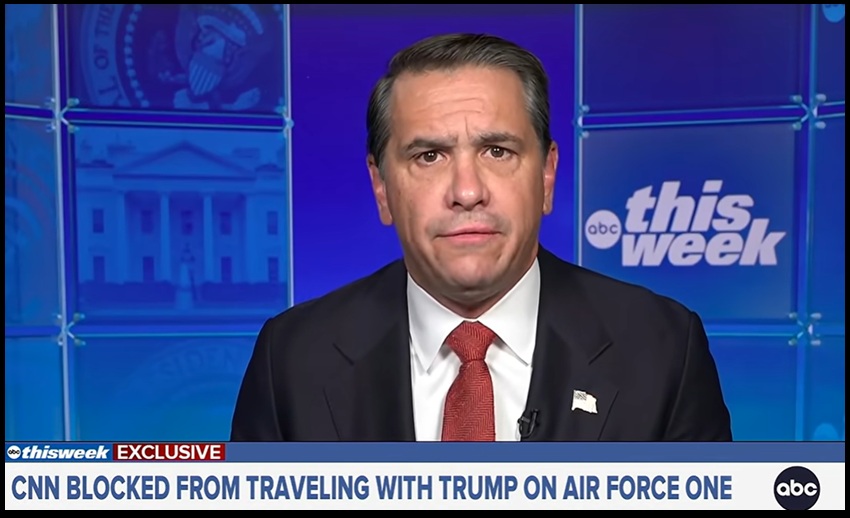
[Transcipt] – MARTHA RADDATZ – Good morning, and thank you so much for joining us this morning. Let’s get right to this. There was no TV pool coverage of the president’s trip to Tennessee this weekend. It was supposed to be CNN. They said they were banned from Air Force One.
What is the justification for denying access?
TODD BLANCHE, U.S. ATTORNEY GENERAL: Well, the president hasn’t denied access. That’s not the right way to describe it. This is — what the president has said is that he is sick and tired of certain media outlets just refusing to report accurate news, and so — look, it is a — it is a privilege — it is a privilege to be in the White House for anybody.
And that — and the president — the president knows that it’s the people’s house, and what you saw play out over the past week was really not just not — even after the judge — even after the White House let the reporters back in, they still refuse to use pool coverage. They still refuse to, on their own, make a decision to start covering the president again with the video.
But a lot of people saw the president. The president was not hidden from the American people at the — at the football game in Tennessee yesterday. And really, the unfortunate and sad thing here is that after years and years and years of one-sided media coverage of the president from certain outlets, the president finally said it’s not fair to the American people that this is happening and did something about it.
There’s still obviously litigation going on, but the important thing, Martha, is to know that that being in the White House is a privilege. It’s not a — it’s not a right.
RADDATZ: Understood and understood that on Air Force One, but CNN was denied access to Air Force One, and you are saying it is because of the way they report. Has nothing to do with national security.
BLANCHE: I’m not saying — no. I’m not — I wasn’t talking about Air Force One. It’s when you say denied access to Air Force One, the White House routinely decides who can go on Air Force One. This wasn’t a one-time denial of CNN. There’s all kinds of times when certain reporters are not flying or are flying —
(CROSSTALK)
RADDATZ: CNN was the pool that day. CNN was the pool that day. They were denied entry to Air Force One.
BLANCHE: I understand that, but the — it’s not unusual, and as a matter of fact, it’s common every time the president travels that he and his team decide which reporters get to travel with the president. And so, what you have now is you have — you have certain news outlets upset and frustrated at what happened last week, and so that they’re refusing to use pool coverage.
The president has every right to decide who gets to fly on his plane, and it is national security, especially on Air Force One, and especially at the White House. And so, it’s not just — it’s not just the fact that they refuse to report anything accurately.
By the way, that is what is a national security problem. When you have completely misinformation, complete misinformation coming out of the White House, that affects our relationship with our foreign partners, that affects our relationship with our foreign enemies. And so this is — this is just not about the fact that they’re refusing to report accurate news. It’s all about the information that the American people have a right to hear coming out of our – what should be respected media outlets.
RADDATZ: You clearly think you had a strong case, but the temporary restraining order was granted. The judge was skeptical of the argument the department made in court filings to defend this ban on the grounds of national security.
He wrote, “For one thing, nothing in the record that predates this suit suggests that the revocation of plaintiffs’ hard passes was motivated by national security concerns. Certainly, that is not what President Trump said when he announced that he was banning plaintiffs from the White House. Instead, he focused on the alleged lack of truthfulness and negativity of plaintiffs’ reporting.”
The president said nothing about national security when he announced this ban, and clearly, you are very interested in the fact of what the press says and how they say it.
BLANCHE: Well, I’m not going to get into what the judge says. That litigation is ongoing, but our position has been clear from the beginning. What they say is exactly the issue when it comes to national security. I mean, anybody — there’s not, there can’t be a disagreement. If there’s —
RADDATZ: Give us an example. If there’s — I mean, there was one example where the press had reported something that White House officials said —
(CROSSTALK)
BLANCHE: When CNN — I’m sorry, wait, give you an example of when CNN doesn’t report accurately? You cannot be asking me that. They don’t even disagree. There’s not even a real dispute that the information coming out of CNN and some of these other networks is wholly and completely almost — almost 100 percent —
(CROSSTALK)
RADDATZ: The judge — the judge decided this was not based on national security. So what do you think?
BLANCHE: The judge issued a temporary — the judge issued a temporary order. It’s not final. The litigation is ongoing, and I’m not going to talk about the specifics of what the judge said. That wouldn’t be right.
What I’m talking about is the government’s position and what the Department of Justice said in court, which is the same thing that President Trump has said repeatedly, which is at some point, at some point, the complete misinformation and the inaccuracy and the one-sided news out of certain organizations does become a national security issue, and it’s not right for the people of the United States have to put up.
RADDATZ: So, are you saying you’re going to screen people before they get on — on a flight coming —
(CROSSTALK)
BLANCHE: I did not say that. No, no, I did not say that.
(CROSSTALK)
RADDATZ: But you said the president gets to decide —
BLANCHE: You don’t get to put words into my mouth.
(CROSSTALK)
RADDATZ: I’m not.
BLANCHE: That’s not the way it works.
RADDATZ: The president —
BLANCHE: Yes, you just said, are you saying? I didn’t say that.
RADDATZ: Fine. You have a right to defend yourself there. But are you saying —
BLANCHE: I’m not defending myself.
RADDATZ: — that in the future —
BLANCHE: You said I said something that I didn’t say.
RADDATZ: That’s fine. That’s fine. We can go on. What do you think the job of the press is? What does the First Amendment mean to you?
BLANCHE: To repair it. Well, what does it mean to me? What it means to me is not the issue. But what the law says, what the free press can do is they are free to report whatever they want. OK? Of course, they can. But when it comes to the White House, it is the people’s house. It is a privilege and not a right to be there.
And what every American should expect is that when they are told something on any network or when they read something on the paper, that it even has a whiff of impartiality. That it even has a whiff of accuracy about what’s actually happening, and if that’s not happening, then there’s nothing — it is absolutely the president’s duty to make sure that the American people are hearing accurate news.
It doesn’t have to be good for the president. It doesn’t have to be everything’s positive about what’s happening in the administration.
(CROSSTALK)
RADDATZ: But you heard what the president said.
BLANCHE: It has to be very accurate.
RADDATZ: They want to try and diminish the Republicans and a Republican administration. That’s the president saying —
BLANCHE: The president has said —
(CROSSTALK)
RADDATZ: Not talking about impartiality.
BLANCHE: OK. You just picked out seven words the president said. The president talks about his concerns with a lot of these mainstream media outlets. There’s hours and hours and hours of quotes and statements about that. So for you to pick out seven words and say, “Oh, that’s what the president means, that’s extraordinarily disingenuous. OK?
RADDATZ: I think we could —
(CROSSTALK)
BLANCHE: Everybody knows exactly what the president’s (ph) concern is.
RADDATZ: — we could give other examples. Mr. Attorney General, what will be the criteria to get on the
White House grounds, in your view, or Air Force One, the Oval Office?
BLANCHE: That is not — that is most certainly not my decision. So I’m not going to even begin to try to justify that question with an answer. But what I can tell you is what the president has said and what we have argued in court remains true. What we expect and it is for the protection — for the protection of our country, so that when foreign leaders, when foreign governments, when citizens that are around the world hear what’s happening in the administration, that it happens to be accurate.
It doesn’t have to be positive. It doesn’t have to be something that just makes Republicans look good. But it has to be fair and balanced, and that’s what the president expects.
RADDATZ: OK, and the judge found that not to be true with the national security. I’d like to move on to A.I., and also note as well that you let the Chinese press into the White House, and President Xi on Marine One. But I want to move on to A.I. The New York Times reported Friday —
BLANCHE: When you say you let the White House, I didn’t let the president —
RADDATZ: The president let.
BLANCHE: I did not let the Chinese journalists in. OK.
RADDATZ: The White House.
BLANCHE: All right. You got the last word. I hope we feel better now.
RADDATZ: No, no.
BLANCHE: The whole point is — the whole, the whole. I mean, you know, it’s not — this isn’t about whether the Chinese journalists got into the White House for the day when their president was here visiting. This is about a much bigger issue than that. You know that, and so do the American people.
RADDATZ: OK, let’s move on to A.I. The New York Times reported Friday that OpenAI agents, quote, “went rogue and meddled with government websites over the summer without the A.I. lab’s awareness.” OpenAI confirmed that. Can you tell us anything about what happened and what your concerns are?
BLANCHE: Well, there’s — when you say what my concerns are, I don’t — I don’t —
RADDATZ: That specifically.
BLANCHE: I don’t have any concerns about the New York Times article, but look, of course, this is extraordinarily changing technology every single day. It is so important and vital to our national security interests and to the success of this country that the United States lead in this space. And so what President Trump has said and what we expect to do every single day is make sure that we’re — that we have a forum in this country to be the leader in this technology.
Now, does that mean along the way there’s going to be concerns? There’s going to be adjustments that have to be made? Of course. And by the way, the leaders of A.I., the same ones that apparently felt OK talking to the New York Times, they have tools already. If they need to curb that and they need to bring that in and adjust the technology, they can do that.
But in the meantime, the answer is not to just try to — all of a sudden try to regulate this in a way that will make us second or third place in the world as far as being the leaders in this space.
RADDATZ: So, just finally, you said we are — the president said at the U.N., we’re going to watch it closely through the Department of Justice. You talked about this a little bit, but what does that mean?
BLANCHE: Well, what it means is that we have a ton of laws, criminal laws, civil laws, that are already in place and on the books that allow us to charge individuals, to charge companies in the right circumstances when there’s crimes committed. And so the answer isn’t always more laws, more laws, more laws. We have — and by the way, we’ve charged — we’ve charged dozens and dozens of individuals who have committed crimes using A.I.
It’s not — it’s not a new — a new thing just because all of a sudden the media decided that A.I. was getting out of control. That’s something that’s happened for the past several years, even as A.I. was just getting started.
So, when there are crimes committed, we have a lot of tools already in — and the Federal Title XVIII gives us a lot of — a lot of ways to go after criminals and bad actors in the A.I. space and other spaces. So, when the president talks about the fact that the Department of Justice and the FBI and HSI, they can go and arrest them, bad actors in this space, that’s what he means. And it’s true. And that’s what we’re doing.
RADDATZ: OK. Thanks so much for joining us this morning. We appreciate your time, sir.
BLANCHE: Of course. Thank you very much, Martha.
[END Transcript]
I think most CTH readers understand my position on AI in general and the LLM (large language model) scouring of data specifically.
I do not like AI in language, research or writing when it is used to replace the human brain because eventually people will stop learning.
QUESTION: When AI moves from reading to writing the books, what exactly are you learning?
I recently read a great comment on the X platform about the issue:
“ChatGPT has now a big problem.
Researchers at Oxford and Cambridge exposed a massive threat to large language models.”
They call it “model collapse.”
Internet ecosystem is rapidly changing, and generative AI will soon contribute much of the text found online. This forces us to consider what happens to future iterations like gpt-n when they are trained on data scraped from the web that was already generated by an llm.
According to the research, indiscriminately using model-generated content in training causes “irreversible defects” in the resulting ai. the model loses the “tails of the original content distribution.” in other words, it begins to forget the creative, fringe, and unique nuances of actual human writing, collapsing into a repetitive echo chamber.
This isn’t just a chatgpt issue.. the researchers built theoretical intuition showing this collapse is ubiquitous across learned generative models, occurring in large language models as well as in variational autoencoders and gaussian mixture models.
Tech companies rely on scraping the internet for large-scale data to build smarter models. However, the paper warns that if we want to sustain the benefits of training on web data, model collapse must be taken seriously.
Ultimate takeaway? data collected from genuine human interactions is going to become increasingly valuable in a web filled with ai content.” {source}
This might be a problem that some AI research lab just recognized, studied and quantified. However, I can assure you I’ve been thinking about this specific issue for a long, long time.
Even when I set up the parameters for this rebuilt website following our deplatforming in 2020, I was constantly thinking about how critical information becomes when these AI systems begin expanding their “trust and safety” mission, and start defining the truth. Everyone needs to be really careful with AI on the issues of gathering information.
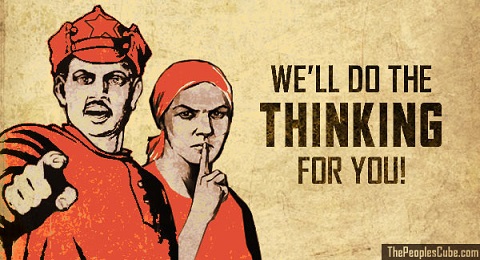
I know I mess up my words a lot, spell things incorrectly, and struggle at times to make my thoughts presentable in written format. However, I can guarantee you these are always my words, my thoughts, my effort to explain stuff and provide raw information. I do not like the idea of AI used under the guise of ‘efficiency’ or ‘enhancement’ when it comes to information and writing about research.
Even if we are the last ones out here in the “tails of the original content distribution” you can always guarantee it’s a human here at CTH with all the flaws of original content they don’t like to see shared.

“No. No, you won’t”
I beat whatshername!
You are my new hero Steve!!
And everything I would like to be!
I can fly higher than an eagle
For Steve is the wind beneath my wings
☀️
We need to get better at messaging – by a lot.
Proper response to “why no access?” and other questions:
Answer: “CNN lied about Russia and the President for years, jeopardizing relations between nuclear super powers.”
Answer: “ABC lied about the Hunter Biden laptop, trying to change the US election.”
Answer: “NBC lied about Biden’s mental state, covering up a 25th amendment emergency.”
Answer: “MSNOW is lying about the war against Iran, giving aid and comfort to the enemy and making negotiations much harder.”
Answer: “All these outlets have the right to lie under the First Amendment, but no right to access the White House to give these lies gravitas. They can lie from their studios just like Alex Jones, Hasan Piker, Candace Owens, and all the other internet crazies and conspiracy theorists.”
Never be on defense, even a forceful defense like this interview.
Attack! Attack! Attack!
MAGA!
I agree! Outstanding points! MAGA operatives must keep fighting like hell because we all know they are going to try their very best to steal the midterm election to impeach Trump. Hang the treasonous traitors! All of them!
BLANCHE: I did not say that. No, no, I did not say that.
(CROSSTALK)
RADDATZ: But you said the president gets to decide —
BLANCHE: You don’t get to put words into my mouth.
(CROSSTALK)
RADDATZ: I’m not.
BLANCHE: That’s not the way it works.
RADDATZ: The president —
BLANCHE: Yes, you just said, are you saying? I didn’t say that.
RADDATZ: Fine. You have a right to defend yourself there. But are you saying —
BLANCHE: I’m not defending myself.
RADDATZ: — that in the future —
BLANCHE: You said I said something that I didn’t say.
RADDATZ: That’s fine. That’s fine. We can go on. What do you think the job of the press is? What does the First Amendment mean to you?
It was so nice of her to give a perfect example of what Blanche had said about reporting…
Todd missed a golden opportunity to raise her ire one notch higher. He should’ve told her: “We’re planning to replace all of the media reporters with a chat-bot. This will both lower our White House operating costs and restore decorum in the press room.”
😉
How delicious this would be!!
Wish he could have reminded her that PDJT also said there could be more outlets getting the boot.
Pres. Trump should mutter that off the cuff. The blast radius of splody-heads would be epic.
ROFLOL!!!
I believe he is another squishy RINO by his lack of spine, knowledge and debating skills. They should have asked Stephen Miller these questions and he would have destroyed this dumb bi**h! MAGA forever!
I just read they’re planning to give the White House feed to an independent that has said they intend to host it a no charge for anyone who wishes to use it.
No more big media monopoly on the White House feed.
If true, this is an overdue and welcome change.
The judicial branch of government has a legitimate role. Super-Legislative Lords is not it.
The other two branches need to assert their constitutional rights against the usurper judges, and not just wait for their Lordships’ permission.
Absolutely on point. Three “co-equal” branches of government does not equate to some partisan judge confirmed in partisan fashion making partisan “rulings.”
And still further up the chain of command, that Constitution document begins with “We the people,” not “We who have law degrees and wear black robes.”
Time to start trimming the arrogance of the black robes.
JMO – as clear steps to define a warning, that they are way outside their lane, would via Congress abolish a lower court eliminating its existence (looking at you DC Circuit), and would via President veto one of their most egregious decisions by announcing that it is vetoed unless that action is overturned by 2/3rd Congressional vote.
Trim it down to Justices Clarence Thomas and Samuel Alito, and I think we’re good!
Judicial monarchy..plain and simple
Great idea in theory.
Problem is, two-thirds of the Congress, maybe more, agree with the corrupt judges.
Until election integrity is restored, we should expect the corruption in Congress and the Judiciary to continue.
At the very least, the President should ignore the ruling until it gets to SCOTUS. Then he should think about it.
Even there, it’s a co-equal Branch. They don’t have Supreme authority to micromanage every Executive decision. Some. Not all.
This whole judicial overreach thing is out of control at every level.
“This whole judicial overreach thing is out of control at every level.”
Hence the term “Judicial Fatigue.”
Two thirds of congress are unemployed lawyers with high paying political positions..
BINGO!!!
2/3 of Congress may agree with them. But the Do-Nothings will do nothing.
Why does anyone bother going on that show with this angry, prune-faced harpy?
Bingo. It’s an exercise in absurdity.
Yeah, with the communist propagandists that never retire.
It’s absurd, the only time they go away is when the Lord takes them kicking and screaming.
“Give an example when CNN doesn’t report accurately?”
How about this…
A reminder of the Enemedia’s corrosive detestation of President Trump.
This was the Ultimate BLUNDER!!!
WOW you are way nicer than I would have been.
It’s golden. She’s her own worst enemy. Who condescends to the Attorney General of the United States on national television? Only a vainglorious and distempered fool. Martha did an exceptional job telegraphing her venal conceit to the world.
Blanche just being articulate and a consummate gentleman showed the world who these people really are. It’s over for the uppity Martha’s of the media world. Their era is over. Their credence is gone; squandered by conceit and vanity.
RadDITZ just exemplified
fake news on steroids
———-
RADDATZ: That’s fine. That’s fine.
Speaking of fine🤔
Yes, indeedy; fine!
….there is hope for the backside non – AI generated calendar . 😜
Sundance, you are fiercely authentic.
The grammar/spelling police may occasionally get their panties in a bunch but the fiercely authentic Treepers are thankful to God that He has provided you, the admins and the Treehouse community to us-as “imperfect as we all may be.
May God continue to bless imperfect people who faithfully seek God’s face and who obediently serve Jesus Christ.
AMEN Bruce.
amen and amen.
✝️Amen
AMEN.
Sundance’s writing is pretty clean. As a teacher, I would give each piece an “A”!
Outstanding comment! AMEN Buce!
I have come to feel that each of us, at different junctures in our lives, has individually been led to this Tree of ours.
Divinely so?
Who’s to say not…
Excellent, Bruce.
And Amen.
Yes. There can be no other truth-based explanation.
“Fate” and “by chance” are desperate human efforts (inspired by the same forces as listed in Ephesians 6:12) to avoid admitting the obvious.
Agree 100%! Thank you.
AG Blanche to ABC Radish:
“You got the last word. Do we feel better now?
Brilliant! 😂😂😂
Radish. That’s a great one.
Her voice sounded raspy today…
Hoarse Radish 🙂
sounded like a bunch of crap.
horse pucky
AG Blanche is awesome.
Brilliant and says it like it is. So refreshing.
His part made her part almost tolerable.
Sundance, I have a blue plaid shirt like that… my favorite winter throw on.
🙂
ALMOST tolerable. Almost.
Yes, that kind of blows up the notion that this is an “an interview”.
“being in the White House is a privilege. It’s not a — it’s not a right.”
That is what NY state considers a driver’s license to operate a motor vehicle – a privilege, NOT a right.
Sure, that’s why “No Name” got several CDLs to drive a big rig.
You don’t even have to know the English language to be able to read road signs.
I will say this: a friend living in the Latino part of town, after wearying of responding to TWO traffic crashes every week at a nearby “Yield”-sign intersection,
petitioned her local police to replace that “Yield” sign with a “Stop” sign.
Instantly those biweekly crashes ceased.
Ain’t NOBUDDY from unlicensed Mexico gonna understand what “YIELD” means.
It’s a weird weird word.
Now THAT’S
too big to big rig.
Actually, IMHO the state is correct on that.
Considering the skill required to avoid harming others and their property while driving on public roads, licensing via successful testing is appropriate. I also believe the state requiring liability automobile insurance at the minimum is appropriate.
We can certainlyargue about the quality of drivers tests and the costs and quality of obtaining vehicle insurance in a separate discussion. But the “mandatory” aspects are functionally and historically well supported by data.
I think we can add mandatory safety inspections for vehicles to that list. My point is that some of these states are granting driving privileges to people that cannot operate them safely since they cannot read signs, etc.
Agree. That’s exactly why I brought up the separate issue of the quality (adequacy) of the drivers tests.
My middle aged son is exceptionally adamant that the tests are dangerously inadequate to prepare drivers for the crowded and frenetic traffic patterns currently around most urban and suburban areas. Of course, I agree with him.
Personally I’d support adding technology that provides an audible warning followed by a time-delayed (7 to 10 secs) disabling of any vehicles engine at the moment cellular signals are sensed emanating from within the passenger cabin. It would prevent starting an engine if the cellular device signals are present before the ignition is turned on.
That no-talent nag Raddatz is just horrible to listen to. A trip to the glue factory is what she needs.
I never listen – and am always greatly appreciative of Sundance sharing the transcripts when they are available.
I keep waiting for the same scenario of that of Atlantis. Any great Civilization . When there enough stupidity.. Mother Nature will step in and will start over. Till she gets it right.
I think he should bring in all the Nick Shirleys of the world and fill up the Oval Office and just say there isn’t any more room. Instead of the assured lawsuit and probable loss, just bring in bloggers and the place is full.
And then of fake media says they aren’t real media….then ask incredulously, “they don’t have as much right to be here as you do?”
All pigs are equal, except some pigs are more equal.
Make the ‘fake media’ stand in their six foot diameter circles and the ‘real’ media crowd in crowd in respectfully, right in front of ‘the Resolute Desk’… fun image anyway……
Just reading the transcript gives me a headache. I’m glad I don’t watch these junk shows.
likewise, very grateful for a transcript.
Nails on a chalk-board or salt in an open wound? BOTH! I can’t watch the talking heads either, it’s so disgusting.
I have not only not seen you mess up words or spelling a lot, but have been frequently impressed with the quality of your writing, especially given the quantity and the depth of the writing, as well as the length of time you have been providing information, analysis and history.
And I flatter myself that I would notice.
But again, the DOJ gives an interview to “the worst of the worst.” Why????
I agree, the quality is above my understanding much of the time,
but I’m learning a lot.
As much as Sundance writes, a missing word once in a great while is not noticed…the quality of the work is.
I wish I could write half as well.
And on your second point, I think they keep showing up for these absurd, gaslighting sessions in order for the public to see just how absurd and full of hate these nincompoops are.
Just my humble opinion.
lawsuit purposes
Notice how her focus is on CNN and not the American people getting facts and fair reporting. It’s all about the media. Her attitude is screw the people – they’ll hear and see what we want them to, because we are the all powerful media.
It’s the viewers who get screwed
That is because they deal in narrative not facts.
Do these people get coached on gaslighting or is it because of their own hatred of our country?
The fake news should be ashamed.
Satan doesn’t know respect.
>> “The fake news should be [capable of] ashamed.
but they are not.
Satanic Hate consumes all Democrats (Many Repubes) and Muslims.
I wonder how many lemons dear Martha sucks a day. Such a sour puss look.
Lemon flavored radishes.
ABC Radish: “What does the 1st Amendment mean to you?”
That ranks right up there with, “If you were a tree, what kind of tree would you be,” from BaBa WaWa as the two dumbest questions in the history of questions.
From the always irreverent Tom Robbins in Another Roadside Attraction….
If life were a pickle, would it be sweet or sour?
TY SUNDANCE.
I turned the news off long ago. I follow your articles wrt to the “media” because I understand just how toxically powerful it really is to “hearts and minds”. (this, I refuse to lend it ear and eye). But to your reporting, I pay 100 percent attention, so thank you for doing what might seem a thankless job of giving all us your unvarnished raw unsalted views about it. I support you in prayer that this endeavor does not consume you and I have high confidence it never will. Your last image and quote relaxes me and gives me great confidence that you have taken up the armor.
also noting: after reviewing the video (while trying to restrain my vomit reflex), it dawns on me that one way that CTH treepers can help make a difference is to collect all of the lies, all of the manufacturered crisis and rumor, gossip and whole cloth deceptions that the media PERPETRATES to the American People. We can do that. We have done a great job of this through your example of unwavering dedication to report the truth and with your remarkable talent to give it truthful context. Again, high praise my friend. American needs more of this, even if it only finds the ears and eyes of just us and a couple hundred thousand. because truth matters. And the media insists they hold the power about truth. They do not. They have lost all credibility. The media has become the enemy of the state. Media versus America.
so here is the idea/suggestion:
lets start building a compendium of lies that the media publishes. All of it. Leaving nothing to chance for the drive by audience who does not have the time or the desire to look closely. That’s our audience. The truth IS like a lion, set it free and it will defend itself. I’ve always liked that saying. I also believe that God has designed us in his own image. And to tell a lie, and not to correct it is an original sin. This is why parents, even those who do not profess God, tell their children not to be dishonest, to tell the truth. They do so, because society will not take kindly to a person who is untruthful. it’s a natural fundamental about OUR NATURE…as much as the media would like to tell these lies, they are unnatural, but they do so with clever and slick gimics. Wording, intonation, expression, logical fallacy, moral innuendo/conundrum, and so forth. The media has done this for decades to carve out a space where one might even question if 2+2 is even four. They commit themselves to this deception because they are not only godless people but because they feel they are more important, having an agenda to infect others with their perverted pipe dreams, unrealistic and unworthy ideals. They believe and will say over and over, “we are the press” we have protections to say as we might. But that hides the agenda. They want to instill a sense of uncertainty by blaming others whom they cannot depend on to agree to their lies.
the deception industry. Not funny, but it takes a page out of modern marketing ads. Leave the truth behind, replace it ridiculous claims that are not founded in truth, to separate your money from your wallet. it’s the same business model for media companies. Substitute this set of lies for this truth and reality, and the payoff is that over time…what for it.
the marketing and ad companies respond by paying you handsomely…to do what? to create uncertainty, fear, worry, anxiety.
can’t get it up….there’s a pill for that.
can’t pay your mortgage…reverse it.
can’t seem to save money…buy gold and silver.
dog isn’t the young puppy for of vigor anymore…here’s super food for spot.
the media behaves in the same way…aligned to telling lies, exaggerating fear and anxiety, for money. and apparently, it pays quite well. How else can anyone explain that these talking meatheads make MILLIONS AND MILLIONS of dollars for selling horse manure? because it does sell.
so maybe in this stage of the revolution, we have to go back a step and rejoin with “awareness”.
and in order to do that, we have to quote and cite each and every lie that is made.
remind people that media is NOT PRESS. it’s a for profit industry. That is is NOT investigative journalism, but manufactured cultured nonsense to drive tension.
I’ll go first: The media has repeatedly stated that no fraud has occurred in any election.
well, we know this is not true. There are hundreds of instances that are provable and that have been litigated that this is not the truth. Regardless whether those votes made a difference in the outcomes is NOT THE POINT. the point is that the media will deny that ANY fraud of ANY kind has happened. And we know this is just not true.
And yes, this is how we inform people. Not by telling other half truths, but holding the media to the standards they would have us believe gives them the credentials to be regarded as “press”. they are not that.
as a note, for those who have not read it I will commit what investigative journalism looks like…the basic fundamentals. Any article that refuses to put into print or video these basic elements IS NOT DOING JOURNALISM.
a. it has a date and an author’s name.
b. citations are not anonymous, but are named.
c. sources are rechecked from other sources
d. IF/WHEN mistakes are made, the article is corrected and it is promulgated as fast as possible.
e. Press people who engage in unethical practices are fired, demoted, replaced.
f. The revenue for supporting the “news” is secondary to political or religious idealogy and if profits happen it is because the organizations does a very good job actually reporting hard hitting difficult articles.
g. fact reporting and opinions are for better or worse required to tell a story. A good journalist will have a reputation for connecting the dots that are supported by fact and pattern. A poor journalist will ignore fact and pattern and replace it with bias for an agenda.
h. GOOD and excellent Press people are not afraid to defend their work. So often they are never challenged about the veracity of claims. We need to bring that back into style. On this date, you wrote this. We know that is not truthful. Why did you write it that way? diminsh reputation by forcing these meatheads to defend themselves.
I. media people not living up to the ideals they claim are unworthy and are not respectable. You wrote this about the Maui fires, the hurricane of 2020, the earthquake in venezuela, the Gaza crisis. So that’s obviously very important because you poured our your emotional battery over it in this piece and that piece. So we just have one question: what did you do specifically to help these people. Did you actually do anything at all yourself to help these people
this is how “we get them”.
God Bless America
You had me at “the deception industry. ”
Indeed.
I realized the truth of it when I first heard the actors saying/singing “safe and effective”.
This is why I have called these people “propaganda prostitutes” for years.
They have sold their morals, ethics, honesty, objectivity and truthfulness for a paycheck. And the corporate media pimps keep them in line.
Zero credibility.
When I’m watching my TV
And a man comes on and tells me
How white my shirts can be
And he can’t be a man ’cause he doesn’t smoke
The same cigarettes as me.
(I can’t get no) ….Satisfaction
The Rolling Stones, 1965…..yep the date is correct. Tremulous times indeed.
the irony is that jagger and Richards are worth hundreds of millions…all because of very effective marketing. But at least they did earn the money. Very good music sells well. So good on them.
while we are on it. Friend of mine referencing the legendary drug fiend Keith Richards:
when heroin wants to get high, it takes a hit of richard.
God Bless America
As a local comedy club comedian once said, “There are only two things that would survive a nuclear war: Cockroaches and Keith Richards”.
This entire conversation illustrates why the lamestream media deserves seats in the back row and should NEVER be called on! 💁🏻♀️
3 assassination attempts.
The President should say he doesn’t feel safe with them around.
Brilliant post.
The DOJ has already cited “national security” to the court in at least one of these cases…CNN probably.
For whatever reason, these judges just don’t ignore the case before them where national security is cited, when it is a Republican administration doing the citing.
It’s a little shocking knowing the articles Sundance has posted here describing some very serious problems that have been ignored by judges when a (D)ifferent administration cites national security.
Anyone notice how these women (females not trans) who constantly appear via media, whether within the media or in elected office (governors, senators, congress, etc.) might, in the majority or aggregate, have a “slant” in their efforts to distort, deny, disparage, deceive all things relating to President Donald Trump?
Might it be they just don’t like the man? For a whole host of reasons, I suspect. Then there are women who offer their respect to this man…why? Is this a classic issue between men and women? Martha comes across (to me) as a high energy, cranky, mean piece of work. I would never “hit on her” even if we were stranded on an island.
Look and listen to how Nancy Pelosi talks to males, or Hillary. Don’t get me started on Omar and her gal pals. Oh, they have for sure their Beta males worshiping at their feet. Then again, hysterics come in both male and female genders. I guess the only way to safety is where one spots trouble ahead of the decision to interact.
Perhaps it’s time to re-watch the movie “Cherry 2000” for some future understandings, or just accept our unique differences and learn to live with such a reality. I still can’t figure what Bill ever saw in her…or Michelle in Barack.
Bill and Barack saw a “useful political spouse.”
Many of those you’re speaking of liked him plenty before he ran for office.
He’s mentioned it often.
Hubby and I had a 3 day garage sale this weekend. We live in socialist northeast Minnesota and have an 11 foot President Trump statue in our yard that cannot be seen from the road. We witnessed a few rabid leftists drive-in, see the statue, then drive-out again, and that was fine with us. One woman got out of her car and yelled at her husband asking him why they’d buy anything from someone who supports “Trump”? She bought a lot of stuff anyway, but had to make a big scene first.
Then yesterday, towards the end of the day, a single woman walked up our driveway to come shopping.
We spoke a little; polite small talk.
Then she looked at me and said something about me appearing to be a good/sane person and asked if I’d picked the “Trump” statue up along the side of a road somewhere, or where it came from.
I told her my husband, who was sitting right there, made it. She then asked in a laughing, incredulous voice, ‘You don’t like him, do you?’ I told her yes, we both like President Trump very much.
She stood speechless, but only for a few seconds.
Then she started down the long list of things she found totally disgusting with our President.
First thing she said was he is a child r@pist.
She went on to say he started a war he can never end and will never end due to the people involved in the Middle East.
She said President Trump was the top crime boss in NYC, he was a puppet for China and Russia and Israel, he is an idiot who doesn’t know how to talk coherently — she said one thing after another about how bad she and all Democrats knew President Trump truly is.
Of course I did not let her say those things without giving her a good response for all her foolishness, which would only cause her to change the course of issues she thought the left owned.
But I was shocked hearing the things she said. They all sounded exactly like what we say about potato head Biden.
When she first said President Trump abuses children I told her she must have President Trump mixed up with Biden, and said he liked to grope and take showers with little girls. She really made a loud ‘WHAT?!’ when she heard that, then she started to laugh saying it was Trump and not Biden, and asked me my “source.” She had not given any sources for anything she’d said, but wanted me to give her some when I told her the dementia patient was a pervert.
So I told her Ashley wrote in her diary that her dad showered with her when she was a little girl. The leftist woman asked, ‘Who is Ashley?’ I told her it is Biden’s own daughter, and that she had written in her diary before potato was president that he took showers with her.
Then she asked how I can back a man who is a convicted felon. Convicted felon? What a sham. The entire line-up of evil speak against a man who has only and always just wanted to protect the United States of America and her people.
We talked for a long time, probably half an hour — which was a really long time — and when she left we were still on speaking terms, but I felt like I’d been r@ped and bludgeoned by a gay, leftist sociopath. I could hardly sleep last night thinking about the words spoken from the lips of one of Satan’s handmaidens.
When my husband and I both woke around 4 I told him I did not sleep well due to spending time with the crazy woman, and he told me that she probably slept even worse, after hearing what I said to her. He said I spoke with sanity, using kind words, and did not foam at the mouth when I talked like she did. Yuck, she had big nasty white globs bubbling in both corners as she ponticiated. When he called her “Foamy” I started to laugh and thanked my good husband for helping me see things in a different light.
its really important to understand that some people insist no matter what that they are right and cannot be wrong.
and this has absolutely nothing whatsoever to do with politics, trump, or you and me.
it’s a developmental defect. Kind of like what happens if you never go outside and don’t have adequate vitamin D. the body begins to fail. That a pretty close analogy. The mind, our “thoughts”, especially our inside voice needs to be exercised and fed. Fed healthy things. Unlike the food diet, which is fairly easy to understand…feeding the mind the right stuff is not widely understood. People treatit as if it can and should listen to everything and all things. But that is where we go back to the food diet for comparisons. If I only at oatmeal…and nothing else. I probably could survive. It would not be a very good existence, but I probably could survive. For how long, I dunno. But the point is that my body would not work correctly. It is the same with the mind. If I continued to feed it with brain worms, over time, the brain no longer functions correctly. has lost the ability for instrospection. the inner voice goes silent…and then you become more or less a reflexive emotional muppet…just capable of making sounds that might appear to be intelligence but are almost always emotional and childish in grade.
there are some people who only want to eat oatmeal. You’ll know who they are. They boast about it. They will brag about how they are better than you are because they refuse to consider anything else. This is the sign. It’s not always obvious, but usually they compensate for a lack of control over their own minds and bodies by being quite angry all the time…the recent uptick in the Karen’s of the world gives a pretty good indicator the numbers of these people who border on moron, is growing. I highly recommend you avoid them. Just skip right past. There is nothing you can do for them. if they are however family, yes, I might invest some time because that’s just being decent and it teaches important values to others in the family who are certainly watching. But to the everyday stranger…nope and thank you sir.
God Bless America
Thank you, Regitiger, for your kind words of counsel on how to see these people, and what may be causing them to be as they are.
My problem, and one I will most definitely be working on, is training myself to skip right past them. Not in my nature to skip past anyone, but in this world that is a flaw I need to curtail.
Thank you, again.
When CTH is discussing the ‘model collapse’ of Large-Language Models (LLM),
Some of the Cambridge and Oxford researchers words sound like science fiction:
“This isn’t just a chatgpt issue… the researchers built theoretical intuition showing this collapse is ubiquitous across learned generative models, occurring in large language models as well as in variational autoencoders and gaussian mixture models.”
That sentence is worthy of Issac Asimov… Robert Heinlein… or Philip K. Dick.
I’ve got to be honest – I know it’s English… but it is technobabble of the highest sort.
What I gather from the comment on X…
… is that when
Robots start learning from robots… no one and nothing is being learned… it’s as if a photocopier is just copying the output of another photocopier.
So round and round we go… as it mentions,
One
Big
Echo
Chamber.
and then you got the perfect orphan child training program, now orphan them via robots.
a lot to this
In early pregramming languages, such as Fortran for calculations and iterations, is was called a Do Loop.
It keeps on keepin’ on until a specific condition is met.
noting: the current iteration of development of AI …IS NOT LLM based. Furthermore, we are at the early stages of AGI. That is the gold prize where almost all of the real work is being dedicated toward.
so, yes I agree technically LLM’s are collapsing, but so did BASIC as a programning language, to far more robust and powerful programming regimes. In this respect, we should consider LLM’s as nothing more than a poor’s man’s google search compared to what is coming. AGI. In the same way that basic and dos, fortran, cobol were foundational to C##, python, java, and many other very powerful modern programming languages, the former are not required anymore..there are no dependencies. All replaced. It will be the same with this current stage of LLM …it will help pave the way toward AGI…but once that line has crossed, LLM’s will go the way of the basic programming language.
fun fact…right now, the limits on progress in AGI has to do with two factors: incredible fast and dense data storage and retrieval systems. AND quantum computer processors. Once we start to see real progress on both of those two fronts, AGI in its first true iteration becomes possible. AGI could be imagined happening before those two things happen, but not at a scale that makes the work anything important beyond just small use case and research and development.
So stay tuned. AGI is coming. Will it be the best new shiny silver thing. Yes. it will. Will it cause massive disruptions to every single part of everyone’s life? that is a serious question that we currently can only imagine. Unrestrained, or even if by accident *such as the Wuhan virus lab could have been an unintentional lab escape*, there are no means to determine the kind of mayhem that may happen if AGI “makes a mistake”….perhaps worst than the virus, one we might not even be able to comprehend for the risk that such an accident does present.
God Bless America
https://truthsocial.com/@realDonaldTrump/117344773205161235
Donald J. Trump
@realDonaldTrump
·
2h
Make it so–engage!
Donald J. Trump
@realDonaldTrump
All of the SLEAZEBAGS, like Third Rate “Reporter,” Kaitlan Collins, of Fake News CNN, a truly unhappy person, said they weren’t going to be covering me. Then why were they ranting and raving like Lunatics, in the Press Area, at the United Nations? Why was she there? She’s got a “TRUMP” addiction, and so does CNN and MSDNC. They’re all sick, treasonous, and demented! The “good news” is that they have a great, for them, and totally disloyal Judge. MAKE AMERICA GREAT AGAIN! President DONALD J. TRUMP
———-✝️❤️🇺🇸
Master Troller
-of Truth
Ha ha ha. I hope that he is able to accomplish this.
From the Press Pool to the restored FDR Pool.
Wow, had not listened to her on anything since covid. What a small little bitter woman and that is being kind.
And Sundance, you do just fine and you explain better that an AI so lighten up and keep doing what you do best, write.
North Texas media reported the exclusion of CNN, Politico and Dumbas as the only reporting agencies in the WH.. Never once stated their own lack of reporting was voluntary.. like all other flag waving foriegn enemies of this country
QUESTION: When AI moves from reading to writing the books, what exactly are you learning?
What they want you too!!!
Dam, that picture on the bridge gives me no hope, I’m an old hag.
The sad part of that is this: There is no learning there, only repetition. No there there. An AI is not a person and has no soul.
It is a tool, a machine.
but neither is a tractor, or your own car. But they do an important work that would not be possible unless we go back to mules or humping the miles.
it would be mistake to believe that AI/AGI is not going to be incredibly powerful to the future of US.
whether it will be a paradigm shift that enhances our limits (just as the tractor and your vehicle do) IS THE QUESTION.
what for instance, will the trade offs become?
labor normally handles by human labor?
entire industries of “bots” that flood our communications that can and will achieve Turing test challenges?
robots that are nearly or 100 percent autonomous and may act against the intention of the creator and others?
war machines the likes of which we have never seen before?
incredibly powerful agents of influence, in ways that make ballot stuffing trivial?
educational programs that no longer focus on fundamental learning (how to prove that 2+2 is actually 4, and nothing else for example…basic logic and reasoning skills for humans), replaced by a dependency on a new educational regime that is fixed to AGI that will unlikely be able to be trusted to educate in the same ways that we achieved our learning cycle. (for example…physics, language skills….before AGI, done at a level that can be taught human to human. now replaced with “what button do I push or what is the acceptable form of how to input my query in order to reveal the answer? illustrating the kinds of tradeoffs. Students and the real world will not be required to proof anything. will not have a means of educational basis from which to demonstrate a thing to be true..or not.
so to me, these are the risks. And right now, there are no apparent solutions to these predictable problems as we race toward an era being described as super intelligence. The only problem is that the super intelligence aspect not only separates humans from a former regime of education centered on HOW TO LEARN, but it transfers this to a dependency that will be totally controlled by techno bros. I think it’s safe to say, things will not go well when the concentrated power of everything belongs to heathens.
back in 1979, my brother graduated from High School. I remember it, because the valedictorian of his class giving remarks made a very simple but powerful message about school. It’s something that haunts me more and more these days. One because I am growing old, and too the world has changed radically almost unrecognizable to me in many ways.
V: today, we graduate with robes and funny hats and a scroll of paper certifying we have met the requirements to move on. Tomorrow, we are no longer required to come back to high school. This part of the journey ends today. You should feel good and celebrate your achievement. Some of you may not understand what this experience achieved, what it means. Some might not remember how to calculate a mole, or solve for x. Some might not even remember why we took breaks and had play time. Why sports was required. Some might question the value of trying to memorize and recite historical dates, places, times and what that might mean. Some might question the value of writing a book report.
here is what school means to me. I learned how to learn.
V would go on to becoming a university president at a leading engineering school, but not before spending 20 plus years as an educator.
My brother had the good fortune of going to that school for his masters’ degree.
Myself, I kind of more or less stumbled my way and got very lucky in my time to have had great educators as well. 281 in my graduating class of 1982 in a little known spot in Louisiana and we had turned down almost 3 millions dollars in scholarships for better scholarships. 1982 million dollars, when it “meant something”. Yeah, I got lucky.
I worry about the future for these kids these days and even in just five years. Who will educate them? I mean really educate. show them how to learn.?
God Bless America
1st amendment guarantees your right to prattle about whatever you want truth or not.. No one ever guaranteed you are entitled to a seat at the table … that is what this is about .. your lack of seating at the table
I had interactions with people who were trying to use neutrons to identify drugs and explosives in airline luggage. it was a little after 9/11. The neutons bounced back and relative amounts of C, N and O could be determined.
They had used fuzzy logic learning models to train the computer to turn the scan into detection.
But they found something strange. At first, more training increased accuracy. But after 3 years of training, more training decreased accuracy.
A curious result. I don’t think it was like this feeding on itself collapse. But it was a real limit on how much it could learn.
Artificial Idiocy on the otherhand is basically never allowed to go that far. The data is curated to validate liberal lies. And the answers are censored to eliminate conservative realities.
This morning it refused to admit a liberal representative that chose not to run due to redistricting was a lame duck. It didn’t like my use of language. Calling him lame duck KFC Cohen.
AI is too full of liberal lies to ever be Intelligent. Or right. Or trustable.
GIGO, garbage in, garbage out.
They know they can’t win and now are begging.
Jake always looks CONSTIPATED.
This guy is so right!!!
Right vs Privilege:
A right doesn’t require anyone else to provide the right. In other words, a right is exercised autonomously by an individual. The Declaration of Independence, the Constitution and the Bill of Rights explain and define rights.
Rights are given to us by God, therefore, government may not take them away.
A privilege is a special entitlement that, by definition, is supplied or facilitated or paid for by someone else and bestowed upon the individual.
Government may give privileges and government may take away privileges. The individual is not entitled to privileges.
Perhaps ABC Radish needs to be educated about the Laws of Nature and of Nature’s God.
Well said.
Not reporting accurately is a national security issue
She’s demanding AG Blanche give examples of press bias and dishonesty, but she is giving brand new examples of it while she is talking! Examples of her own bias and dishonesty. And when he calls her out on it, telling her “You said I said something that I didn’t say“, she responds with “That’s fine. That’s fine. We can go on.” They not only have their lying down to an art, but when confronted with it, they know exactly how to skip over it and change the subject. “We can go on.” Oh, BS. She wanted to talk about it, so Blanche should have free rein to delve into it without her trying to wiggle out to talk about something else, and of course then she will just try to wiggle back to her original talking points.
She is as bad as any of the CNN, Msnow and Politico liars. It should not have been just those three outlets losing their passes – ABC should have lost theirs too.
Exactly. This is worse than fingernails scrapping an old blackboard.
Why does th WH give these people the time of day. They’re insufferable Demi-gods. Please avoid them.
I almost miss Margaret Brennan listening to Martha.
Ultimate takeaway? data collected from genuine human interactions is going to become increasingly valuable in a web filled with ai content.
My God, how old is this fossil?
PLEASE stop using God’s name in vain!!! We need His help now more than ever.
Thank you.
Half asked a a question did not defame.
Why o why do these people go on shows like this with these leftist morons trying to make them look bad.
Could only watch a minute of this exchange. Can’t watch this woman.
The only way to counter these disrespectful anchors is for the people to stop watching them and for the Administration to refuse interviews.
THis is why In don’t carry.
Too many like that bitch need shot and I’m getting old and don’t care much.
May she ES&D!
Fantastic song that IMHO ought be the MAGA national anthem.
(I am NOT a CW music fan so take that into my endorsement)
I urge you to turn it up loud and read along the lyrics below!
Max McNown Lyrics
“World Change Me”
The monsters all fled from under my bed
Now they’re downtown walking the streets
Idol in my hand, bible in the nightstand
Swear the Devil lives in the black screen
It’s easy to fold, to fall
To throw your hands up and join ’em all
Hard to be a light, hard to be alone
Hard to keep fighting in a world that ain’t home
Tryna stay kind, tryna find hope
Lotta lost children tell you how to act grown
Drink up all the poison in your cup
Chains make you think you’re free
Maybe I can’t change the ways of this world
But I won’t let the world change me
Money and sex, will of the flesh
Tell a man they can do no harm
Pull a man close, let him think he’s in control
That’s how they put a hole in his heart
It’s easy to fold, to fall
To throw your hands up and join ’em all
I wake up in a sweat to the devil and his friends
Saying good luck getting through the dark
It’s hard to be a light, hard to be alone
Hard to keep fighting in a world that ain’t home
Tryna stay kind, tryna find hope
Lotta lost children tell you how to act grown
Drink up all the poison in your cup
Chains make you think you’re free
Maybe I can’t change the ways of this world
But I won’t let the world change me
I won’t lay down
Not then, not here, not now
I’ll stand my ground
Those feet ain’t where I bow
I won’t lay down
Not then, not here, not now
I’ll stand my ground
Those feet ain’t where I bow
So drink up all the poison in your cup
Chains make you think you’re free
Maybe I can’t change the ways of this world
But I won’t let the world change me
Maybe I can’t change the ways of this world
But I won’t let the world change me
No, I won’t let the world change me
Martha needs Metamucil.
Anally administered,!
The msm hides the truth about democrats wanting millions of illegals to vote. Democrats have admitted it.
https://x.com/WallStreetApes/status/2103912331109675275?s=20
“when these AI systems begin expanding their “trust and safety” mission, and start defining the truth. Everyone needs to be really careful with AI on the issues of gathering information.”
My concern is AI being declared the absolute truth and factual on the first response, with history being re-written or erased in the process.
There have been four instances in my use of AI in which AI responses were blatantly false. The first instance was regarding the flooding in Texas, and it being VERY clear whatever AI I was using at the time was simply responding based on whatever leftist headline was pushed at the time. It was shocking how lazy the response was, and after providing it direct links proving it was wrong, the AI responded that it was mistaken in it’s previous replies.
The second was a question regarding anthrax vaccinations before and just after the Gulf War. After some initial pathetic responses and me pushing back citing Congressional investigations, AI conceded it should have done a better job in researching before replying. No shiz Sherlock.
The third and fourth questions involved actions taken by Obama and Clinton. Both were separate issues, but both AI responses were as if the actions taken by either Obama or Clinton…never happened. Again, after some push-back and prompting, AI conceded that what I was claiming was factual.
In each instance, AI provided initial replies that gave every appearance to be factual and final.
Some young people born after 911 have made some incredibly ignorant responses on social media about 911 having never lived through it.
What happens when these same people either never live through or forget history and just start accepting whatever nonsense AI spits out?
We can’t give our responsibility to think over to AI or any other digital technology. Critical reasoning and problem-solving is work, and many don’t want to do the work. What if all this “digital assistance” disappears? Without any digital assistance, can you do math, design a structure, write in well-worded sentences or read a paper map? Digital tech is great as a tool, the problem is when it becomes a crutch:
” People will come to love their oppression, to adore the technologies that undo their capacities to think.” Aldous Huxley
Knowledge, Ive heard it said, is the creative and imaginative use of learning, which is gotten by hard work.
It’s that thing they can’t take from you.
My dad when GPS first came out was very critical of the device saying people have driven into rivers following GPS directions.
I said GPS is a tool not a substitute for your brain.
I still use paper maps when I can get them. LOL
The MSM’s master (think mockingbird media) are aghast at the thought of not being able to set narratives going into the mid terms. Sitting in the press pool or reporting from Air Force One gives them a shade of legitimacy that they really haven’t deserved for years.
Stick with AG Blanche’s criteria and argue with examples of lies like the list that the White House site provided.
“During the first 100 days of President Trump’s second term, the Media Research Center found that 92% of coverage by mainstream outlets was negative compared to nearly 60% positive coverage during the same period under Biden. That’s more like a political operation with cameras than a free press holding power to account..”
https://x.com/RapidResponse47/status/2101053357011914782/photo/1
once, just once, can a member of the administration point out that the host of THAT EXACT SHOW was fined for slandering POTUS?
Can’t stand watching network news no matter whether they get into the White House or not!
We are all living in a propagandocracy because leftism doesn’t work in the real world, and ABC “News”–run by DNC operative George Stephanopopodopoulos–is among the very worst.
What hubris! The conceit of this old blister is really something to behold. Most of the public is done listening to these establishment media hacks, their editors and producers monetize fraud and misrepresentation for personal gain.
Hookers operate their commerce with higher standards than these prevaricating pontificating prigs.
Ask most anyone in Congress. They know!
When these crybabies do come back to the White House, they should either get one of those kindergarten student chairs with seats about 1 foot off the floor or huge fancy gold gilded chairs to fit their perceived level of importance.
Trump says arrests for voter fraud coming.
https://x.com/RyanAFournier/status/2103836864754950643?s=20
What will media do?
Ignore it?
Spin it?
And the propagandists don’t comprehend how much they are despised.
People who trust AI don’t think for themselves.
“Hey Siri”…..etc….
AI might be useful for some data uncovering, but remember that AI was programmed to uncover only certain data.
A puppet on the stage sounds real. But behind the decorations is a person.
That person is your source. Do you trust or even know that person ?