CTH strongly emphasizes two key policy sectors, Maganomics and Immigration enforcement; they go together. We cannot achieve the economic results we want for the American people unless strong and powerful immigration enforcement is in place.
While the Dept of Homeland Security (DHS) navigates the deportation and removal process (painfully slow in my opinion), Secretary of State Marco has revoked, blocked and restricted visa entry processes. The State Dept effort is strong, but continually encounters resistance from the Lawfare communists who are trying to destroy U.S. nationalism.
NASSCOM (National Association of Software and Service Companies) is an Indian non-governmental trade association and advocacy group that primarily serves the Indian technology industry. Founded in 1988, NASSCOM operates as a nonprofit organization and serves as a key entity within the Indian technology sector. NASSCOM is the primary advocacy group for manipulating the U.S. visa entry system.

When we discuss the politics in countries who accept bribes and payments for influence in political decisions, we call that bribery and corruption. However, when the exact same activity takes place in Washington DC, we call it Lobbying. NASSCOM is now spending money to purchase U.S. politicians and look specifically about how they frame the discussion. (emphasis mine):
[…] Ameet Nivsarkar, VP in Nasscom, said the association was working on various strategies to limit the adverse impact of the immigration bill. “We are engaging with coalitions and consortiums in the US like the US India Business Council, an independent think-tank. It’s also important for our members and non-members to be a part of the advocacy through multiple engagements that requires having local representatives in the US or even talking to their customers to raise the issue on their behalf,” he said.
The immigration bill seeks to make work visas like H-1B more expensive and difficult to obtain for companies that already have a high proportion of their US staff on such visas. Infosys, for instance, is said to have almost 90% of their 15,000 employees in the US on such visas. If these visas become difficult to obtain, it will compel Indian IT companies to significantly alter their business models. They would either have to hire many more local Americans, which would be expensive, or find ways to do more of the work offshore, which would be difficult. Any such changes would put Indian IT companies at a disadvantage against their global competitors who have a strong local American presence. {SOURCE}
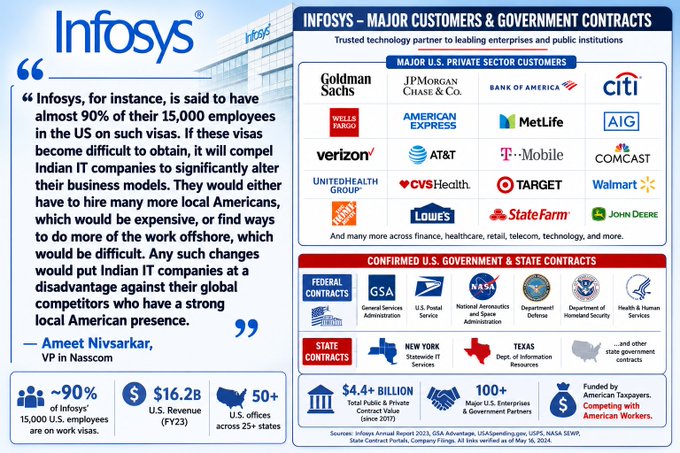
As noted by Amanda Louise on X: “[NASSCOM’s] concern wasn’t that jobs would go unfilled because America lacked skilled workers. It was that companies like Infosys would have to “hire many more local Americans, which would be expensive.”
“Americans weren’t described as unavailable. Americans were described as the more expensive alternative.
And they acknowledged the other half of the problem.. companies with a “strong local American presence” would have a competitive advantage if visa-dependent companies lost easy access to that labor.
That tells Americans exactly what this business model does. Use visa labor to lower costs. Compete against companies that hire more Americans. Win their contracts. And now those American-employing companies have fewer jobs to offer too.
The American worker loses twice.
So why are we still debating what these visa programs are being used for? Their statements tell us the incentive. The immigration filings show us the scale. The layoffs show us who pays the price.
How much more evidence does Congress need before it answers why U.S. immigration policy gives companies a competitive advantage for hiring visa workers instead of Americans?”
The Commonwealth Bank of Australia (CBA) ran their biggest recruitment drive ever in India, while at the exact same time they were terminating 2000 position within CBA. They reported this like it was awesome.
Recruitment drives in India don’t target jobs, they target quota’s. Not a chance 2000 Indians were being recruited for the banking sector, that’s just the placard fluff.
Mass recruitment and distribution of cheap foreign labor throughout trade industries is the goal. Australians have been removed from the labor equation, the workforce already changed.
Tariffs work well to make US products competitive with foreign products. Why not ‘tariff’ imported foreign labor the same way.
Theese aren’t landscapers and hotel maids. These are what your kids paid to get drgre rd s in from overpriced colleges, who pay their worthless professors millions to teach two classes a week 8 months a year and indoctrinate our youth.
we dont need extra landscapers or maids, either.
You may be correct. One thing is for sure. The narrative being repeated daily that we need to keep the willingly cheap work force because they are doing jobs Americans don’t want to do is total BS. Pay market wages once the foreign workers are removed and the jobs will be filled.
Time to make India great.. for the fist time.. the homeland is calling.
Their homeland is calling!
🎯🎯🎯
Just checking first site recommended whe I wanted to see salary rates. This one came up. Gets pretty descriptive.
https://h1bvisajobs.com/h1b-salary-tech-industry
From above link FAQ;
What is the average H1B salary in tech?
Based on DOL LCA data, the average H1B wage across all tech roles is approximately $138,000. FAANG engineers average $195K+, non-FAANG product companies $155K–$185K, VC-backed startups $145K–$175K, and IT consulting firms $88K–$110K. The gap between the top and bottom of the employer spectrum exceeds $100K for equivalent job titles.
That is good money. Why is it considered less than what an American would work for?
You’re not thinking about all the American costs that doesn’t go to salary. Payroll tax, SS, health insurance, all those things that cost per employee if you’re American. Also, I believe labor laws.
Don’t fool yourself, those positions get benefits from employers too.
I agree. Those salaries are darn good. Any young American should be thrilled to step into a first or second job with this salary, and if you are sharing expenses with a roommate then even better to begin saving and if you are married than adding your spouse salary is perfect to save one salary and use the other for living expenses. I’m not sure what is wrong with young people today who think they should go from college into the workplace making whatever they think these days. Just crazy.
Your assumption that Americans won work for those wages is incorrect & it’s also incorrect to make that assumption based on average salaries. What is an average again?
Maybe ask the corporate slave owners why they don’t want to pay for SS/medicare taxes & health insurance that they’d have to pay to hire Americans.
Then ask about the tax incentives they get to hire foreign workers.
As @Sundance told us not long ago, the employer share of social security tax and Medicare contribution are not required as payroll deductions thru these visa program hires.
On $100K/year that’s $7,650.00
Whose bright idea was that?
I’m gonna take a wild guess and say the US Chamber of Commerce lobbied that one.
So that’s what happened to Social Security!
That’s not all that happened. Once in the greencard pipeline Family reunification happens. That means that they bring their elderly parents & even grandparents here who then… are enrolled in SS/medicare, SSDI or the the offshoot program for the “poor.”
Yes yes yes
A thousand times yes!!!
Each H-1B visa may represent 6, 7, 8 people coming to live in the US.
BINGO!
Before I retired for the last time in 2022, the architecture firm I worked for was trying to hire 3 or 4 Cad design personnel with 5 or 6 years experience to replace some employees that had been poached earlier in the year. We interviewed several potential candidates and everyone of them had ridiculous expectations and requirements. Unreal salary expectations, unreasonable flexible work schedules, working remotely, etc. None of them met our expectations or requirements. We didn’t hire any of them. That’s the mindset of many pampered, entitled young people today!
Maybe why those employees were poached.
They don’t realize you have to start at the bottom and work your way up. At least that’s the way it use to be. People ‘s starting salary now is what I had to work my way up to, for YEARS!!!!
Nobody starts at the bottom with 5-6 years of experience.
And I don’t care what industry it is, most companies want at least 2 years experience for entry-level jobs. Fast Food may be the exception.
As the “Bobblehead” would say, “C’mon, man!” Times have changed. The days and policies you speak of were “the norm” before the communists infiltrated every institution in America.
Today? The last two generations have been taught that the government owes them everything. You know, that socialism/communism thingy? Personal responsibility? Not so much.
And although President Trump has been trying hard to turn the ship back around, the resistance continues to be tremendous, to say the least. Spiritual battle as well as physical currently storming all around us.
You seem to miss the point.
Those are the rates that the consulting company charges. The actual Indian workers get about 1/2 what is charged. And, because the consulting company pays the workers, it’s an expense instead of a liability on the books of the company that contracts with the consultants. This changes the profit calculations. The outcome is still the same: cheaper workers that take the jobs of Americans (who never had a chance). It was easier to hide this when everything was outsourced overseas.
Thank you for that explanation! Expence v.s. liability on company books. 🤔 then 🤬
This is correct. They cram into apartments, work horrible hours, travel frequently and one out of several is actually a peak performer and is called upon by his associates nonstop.
This includes the doctors on J1 visas as well.
Could you explain how “it’s an expense instead of a liability on the books of the company that contracts with the consultants.” works? Isn’t a contract off balance sheet and expensed when the service provided?
Sure under accrual accounting accrued expenses are liabilities, but are liquidated when paid.
Yes! I used to work in that employee benefit field in Silicon Valley and what you say is true. I had a client who was one of those Consultants. I watched the white guys being pushed out.
Sorry, but what is an FAANG engineer or VC ? 1975 BSEE here with over 50 years in Aerospace Manufacturing Tech to Middle MAnagement
I looked it up via Brave ‘s search AI. Better if you do similar as it explains functions of engineers working for Facebook, Apple, Amazon, Netflix and Google (FAANG).
NASSCOM said hiring more Americans would COST MORE.
That means H-1B workers can give companies a CHEAPER way to hire.
If that hurts American workers too, then the system is being used the WRONG WAY.
Are those actual salaries seen by the workers in their checks, or are those fully allocated costs? Those run anywhere up to four times what the employee sees in their check.
Wasn’t an Indian IT/Software company responsible for the software ‘bug’ in the 737 Max?
Wasn’t a bug it was poor design: aircraft didn’t respond as required by FAA in certain high AoA situations, so a software “fix” was introduced to move the stabilizer to create the needed response. Boeing “forgot” to tell the pilots about the “fix”. So when there was a fault that gave incorrect AoA and the “fix” kicked in, pilots couldn’t figure out what was happening.
Thank you. I’m always grateful for the level of intelligence expressed by most of CTH comments.
There are few newbies that sound more like bots but on the whole; great stuff.
How about making policy to promote America for AMERICANS?!?!?!?
Local news item: Arkansas has highest number of ICE plus local LEA arrests in recent history; DeQueen, AR is well-known chicken processing area, so Tyson Foods are hardest hit, and locals be damned.
Dardanelle also.
Meat and Poultry plants are 75% illegals.
Many plants have 4 plus languages spoken if not 6.
No worries – plants, paperwork, politicians and power. Will NEVER change.
USAA Insurance hires thousands of foreign workers. The area around it use to have American stores and food, now it is middle eastern.. The apartment building behind USAA are occupied completely by them. AND THEY STILL CLAIM THEY ARE ABOUT VETERANS.
USAA lost their way a long time ago. I’ve been with them for decades so I know of what I speak. They just recently hired a CEO that wasn’t a retired flag officer. That’s a first.
USAA was created by Texas Army Officers as a mutual insurance to get car insurance. But they decided that they need to grow rather than just service their original population. Now I think if you can spell D-O-W you can become a member.
That said if I call I do get someone whose English I can understand, unlike many other companies.
My favorite is, “I thought about enlisting so now I’m eligible.”
I’m truly sorry to hear that; been with USAA since ’66.
though I’m beginning to think that many (if not most) US companies are doing the same thing
including not just gardening (the cut your grass) concerns, but local plumbers, electricians, frames, etc.
and I have to be able to speak Spanish now at many street front stores I use, as well as at the hospital
The quality of USAA has dramatically decreased. It became noticeable to me around ten years ago.
They still respond quickly and fairly to insurance claims and most reps speak good English. That said the customer service is no longer as knowledgeable (I have had to correct them on mistakes they made) and their products are becoming less competitive. It used to be I wouldn’t bother to shop other providers because they were always the best.
Miss their superior quality.
Pa Kettle has been in IT for 40 years. He is a DBA. He has a specific title and talent of expertise with his title but that’s neither here nor there.
He has worked with hundreds of H-1B holders, then of course, the DEI hires that have followed.
We are 25 years too late. NASSCOM can go f themselves.
Starting at all to pave the way for our natural born American children and family members, like what constitutes that anymore (?), is at least a start. Like how do we determine that???????
Hope springs eternal.
<NASSCOM can go f themselves.>
Ma Kettle getting real 🙂
smooch, smooch !!
honestly.
you rock.
Hard as woodpecker lips. 😎
And now a few words to our NASSCOM sponsor:
“We have a self-deport app for you.
Gentlemen, start your Injuns.”
I see it too with H-1B and mostly with offshore contractors. I’m 10 years behind Pa Kettle (I’m not a DBA).
You’re right, 25 years too late. I saw & dealt with it back then and all the way up until now. And here we are, but I have little to no hope. The only hope I have is in Jesus.
There are good things going on, but will it be enough and will it continue?
When I depart this plane of existence, at least I won’t be on-call anymore.
My goodness, sleepless nights don’t even describe it, our sacrifice for our family.
Pa has ‘golden handcuffs on”.
We hope to retire soon, long after Plan A or B, for our sunset years.
He is the last hope for his company. Ethics, knowledge, professionalism.
By all standards, Pa is the last of an extinct breed at the job.
Frankly, get scared.
The SACRED “CLOUD”, is fumbling, bumbling, bullshit mess.
But dam, plow ahead.
What do I know.
These Companies have been sold complete lies, a costly shakedown of $$$$.
And offered up their entire accounting books, with the technology, that went to the SACRED “CLOUD”.
Think about that.
Ma and Paw Kettle math.
5 into 25=14 😳
https://mathbits.com/MathBits/MathMovies/Ma%20and%20Pa%20Kettle.pdf
I would say, born in America, from parents whose grandparents were born in America.
I was going through college options with my grandson, it was pretty depressing. Exactly what degree can you possibly steer a white male into these days that won’t be stolen by a foreigner or dei candidate first?
Sundance posted some great articles about AI and jobs not long ago.
I am also experiencing first born grandson visiting colleges.
From what I understand through reading here and following good links included with posts and comments, the best direction we can advise our Grandchildren to take is to get the degree in field of choice but by mastering it with AI and creating through personalizing it to your profession, your AI nitch becomes valuable to your success and the prosperity of your company and job worth.
I may not have explained that well enough but maybe someone smarter than I can help me out. Lol.
Ma Kettle is right. It’s too bad Our President wasn’t able to take this action in 2017 – now a lot of damage has been done.
Many of the
H-1Bs and their H-4 family members now have LPR cards or are USCs… and their B-2 parents have been petitioned and are also LPRs now as well.
Their system is to be reliant upon our systems.
Sam Kinison said they should go to where the food is.
I guess someone was listening after all. . .
The biggest threat to India right now is AI. A lot of call center work can be done by AI. If it can be outsourced, it can be done by AI today.
That is something that AI might improve. I can’t understand a dang word these people say.
x2, x3, x10
I was thinking the same thing. So very frustrating! 😠😡🤬
Amen. I’m so glad when an American answers.
Heck, I have a hard time understanding Americans of the melanin content kind. I’m old, but it’s been that way for decades for me.
That’s one thing I’ve been grateful for. Most bill paying phone call centers are now computerized voices in clear English! Many still need to be modified to get straight to the point when pushing the # to pay your bill, but I’m sure some HB Indian wrote the program too! And I don’t feel guilty because they replaced those Americans long ago. It would be nice if an English speaking American could do those jobs again but I think we’ve surpassed that.
JMO.
I’m a proud American.
Therefore I am an “America First Constitutional Republic” warrior.
To paraphrase Sundance, “My weapon is President Donald Trump and his cabinet.”
His / my movement is “MAGA / America First.”
Our “MAGA / America First” movement has the numerical, economic, moral, intellect and armed majorities in America, aka it holds all the cards.
“MAGA / America First” has known enemies, both domestic and foreign.
The enemy’s numbers are smaller in 2026 than in 2020, notwithstanding the level of election fraud that allowed anti-American, treasonous fraudsters to be inserted into pivotal, political positions of power within all 3 branches of the federal government.
Further election integrity steps will speed up the reduction in the number of “MAGA / America First” enemies, both domestic and foreign …. to a nuisance level.
It is predestined. It is in the numbers …. first gradually and then suddenly. First 2020 and then 2026. No brag, just fact.
MAGA / America First isn’t just our motto, it it our duty!
NASSCOM should instead busy itself with advising folks how to self-deport in a timely fashion, so that they don’t have to undergo “the Milo treatment.”
Then, perhaps some American college graduates can get some jobs, instead of watching Piker vids all day and firebombing their local ICE detention facility.
I they self deport, they would at least have time to pack a suitcase. Looks like Milo wasn’t afforded that opportunity.
Sure he did. He had from the time he decided not to make his court date until he was arrested to pack his suitcase.
I would love to know how many illegals are being deported daily…..the real numbers……
millions came in ……when PT is gone who will keep deporting ???
tick -tock
That depends entirely on the outcome of the 2026 and 2028 elections. We need to vote like our lives depend on it.
Because they do.
Not enough in my estimation.
I have noticed the car traffic has thinned out compared to even a year ago.
Also many newer used SUV’s and Pick-ups for sale.
We need the people that are experts on culling out information that are the indicators of those numbers to tell us.
All these people being deported were living somewhere right? so there should be empty housing all over the place wherever they were living.
What are these numbers?
I would think we’d see a whole lot of businesses looking for help.
Every person gone left a lot that is now not there, there are less mouths to feed so I’d think that sales in the grocery store where there are many deportations now are going down.
We need the people that know how to study all these indicators of these numbers to get this for us.
It seems there are two factors at work here.
One is corporate greed. They can pay less to foreign employees, that will increase their bottom line.
A skilled foreign work force legally in America in addition to unskilled foreign illegal alien workers, undermine American heritage and cohesion.
This is the intent of globalism.
There are lots of factors. Another is that many companies donate to and support democrats who like to provide lots of freebies incentivizing people to NOT work. Those same companies now use economics as a reason to hire cheap labor because they don’t understand their own political ideology raises the cost to hire Americans.
There is also a high cost in foreign workers from a culture perspective when it comes to design, manufacturing, and customer service, done by foreigners, giving these companies bad ratings.
They brought it on themselves, deal with it or disappear. This trend has happened before in a little different way. In the early eighties manufacturing was laying off northern workers and closing facilities so they could benefit from lower wages of Southern workers. My company moved from Kankakee IL to Georgia and South Carolina only to find out quality took a nosedive and production faltered. They never recovered from that downturn.
Just what I need.
More Dots and not enough feathers.
One of these days someone, and most definitely not me, is going to start a game of Cowboys and Indians.
Stand firm America or lose the nation. If you have any doubts go to NYC and see the minarets and all the Muslims praying in the streets. London got a Muslim mayor and now NYC has one. What the hell is wrong with our voters?
They don’t bother to vote!
Too Many of THEM here in the US.
When Money is talking, the Congress and the Judiciary listen.
When righteous indignation screams, it falls on deaf ears. Which is why ballots are printed and then counted behind closed doors.
I hope we see a list of all the politicians being bought.
The list of all the politicians not being bought is much, much shorter.
Your lips to God’s ears.
Well now, on the Federal level there’s 435 members in the House and 100 members in the Senate for a total of 535.
There’s your list.
Lets call these companies their owners and congress what they are greedy slimy trash. What do they do with trash, take it out and buried in the dirt.
Being infosys is indian and their believe in the caste system its no wonder the caste system is here in the U.S. But the question are these the children of the first class or bottom class. These H1B’s look to be making good money here in the U.S. and how many of these H1Bers have to hand over a big chunk of the wages to the indian gov.!
Mammon has become their god and they are seriously doomed because of it, we should pity them, their ending is eternal death. Whether they believe that or not!
Maybe these companies should lobby their representatives to restrict and or deny government benefits to those Americans out there perfectly capable of working. Taking away their freebies would force them back into the labor force which would give these companies plenty of workers to choose from, lower their federal taxes, and allow them to pay less because the supply of workers would be high.
Just because they lose cheap foreign labor doesn’t mean there is no other solution. I believe I saw a few weeks ago the labor force participation rate was only 60% or so. There are plenty of on-shore workers and if government benefits are cut, companies will lower their tax burden, lowering their cost overall to hire Americans..
Those in charge of many companies do not want to hire Americans.
I see many capable workers out there on the street corners panhandling for Drug money !!!
It is not just the H1B visas, no one is talking about thousands of high paying accounting, technology and white collar jobs outsourced to India. Thousands of of staff are let go in the USA and jobs sent to India.
It’s both IMHO
President Trump must halt or curtail H1B’s and all the other visa scams used to take American jobs.
Corporate welfare has become an “in your face” insult to the American workers.
Wow! Clear admission of guilt.
Similarly, there is a major employment agency for health care workers fro India:
https://aapiusa.org/
Obammy did this to us with the unAffordable Care Act. Foreign workers in the healthcare industry was mandated in the ACA. Foreigners were given dibs on educations/degrees with bonuses paid to any foreigner that would go to school here and then stay to work in clinics, labs, hospitals, etc. Every time I go to see my cardiologist, rheumatologist, PCP or to the lab, the hallways and waiting rooms are filled with people speaking unintelligible languages. I can count on my one hand the number of white American doctors I have interacted with over the past 20 plus years at my health care facility.
Congress is bought and paid for by the foreign companies. Those companies learned years ago that it’s far cheaper to buy a Senator, buy a Congressman than it is to compete fairly.
CON-gress IS the problem.
One of the often overlooked effects of the H1B system is the impact it has had, especially over the last decade on the real estate market. Obama made it easier for spouses of H1B visa holders to get “employment” as well, in spite of being on a dependent H4 visa. The result – tons of doctored resumes, making sure their wives get into “QA” (Quality Assurance), the easiest way to get into the IT field and which does not require any notable technical skills. And they rely on Indian managers to hire them so it’s a scam from the get-go.
And then they swoop into the housing market, get anchor babies, crowd out citizens by buying homes with escalation clause offers (how they can afford expensive homes is anybody’s guess) and next thing you know is the proliferation of entire developments dominated by Indian H1B workers. They know they are secure with H1B extensions and the anchor babies, so are in for the long haul. The Philly western suburbs are full of them.
Just read the other day that the Trump administration is now looking to revoke that H4 visa employment benefit. That is long overdue and whoever thought of that and realized what is going on (Steven Miller?) deserves all kudos.
“90% of their 15,000 employees in the US on such visas. “
Wholesale theft of American jobs. This should be completely illegal.
It’s way too late for that! You’ll still smell curry in every motel lobby you walk into!
India: “We really put the ASS in NASSCOM.”
H1b visas should not be made “more expensive and difficult to obtain,” they should be zeroed out completely.
Imagine a world where you DIDN’T get an Indian speaking butchered English with an undecipherable accent trying and failing to solve your customer service problem with a script because they don’t know what they are talking about and have zero skills.
It’s coming.
Lobbying should be outlawed as a criminal offense against the American people. It should be a mandatory 10 year sentence with no parole in a federal penitentiary for the lobbyist. Any government official who accepts a lobbyist money should be imprisoned with a 20 year mandatory prison sentence in a federal penitentiary. No parole. No pension as well. All the political cockroaches (elected officials) will scurry for the hills like the cowards they are after the first bum has been convicted. This will cure the cancer that has infected this country for decades.
It wouldn’t hurt my feelings if they ended all foreign work visas permanently.
How many companies are actually American anymore
Seems to me the ones able to utilize H1b visas are pretty much owned by globalist conglomerates, who don’t care about any people anywhere
Who did the robber barons use to build the railroads?
The uncertifiably elected and therefore illegitimate uni-party (D+R) is with the one world, global communist, destroy America agenda. More and more plain to see even by useful idiots.
Uh, “It’s going to be harder.” Sounds like a personal problem to me. Take it up with the Chaplain.
Good.
There is NOTHING that a politician likes more than a fresh flood of campaign contributions. The Democrats will screech it’s racist not to replace U.S. workers with foreign labor while accelerating all of the other methods to forgo having to hire U.S. workers. The Republicans will screen we need less government so they can accelerate replacing U.S. workers with foreign labor while accelerating all of the other methods to forgo having to hire U.S. workers. They are paid to accomplish the same objective. The only difference is that Democrats want more government and hyper-inflation while the Republicans want less government and strict austerity. Either way, U.S. workers get screwed when President Trump leaves office.
Cut India off.