The National Hurricane Center has provided a 5:00pm ET update. [SEE HERE]
At 500 PM EDT (2100 UTC), the center of Tropical Storm Helene was located near latitude 19.7 North, longitude 84.7 West. Helene is moving toward the west-northwest near 12 mph (19 km/h). A turn toward the northwest is expected tonight, followed by a general northward motion beginning on Wednesday and continuing through Friday. On the forecast track, the center of Helene will pass near the northeastern coast of the Yucatan Peninsula on Wednesday, move across the eastern Gulf of Mexico on Wednesday and Thursday, and reach the Big Bend coast of Florida late Thursday.
Maximum sustained winds have increased to near 50 mph (85 km/h) with higher gusts. Additional strengthening is forecast, and Helene is expected to become a hurricane on Wednesday. The storm is forecast to rapidly strengthen over the eastern Gulf of Mexico and become a major hurricane on Thursday. (link)

There are many variables still present within the models for the track of TS Helene as it develops and strengthens into a hurricane. Essentially, the largest variable is the intensity of the storm as it approaches the coastline. There are significant variables; however, everyone should prepare for the worst scenario and then adjust with additional information as it is provided.
It is very important to pay attention to your local officials and emergency management teams. Each area is very different, and each community can feel a totally different impact depending on topographical, geographical and regional distinctions. Listen to state officials, pay attention to the National Hurricane experts, but the best suggestion is to focus your attention on the advice of local EMS officials.
Florida Governor Ron DeSantis provided a press briefing earlier today (below).
.
I am repeating the original advice from yesterday along with a note about the BUZZSAW part that always gets the most attention.
During a hurricane, even if you experience significant impacts, the odds of being in the eyewall part of the hurricane itself is very low. The eyewall gets all of the attention: windspeed, intensity, Cat status, etc. However, the eyewall is not the total of a hurricane, the eyewall is a very limited area and the most dangerous.
During Ian the old axiom remained mostly true, “hunker down from wind, but run from water.”
Now, I say “mostly true“, because to be brutally honest -due to the unique nature of Ian- if you are going to be inside that buzzsaw area (the eyewall) for 8 hours, hunkering down is really not a safe option. Fortunately, Ian was a rare system in terms of its slow-moving nature, even after hitting land. Most hurricane impact events are less than 3 hours in duration. Ian was dangerously unique.
To give scale to the size of the buzzsaw, again we are talking about the most dangerous part of any hurricane – the eyewall itself, this next image shows a comparison between the eyewall of Hurricane Charley in 2004 and the eyewall of Hurricane Ian in 2022.

That is the eye of Charley overlaid inside the eye of Ian in almost the same location. You can see how much bigger the buzzsaw was for Ian as opposed to Charley.
Both Hurricane Charley (’04) and Hurricane Ian (’22) came ashore in generally the same place. Charley made official landfall at Upper Captiva Island and Ian at Bokeelia. The distance between both landfall locations is only about 4 miles apart as the crow flies.
Both storms were Cat-4 landfall events. However, Charley was much smaller, had a smaller buzzsaw and moved quickly around 20 mph. Ian was big, had a much bigger buzzsaw and moved slowly around 5pmh.
The duration of Charley was around 2 to 3 hrs. The duration of Ian was around 8 to 9 hrs. Ian was bigger and just moved slower. Inside this distinction you discover why, despite their almost identical regional proximity, the damage from Ian was much more severe. Topography was changed.
If there is a possibility you will be hit by the eyewall section; you should evacuate – period!

DAY ONE (Monday)
Determine Your Risk
Make a Written Plan
Develop and Evacuation Plan
Inventory hurricane/storm supplies.
DAY TWO (Tuesday)
Get Storm Update
Assemble and Purchase Hurricane Supplies
Contact Insurance Company – Updates
Secure Important Papers.
Strengthen and Secure Your Home
Make Evacuation Decision for your Family.
DAY THREE (Wednesday)
Get Storm Update
Re-Evaluate your Supplies based on storm update
Finish last minute preparation
Assist Your Neighbors
If Needed – Evacuate Your Family
Communication is important. Update your contact list. Stay in touch with family and friends, let them know your plans. Select a single point of contact for communication from you that all others can then contact for updates if needed. Today/tomorrow are good days to organize your important papers, insurance forms, personal papers and place them in one ‘ready-to-go’ location.
Evaluate your personal hurricane and storm supplies; update and replace anything you might have used. Assess, modify and/or update any possible evacuation plans based on your location, and/or any changes to your family status.
Check your shutters and window coverings; test your generator; re-organize and familiarize yourself with all of your supplies and hardware. Check batteries in portable tools; locate tools you might need; walk your property to consider what you may need to do based on the storm’s path. All decisions are yours. You are in control.
Consider travel plans based on roads and traffic density. Being proactive now helps to keep any future stress level low. You are in control. If you have pets, additional plans may be needed.
One possible proactive measure is to make a list of hotels further inland that you would consider evacuating to. Make that list today and follow updates of the storms’ progress.
Depending on information tomorrow you might call in advance and make a reservation; you can always cancel if not needed. It is better to have a secondary evacuation place established in advance. Being proactive reduces stress. Even if you wait until much later to cancel, it is better to pay a cancellation fee (usually one night charge) than to not have a plan on where to go. Trust me, it’s worth it. Protect your family. Make the list of possibilities today, make the booking decision in the next 24 hrs.
Look over the National Hurricane Center resources for planning assistance. [SEE HERE]
Stuff People Do not Talk About….
The ‘context’ of Ian in 2022 was shared previously {Go Deep}. What follows below are things to consider if you are prepping for a hurricane impact and/or deciding whether to stay in your home or evacuate. Standard hurricane preparations should always be followed. Protect your family, secure your property and belongings, and prepare for the aftermath.
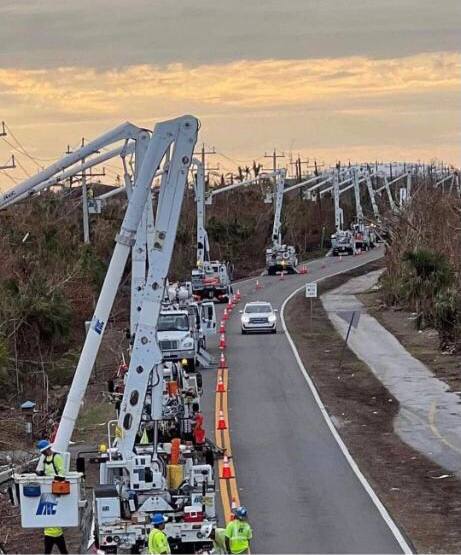 What you do before the hurricane hits is going to determine where you are in the recovery phase.
Additionally, and this should be emphasized and discussed within your family, if you cannot be self-sufficient in the aftermath – for any reason, then you should evacuate.
Self-sufficiency in this context requires being able to cope for up to several weeks:
(1) potentially without power; (2) potentially without potable running water (3) potentially without internet service; (4) potentially without communication outside the region; and (5) with limited municipal and private sector assistance. If you decide you cannot deal with these outcomes, you should evacuate.
Additionally, as a family or individual, you should also honestly evaluate:
(1) your physical abilities; (2) your emotional and psychological ability to withstand extreme pressures; and (3) your comfort in losing daily routines, familiar schedules and often overlooked things you might take for granted.
Post hurricane recovery is fraught with stress, frustration and unforeseeable challenges.
I saw a video presented by a structural engineer who was sharing his experience with Hurricane Ian. I am going to use his video for a few references because even with professional credentials, some of the common mistakes people make are highlighted in his experience. Keep in mind his video is taken about 30 miles inland from where the majority impact area (coastal region) is located.
The video below was shot from the soft side (western side) of the storm, and if we were to scale the difference between his experience and a person who was located in/around Fort Myers Beach, Sanibel, Pine Island or Cape Coral, he would be around a “5” on a ten-point impact scale.
Meaning the severity of conditions 30 miles southeast of him was twice as severe as his inland experience.
Key Points – At the 21: 35 moment (prompted), notice how his #2 vehicle is parked outside. Also, at the 22:00 minute moment, notice what he is describing and showing with his garage door and how his #1 vehicle (a pickup truck) is positioned inside the garage. WATCH:
.
♦ This is exactly what I was talking about in hurricane preparation when discussing the garage door. If that videographer was located 30 miles southeast, and/or his house was positioned facing West, instead of North, his garage door would have failed. If you lose the garage door, YOU COULD LOSE YOUR ROOF.
You can always tell those people who have been through direct hurricane impacts by how they parked their cars. I have never included this in the hurricane advice before so it’s worth a mention. If you lose your Florida garage door you will more than likely lose your roof. That’s just the reality of having a massive opening in your structure to 150 mph winds that will lift the trusses.
If you have two vehicles, put one vehicle inside the garage with the front bumper against the door to help stop the flex (do this carefully). Put the other vehicle outside blocking the garage door facing down the driveway or facing parallel to the garage. The goal is to use the aero dynamics of the car to push the wind away from the door and provide protection.
Purchase a cheap car cover to protect the outside vehicle and/or use old blankets (cable ties, bungee cords) to stop the outside vehicle from getting sandblasted and destroyed. Place double folded corrugated cardboard in front of the radiator to protect it from storm debris.
Additionally, if you live in a flood zone, or if you are concerned about storm surge, the day before impact take your #1 car to the nearest airport or hotel with a parking garage and park in the upper levels. Take an uber back home if you don’t have a friend or partner to help you. This way you know you will have one workable vehicle, just in case.
♦ Another lesson from Ian, if you drive an electric vehicle and sustain saltwater intrusion (of any level) your car is not safe. Saltwater makes the vehicle batteries extremely dangerous, and they could spark or catch fire. Multiple homes survived Hurricane Ian only to have the electric car catch fire in the garage and burn the house to the ground. Hurricane rain is saltwater rain. The fire department was begging people to put their ev’s outside and not to plug them in. Dozens of ev’s also erupted in flames while driving down the streets after the storm.
Back to the video above…
♦ Notice at 24:30 of the video this professional structural engineer is standing and physically supporting his glass patio doors, with his wife, trying to keep them from breaking in due to wind and pressure changes. DO NOT DO THIS ! That is beyond dangerous. Any small item of debris (even a small twig or branch) could hit that window and shatter it, turning flying glass into instant flying blades.
Put 3/4-inch plywood or steel bolted hurricane shutters over all your windows and doors. Period. This is not an option. My steel bolted hurricane shutters were hit with debris so hard – whatever it was physically dented the steel. Every window and door need to be covered and protected, especially glass patio doors (even if tempered). Do not think you can stand there and protect glass doors. It’s beyond dangerous.
♦ Hardening your home is a matter of careful thought and physical work. However, every opening into your structure must be protected, leaving yourself with one small exit opportunity just in case. Hopefully you have a bolted door with no glass windows you can use as an emergency exit. If not, select a small window and leave only enough room uncovered for you to get out in case of emergency or structural collapse.
Beyond the ordinary supplies like drinking water, batteries, flashlights, battery or hand-crank radio, generators, gasoline, etc. Evaluate the scale of what you have against the likelihood of weeks without power or water. A few pro tips below:
♦ Put three 30-gallon trash cans in the shower and fill them with water before the storm. This will give you 90 gallons of water for cooking and personal hygiene. You will also need water to manually flush your toilets. Bottled water is great for drinking, hydrating and toothbrushing, but you will need much more potable water if the municipal supply is compromised or broken.
♦ A standard 6,500-to-8,500-watt generator will run for approximately 8 hours on five gallons of gasoline. Do not run it all the time. Turn it on, chill the fridge, make coffee, use the microwave or charge stuff, then turn it off. Do this in 4-hour shifts and the fridge will be ok and your gasoline will last longer. Gasoline is a scarce and rare commodity in the aftermath of a hurricane. Gas stations don’t work without power. Check the oil in the generator every few days. Also, have a can of quick start or butane available in case the generator starts acting up.
♦ Extension cords. If you are purchasing them buy at least one 100 to 150′ extension cord with a triple ponytail. This way you can use one cord into a central location to charge up your electronic devices. Establish a central recharging station for phones, pads, laptops, and rechargeable stuff.
♦ Purchase a box of “contractor garbage bags” and just keep them in the garage. These are large, thick, industrial trash bags that fit 40-gallon drums. They can be used for trash, or even cut open for tarps in the aftermath of a storm. These thick mil contractor bags have multiple uses following a hurricane.
♦ Do all of your laundry before the hurricane hits. You will likely not have the ability again for a few weeks.
♦ Cook a week’s worth of meals in advance of the hurricane. Store in fridge so you can microwave for a meal. Eating a constant diet of sandwiches gets old after the first week. Dinty Moore canned beef stew and or Chef-boy-ardee raviolis can make a nice break…. anything, except another sandwich.
♦ Have bleach for use in disinfecting stuff before and after a hurricane. Also have antibiotics and antiseptics for use. Hygiene and not getting simple infections after a hurricane is critical and often forgotten. Again, this is where the extra potable water becomes important. Simple cuts and scrapes become big deals when clean potable water is not regularly available. Keep your scrapes and abrasions clean and use antiseptic creams immediately.
♦ Do not forget sunscreen and things to relieve muscle aches and pains. Hurricane recovery involves physical effort. You will be sore and/or exposed to the elements. Remember, it’s all about self-sufficiency because the normal services are not available. A well-equipped first aid kit is a must have.
♦ Buy a small camping stove. Nothing big or expensive, just something you can cook on outside in case of emergency. It will be a luxury when you are 2+ weeks without power and all the stores and restaurants are closed for miles.
♦ Those small flashlights that you can strap around your head that take a few AAA batteries? Yup, GOLD. Those types of handsfree flashlights are lifesavers inside and outside when you need to see your way around. Nighttime is especially dark without electricity in the entire town. Doing stuff like filling a generator with gasoline in the middle of the night is much easier with one of those head strap flashlights. Strongly advise getting a few, they’re inexpensive too.
♦ Cash. You will need it. Without power anything you may need to purchase will require cash, especially gasoline. Additionally, anyone you hire to help or support your immediate efforts will need to be paid. Cash is critical. How much, depends on your individual situation, but your cash burn rate will likely go into the thousands in the first few days. Also keep in mind, you may or may not be able to work and without internet access even getting funds into place could be challenging.
♦ Hardware. A box of self-tapping sheet metal screws (short and long) is important, along with a box or two of various wood screws or Tyvex screws. A battery drill or screw gun is another necessity. Check all of this stuff during hurricane prep.
This is a fury of nature, a battle where the odds are against you, that you may or may not be aware you are contemplating when you are choosing to stay or evacuate. It’s not the hurricane per se’, it’s that much smaller killer buzzsaw – the eyewall- that you are rolling the dice, never to see.
When it comes to the eyewall, the truest measure of the “cone of uncertainty“, the difference between scared out of your mind and almost certain death, is literally a matter of a few miles,…. and there ain’t no changing your mind once it starts.
Michigan friends just shared they are at captiva island 🤷♀️🤦♀️🙏🏻
Not for long!
They need to leave while they can. Idiots are the ones who decide to stay for the excitement of it all. Some of them don’t survive and cause first responders a lot of grief after the hurricane is past and their bodies have to be dealt with.
Be safe. Good advice. Don’t ignore the threat. Be ready. Plan ahead. Move inland if necessary. 😀🙏🏻
There are available Air BnB in the Ocala region for now..
Might get a break. She is getting pushed around, might not get what she needs to get the MOJO kicked up. Looking at cat 2. Going to get another soon.
Cans of SafeCatch tuna and Vienna sausage at the ready (the fridge is bare except for organic fruits for blending) we fueled up today and i got the oil changed in the sedan.
I am finishing up laundry and going to mop the floors, there is nothing worse than wanting to clean the house with limited electricity.
The real bummer is our river system and aquifer are brim full just like when we were spared by Ian..
Let’s ALL PRAY this thing GOES AWAY!!! Be safe, Cornbread, and other friends affected by this.
I live in Central Florida and we are saturated too.
Northeast Florida… we had over 22″ of rain in about 12 days following Labor Day – and a few impressive showers since.
All the rain will carry everyone through the dry season. Full aquifers are a good thing but you will need to seek higher ground for a while.
Not with all the people pulling water out of the aquifer. I expect a whole bunch of sinkholes come April and May.
I would watch the wind field on this one all the way down to Naples.
Same old thing…50 mph means FPL power goes out (FPL randomly goes down at 0 mph)…downed power lines and repair crews that can’t get out until it dies down to 35 mph, branches flyin’ through everything, flooding, etc.
I believe they shut off power so people don’t get electrocuted tromping around in wet yards with downed power lines.
If it’s a saltwater rain, I’d think vegetation would be hardest hit. I’m not sure FL is a retirement destination for me after reading all of this.
It ain’t for everyone..
The outflow bands and feeder bands are just regular rain.
Some blows have a lot of rain, others not so much.
The splashing water along the beach is salty.
Central Florida is no longer a retirement destination unless you are wealthy. Property is no longer affordable, and the county taxes are now being assessed on the ridiculous overpriced real estate market. Car and homeowners insurance are among the highest. Don’t buy a condo, as that market is collapsing. Also, we have experienced such an influx of people since Covid, that a mass evacuation would be nothing but gridlock on 1-4 and 408 in Central Florida.
Sadly this is the absolute truth and not limited to only the central part of the state. Call it paradise and kiss it good-bye.
I-4 and the 408 around Disney are often grid locked worse than Cali. Mass evacuation from south or central Florida is no longer possible. We bailed because of the property insurance after Ian. My home insurance hit 4500+ with high wind deductibles and my auto jumped to 3k+ with zero claims on both in decades. Then the property taxes soared again. Sold at top of ’22 and moved to Ohio. Paying 1/4 in taxes and insurance on much bigger property.
Orange County has seen better days. Now the City Of Orlando is about to annex 50,000 acres of The Mormon Ranch to expand the City’s footprint..
Just about every spot has their natural disasters. 1000 year storms that now happen every 5 years, wildfires, earthquakes, name your poison.
If you go to NC you’ll find what they call half backs.
It’s New Yorkers that moved to Florida and didn’t like it. They didn’t want to go back to NY so they stopped half way back in NC.
Love beautiful NC, but in many parts they don’t have updated infrastructure, roads and medical facilities that are on par with most Florida cities. The elderly need specialized care and you have to drive quite far to find a good doctor, unless you live in Charlotte or Asheville. It also gets very cold, with fog and icy roads.
We retired in the northeast Georgia mountains. Rather live with the bears than deal with hurricanes. But, having lived with tons of snow, we are always prepared. Invest in a generator no matter where you live.
New gulf coast Florida (Clearwater) resident here…moved from NJ…2nd potential hurricane/tropical storm so far…I am amazed at how calm and methodical Floridians are when these storms are coming in…I expected to encounter crowds at the local Publix like I did up north when a snow storm was coming…everyone getting bread, milk and eggs as if they would have to go for weeks without them…Nope. Not in Florida. There were a few people getting a few things but not carts full of water and toilet paper. People calmly checking generators, filling cars with gas, getting sandbags as needed…chatting with local neighbors and checking in….Love living here in paradise…
It will happen for sure tomorrow. Many out of milk already.
You won’t see any panic until the warnings are posted for Cat 3+. Most long-term FL residents ride out Cat 1/2 without any real concerns. Most won’t even board up for a Cat 2. Homes built there since Andrew in 92 must meet much more stringent building codes.
Floridians know do not fill up the fridge with perishable food when the power will be out for days, possibly weeks. Coolers with minimum perishables, ice, pantry staples, fresh water, charcoal/propane, candles or flashlights, and cool off with a garden hose or pool. You can survive without generators too, just like camping but with a lot of devastation around.
Ma’am, filling up the fridge is a fools errand. I like ” canning water” in large Ball mason jars. Bottled water is poison.
I have a closet full of flushable baby wipes from the Scamdemic.
I have a canal behind my house and I use an old 5 gallon water dispenser jug to fill up the tanks of my toilets what there is no power to run the well pump.
Prayers up for all in the storm’s path…
Add a can opener to that ‘gold list’…
Make sure Fido and Fluffy are taken care of in terms of ‘needs’…
…update chip info… get a cheap collar tag from petco or wherever…with pet name and your phone number on it….
have meds on hand that they may take…any medical papers…too.
keep a few extra leashes and collars on hand….for your own pets and for possibly any strays one may encounter, that get separated from ‘their people’ and some treats on hand for ‘bribery’….remember they will be scared, stressed and may run further away out of fear…in a pinch…cut up hot dogs work…pepperoni pieces or non spicy slim jim’s and like snacks…goldfish crackers…
…reuniting a lost pet with the owner, will elevate one to HERO status….
Keep a few up to date photos of your pets that should you get separated…you can post afterwards….
My own preference is canned food for the duration…avoids the worry about dampness and mold…And a can opener…
A formed plastic baby pool with some sod in it, placed in the garage or laundry room…a convenient place for the dogs to do business….cats have their litter boxes….
The closest I ever came to being in a hurricane…was “Bob”… so prayers up for all our Floridian Treeeprs…I cannot imagine what it is like….Know that prayers will be offered!
Thank you for the update!
Make sure they are up to date on heartworm preventatives…the skeeters will abound…
And as always…check with your vet for specifics…
I just give my puppers a little squirt of Ivermectin that I have stockpiled, it is what most of the expensive vet meds for heartworm is.
thanks Aggie, being new to Hurricane world I do forget about how this affects the pets…we have 5 of our own but (selfishly) never thought about those that get separated from their parents…
Been thru them since 1970, they all have the 2 main ingredients, then there are the jokers, like micro burst tornadoes.
Oh what fun those window rattlers are. Stand against a wall and feel it move.
One of the hardest things was in 2004 when we had so many was trying to keep an elderly couple calm thru the night.
Night time storms can be frighting after the power goes out and everyone is sitting around battery powered lights and TV.
You hear every creak and crack of the house and what ever is hitting it.
Some of the worst damage was from green avocados leaving the trees at around 90 mph.
We’re lucky this time as we are on east coast but there is another out there that cold head our way.
To all on the west coast and panhandle you are in our thoughts, we know what your future is going to be like.
Please stay safe
Thank you, Sundance!!!
I believe this storm is going to impact geographies inhabited by Sundance and Catturd. May all be safe from this storm. Prepare correctly and stay safe.
We are praying HARD for selfish reasons and those not at all selfish – that this hurricane will TURN and STAY OFF COAST and that God Will show His Mercy on all in this storm’s path. Please GOD make this thing GO AWAY! We don’t need a hurricane right now. I pray this in Jesus Christ’s Holy and Saving Name, AMEN
Amen! Pray the great an FREE state of Florida is spared-my spouse is in GulfBreeze working.
Will certainly be keeping your spouse and the state of Florida and all along the path of this thing in our prayers, Sinkingship. God Is Merciful and True!
Opal approached the Floridian Trench as a Cat 3 but churned up so much cold water that it dropped to Cat 1 for land fall. Still a mess but nothing like what it could have been. I’m hoping that Helena will do the same thing. They keep harping on the warm temps and the sharp bend in the Gulf Current but no one mentions the deep cold water trench that lies off the coast that this monster will also have to traverse. Praying.
Rho, if we know anything at all… it is that God Is in the miracle-making business and that all the science in the world, and all human knowledge, is poor in comparison to His Infinite Wisdom. Time and again, He Has thwarted the evil enemies’ schemes. I pray it so this time, as well. We have witnessed Him move a winter storm that was to produce ice and strong winds here in Central Indiana – and He completely dissipated it – as we were traveling to our friend’s deathbed in Chicago. I ask, in Jesus’s Name, that this storm be quieted and that He moves it out of the way of all human casualty and calamity. Just make it “gone”. Praying for you, too, Rho.
Lots of links here for weather / hurricane geeks (which I think comes with living in Florida)
https://spaghettimodels.com/
SW FL here…
I literally just moved about 12 miles further inland. 🤞
For Ian I was about 5mi from the coast, & on the North side of it. We were fortunate & only lost a few roof tiles & tree limbs, but it was a wild ride!
We do NOT need anymore rain around here- won’t be good!
This will be me on the beach tomorrow morning: 🌬️🌬️🌬️ (my apologies to anyone North of)
Rainfall fills the aquifers.
Not as fast as the growing population empties them.
Just got back yesterday from a beautiful week at Gulf Breeze and Fort Pickens ….they already had closed 2 of the beach access parking lots from just the rainfall from previous storm that hit LA–pray it spares this pristine park.
Hope all the illegal aliens living in their tent cities are paying attention.
They’ll undoubtedly get first priority at the shelters.
To all those in the storm’s path ~
I am praying for your safety & wellbeing. May the Lord protect you and may you have His peace.
Thank you, Sundance, for sharing your invaluable knowledge.
Thanks! New to Tallahassee.
For my friends in Florida:
“God is our refuge and strength,
an ever-present help in trouble.
Therefore we will not fear, though the earth give way
and the mountains fall into the heart of the sea,
though its waters roar and foam
and the mountains quake with their surging.”
– Psalm 46:1-3
We have been in and out of the cone of death. Think we will get side swiped. Nature coast FL
Looking at the current track, Helene is headed straight toward Shell Point Beach and Live Oak Island.
Again. Ryan Hall Y’all had his people set up live cams at both of those places when Debby (Cat 1) made landfall there. Crazy if they get a direct hit again.
Watching this closely, Ryan thinks it might track further Westward, and I sure hope he’s wrong.
His latest, but he’s going to cover this live eventually — for those who don’t know by now, Ryan Hall is the best weather coverage on the internet, and of course far better than any on television:
Stay safe, Sundance! My prayers go with you and your family.
Thank you for all the excellent information about surviving hey hurricane. I’ve lived in Florida nine years now and I’ve yet to experience a direct hit and I hope I never do. But when I first came here it was very scary. Every time there was News the one because you don’t know what to expect. For our newcomers thus advice you give us us invaluable.
I printed Sundance’s list to add to the family Betsy, Camille, Katrina et al file. lol Or as it is traditionally labeled, CYA . lol
Florida born and raised in central Brevard/Merritt Island area. Lived several years in Palm Beach/Ft Lauderdale area, then retired in small rural area of SE Polk county, 40+ miles inland from where Ian came ashore. Been through a lot of canes, the eye of two at ‘only’ Cat 2. I always evac’d for Cat 3+. After Ian, we sold and bought a small farm in se Ohio. No more ‘canes.
I say all that to make my comment more relevant that SunDance’s advice re hurricane survival is the very best there is.
Every. Single. Word. Is. Gold.
IIRC he is CERT (Community Emergency Response Team) trained and certified. He’s not only lived through them himself, but he’s seen up close and personal the trauma it has on survivors’ lives and the effort needed to restore even the basic necessities in the aftermath.
Thank you, SunDance.
There will be many displaced critters including cats and dogs.
But especially watch out for rats, black bear, venomous snakes and gators whose habitats will be destroyed in the flooding.
Prayers for our family home on St. George Island please. ..too close to the eye for comfort. Prayers for EVERYONE in its path!
We lost our home in Fort Myers to Ian. Wind ripped the roof off, rain poured in, total loss. The “wind” insurance paid for the structure but to collect the “contents” insurance (furniture, wall hangings, appliances, etc) we had to prove to the insurance company what we owned, and what it would cost to replace, with photos. That’s a reasonable requirement so I can’t claim to own Van Gogh and Rembrandt masterpieces, but it took weeks of scouring photo albums to remember “Oh, yeah, we had that waffle maker, add that.” Not that I need a waffle maker, but it increases the amount of my insurance claim. Pro Tip: Open every closet, Open every drawer, take photos, store them somewhere safe, and pray you never need them.
Anyone here know updates for Cape San Blas FL.? We are scheduled for 2 weeks on the cape starting this Saturday😳
I been through one hurricane in Destin many years ago and don’t want a repeat of event. Wind gusts to 105mph so nothing like this one.
At this point our understanding is no refunds if mandatory evacuation is not ordered?
thanks for any and all info!
Great advice, Sundance. Thank you.
Excellent advice Sundance! Thank you for sharing this again. I know the area you live in having lived in the area a dozen years ago, and read all your posts on the terrible damage inflicted on you and the area.
Having lived through Hurricane Michael which struck the Gulf Coast near Mexico Beach on October 10, 2018, I concur with everything that Sundance offers, but would like to add my two cents. Michael was a CAT 5 when it hit the coast with sustained winds of 160 mph. I only live about 80 miles Northeast so perhaps 40-50 miles East of its path. Pecan orchards 120 miles away in Georgia were toppled!
My wife and I weathered out the storm with winds far less than 160, but sufficient to topple ten trees in our yard including a 96′ pine tree that was only 10′ in front of the house. Praise God, it fell parallel to the house as even a brick house cannot withstand the mass and inertia of a falling tree that size. Neighbors across the street felt it when it hit the ground.
One of the trees broke a water line that we did not find for two weeks, so I had to turn on the water at the street, and when finished with bathing, cooking, or what have you, I would have to go back out and turn it back off. That strapped headlamp does come in handy.
We were without power for better than two weeks, and a generator is a key to making life livable while trying to put your home and lives back together. One word of advice on generators. Spend the extra money on an Inverter Generator!!! They are infinitely quieter, and only consume the fuel needed to maintain the load. A regular generator runs at full RPM the entire time consuming far more fuel and making racket that you will soon tire of. I could run my 3,000 watt inverter generator for 11 hours on a tank of gas; less than 5 gallons.
A safety note on generators. If you are simply using extension cords to appliances, Sundance’s advice is good. Make sure the wire gauge of the extension cord can handle the load you intend to plug into it. If not, the cord will heat, and potentially fail. If you have a standby generator, or one that you connect directly to your Electric Panel, disconnect your Mains so that you don’t injure or kill someone working on the downed power lines. Though mine was off, they took no chances and physically removed power from my house.
If you have trees in your yard and you are have experience with a chain saw, hopefully you have a functioning saw with an adequate bar length to deal with the endless hours you will spend cutting down trees, trimming, and bucking limbs. Make sure you have mixed gas, proper oil for mixing more fuel, bar oil, and a sharpener. My 16″ Stihl was not up to the job, and the 18″ I got was barely adequate. Speaking of that saw, I have to give a hats off to the company I worked for, BASF who bought generators and chainsaws for everyone who needed one! My 16″ Stihl was insufficient for the pine tree that had a girth at its base of 94″ and a root ball 9′ in diameter. Friends from church came with larger saws to help.
My wife spent every day dragging branches and debris, and rolling the logs I’d cut the night before, into piles at the street for the crews who constantly came to pick them up. I would come home from work and work till dark cutting, stacking, and clearing debris. We did that every day for six weeks!
You will need lots of properly sized gloves appropriate to the task.
You will have to deal with the cleanup whether you stay or leave, but after riding out that storm, we both said that we would evacuate next time. That may be Wednesday as we continue to monitor the path of Helene. You can always come back, assess the damage, and begin the work cleanup and restoration.