During an interview with film director Emir Kusturica for his project “Our Baptism – The Patriarch” Russian President Vladimir Putin mentioned, “Moscow is the third Rome.” Immediately western media went bananas, so I had to go look for exactly what was said.
BACKGROUND: Constantinople was called the Second Rome because Emperor Constantine moved the capital of the Roman Empire there in 330 AD. The Eastern Roman Empire survived for another thousand years after the fall of the Western Roman Empire, until Constantinople fell to the Ottoman Turks in 1453.
Then, in 1472, Ivan III, Grand Prince of Moscow, married Sophia Palaiologina, the niece of the last Byzantine emperor, Constantine XI. And Sophia didn’t exactly arrive in Moscow with just a suitcase. She came with an entourage and brought connections to Byzantine court culture, traditions, and ceremonial practices that would influence the Russian court for centuries.
By the early 16th century, the monk Philotheus famously articulated the idea: “Two Romes have fallen. The third stands. And there will be no fourth.” The Russian title Tsar comes from Caesar, the title of Roman emperors.
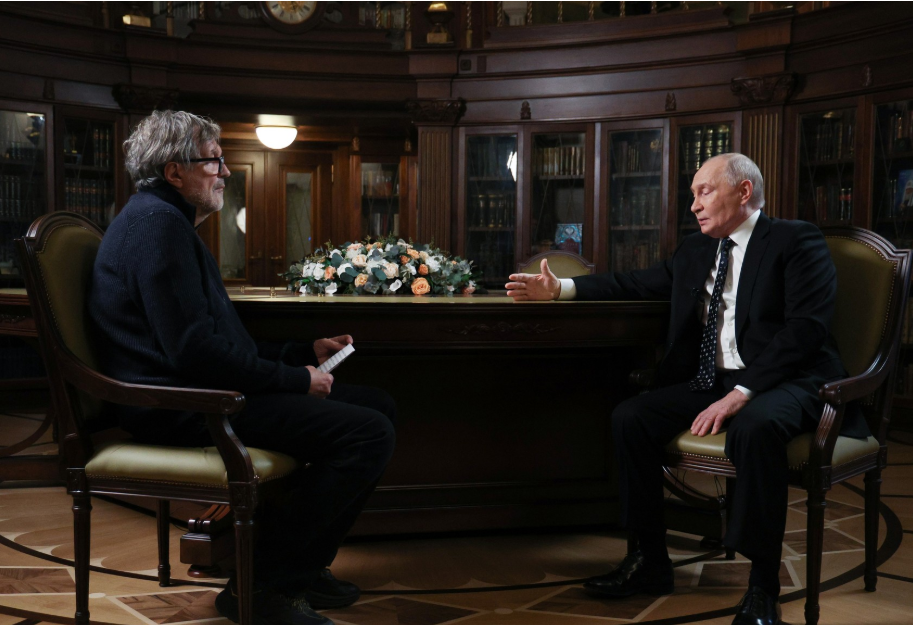
[Partial Transcript] – […] Emir Kusturica: Today, the Russian Orthodox Church is represented in more than a hundred countries of the world, and the Russian state is the foundation of the entire Russian civilisation. Do you think the Russian civilisation can become a sort of an ‘ark’ that can save all those who believe in Christ?
Vladimir Putin: It can. Absolutely.
I am saying it with such confidence not just because the Russian theological and philosophical thought is centred around one concept that dates centuries back: Moscow is the Third Rome, a fourth there shall not be.
What does it mean? It means that Christianity came into existence in ancient Rome, then Rome fell, and Christianity moved to Byzantium, the Eastern Roman Empire. Constantine became the first emperor to convert to Christianity. The Byzantine Empire also fell, but by that time, Christianity had already spread to Russian soil and reached Moscow. Thus, Moscow inherited this faith and these traditions. In a way, it became the Third Rome, the spiritual keeper of those holy values, that heritage.
Yet this theological, or philosophic, idea, which, as I said, Russia has cherished for ages, is not the main point here. It is all about today.
Today, for example, we see cases – I know it is not widespread – but we see cases when people move to Russia from other countries, including European countries. When I chat with them on occasion, they say that the main driver, the main reason why they moved to our country was their desire to preserve their values, their families and the future, secure the future for their children, who, they believe, should have the right to grow up and be raised in traditional religious values.
So, when you ask whether Russia can become the ‘ark’ to save people, I would say that it would be not only for Orthodox Christians, and actually not just for Christians.
As you know, we have four traditional religions in Russia: Buddhism, Judaism, Islam, and Orthodox Christianity, all their adherents developing and evolving side by side. In fact, we have the same traditional values, no matter how hard some followers of these religions seek to underline the distinctions. There would always be distinctions, but fundamental values are the same. By creating enabling environment for these traditional values to evolve, Russia provides a space where people can live in line with these values. Of course, in this sense, Russia could become the ‘ark’ you are talking about.
Now, in many societies, especially in the West, we are witnessing a struggle for human rights involving various minorities. Is it anything new? Nothing – history is repeating itself, this is as old as humanity itself. It is just that now certain groups have become more aggressive, increasingly claiming their rights and so on.
You see, we are not trying to limit anyone in anything. But the idea upheld by the Russian Orthodox Church, as our Patriarch always confirms in public, and by the Russian state policy, too, is that the human, human spirituality, and, crucially, if I may say so, the human as a biological species should be preserved. We are seeking to secure this through our state policy and support the Church in its efforts, of course, in keeping with today’s demands, with the requirements of the modern civilisation. This is the main focus of our joint work with the Church.
So yes, in this sense, Russia and Orthodox Christianity could serve as the ‘ark’ you have mentioned.
Emir Kusturica: And how does it all get along with the reality in the West, in which the Christian church fails to play the great role Orthodox Christianity is playing in Russia?
 Vladimir Putin: I think it has to do with the fact that… We actually treat our brothers and sisters in Europe with respect, and we, as a matter of fact, try to support them when we see that certain branches of Christianity are obviously mistreated or harassed. But I am afraid that the backslide by these churches, their certain departure from the canons is not strengthening their position in society but works the other way round. Perhaps, by departing from the established canons and principles, they seek to update something, make it easier to understand and adapt to our everyday life. But in reality, I think this is exactly why the grip of Christian ideas and the church on society, on the minds, is weakening.
Emir Kusturica: Over the past five years, North America has seen 1.5 million newly converted to Orthodox Christianity.
Vladimir Putin: That is exactly what I am talking about. Orthodox Christianity is, on the contrary, attracting people because it protects the values I mentioned.
Emir Kusturica: How would you define the Russian civilisation, as a concept?
Vladimir Putin: It is a tricky question. Yes, we are talking about the Russian civilisation, and I guess that is how we really see it. God forbid, this is not some sort of vanity or arrogance.
We acknowledge that the Russian civilisation is a great civilisation. And we know that there are others – the Chinese civilisation, for instance, which dates back thousands of years. And we remember history. Say, the Mongols waged long wars against China, and eventually established their own, Mongol-led dynasty in China. And where did it all take them in the end? They were absorbed by the Chinese.
Emir Kusturica: Orthodox Christianity played a great role there.
Vladimir Putin: Yes, that is what I am driving at. You are absolutely right.
Well, the Chinese state and Chinese nation just absorbed those conquerors. And that was it, they assimilated.
Or take, for once, the Indian civilisation, which is the oldest. It is very interesting. The more I get to know about it, the more interested I become.
Not long ago I asked Prime Minister Modi when we were talking: “How many Indians speak the primary language?” He answered: “About 600 million.” – “And what is the population of the country?” – “One and a half billion”. Only one third speaking the titular nation’s language. “And what about the other two thirds?” – “And those speak their own languages.” Don’t you find this surprising? It really is!
But what is it that makes the Russian civilisation so different? You know, I think about it constantly. And here is my conclusion: the Russian civilisation never took over others. It provided for the evolution of the Russian people, the Russian ethnicity, but it also provided enabling conditions for the development of other peoples and ethnicities that made part of the Russian empire, of the family formed by the Russian state. It allowed for everyone’s development, including their sovereign spiritual development, religion, traditions and languages. This is, we may say, a unique feature of the Russian civilisation.
Going back to your first question about the mystery, about Russia’s uniqueness, Dostoevsky gave a very good description of a Russian man. According to him, a Russian man easily interacts with others, lives alongside others and adapts to anything different. And, generally speaking, a Russian man has a very strong ‘pan-humanity’ instinct. This is what distinguishes the Russian civilisation.
Emir Kusturica: As the leader of the Russian state, do you see the Russian Orthodox Church as its essential, holy, spiritual pillar? What are your relations with Patriarch Kirill?
Vladimir Putin: I will start from the end. We have great relations of true friendship. And the relations between the state and the Church are very stable, as I see it. They are truly unique, because even in the time of the Russian empire, the emperor – the tsar, the ruler – never was, strictly speaking, the head of the Church, but was considered its guardian, patron, etc.
So, it was not the way it was in England, in Great Britain, where they had the Queen as head of the Anglican Church. We didn’t have such direct subordination. Yet there has always been interrelation between the head of state and the Church. He did play a role that was an important one. Then, we had such institutions as the Synod, which was the supreme ecclesiastical authority in the country, and the Ober-Procurator of the Holy Synod, who was a non-clerical state official.
In the Soviet period, the authorities of the USSR declared the separation of Church and state. But in fact, there existed a council for religious affairs and its local subsidiary bodies, which governed – or at least tried to control – the religious life in the country. I can only guess who actually was more influential.
You know, as I started my career with state security bodies, we had special units there responsible for domestic opposition. The Church in the Soviet times was the only legally recognised opposition to the state, as it supported an alternative ideology. Interestingly, all the KGB officers I know personally, those who served in those units, got baptised: so you could not tell for sure, who was influencing whom: the state and the KGB influenced the Church, or just the other way round. They would always bring Easter eggs and kulichi to all the rest of us in other departments, and things like that. Yet there were attempts to influence the spiritual life of people.
Today, the Church and state are really separated: the state does not interfere in church affairs, which is acknowledged by our Patriarch. This has its own great advantages: when the Church used to be part of the state apparatus, public authority and governance, it occasionally faced criticism for actions and results which the state and government were responsible for, thus sharing the responsibility.
The Church was considered part of the state machine. There was a period, in the early years after the 1917 Revolution, when the Church was persecuted, and it was really brutal. Why? Because the Church was being suppressed as an element of a state that was passing away.
We do not have this problem anymore. I think this is very good and right. In this way, the Church can evolve freely, in line with its own inner rules.
As for the role and place of religion and the Church in the history of the Russian state, it is absolutely unique. Clearly, the spiritual life and the church are important in any society, whatever people may think of it. But it is of particular importance in the history of the Russian state. Why? Remember what we had before 988, before the Baptism of Rus’ by Prince Vladimir. There was no single Russian state, nor was there a Russian people as a distinct ethnic group. There were about 15, if I have it right, Slavic ethnic groups: Drevlians, Polyans, Kriviches, Vyatiches… and there were other tribes in the North-West. About 15 overall. But there were no Russians. There was already the sole authority of the prince, there was a single market, as we call it nowadays, I mean there was a single economic system, and there was one common language – Russian, which is very important. But there was no common religion. All those groups were pagans; sometimes they worshipped the same deities and sometimes different ones. But there was no common religion.
And then there came a time for this final move. A single religion was established, paving the way for a single Russian people and a centralised Russian state.
In this sense, the Russian Orthodox Church played a unique role in helping shape the Russian nation and Russian statehood.
That is why our attitude towards the Russian Orthodox Church is special. The ROC has always stood by its people in the face of the hardest trials.
It is not by a mere chance that during the Second World War, in 1943, I think, when the Battle of Stalingrad and the Battle of Kursk were over, Stalin decided to restore the patriarchate. Because no matter how brutal the persecutions against the Orthodox Church, against the religion in general were inside the country, in the Soviet Union, despite the efforts to eliminate the clergy, the very day the hardships of the Great Patriotic War befell our country, the Church rose to the defence of our Motherland without hesitation.
Emir Kusturica: The Church has preserved its foundation and its canons intact for 1,500 years. And now comes a new human, so technologically and biologically advanced, yet they will regard the church a fundamental element of life. Maybe that is why there are people in America who want to convert to Orthodoxy because it has remained unchanged for 1,500 years.
Vladimir Putin: Yes. I agree with you here. That is what I was talking about. Of course we must move forward, we must not be held back, we must not feel hog-tied in our development. But there are fundamental factors that make us human and that ensure the continuation of the human race. They constitute the fundamental values of Orthodox Christianity.
Emir Kusturica: Orthodox Christianity and humanity?
Vladimir Putin: Exactly.
Emir Kusturica: You have repeatedly said that Russians and Ukrainians are one people dragged into a fratricidal war by their enemies. What message would you like to convey to Ukrainians? Why do you think that Russia’s victory is in their interests?
 Vladimir Putin: You have come upon a very delicate issue. I do not know whether I should answer your question or not.
There is a well-known Latin phrase, ‘divide and rule.’ What does it mean? It is a principle of the Senate in ancient Rome. And it is very simple: if anything large, powerful, effective, and influential emerges and grows, it is seen as a threat to Rome: then it must be divided and ruled, to serve Rome’s interests.
The history of our country abounds in such examples. As soon as Russia grew stronger, there immediately appeared forces that wished to divide and rule.
By the way, all such invasions against Russia in modern history are, in my view, also connected with this: Napoleon’s invasion, World War I, World War II, our Great Patriotic War, the Nazi invasion. I believe that ideological considerations played an absolutely secondary or tertiary role there. The most important factors were issues of geopolitical interest and the ‘divide and rule’ mentality.
The same thing happened with Russia in ancient times, when, as a result of a whole series of circumstances (let’s not go into detail here), it became fragmented. After the Russian lands started consolidating following the so-called Mongol yoke, part of the territory of Ancient Rus’, namely Kiev, its surrounding areas, today’s Chernigov and Zhitomir regions, became part of the Russian-Lithuanian state, and then, as a result of the union with Poland, became part of Poland, the Polish-Lithuanian Commonwealth, with the Poles playing a dominant role. And, naturally, they started a policy of Polonisation, which is not surprising at all, trying to bring everyone under the same umbrella according to their own interests; this led to the first changes in the language, and so on.
By the way, as for today’s Russians, Ukrainians who lived in those territories back then and identified themselves as Russians at the time, they were all treated quite harshly, not to say cruelly, and were considered to be second-class people. And then this continued before World War I, and so on.
But that’s not what I’m talking about right now. Right or wrong, that’s just how it happened. And what we see now is a continuation of that same ‘divide and rule’ policy and an effort to weaken Russia’s potential, make it more compliant, and ultimately, one way or another, in one form or another, make it serve their interests.
Everyone should understand and be aware of this, including those who live in Russia – and we do know this, we understand this, I can feel it and I can see this in our society – but also those who live in the territory of today’s Ukraine, people should realise that everything that is happening and everyone who supports them, including in the current confrontation with Russia, they are doing this not in the interests of Ukraine, but in their own interests with the aim of weakening everyone, splitting them up, breaking down into separate parts, and subjugating to their will. Being aware of this, I think we all should seek to achieve unity, including those who currently live in Ukraine. Maybe not as part of a single state, that’s absolutely not what I’m talking about, but unity in the broadest sense of the word.
Back in Soviet times, according to the census conducted in 1986, if I’m not mistaken, 51 or 52 million people lived in the territory of today’s Ukraine, making it one of the largest industrially developed regions of Europe. And what happened after the collapse of the Soviet Union and Ukraine gaining independence? It lost everything; shipbuilding, aircraft and spacecraft manufacturing were gone. There was also a decline in population, and in a couple of decades, the population was first estimated at 41 million people, then it reduced to 31 million, and now, they say, there are only about 20 million people left in the territory of Ukraine; and also deindustrialisation – everything has fallen apart. It didn’t happen now, not in the past few weeks as a result of retaliatory strikes by the Russian missile forces. No, it fell apart on its own.
Why? Because power in Ukraine was seized not by its patriots, but by nationalists. The difference between patriotism and nationalism, as you know, is that patriots love their country, while nationalists hate other peoples. That’s the difference. But you won’t get far with such hatred toward other peoples.
And that is why, if we are talking about Ukrainians – and I’d like them to hear this – no matter what is happening now, no matter what tragedies are unfolding today, we should think about the future, about the future of our children, and we should understand that if we are to be strong, powerful and well-positioned for positive development, we certainly need to stand united, that is, we should join our efforts to achieve our common goals.
As for Ukrainian soldiers, I have already mentioned, I do not want to say that they should surrender, for it sounds somewhat humiliating. After all, they are fighting, they keep on fighting. I would like to tell them to come over to our side, because it is our shared side ‒ and the right side of history.”
[END Transcript]
That’s what they taught me in HS.
Rome, Constantinople, Moscow.
The Rus adopted Christianity over Islam because they weren’t going to stop drinking alcohol for any religion.
Well, in fact, Christianity started in Israel.
Not sure about the label “Christian” or ‘little Christ’ -meant to insult the earliest evangelists – but I suspect even that label was not first heard in Rome.