I guarantee you two things. First, there are dozens of U.S. intelligence analysts feveriously watching this video of Russian Federation President Vladimir Putin engaged in discussion with U.S. envoys Steve Witkoff and Jared Kusher. Second, most of the analysts will get their interpretations wrong.
Beyond the unusual and remarkable transparency of Russia allowing the media to witness and record some very substantive points being made, the animated nature of Vladimir Putin [15:00 forward] is not customary for him. Putin is normally stoic in his body language and does not usually animate his words with his hands; in this discussion he does.
After the formalities and diplomatic niceties expressed by Putin, he gets right down to business asking both Witkoff and Kushner to summarize their perspectives on the recent Abu Dhabi talks. You can see Kushner caught off guard when asked to answer a question -specificicity- that would normally not be asked during public moments [14:45].
I can tell you from experience in studying Russian’s close up over a long timeframe, President Putin is frustrated at the remarks from the U.S. side because Russia doesn’t culturally engage in ‘blah, blah, blah.’ You see this when Putin talks about the “grey zones” that are stunningly antithetical to the mindset of any Russian.
In Russia there is Yes or No, there is not this western talk of ‘maybe.’
In Russia there are clear boundaries in almost everything. There is yours and mine, there is no ours. There is right and wrong, there is no “kinda.” When a Russian has something to say, they say it – and there is a point to it, a specific point.
Russians approach things with a ‘do’ or ‘do not’ perspective, it is just their culture.
President Putin, just like any other Russian, is not being curt or rude, he is being direct. Say or don’t say, but do not talk circles about maybe saying or maybe doing; it will piss off a Russian quickly. Do or do not, but don’t talk about doing for the sake of talking about doing. You either do, or don’t – that’s it.
The failure of Americans or western viewers to understand the Russian mindset leads to poor analysis of what Russia says and does. Russians seem rude to western eyes and ears, but they are not – they’re just very direct and they don’t engage in small talk about anything. Everything a Russian says has a point to it, or they just don’t say anything.
With that in mind, watch the video:
1. Vladimir Putin’s Opening Remarks [00:16]
Gratitude to the U.S. Administration: Putin welcomes Steven Witkoff and Jared Kushner and asks them to convey his gratitude to President Donald Trump for organizing contacts with the Ukrainian side.
Humanitarian Track & Prisoner Exchanges: He notes that positive results have been achieved on at least one track—the humanitarian exchange of detained persons between both sides—and mentions that another major step in this direction is upcoming.
Recognition of Melania Trump & U.S. Agencies: Putin requests that thanks be passed on to First Lady Melania Trump for her active participation in resolving humanitarian issues surrounding the town of Oleshky in the Kherson region. He acknowledges that this would not have been possible without the support of President Trump’s entire team, including the State Department and the Defense Department (jokingly referencing its rebranding as the “Department of War”).
Assessment of Abu Dhabi Talks: Putin proposes continuing this humanitarian practice by involving human rights commissioners from both Russia and Ukraine. He then asks the U.S. delegation for their assessment of the recent negotiations in Abu Dhabi between Russia and Ukraine, the prospects for future contacts, and their engagement with European representatives.
2. Steven Witkoff’s Response [04:41]
Trilateral Format & U.S. Commitment: Witkoff thanks Putin for hosting them and announces that work has resumed in a trilateral format. He conveys President Trump’s strong desire to end the conflict as quickly as possible, noting that Secretary of State Marco Rubio and the broader U.S. team are working diligently toward a resolution.
Positive Atmosphere in Abu Dhabi: Witkoff characterizes the recent meetings in the United Arab Emirates as very positive and purposeful. He notes that Russian and Ukrainian delegations sat at the same table to actively work through detailed issues, pointing to the upcoming prisoner swap—described as the largest ever between the two countries—as proof of tangible progress.
Acknowledgments: He thanks Russian Presidential Aide Vladimir Medinsky for his multi-year commitment to resolving the conflict, and expresses appreciation to Yuri Ushakov and Kirill Dmitriev for their productive meetings and ongoing work.
Role of Europe & Next Steps with Zelenskyy: Witkoff clarifies that while European representatives did not sit at the negotiating table in Abu Dhabi, they were physically present in the UAE, thoroughly briefed, and consulted throughout the process. He adds that immediately following this Moscow meeting, the U.S. delegation will travel to Ireland to brief Ukrainian President Volodymyr Zelenskyy before he returns to Ukraine, expressing hope that they will soon announce the next trilateral meeting.
3. Jared Kushner’s Remarks [11:31]
Pathways to Ending the Conflict: Kushner notes that during the talks in Abu Dhabi, representatives from Russia, Ukraine, and Europe all agreed they want to see an end to the armed conflict, though the final steps still need to be worked out. He expresses hope that today’s meeting will identify concrete pathways to bring the conflict to a definitive close, which they will then present to President Zelenskyy to encourage moving forward along one of those paths.
European Security Architecture: Kushner highlights positive movement from the European side, noting that Europe wants not just an end to the war, but a lasting peace afterward. He explains that discussions have begun regarding a long-term security architecture involving Russia, Ukraine, and the European continent to prevent a new conflict from starting—noting that this is closely tied to territorial questions.
4. Vladimir Putin on Territory, “Gray Zones,” and Kostiantynivka [15:01]
Focus on People & Rejection of “Gray Zones”: Putin agrees that territorial issues will be discussed today and states that Russia also wants a reliable, “eternal” peace. He emphasizes that for Russia, the priority is the people living in those regions, their culture, and their right to live according to their traditional values. He rejects Kyiv’s proposals regarding “gray zones,” arguing that ambiguous boundaries inevitably lead to disputes and instability, whereas a clear state border line leaves no room for confusion.
The Kostiantynivka Humanitarian Proposal: Addressing conflicting claims over who controls specific front-line areas, Putin proposes replicating the Oleshky humanitarian operation in Kostiantynivka (a town on Ukraine’s defensive line in Donbas where he estimates 400–500 civilians remain).
Five-Day Demining & Media Verification: Putin suggests a 5-day period to demine the approaches to Kostiantynivka and invites U.S., international, European, Ukrainian, and Russian journalists, alongside human rights commissioners from both sides, to evacuate the remaining civilians. He states that if Kyiv claims control of the town, they should ensure security; otherwise, Russian forces will provide security, allowing observers to verify who actually controls the area.
5. Vladimir Putin on Europe and Foreign Troops [23:05]
Dialogue with Europe: Putin asserts that Russia has never opposed dialogue with Europe and was not the side that broke off relations, expressing readiness to work with European nations.
Unacceptability of Foreign Troops: He reiterates that the presence of any foreign troops on Ukrainian territory is completely unacceptable to Russia and poses a direct threat to its security—a point he notes was broadly understood during the earlier Istanbul negotiations. Putin warns that if European nations deploy troops to Ukraine immediately after a peace deal is signed, Russia will view them as legitimate military targets, which would immediately reignite the war.
The “Circular Logic” Critique: Putin contrasts President Trump’s proposal—to negotiate comprehensive European security instruments—with Europe’s stance of refusing security talks until after peace in Ukraine, while simultaneously planning to send troops into Ukraine once peace is reached. Illustrating this contradiction with a classic Russian joke about a man claiming he gets money from a nightstand that he himself refills, Putin urges the U.S. administration to work with its European allies so they clearly decide whether they want peace or continued war in Ukraine.
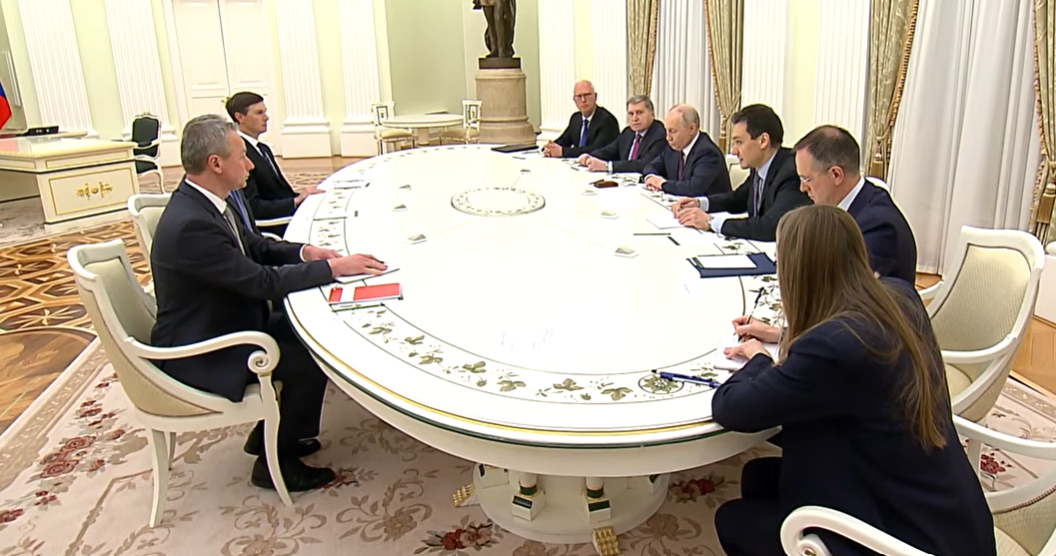
Putin is eyerolling at moments because from his perspective Putin wants this war to end, and he wants it to end on direct and easy to understand terms. The western approach is blah, blah, blah… working toward, understanding, starting the framework, building toward some vague beginning of something that first needs to be defined in order to understand it… blah… blah…. blah.
You can tell from this video President Putin wants direct, simple, black-and-white, regional lines and territory drawn. Europe/NATO has no need to inject themselves into the issues that are between Russia and Ukraine to resolve, and Putin has no respect for the western process of endness paralysis by analysis.
Fake War
“Do or Do Not…there is no TRY” – Yoda
Point 5 : Unacceptability of Foreign Troops. The point made by Putin here is why the EU is going to keep this war going. They want war with Russia and expect the U.S. Military to bail their sorry butts out of a jam of their own making. The U.S. is a fool if they fall for this scam.
Mearsheimer says there is only one issue of overriding consequence: security guarantees-and Russia will never accept Ukraine’s (and Europe) presumptive proposed and Ukraine (and Europe) will not accept Russia’s presumptive proposed. So no comprehensive settlement can be achieved.
Dump London, EU and the ME. All they do is cause problems.
Ally with Russia and all the countries in the Western hemisphere. Hemispheric defense + Russia.
U.S. and Russia as friends can be the world leaders for peace and prosperity for all in the spirit of Christ without the endless wars and rent seeking parasites always asking for handouts.