Secretary of State Marco Rubio continues to impress; however, his response to the Wall Street Journalist narrative engineer is absolutely brilliant.
Following visits to Colombia and Ecuador, Secretary Rubio is in Peru today to discuss the “Shield of The America’s; a joint collaboration and intensely strategic partnership between the United States and Latin American countries to eliminate corruption, arrest narcotraffickers and remove all corrupt elements.
During a news conference with Peruvian President Keiko Fujimori, Secretary Rubio addressed the Peruvian people in both English and Spanish as he explained the specifics of the Shield and what the partnership entails. During the Q&A session of the press conference, a Wall Street Journal narrative engineer asked a question about sovereignty and the U.S. acting unilaterally if Peru didn’t agree to address the threat.
Essentially, Rubio responded by telling the journalist to stop working for the ‘Bureau of Imaginary Problems’. I have prompted the video at the point of the question and then provided the transcript from that moment to the end. The overall English audio-dub is not bad, so the entire presser is well worth watching:
[Transcript] – QUESTION: Vera Bergengruen with The Wall Street Journal. Mr. Secretary, you have stressed that the members of the Shield of the Americas are sovereign partners. But if one of these governments refuses to act against one of these groups that Washington deems a terrorist threat, does the U.S. reserve the right to act unilaterally, including here in Peru?
And President Fujimori: (Via interpreter) The question wanted more information about the partner of the Shield of the Americas. This will include to collaborate with the United States here in the country.
SECRETARY RUBIO: I’ll answer that question in English and Spanish. I don’t know if you guys heard it. Basically, the gist of the question is, if you’re a member of the Shield and refuse to act, does the United States – will the United States act unilaterally?
Well, if we were going to act unilaterally, why would we need the Shield? We’re not – if we were interested in acting unilaterally, we have the capacity to act unilaterally. The reason why we’re not doing it is because we want to do it with our partners. It’s the most effective way to do it. For us to confront transnational criminal groups, we need to do it inside the sovereign territory of countries, and we want to partner with those countries. It’s in their interest to do it. That is why we have the Shield. That is why the Shield exists.
People make up these problems that don’t exist. They’re getting ahead of themselves with these – these ridiculous sort of things that no one’s even contemplating. The bottom line is the reason why we have a Shield is because we choose to act in partnership with our partners. So it’s very simple. This is not very complicated; let me explain this to you. It’s a very, very simple equation. We have a country that says we want to defeat these criminals, these terrorists, these evil, despicable human beings; we want to defeat them. We want to work with America to defeat them. And so we say, of course we want to work – what should we say to them? No, we don’t want to work with you? No, we’d like you not to do anything about these groups?
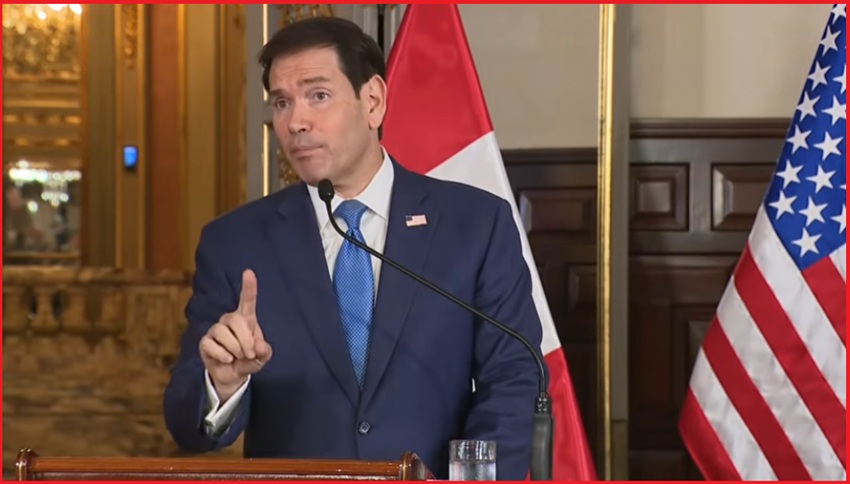
We have a president here who has said very clearly – not to us, to the people of her country; it’s why they elected her – I am going to defeat these groups that extort you, I am going to defeat these groups that kill you, I am going to defeat these groups that terrorize your children in our communities. And the United States has said we’re so happy you’re doing that, it’s important for us as well, and we’re going to partner with you. That is the purpose of the Shield, to shield the region against this threat to the sovereignty of every one of our nations.
(Via interpreter – Rubio Spanish) The question was if the United States will act unilaterally if the member country of the Shield will not act. It’s a ridiculous question because if we’re going to do it unilaterally, then why would we have the Shield? The reason why we have the Shield is because we don’t want to act unilaterally. We want to act together. We want to act jointly.
Why do we want it? It’s very simple. These are terrorist groups. Please be clear, these are not criminals stealing a bank. These are terrorist groups extorting people, extorting and doing a lot of – committing multiple crimes, things that you cannot even think about. They’re evil. So these – we need to defeat them, and we need to work together. When we see that there is a leader, a president that was elected with that promise to the people – and she is compliant with this; she will defeat and confront these groups – we will support her. Because it’s of our interest as well to work with you, of course, to your country or a sovereign country.
And this is an enormous responsibility to confront these groups, and we will do our best to support to be able so she can comply with that promise. She will help us, but we will help them as well. This is how the partnerships work, this is how allies work, and this is what is the Shield. It is a powerful partnership against these diabolic groups that have terrorized the region for many, many years and through multiple leaders, and many, many, many political leaders from multiple countries don’t have the courage to confront them, or at many times they were involved. And this impunity will no longer be accepted, and this is what we are seeing, and in other countries as well that are a member of the Shield of the Americans.
PRESIDENT FUJIMORI: (Via interpreter) I want to reflect on a question. When we requested powers, this request was filed with congress by the prime minister. We requested to declare these criminal groups as hostile and terrorist groups. This mechanism will be fundamental.
Second of all, we want to coordinate and strengthen the justice administration system to face decisively these criminal organizations. All of these mechanisms will help us obtain information through the Shield of the Americas and the different government agencies.
(In English) So we are extremely happy, and we are thankful for Peru to be part now of the Shield of the Americas.
QUESTION: (Via interpreter) Ayrton Luera from ATV Noticias. My question was with this incorporation of Peru into Shield of Americas, Mr. Rubio, would be – will we expect military operations or emergency operations in Peruvian territory?
And if so, Madam President, could you tell us about the conversations that have taken place, if these interventions respect Peruvian sovereignty? And Mr. Rubio, what would be your answer to this public response of the Chinese embassy after your column in the press?
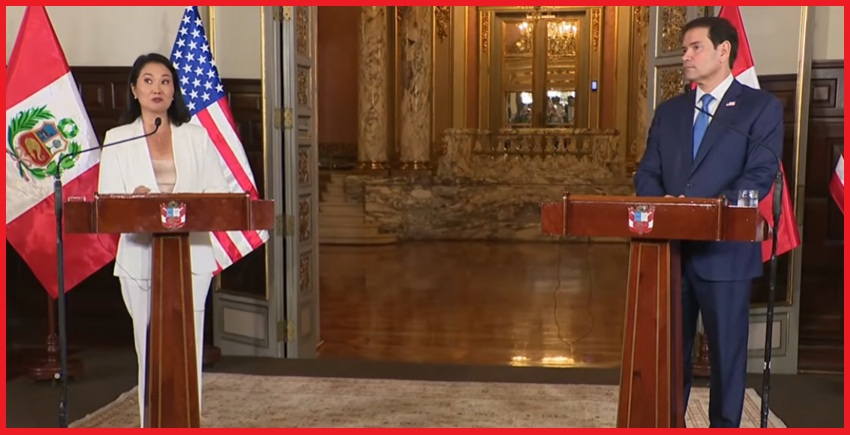
SECRETARY RUBIO: (Via interpreter) I don’t know what the Chinese embassy said. I’m not here to talk about what the Chinese embassy said. So, but the first question that you asked, we’re going to be – this is a sovereign country. You have your laws, you have a process. It’s a democratic country. You have a system, government system, a legal system; you will comply to that. We’re willing to do all what we can to assist you. This is going to be based on the cooperation that you request. We don’t want to be less, offer less, but not offer more than what you’re requesting. We’ll work together with this government that has an interest in defeating and have an obligation it’s committed to confront and defeat these criminal groups. So we’re not going to do anything that is outside the legal framework of your country or outside what the government will request.
(In English) The question was would we do anything in the country, military activities and the like – we’re not going do anything that our partners don’t ask us to do. This is a democracy. This is a republic. They have laws, they have a system of government, they have regulations, they have a process they have to go through. We are not – we don’t want to do less than what you ask of us, but we’re not going to do more than what you ask of us. We are partners and we are allies. That’s how partnerships and alliances work.
PRESIDENT FUJIMORI: (Via interpreter) I wanted to mention that even before we entered the Shield of the Americas our police force was being trained by the FBI. Even Great Britain was assisting us in this training and in the strengthening of our police force. And with our entry into the Shield of Americas we will have a more solid position.
With regard to the entry of troops, there is a special provision in the constitution. Every time there is this kind of entry, a special authorization is requested to the congress of the republic. Of course, we will uphold this rule. Peru’s sovereignty is intact. We will recover order, tranquility, and peace for all of the Peruvian people. For this reason, we thank Secretary Rubio for his presence and to be here to be able to announce that Peru will be part of the Shield of the Americas. Thank you so much.
MODERATOR: (Via interpreter) We will now listen to the last question of this conference.
QUESTION: Eric Martin with Bloomberg News. Secretary Rubio, as you get ready to conclude this three-day visit to Peru, Colombia, and Ecuador, what is your message to the people of the region about the benefits of partnering with the U.S. and to voters in neighboring Brazil as they face elections in one month from now in some of the same security and other challenges of countries in the region?
And President Fujimori – Presidente Fujimori: (Via interpreter) After the visit of Secretary Rubio —
SECRETARY RUBIO: (Via interpreter) Oh, he spoke Spanish. You’re tricky.
(In English) I didn’t know he spoke Spanish.
(Via interpreter) I can no longer speak Spanish because he’ll know.
(In English) I’m sorry.
QUESTION: (Via interpreter) Thank you, Secretary. President Fujimori, after the visit of Secretary Rubio, after today, and after being six weeks in office, are you prepared to take more steps to associate and work with the United States despite the massive investment of China in Peru during the last years, including the Port of Chancay? Thank you.
SECRETARY RUBIO: (Via interpreter) Thank you. He speaks Spanish. I mean, I was – I’m no longer going to be able to speak Spanish in front of you. It’s a joke, obviously.
First, what’s our message? Let’s be clear on this. I’ve said for more than 20 years, unfortunately, administrations of both political parties, they’ve ignored the region. The focus was on different parts of the world. If you study – because I have two jobs: Secretary of State and also I am a consultant to the national security for President Trump at the Security Council. So our National Security Strategy speaks very openly about we will give priority to this side of the hemisphere. Why? Because we’re part of it, because geography is real, and the problems of the hemisphere impacts directly. It doesn’t mean that other problems outside this hemisphere are not important, but what really happens here in South America, Central America, and the Caribbean has a direct impact to the United States.
Number two, we have a lot of people in common. How many U.S. Americans come visit, have businesses here, are tourists, live here, and vice versa? We have very – a very strong bond we cannot ignore, so we’ll give the priority. And not rhetorically – because there has been other administrations, oh, no, yes, we are focused on the side of the hemisphere, but they are not doing things, they haven’t done things. We are going to be focusing. First, it’s important for us, Peru as a country, as part of our national interest.
So this visit is not unexpected. I’ve done this visit as a senator, I’m doing this as the Secretary of State, and we will continue doing this type of visits, and we will have concrete efforts. It’s not just simply the Shield of the Americas. We’ll have other efforts jointly to confront the interests that we have in common with our friends and our allies. And we want all the time – this is the most important. This is very, very important in democracy. When a president is elected and the president decides to cooperate and work with the United States, it’s super important that we can show the people that there are benefits for the people to get a partnership with the United States and work together, not only at the security level but as well trade and economically speaking.
And we need to try to do that, and we want to make sure that the countries that cooperate with us are going to be able to respond to their voters: This is the consequence, the result of our cooperation with the United States.
(In English) Very briefly, the question was in English: What is our message? Our message is what we’ve been saying all along. We have a National Security Strategy. I helped write it. And it talks about how the Western Hemisphere is a priority for this administration – not a rhetorical priority, not a symbolic priority, not a ceremonial priority – a real priority. That’s why I’ve traveled extensively in the region, that’s why we’ve received visitors from the region, and that’s why we’re here today. Because geography is real. The things that happen in this hemisphere directly impact us. We’re not doing anybody a favor here. Us getting involved in the region is not a favor; it is essential to our own security, to our own prosperity, to our own well-being in the United States of America.
And this administration is committed to this. And there’ll be more if – people talk about the Shield of the Americas. I’m very proud of it. There’s going to be more initiatives like that in multiple realms where we can work together. But for this administration, this hemisphere is a priority, and you will continue to see it demonstrated over and over and over again.
PRESIDENT FUJIMORI: (Via interpreter) Peru is part of APEC, the Asian Pacific economic forum; the United States too. And Peru has a significant production of minerals, fish products, agricultural products, and we will continue with this effort of having trade exchanges with different countries from Asia, from the Pacific, and from Europe of course. But today, with the presence of Secretary Rubio and the agreement signed in recent days, and with this direct collaboration that will be reciprocal, we begin a new era of relations between Peru and the United States. And these relations will surely strengthen both countries.
So thank you, Secretary Rubio, for your presence. We hope you can visit us again. And we have already talked about other dates where we will be able to exchange more ideas and re-establish this cooperation, bridges between both countries. Thank you. (Applause.)
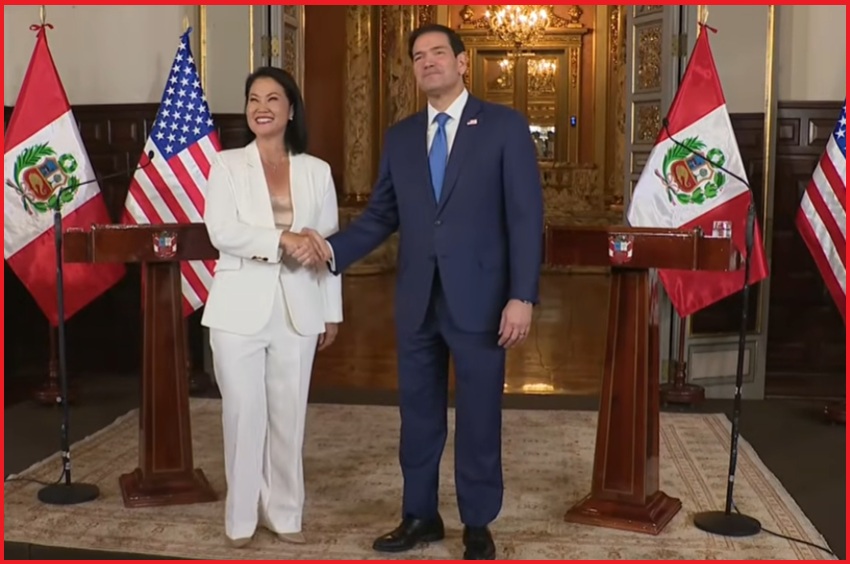
MODERATOR: (Via interpreter) We would like to thank the press for their questions, and we would like to invite President Fujimori and Secretary Rubio to step up for an official photograph. We hope that you can move forward to be able to capture this photo. This act has ended. Thank you for your presence. We wish you a good afternoon, and we will now like to request the Peruvian press to remain in your places while we wait for the other part of the press to leave. Thank you.
“During the Q&A session of the press conference, a Wall Street Journal narrative engineer asked a question about sovereignty and the U.S. acting unilaterally if Peru didn’t agree to address the threat.
Essentially, Rubio responded by telling the journalist to stop working for the ‘Bureau of Imaginary Problems’.”
FAFO.
It about time these people are “put in their place” and not allowed to continue to generate “fake news”.
Love him! So articulate on diplomatic matters yet can joke around re: PopTarts etc.
I qut reading the wsj several years ago after finding quality financial information free on the web. Disappointing beacuse I used to like the rag, but not anymore.
No longer respect the WSJ, but it’s a relevant question. Wouldn’t put it by Rubio to actually have it planted so he could spike it.
Impressive.
The late Scott Adams suggested this approach, of Trump or his administration telling people he would assign their concerns to the Bureau of Imaginary Problems. Love to see it put in action. Thank you Scott.
My father told me he cancelled WSJ decades ago because he read an editorial that basically said the U.S. is lucky the Chinese are stupid because they give us a lot of cheap imports and all we have to do is give them IOUs.
Journ-o-list…wow, that is a throwback to the very first incarnation of Obama, when Ezra Klein created a “word of the day” that every good “comrade” had to use – Rush Limbaugh pointed it out so often that they had to change their tactics, because it was becoming too obvious that they were ALL colluding!
So happy that there are frequent references to El Rushbo here on CTH. A treasure!
The stars are aligning one by one in South America. Fujimori’s victory was well timed.