A rather ironic sequence of events as Canada formally requests to renew the USMCA (CUSMA) trade agreement for 16-years, followed a day later by the U.S. announcing additional tariffs toward 60 countries including Canada.
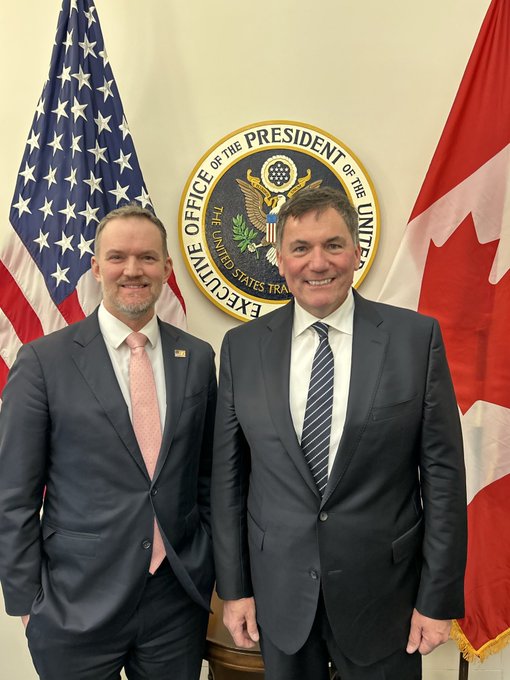 On Tuesday, Dominic LeBlanc, the trade minister from Canada assigned to USMCA negotiations, traveled to Washington DC for a meeting with U.S. Trade Representative Jamieson Greer.
LeBlanc, reflecting the obtuse nature the Canadian trade delegation is now well known for, seemed oblivious to the friction points in the U.S. position and formally requested the trade deal be renewed for another 16 years. {Citation}
LeBlanc called the agreement “highly beneficial” to all three countries. From the Canadian position this may be true, but that’s not even remotely what the U.S. team has presented in private and public comments.
Additionally, over the past two weeks the shift in Canadian strategy has become clearer. While Carney’s administration previously seemed to be targeting Democrats in the U.S. congress to support retaining a trade agreement with Canada, that approach ended abruptly after several key Democrat senators began taking the position of influential U.S. labor unions who want the deal scrapped. Canada now seems to be relying on pressure from the U.S. Chamber of Commerce and corporate republicans to support their position.
The day after news reports of Dominic LeBlanc’s expressed position, USTR Greer announced a new round of 301 tariffs against 60 countries who participate in third-party trade agreements with countries who use forced labor. {Citation} Suddenly, Canada’s embrace of China becomes even more serious.
USTR – “The U.S. Trade Representative today has determined that the failure of each of the 60 investigated economies to impose and effectively enforce a forced labor import prohibition is unreasonable or discriminatory and burdens or restricts U.S. commerce, and thus is actionable under Section 301(b)(1) of the Trade Act. In particular, the U.S. Trade Representative determined:
The following 54 economies have failed to impose and effectively enforce a prohibition on the importation of goods produced with forced labor:
Algeria; Angola; Argentina; Australia; the Bahamas; Bahrain; Bangladesh; Brazil; Cambodia; Chile; China, People’s Republic of; Colombia; Costa Rica; Dominican Republic; Egypt; El Salvador; Guatemala; Guyana; Honduras; Hong Kong, China; India; Iraq; Israel; Japan; Jordan; Kazakhstan; Kuwait; Libya; Malaysia; Morocco; New Zealand; Nicaragua; Nigeria; Norway; Oman; Peru; the Philippines; Qatar; Russia; Saudi Arabia; Singapore; South Africa; South Korea; Sri Lanka; Switzerland; Taiwan; Thailand; Trinidad and Tobago; Türkiye; United Arab Emirates; United Kingdom; Uruguay; Venezuela; and Vietnam.
The following six economies have failed to effectively enforce a prohibition on the importation of goods produced with forced labor: Canada; Ecuador, the European Union; Indonesia; Mexico; and Pakistan.
Therefore, all of the investigated economies have failed both to impose a forced labor import prohibition and to effectively enforce such a prohibition.” (more)
The 54 countries with forced labor imports directly will face 12.5% additional tariffs. The six countries, Canada included, who have failed to enforce the prohibition on goods produced with forced labor now face an additional 10% tariff.
Both the EU and Canada reacted to the 301 investigative outcome and USTR announcement by saying they would immediately step up enforcement of child labor and forced labor standards within their trade agreements. However, given that both the EU and Canada have recently begun new trade agreements with China, and the fact that China has some of the worst labor practices in the world, the ability of Canada and Europe to actually enforce the standard is highly unlikely.
 The manipulation of labor in third-party trade agreements becomes another irreconcilable issue within the USMCA, and the labor leveling tariff applies to both Mexico and Canada, regardless of USMCA trade status.
Once again, the U.S. approach toward a reciprocal trade agreement highlights the almost impossible task of maintaining a trilateral North American trade pact. This labor issue is not coincidentally at the heart of the number one complaint by U.S. labor unions, including the United Auto Workers.
President Trump and USTR Greer are aligned with U.S. labor unions on this issue of wages and benefits. Corporate Republicans, multinational corporations, the U.S. Chamber of Commerce and Canadians are not.
Then on Thursday President Trump signed an executive order to give the USTR section 301 labor tariffs more strength. {SEE HERE} The new rules for external “Importers of Record” or IORs now requires registration and identification of assets to better help U.S. customs authorities track and ultimately trace the source of imports from other trade partners.
IORs now have to provide proof of assets or a substantial surety bond, so that if they cheat, violate customs duties or U.S. trade parameters, there is a method to hold them financially accountable. As noted in Section ii:
[…] This is in part due to the substantially higher volumes of low-value articles that are imported by foreign individuals and companies that are less familiar with U.S. customs and trade laws and that face lower penalty amounts and financial consequences for noncompliance where penalty amounts are correlated to value. It is critically important that the United States be able to counter these challenges through meaningful and effective enforcement actions. The United States faces substantial barriers when seeking to enforce U.S. customs and trade laws against foreign actors like foreign IORs, particularly when assets, operations, and key individuals are located overseas. (link)
What does this mean for Canada?
Every Canadian company shipping to the US must now: ♦Post much higher per shipment bonds; ♦Be CTPAT validated by US customs; ♦Disclose beneficial ownership & domestic assets; ♦Provide foreign tax IDs & detailed supply chain data, and they lose access to “informal entry” for low value shipments.
Why? Because the USTR investigation has revealed that foreign importers can’t be trusted to comply with US law.
What triggered this for Canada? Canada’s documented failure to enforce its own forced labor ban; including a Canadian ban on imported products that used unfair labor practices in the shipment of component goods that were final assembled in Canada for delivery into the United States. It’s one of those downstream consequences of not manufacturing or producing the product internally.
Now, pause for moment, step back and look at the big picture.
Does all of this sound like something that would underpin a continued or renewed USMCA?
These forced labor tariffs are in addition to any pre-existing tariffs, and they apply toward any nation who has not enforced the labor section of any trade agreement with the United States, including goods from Canada and Mexico that are not covered by the USMCA.
Back to USTR Jamieson Greer:
A separate, ongoing 301 probe into industrial overcapacity is “a matter of weeks” from completion, Greer said. “It’s on a little bit of a different time schedule” given its complexity, he said.
“With all the deals the president has struck over the past year, these are historic deals — our view is we want to stick to these deals,” he said. “We want to make sure that those countries, whether Japan or anyone else, we want to make sure that they are responding to the types of unfair practices that were identified.”
Greer said China received advanced notice on the forced-labor announcement and that consultations will continue.
“We’re being very responsible about the relationship,” Greer said of talks with Beijing, “We have to protect our economy, we have to have a certain level of tariffs — and our expectation is that as we go through these Section 301 investigations we’ll continue to have conversations with China to try to mitigate the challenges we identify at the same time having an appropriate tariff level as part of that mitigation.” (more)

Does the US ban shipments from China, or just impose a significant tariff?
I think it depends on the product?
Alcohol is exempt…
It whiskey business 🙂
Top gun.
I would rather have a bottle in front of me than a frontal lobotomy.
love the lisp
That was highly insensitive. Hahahahaha
A rye comment.
🤣🤣🤣
At least whiskey comes with proof. Most Democrat policy just comes with virtue labels.
I think the enormous amount of Chines made goods in America answers your question.
four days ago there was an artile on Al Jazeera (so verification of fact is up to the reader) that the United States does ban AI chips from China.
If we don’t, we should. China alone knows what hidden stuff they can put on the chips they send out to the rest of the world.
Here’s an example: https://www.reuters.com/world/us/us-bans-imports-more-companies-over-uyghur-forced-labor-2025-01-14/
Only two good things ever came from Canada.
Ruby KeelerMint technology for .9999 fine silver
Gordie Howe
As Wayne Gretzky would say
“Mr. Howe”
Gretzky does a couple of good-humored mugs in this Nickelback video, “Rockstar”
Thanks for that. Stepping back in time.
Poutine.
I don’t think Canada can claim that. I will give them maple syrup though.
They can .. their Irish imports did it years ago
Oh, maybe Second City TV was good.
Still the best!
Corner Gas, Trailer Park Boys.
TPB: still the definitive Canadian contribution to western civilization! 🙂
Pirini Scleroso.
Canadian ballet
CBC Saturday program with Randy Bachman? 3 years in Afghanistan. Great tunes and the only radio station you could pick up with all the frequency jamming going on. 😎
Tim Horton’s
Favorite of the elbows up crowd.
Tabernac! Kindly remove that apostrophe or I’ll have to report you to the Quebec language police. 😉
When I got here 30 years ago Tims was the gathering place in all small towns. Kinda like a non-alcoholic village pub. 👍 Canadian owned and staffed by locals always ready to have a gossip and a laugh. Coffee was half-decent too.
These days it’s not Canadian and mostly staffed by “South Asian” TFWs. No chance of meaningful human interaction, your order’s likely misunderstood and the coffee’s merde.
A handy metaphor for Canada’s demise. 😭 😡
CORRECTION: Tim Hortons
👍 💯 Saved me a call… 🤣
Dudley Do-Right
Lobster from Nova Scotia
John Candy
Mike Bossy, Brian Trottier, Billy Smith, Clarke Gillies, and I could go on.
“You Can’t Do That on Television” – my favorite kids show
Avril Lavigne, Jim Carey and Pam Anderson.
Wayne’s World
👍 But forever sullied by the turncoat scumbag sellout Meyers. 🤮 😡
Myers, obvs. 😉
after the November elections, with the rampant cheating that will happen,,,,,all of this will be reversed, so, IMHO, we will be forced, by the incoming democrat congress, to sign another uscma that will drain us financially, because, after all, who are we to push back against our betters?
You seem to forget the president has a veto.
Yep.and canada can’t last two years more.
Unless CW2 breaks out.
That’ll be quick.
You must be fun at parties
Pragmatic and cynical alex
Unfortunately, you’re 100% right, Cherp! USTR Greer acts like his 10% tariff on 60 countries is a winning strategy in the November 2026 election. He’s tone deaf. It’s just the opposite because most Americans see prices at Walmart, Amazon and the supermarket substantially higher, interest rates substantially higher and inflation substantially higher.
With oil prices over $90 a barrel vs $57 just three months ago, gas prices almost double and US Treasury borrowing cost at 4.5% instead of 1.5% ballooning the federal deficit.
Any revenue raised by these tariffs is dwarfed by the increase in interest rates on federal borrowing with no hope of a drop in rates because Jerome Powell still controls the Federal Reserve!
Perhaps you should run for President since you know how to do it so much better.
Actually, lower oil and gas price, lower interest rates and lower inflation are exactly what President Trump ran on and won three Presidential Elections campaigning on. We watched dozens of his campaign rallys and not once did I hear President Trump promise to raise oil and gas price, raise interest rates to the highest in years or bomb Iran.
You didn’t either! 😎
Actually I heard trump say no iran bomb,many many times. I knew what he meant.
I absolutely never heard President Trump once mention Iran at a rally and I watched dozens of them.
Zero.
Now.to qoute a famous congressman You Lie
He’s been crystal clear on this point since the 80s and he absolutely made it crystal clear that he planned to cancel the JCPOA. The next logical step after that was undoing what Obama did, choosing Iran as the other ME nation to have a nuclear bomb to counter Israel. Not just as a gift to Valerie Jarrett, but because he’s a Muslim.
Well bless your heart. It’s not as if you’re transparent or anything.
Well, bless your heart, too! 😎
God blessed Texas
With His own hand
Brought down angels from the promised land
Gave ’em a place where they could dance
If you wanna see heaven, brother, here’s your chance
I’ve been sent to spread the message
God blessed Texas 💃💃💃💃
It’s already been done.
I’m not sure exactly how your comment applies, even though it’s a good song. But to remind everyone thinking about moving here, to paraphrase the old saying – Texas is a land of constant debilitating drought broken by rare massive deadly flooding. Enter at your own risk.
You’re not fooling anyone, commie.
I’m pretty sure PDJT thought it might be better for you and your family if Iran didn’t irradiate them with a nuclear weapon or two.
You might not care for US safety the way true Patriots do.
Protecting the Homeland ranks pretty close to the top of my list.
Live Updates: Trump says only US, China have capability to retrieve enriched uranium from Iran | Fox News Digital
Only US and China can retrieve enriched uranium from Iran’s ‘obliterated’ nuclear sites, Trump says
President Donald Trump said only the U.S. and China can retrieve enriched uranium from Iran’s buried nuclear sites after they were ‘obliterated’ by strikes last year.
https://share.google/MCiATC4T9r3iK2bQB
And??? You want China to give them the equipment to dig it out??
“Protecting the Homeland ranks pretty close to the top of my list.”
Ann Coulter is fond of saying that Iranians or Syrians aren’t the ones drunk driving and killing Americans, to name but one of the crimes against American humanity. It is the detritus from south of the border, all 70 plus million, who are a bigger threat.
It would be a simple task for ICE to simply round up every non white scrap of human garbage and throw them into the nearest boxcar for transport to the coast and into a ship’s hold until the US population is down to 225 or so million, or at a time when normal humans could feel safe in their community, not have to press 1 for english or lock their doors.
And if Iran DOES have a nuke, please Mr Mullah, test it on Ottawa when Carney is in town.
If rounding up illegal aliens and deporting them was such as easy task, Trump would have completed it already. It’s far from easy. It also turns the American populace/voter base against the administration doing the difficult things that it takes to do so. That’s why I’m a “Cynical Doomer” because once they were able to get them into the country, especially settled into sanctuary cities, they had won more than half of the battle.
I didn’t realize the President controlled interest rates. Or oil and gas prices for that matter….
Well you obviously either didn’t live through the 80s or are too young to remember that interest rates on homes were as high as 18%.
Everyone gets their shorts in a bunch over five and 6% when in the 1960s that was considered absolutely great interest rate. The veterans interest rate, considered enviable at that time was 5 1/4.
But yet everyone is here complaining because they’re not getting two and three percent interest rates on home loans. Country has turned into a bunch of wimps.
Yep! And in the 70’s during the Arab oil embargo you could only buy gas on even or odd days, depending on the last digit of your license plate. And you had to wait in a long line!
Then the station would run dry with you still in line! Sorry about that, see you tomorrow?
As a 1970 US Army veteran and University graduate, my first home was a private contract at 12% interest. Mortgage rates were 16-18% if you could get one…bill
Yep! In 93 I was happy to get a 3 yr Arm @ 7 1/8%, when I purchased my first house.
As usually, you’re actually full of bovine excrement…
Interest rates:
Inflation:
And while gas prices are higher THIS year so far, the trade off involving removal of a nuclear weapons capabilities, the rerouting of major oil flows away from the Strait of Hormuz to preclude its future use as a choke point, and the long term trajectory of said prices are all pluses.
You aren’t a “patriot” – your a piss poor troll.
Sunrise can’t run for any office because he’s terrible at reading a room.
He still hasn’t realized the only thing his comments here achieve are to showcase his lack of knowledge and inability to think.
I have noticed…. 😉
Sounds like a liberal troll.
That’s exactly what he is. And he runs new sock puppets every day as the old ones get banned. Been doing it for months now.
I try not to comment much due to the high volume of anger if one speaks the opposite of Trump. Some of us expected the relief we felt under his first term and it’s not coming yet. We get frustrated waiting. Is it because we’re stuck in a blue state, idk. I don’t understand why people can’t express their feelings unless people know it’s just a naysayer trying to drive us apart?
Gas dropped 15-20 cents since last night
My eyes did a double take on the signs this morning
$3.55 a gal my locality.
Almost $7.00/gal here in broken CA. Diesel even higher.
All on the boney shoulders of Gaviscon Newsom. He has a fetish for EVs and intends for gas to skyrocket.
GTFO…of Cal. NOW.
Cheapest I’ve seen it here in WA state is $5.40 a gallon.
Paid less than HALF that in Ohio yesterday for fill up.
I drive by Sun Oil Refinery in Toledo and think, ahh, the sweet, sweet smell of progress.
I paid 3.59 on Sunday.
I paid $3.53 today in NC.
“It’s medication time.”
Sorry but you need to check facts.
A barrel of oil in march was $111.00 and prices at stores are manipulated by the globalist thieves who own them.
Or the beef supply where almost all the beef in the U.S. comes from Mexico or South America with massive tariffs for unsafe garbage pin worm meat.
PDJT has absolutely no control over garbage people buy at Walmart or amazon or anywhere else.
I buy from my rancher buddy’s….all American grass fed non mRNA cattle. He emails me when he’s going to slaughter and I place my order….no meat on my table from Mex or SAm
Also buy from a rancher who raises his livestock (cattle/chicken/hogs/lambs/turkeys) and doesn’t vaxx (and no grains) and rotates his animals around his different pastures so they’re always eating off the land and the land doesn’t get saturated with constant elimination in the same places. I won’t even eat outside meat anymore. This is just one more thing I love about living in the deep south. Community Supported Ag.
I truly envy you… although it is one of the deadly sins.
Where are you located?
I get mine at goodranchers.com, all american, no drugs, grass fed
Butchered 2 steers before Christmas, they were isolated to a separate pasture and fed a finishing mix for 90 days. The end product is most excellent.
Just had 2 bulls born they are steers now in about 20 to 24 months they will be in freezers.
The slaughter house has an outlet to purchase local beef from different ranches, nice to try the other products.
But if Marxist media tells its zombie watchers that he’s responsible they believe it.
Being a Democrat and labeling yourself Patriotic is incompatible.
Kind of like saying Talarico (or pretty much any democrat) is a Christian.
Fetterman is the only democrat I know of who is somewhat patriotic…bill
Many people do as they are told by the media, regardless of the agenda.. Tariffs are not the problem false information and governance corruption is..
Biden drained our oil reserve down to sludge to give lower gas prices. FOR A WHILE…
and stopped drilling, strong regulation on drilling leases. None on federal land and more.
Thank auto pen for these gas prices.
Never heard a word from the D RATS or the Rinos and the Fake News when Biden had inflation through the roof.
Get lost troll. You’re a fraud and every single post you make is calculated for effect. “Undercover Communist” is a more accurate handle for you.
You are drooling, yet again. Continuously drooling makes for a very soggy pillow.
If the mayoral and gubernatorial primaries in California end up being obviously manipulated (stolen), the rampant federal fraud continues to be exposed in predominantly Blue cities & states, and a few choice indictments (not enough time for trials to be completed) for Democrat crooks like Comey, Brennan, etc. come down before November, I think Republicans can gain seats.
You forgot Newsom and all his buddies out here in CA.
Broma
What, is congress going to refuse to pass the Save America Act? (sar)
It’s not just cheating. The GOP has pushed away all the non-senior adult independent and Republican voters who rely on Medicaid in a labor market that’s running a functional unemployment percentage of 24.1%. With the electorate almost divided right down the line, it is a very narrow voter market to do something like that and so they’ll lose that support. The next election will be interesting but the one after that will be very interesting given the fact that the GOP wants to return to 20% co-insurance across the board and no subsidized healthcare. And apart from President Trump, the rest of them would happily begin mass shipping jobs overseas much faster while importing replacement labor… just like before. The Democrats do it too isn’t enough of a reason to vote for the GOP when the Republicans do the same thing.
Why don’t they use a Direct Primary Care membership practice? It’s the medicine of the future, for individuals & small businesses.
It’s a membership model with a monthly membership fee (maybe $125/mo for an adult, $25 for each child. Inclused as many doctor visis as needed, house calls, teleheath, some in-house surgery (lacerations, some broken bone setting), labs & meds at wholesale, x-rays, etc. 30 minute visit are standard, no insurance
Then buy an inexpensive Major Medical policy for the biggies like a heart attack or cancer.
See here. He was the pioneer in this method of HC delivery. There are many other of his videos on YT, for more info.
You seem to think it is impossible for the GOP to maintain control. Despite the historical precedents, there are several factors that are already swaying opinion.
This Congress is hanging itself.
The Electorate is DISPLEASED @ Congress – perhaps more than at POTUS.
With all their shenanigans, Congress should expect other serious contenders to prevail over the incumbants.
Um, did you actually read the article? It’s (D)s and the labor unions that support them that don’t want us to extend USMCA. They don’t want US cars made in Canadian plants. This is one of the rare cases where the interests of the Trump administration and the (D)s are in alignment. Oh, I’m sure the (D)s would love to screw up what Trump is doing or plans to do with Canada just because it’s Trump doing it and America first, but they can’t anger the labor unions and lose their voting bloc.
To be this obtuse as a nation is alarming. For Carney, & by extension the EU, to behave as if they hold leverage or a significant bargaining position over the U.S. is laughable. These countries have yet to realize, or at least acknowledge, that they’re in possession of a “Dead Man’s Hand”.
It’s actually fascinating to see that Trump Derangement Syndrome extends far beyond individuals but to global institutions as well.
In my best Archie Bunker speak, “Whadda bunch of MORONS!”
Or Bugs Bunny. What a bunch of Maroons.
The Canadians, NZ, AUS, GB and the EU have gotten by with unfair trade agreements along with the Marshall Plan for the EU since 1945. Why wouldn’t they expect to continue…….only one man stands in their way.
“Free” trade was anything but fair trade for the US of A.
this is what all Americans need to realize. They’ve been grifting off the US since the end of WWII. And all the major politicians in the US, except for Trump and those who support him, are happy to let them continue. To balloon our debt and (I’m sure) receive kickbacks under the table.
I spit on Bush the first for that NAFTA crap and Clinton for agreeing and signing it all.
None of the rules in the “rules-based order” were meant to apply to its rulers and never do apply in their own sphere.
Apparently they find the very idea that rules should apply equally to them and their entitlements such an insult to the proper order of the universe that if their first reaction – to correct the situation – and their second – to righteously destroy it – consistently fail, then they’re stuck. They can’t bring themselves to seriously engage with it and keep tripping over their own assumptions when they try.
Reality Derangement Syndrome, when little government gods run into the wall of the reality outside their politics.
Hubris -> Atis -> Nemesis -> Tisis
(Arrogance, Mental Blindness, Divine Vengeance, Punishment by Destruction)
Sounds like an Iranian telling the world they are winning.
Nicely done!
Carney is unbelievable. No matter how you analyze why he has done and acted the way he has. None of them make him look good. 1. Knowingly sell out Canada(for his banker friends) in the short term and having an exit strategy on day one. 2. Believing that something would happen and Trump would go away and he could keep the status quo while looking like a hero. 3. Playing the tough guy to his liberal audience with no thought of the day of consequences. 4. Thinking that Trump would eventually get bought off by the deep state like every other president. 5. Thinking the world could bully Trump? Please add other possible thought processes.
” Canada now seems to be relying on pressure from the U.S. Chamber of Commerce and corporate republicans to support their position.”
I guess parasites seek strength in numbers.
Nature is illustrative here in that enough parasites can subdue a host, and more than that will eventually kill their host given time.
This has to be for domestic consumption…
Does Carney think, and maybe he’s correct, that the Canadian public thinks everything with respect to the USMCA is going along just swimmingly?
And when Trump puts the official kibosh on it, he can act totally blindsided by it…as if he had no idea…
Maybe that is his only actual path forward…literally whistling past the graveyard…
When the Canadian public gets wind of no trade deal with US but added tariffs instead, they are gonna be pissed!
It will be viewed as another Carney failure.
How long before civilians revolt?
Or will it actually inflame their little TDS added brains instead of blaming their govt “leaders”?
They say there’s 5 stages of grief over a death…Denial, Anger, Bargaining, Depression, and Acceptance.
Canadian citizens are not even at Step 1, Denial, because the Canadian fascists don’t tell them the truth about anything. Right now they have no clue what is about to happen to them.
So sad.
Yes, the Canadian government controls what its people are allowed to see in the media. They are completely gaslit.
Thank you US Supreme Court for your tariff ruling that opened this delicious can of worms.
You know the ones in black housecoats who were told to vote against the tariffs are going to find out PDJT may get cornered,,, but he ain’t going down. He’s going to Fight, Fight, Fight. Bark you may be absolutely correct, this can of worms exactly! 🎯
‘…countries who participate in third-party trade agreements with countries who use forced labor’
You mean, including the US?
The cobalt in that li-ion battery in your phone, the phone itself. The clothes you are wearing. The shrimp you recently enjoyed.
If not “forced” then basically indentured, nearly slave labor. Which also describes the H-1B so beloved by US corporations as they use it to deny decent jobs to Americans.
Tip of the iceberg of a very long list.
But in-your-face hypocrisy seems to be the rule with the current administration. For example: pretending MAHA goals while continuing the poison injections masquerading as “vaccines”.
Example of the current administration hypocrisy in the MAHA BS – or is it actually intentional degradation of America while pretending?
https://www.trialsitenews.com/a/the-variant-was-examined.-the-safety-system-wasnt.-fda-advisers-vote-for-stratus-vaccine-update-while-a-larger-debate-never-happens-e2a5ea71
https://justthenews.com/politics-policy/coronavirus/cdc-shrugs-when-asked-covid-vaccine-safety-data-advisory-committee
Another tip of the iceberg. We are being played, and the apparent goals include sinking the nation.
Isn’t this tariff a great step to correct past wrongs that other administrations let slide?
Unless you like child labor or low-paying forced labor, this looks good.
“looks good”, is right.
Window dressing.
When labor is so cheap, the profiteers have a lot of room to absorb tariffs.
lol! Lol! It’s going to be so fun making liberals explain why Trump is bad for putting tariffs on slave labor.
The reverse virtue signaling we will get to indulge in – will be so delicious.
I suspect they will try “hypocrisy” -as just done above.
But that just tees it up for me to shame them for not demanding stricter controls on anll countries and demand even higher tariffs to stop it.
2. Regarding higher prices, I will virtue signal gleefully with:
“I would rather forgo luxury than benefit from slavery”then mock them for using the arguments of confederate southerners.
3. This will provide conservatives a chance to find common ground at the dinner table of supporting the end of slavery as well as educate on the magnitude of slavery currently occurring world wide
This is going to be great! Bring it ooonnn!
Low-paying jobs for sure are problems but we do have laws against forced labor and we recently have been expanded the list of offending importers (https://www.walkfree.org/news/2025/us-expands-import-ban-to-37-chinese-companies-over-uyghur-forced-labour-including-industry-giant-huafu-fashion/ ) and there’s recent news on enforcement
Canada’s political leaders make our UniParty functionaries look like geniuses.
May God bless and protect the Canadian people. This will get way worse.
I wish we would stop accepting and using Newspeak.
“forced labor” is Slavery.
“transsexual” is Mental illness
“gay” in modern usage is homosexual
add your own…
“Democracy” is Socialism.
“Human caused Climate Change” is 99+% naturally caused by factors outside human control or influence.
“Fair share” of taxes is about appropriating wealth from those who earned it and giving it those who did not. From each according to his ability to each their need.
“Fraudster” for thief.
“Democratic” for tyrannical.
Carney said “the US Canadian relationship is OVER”! So now if Canada wants to start a NEW relationship then its just that NEW, not a continuation of the same ole BS
Canada must be forced to understand that its “international business model” cannot merely consist of importing products from China, then moving one bolt from one hole to another, then exporting the same products as “Canadian.”
IS there no notion, among any of these people, for: “Make Canada Great Again?™” I now despair to think that there is not.
Also: Planet Earth will not respect you for your futile attempts to “save it.™”
Forced to understand – a collapsing economy will do that to you. Canada is already in a recession. It will get worse. Much worse.
It’s weird how no one ever talks about what a burden Israel is to America.
That’s because they are not a burden. Their $3 billion in “foreign aid” ended under Trump 2.0.
lol. New here?
Federal Reserve Chairman Jerome Powell kept interest rates exorbitantly high because he said the IEEPA Tariffs would increase inflation. As a result the T-bill rates were 4.5% instead of the 1.5% President argued they should be.
The U.S. taxpayer and consumer paid these higher interest rates on T-bills, mortgages and car loans for a year while every federal court that heard the IEEPA tariff cases ruled they were illegal. That included a three judge panel and an eleven judge panel of the Court of International Trade. The U.S. Court of Appeals and The Supreme Court finally ordering a total refund of the tariffs paid by American importers. The Federal Courts ruled the IEEPA doesn’t even mention the word “tariff” in the entire law.
So, we paid high interest rates because of tariffs that were repeatedly ruled illegal including the IEEPA Tariffs and the later Section 122 Tariffs. Now were up to the 3rd attempt with Section 301 Tariffs which the same trade lawyers have said are also illegal and will contest.
Any revenue raised by these newesr tariffs is dwarfed by the increase in interest rates on federal borrowing with no hope of a drop in rates because Jerome Powell still controls the Federal Reserve!
Dominic LeBlanc is a bozo. I’ll bet he brings an extra pair of shorts to every meeting with Greer.
Lots of descendants of slaves in the USA vote for the Democrat Party whose policies favor a country who relies on slave labor.
Awful, isn’t it?
Part of the problem is people are busy with jobs and family, so they tend to listen to corporate media.
But recently I’ve started to believe democrats vote the way they do because of emotion. In their work they might use their brain, but in cultural interactions — voting being one — they vote with feelings. And their feelings seem to focus on doing what they think makes them a “good” person. That seems to matter to them more than anything else, including competence of true morality.
They can’t see that President Trump is one of the most decent people alive. Yet they lambaste him and at the same time vote for corrupt, incompetent a***** who claim to support “good” things.
Awful, isn’t it?
Part of the problem is people are busy with jobs and family, so they tend to listen to corporate media.
But recently I’ve started to believe democrats vote the way they do because of emotion. In their work they might use their brain, but in cultural interactions — voting being one — they vote with feelings. And their feelings seem to focus on doing what they think makes them a “good” person. That seems to matter to them more than anything else, including competence or true morality.
They can’t see that President Trump is one of the most decent people alive. Yet they lambaste him and at the same time vote for corrupt, incompetent a***** who claim to be promoting “good” things.
This site is becoming almost completely unusable with this McAfee bug.
I have had no issues whatsoever.
it’s your browser
Use the Brave browser, your issues will go away.
I agree. I switched to Brave as my browser some time ago and have been well pleased.
On a separate note, I rarely post so not sure how to post here other than to “reply” to someone’s post. I am trying to search out and buy American made products. It is very difficult to find these. Several times, I believe products are U.S. made but obviously are NOT when they arrive. Can anyone here provide assistance in locating U.S. made products?
The problem with Brave is that it is very sluggish. Watch as you type and it falls behind in displaying what you typed. It is very big and resource heavy.
Same for me
How indeed….
Carney is covering his eyes, hoping that the USMCA bonfire in front of him really isn’t there.
His behavior is stubbornly foolish to knowledgeable observers and economically tragic for Canadians.
The Red Green Show was a fairly nice Canadian import. I always liked the Band and of course Gordon Lightfoot was delightful. Neil Young was on the other hand an act of war that can never be forgiven. The Canadians don’t seem capable of making anything other than woke nonsense and Chinese crap. Build the wall, we have too many hockey fans as it is.
This is just theatre to pretend they tried to get a deal – all the while doing everthing they could to scuttle it and align Canada with the EU/China/Globalists. And then blaming Trump. Liberal government in Canada knows exactly what they are trying to do- and its to collapse Canada economically to be able to bring in UBI, CBDCs and Digital ID – while destroying relationship with USA
I predict a shortage of men’s underwear in the near future in the US.
Double Mikey.
Didn’t Canada demand that we not be involved in their political system?
Carney of Canada has, in the past, been fined for using slave labor in Brazilian soy bean fields – watch him very carefully.
https://x.com/StevenBonkMP/status/2062524354567577942
There is one thing that is not being discussed much. The fact that Canada is big on putting their own citizens “mercifully” to death via MAID, and that China is the biggest trader of body parts. That’s one sick relationship right there. I love Canadians. I hate devious, perverted, corrupt governments, and whomever is getting rich off demented practices. Just sayin’. Not that America is any better with the abortion/baby parts trade. Judgement is coming. I hope to see the day when these godless practices are punishable.
This is the part in Casino where Trump has Carney’s head in a vise. Put on your Count Floyd 3D glasses for when his eye pops out and comes straight at you. And then they finished him off with a Kirpan. Might have been a knife…..
At least 97 of the more than 1,500 individuals granted clemency by President Trump for their roles in the January 6 Capitol attack have been arrested for, charged with, or convicted of crimes separate from Jan. 6 since their participation in the Jan. 6 riot.
https://www.lawfaremedia.org/article/the-jan-6-pardons–how-many-clemency-recipients-have-faced-other-charges
I don’t think anyone here could care less.
Fact is J6 was a deep state setup to entrap President Trump supporters and stolen election protestors. There were 275 FBI agents in the crowd. The capitol police and FBI fired flash bangs on a peaceful crowd to incite them to violence.
My only disagreement MichaelJ is there were likely a lot more government agents in the crowd along with hundreds of paid Antifa.
“False flags” — exactly tons of evidence of that. Those crooks are not who need protection. But if Patriots, including Moms that love our country are suspiciously re-arrested for something bogus then we need an investigation
I think it is beautiful. The WEF, USCOC, democrats, communists, socialists have been tearing us down with their fake moral high ground over Green, LGBT+, “racism” — mostly to the level of pure BS. These same people, however, are willfully blind to slavery, genocide, mass murder in other countries, and by world wide corporations and even corporations in our own country. They are blind to theft of medical care from patients, and abuse of healthcare workers by our own medical industrial complex.
Our president, however, is enforcing moral standards that end slavery, the end genocide and mass murder. Enforcing principles that give common U.S. citizens the ability to have and keep what they earn, to pursue the “American Dream”. he is holding other countries accountable with economic teeth — to the standard of the Creator of all of us.
Ironically, he is doing more for the moral standards of the world and safety for people than any of the other so called moral leaders – political, religious, or otherwise. And he’s doing it with economic teeth that are effective.
He is saying, you are no longer going to abuse us as a country. You are no longer going to be allowed to deconstruct our core values. And if you are abusing your own people, you may not have the privilege of doing business with us without a penalty. You are not going to be a most favored nation with us — even if you are a member of NATO, UN or any other alliance.
And he is saying, “I don’t have to be nice about it. Or “diplomatic”, or “gentlemanly”, or “Presidential”. I don’t care if you are a world leader, if you are a liar, swindler, or cheat, or a citizen abuser, I’m going to call you out. If you are a hypocrite, I’m going to shed light on it.
I know that it is self serving. and I am okay with that. However I think that it is great that my President Trump is taking a stand against slave labor. The only way to stop it, is for it no longer to be profitable. To think the one President that actually has taken a stand against slave labor in the past 40 years has been the one that the left calls uncaring.
How bout nooooo?
Whew! Iran and North Korea were left off the naughty list this time around. (I’m just kidding. I imagine it’s a footnote somewhere)
I’d love for MSM channels to cover in depth the intent and architecture of forced labor protection tarriffs.
Is it humanitarian or capatilist… a hybrid?
I’d say it’s honest and practical, and that’s where the inheritent protection from exploiting forced human labor.
Where the left will say “we are against forced human labor” and then cash the checks of the exact exploitation they claim to be against,.. the Trump Admin seems to align with something different… not good or bad, just honest… and as we see here often, of a non pretending nature.
How hard would it be to have a QR code on each item that shows the Forced Human Labor component of the product? You think other nations would exploit it if they knew the American Consumer (when honestly informed, so Dems need not apply) would drastically cut back the purchase?
Why not go a step further,… allow forced human labor to whatever the degree the other nations want to use it, but be GD’md sure the American consumer knows what is going on, and know which one of their peers are purchasing it.
Might be confusing for the “No Kings” to figure out what is right when their “truth” is not being funneled down their throat using the sewage pipe out of the Mockingbird Media, but that would self correct if my hunch about human nature is correct. The expoilative aspect is only tolerated in shadow or in times of great duress.