The movement to recruit Secretary of State Marco Rubio as the 2028 GOP Presidential Nominee officially began this weekend with the production created around this speech at the Federalist Society National Lawyers Convention in Washington DC.
Right now, Secretary Rubio has no substantive reason to run for office in 2028. However, there are exceptionally well-funded organizations and interests that are strongly positioning to change that. The speech was followed by a question-and-answer session that is as substantive as the speech itself.
Rubio was introduced by his daughter, and it is well worth watching the introduction first – so there are two videos, starting with the introduction. WATCH:
The full speech video and Q/A with Secretary Rubio is below.
.
[Transcript] – SECRETARY RUBIO: Thank you. Thank you. Thank you very much. Thank you. Thank you. Thank you. Thank you very much. Thank you. Thank you. Thank you.
Was that cool or what? (Laughter.) My kids, I used to bring them on stage and show them off, now they’re introducing – I don’t know where she got this. Has no stage fright, she’s not afraid to speak. I mean, I don’t really like public speaking that much, but she – (laughter) – she, on the other hand – that’s fantastic. That’s great. Thank you, Danielle. You did very good. She’s a third-year law student at the University of Virginia. I heard that’s a good law school. (Laughter.) I hope it is. (Applause.) I hope it is, because it’s expensive law school. It’s – (laughter) – I hope it is. No, she’s great. And of course my wife Janette is here as well.
And I was also a lawyer, but I was a different kind of lawyer. I was a land use and zoning attorney, and I always tell them as a land use and zoning attorney, if you ever wind up in court, something went horribly wrong. (Laughter.) She, on the other hand, is going to be like a real lawyer. So we’re – she’s fantastic, and it’s an honor to be with all of you here today, and thank you. And primarily I am here in this collection of lawyers – how many – are there any lawyers here? (Laughter.) Good. Thank you, because on election night there was a congressman that said we all needed to lawyer up, so here we are. (Laughter and applause.)
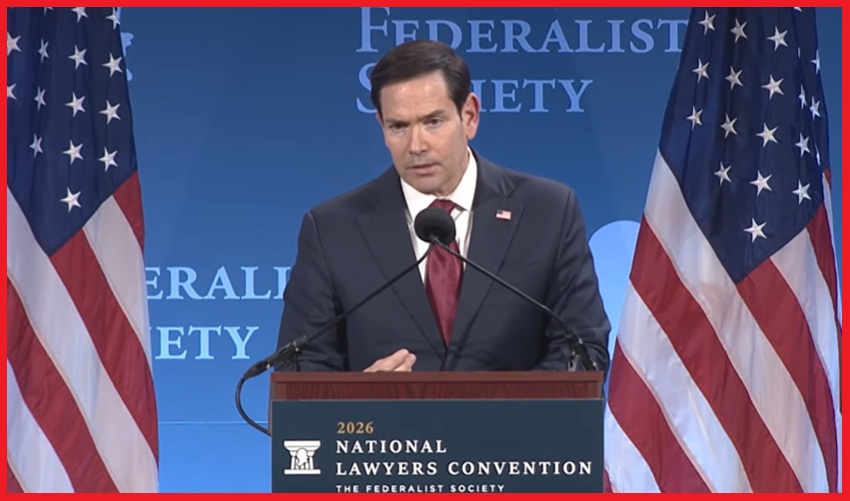
Anyway, anyway, so – and on a serious topic, less than two years into Ronald Reagan’s first term in office, you know that everything sort of seemed headed in the wrong direction. It’s hard for us to remember that right now, but that’s what it was like. After his first two years in office, things seemed headed in the wrong direction. He had won a stunning landslide victory. He had been hailed as a conservative – which was hailed as a conservative revolution and upended the political establishment. He’d been swept into office with this ambitious political mandate, he survived an assassination attempt, and he promptly delivered on a signature campaign promise, which was a historic tax cut, and he did all of this in the first eight months of his presidency.
But by early 1982 – which, by the way, I think I was in sixth grade – but by early 1982, celebrations had given way to a growing sense of gloom. The Reagan administration was facing its first major political crisis. In less than a year, the approval ratings of the Reagan administration had plummeted from – by 25 points, from 68 percent down to 43 percent. By March of 1982 – think about this, what I’m about to tell you, for a moment – by March of 1982, President Reagan was four points less popular than Jimmy Carter at the same point at his term. The economy had taken a nosedive. In fact, it faced a full-fledged recession. Unemployment was approaching double digits, the worst it had been in 40 years, with many, fairly or unfairly, blaming the president for all of this. Even his foreign policy ambitions were beginning to lose ground, with rising fears of nuclear war with Russia spilling out into a popular revolt against his efforts to take on the Soviet communism around the world.
On all fronts, the Reagan administration and the conservative movement at that time was on the defensive. But it was against that backdrop that I just described to you in 1982 – which, by the way, also culminated in devastating losses for the president’s parties in Congress – it was against that backdrop, amid plummeting morale, the anxiety, the despair, that something new began to stir. And it was – at that time it was little more than just an idea. It was germinating in just a few law schools – common – in the common rooms of several law schools and lecture halls. But soon what was stirring would remake the whole landscape of American politics and law, forever changing the course of the nation.
In April of 1982, in the middle of everything I just described to you, there were four law school students that organized a symposium on federalism in New Haven, Connecticut. About 200 people came. One of the speakers that came was this 46-year-old professor from Chicago. His name was Antonin Scalia, and he diagnosed a basic problem to the room. He said conservatives have simply been outgunned at the federal level for half a century. And, of course, nowhere was that more obvious at the time than in the courts. Republicans had won three of the last four presidential elections. Seven of the nine justices at the time on the Supreme Court had been appointed by Republican presidents, and yet none of it seemed to matter much at all.
Nine years earlier, the court had delivered its ruling on Roe v. Wade. Five of the seven votes for the decision were Republican appointees. The majority opinion was written by a justice who had been nominated by President Richard Nixon. The most consistent conservative on that court was William Rehnquist, and he spent much of his time as the lone voice of dissent – so much so that his law clerks gifted him a doll of the Lone Ranger. (Laughter.)
At the time, only one major law school in the country had a conservative student journal. By the way, it happened to be Harvard. It had been founded four years earlier. And the very term “originalism” itself was only two years old, and it wasn’t coined by an originalist. It was coined by a liberal Stanford professor in an article written to criticize and refute the concept. Just a few years later, a sitting justice on the Supreme Court would dismiss this idea of originalism. He would dismiss it as, quote, “little more than arrogance cloaked as humility,” sneering that its advocates were “persons who have no familiarity with the historical record.” This was how the Federalist Society began.
But your critics aren’t sneering anymore. The Federalist Society helped to change and advance America, and there are many lessons for us to learn today from that success. One of those lessons is that politics requires more than simply winning elections, because the government is not the only source of political power. Power also lives in the universities. Power lives in the press. Power lives in the whole expanse of civil society, all of the institutions that define and shape our understanding of ourselves as a nation and as a people. Every society – and I mean every society – has an elite, has a ruling class. And in ours, that class resides not just in the White House, not just in Congress or the courts, it also resides in academia, in powerful nonprofits, and in nongovernment organizations. It resides in corporate board rooms and C-suites and think tanks and journals, in foundations and in mass media, stretching across the commanding heights of business and education and culture.
This is something that the left over the last six decades has frankly often understood better than the right. Elections, elections decide who holds office for a season. But elections, they do not – they do not decide by themselves what our institutions teach or what our lawyers believe, which ideas are treated as respectable or normal, and which are deemed beyond the pale. The government, of course, can and does play a critical role in shaping these things. But the government can’t fundamentally transform them into two or four or – it can’t transform them in just two, four, or eight years. That kind of change – that of change is implemented over the course of a generation or more, and even then only through the dedicated work of a coalition of allies across institutions, working together both inside and outside of the state.
The Federalist Society’s victories were built on this insight. It’s not just about placing good judges in positions to interpret the law. It’s about shaping the world in which they do so, about shaping the norms and the values, the ideas and beliefs, the expectations and the assumptions, that underpin how they think and reason and act. Who defines these things and to what end – that is what power is. That’s not unique to our country’s legal system. At the State Department, we have seen the same thing firsthand in the realm of what is called international law. We’ve heard the concept international law invoked against nearly every major foreign policy decision or action of this administration.
So, for example, when President Trump ordered our military to sink cartel boats in the Caribbean, we were told that they were violating international law. The founding chief prosecutor of the fake and illegitimate International Criminal Court even accused us of crimes against humanity.
When American forces captured Nicolás Maduro, a fugitive of American justice, and brought him to the United States to face that justice, we heard the same – (applause) – when we did that, we heard the same accusations from the highest levels of the – I’m not going to call them a name – the United Nations. (Laughter.)
Even the enforcement of our immigration laws – even the enforcement of our own immigration laws here on American soil – has faced this attack. Earlier this year, for example, groups like the ACLU were petitioning the United Nations to investigate ICE’s blatant violations of international law here in the United States.
Over the past decade, we’ve received an endless barrage of claims about America’s alleged violations of international rules and norms, ranging from our foreign policy to our border enforcement to even what they call – what they call – our systemic racism. Even on the issue of abortion, for example, when Roe v. Wade was overturned by the Supreme Court in 2022, it was swiftly denounced by a cadre of, you guessed it, UN human rights experts, an oxymoron – (laughter) – as a betrayal of America’s binding legal obligations under international law.
None of this has anything to do – none of this has anything to do – with any real higher standard of justice. It is a function of the people who control the official organs of global governance. It is the function of the sprawling network of NGOs and agencies staffed by international activists and bureaucrats, along with their patrons here in the United States and around the world.
For this global elite, international law is not a neutral body of rules; international law is an instrument, an instrument to advance their interests under the pretense of universal principles. For example, they’re staunch defenders of democracy – until particular elections challenge their interests. They lecture us on the importance of sovereignty even as they demand that nations surrender control of their borders and outsource their immigration laws to unelected international courts. They oppose, they say, all forms of imperialism, of conquest, of domination, but they seek to exercise authority over every country and every government on Earth.
That’s why, earlier this year, President Trump made the unprecedented decision to sanction the fake International Criminal Court – (applause) – a fake court which is an unelected world tribunal, which claims to supersede the laws and constitutions of sovereign states, even those who never signed up for it.
Americans have never agreed to submit to the ICC’s authority, but that court and its allies in the global bureaucracy have appointed themselves judge and jury and executioner of the international order, ruling over all but account – ruling over all. They’re ruling – they think they have the right to rule over everyone, but they are accountable to no one, armed with the power to investigate, to prosecute, to persecute, and to jail our citizens according to laws we neither consent nor control.
They can certainly try, I would say. But if they’re foolish enough to try to enforce their paper decrees on Americans, our answer will probably be the same as the Roman general, Pompey, when he said to those who were trying to invoke their cities’ charters against his legions. He said, “Stop quoting laws to men with swords.” (Laughter.) Not politically correct to say that, but that’s what he said. That’s what he said. (Applause.)
Anyway, look, the weaponization of international law is not altogether different from what we’ve seen here at home. The activist courts who seek to govern by injunction, twisting the law to fit whatever their preferences happen to be at any given place or time; their allies in the academy, in the press, the professional activist class – the same people who just a few years earlier were denouncing the Constitution, okay? These are the same people who just a few years ago were saying and denouncing the Constitution as a racist and backwards document that was written by slaveowners designed only to protect the interest of wealthy white men.
These same people now wax poetic about how – defending our principles of government and how they’re carrying out their constitutional duties. For these people – for these people – the fundamental purpose of the law, American law and international law alike, is to weaken the United States. It is to undermine our power as a sovereign nation to act. It is to hinder the American Government’s ability to defend American interests at home and abroad. They tell us that we are compelled by a sacred legal obligation to give up our power, to surrender our sovereignty, to submit to the whims of our enemies, to allow our cities to descend into violent anarchy, to welcome in any foreigner from anywhere in the world who arrives at our doorstep without permission, to transform our towns into refugee camps for the entire planet. And beyond our borders too, they would have us believe that we must allow our rivals to act against us with impunity, that those who flood our country with drugs and crime and death should be met with little more than the occasional and polite complaint. There is nothing – there is nothing – in our history or the history of any other great nation that requires us to recognize the authority or legitimacy of any of these ridiculous ideas.
Quite the opposite – it is not only alien to our political and legal tradition; it is alien to who we are. It is an attack on our essential character as a people, a rejection of the qualities and the instincts that have defined Americans since before the founding itself. America has always and, I believe, will always be a nation of irrepressible ambition, ambition which, since the very beginning, extended far beyond our borders. Low ceilings and small horizons were never our destiny. Even the American Revolution itself was driven in part by our forefathers’ anger at British limits on our westward expansion – a grievance cited in the very Declaration of Independence itself. The history of our nation and our people brims – it brims with a hunger to expand, to grow, to explore, to conquer, to stake a claim to new frontiers. It can be found, by the way, in the opening paragraph of the Federalist Papers, where Hamilton begins by announcing to his readers that the ratification debate would decide the fate of an empire – in many respects, the most interesting in the world.
We, Americans, we are not passive, an inward-looking people. To submit to the sterile vision of radical judges or soulless global bureaucrats would be to betray who we are, to betray ourselves. The real America, the nation that actually exists in the text of our founding documents, that actually exists in the history of our people, in the conduct of the men who built backwater colonies into the greatest superpower on Earth, was always destined to go beyond, to be greater and stronger, more than which had come before. Our laws, our Constitution, our legal norms, and our political traditions developed because – not in spite – of that fact.
This is the true American genius of self-government, the unique and distinctive structure of our Constitution, marrying a remarkable freedom and independence with an equally remarkable strength for collective action. It is the expression of these characteristics and instincts our institutions developed to organize and channel our ambition, not to suffocate them. Our laws were written by and for a people who were called upwards and eventually even outwards to the stars.
From the very beginning, America was on the move. It was alive, it was dynamic, and it was expanding – a nation advancing across the continent, settling land, building cities, laying roads and railways, subduing the wilderness, and painting a great civilization upon the canvas of a new world.
In 1776, our new Republic was 13 states clustered along the eastern coast and a handful of scattered frontier outposts just beyond the Appalachians. In 1848 – this is just in – just 72 years later, the American flag flew over a continental empire spanning nearly 3 million square miles in size, running from the eastern cities of Boston and New York to the port of San Francisco Bay – to the ports of San Francisco Bay. So think about it this way: A child that was born the year we declared our independence could have lived to see his or her country stretch from the Atlantic to the Pacific.
And as our territory expanded, our horizons only grew. No sooner had we reached the western edge of Oregon than we began building new systems, networks, and technologies that extended out across the world; cutting canals across continents that rewrote the rules of geography; and forging satellites and spaceships that reached beyond the boundaries of Earth itself. None of this happened by accident.
When our predecessors first arrived in North America, when they first came, there were no factories, there were no railroads, there were no skyscrapers. These things exist because we built them, because we acted. (Applause.) These things exist because we acted without fear or moral doubt and overcame all that which threatened or stood in our way.
But today we are told by some that the age of great nations pursuing great destinies is over, that we cannot act, that we cannot impose ourselves upon the world, that we must surrender our dreams to the consensus of distant tribunals and submit to our place as merely one nation among the many, that we must accustom ourselves to the comfortable and to quiet decline. We are told that our determination to act in our own interests, on our own terms, is an assault on the universal, quote-unquote, “rules-based order.”
For example, under this theory, the President himself cannot execute the foreign policy of the United States, he cannot restrict trade or immigration or even examine the way in which we spend our citizens’ tax dollars abroad, without facing the fury of international lawyers and jurists and NGOs and UN bureaucrats condemning his threats to – condemning his threats to global values and norms.
All of this, at home and abroad, is a child of the leveling and pessimistic spirit of the age. It entices us to relinquish responsibility for our own destiny and to relieve ourselves of the burdens of greatness and seek refuge in these glittering generalities of international law. Even as we defeated the institution of Soviet communism, we did not triumph over the spirit of Marx. That spirit of Marx, it lives. It lives on in these new forms and doctrines, which would subordinate the national will to the menial consensus of the world. Marxism sought to abolish the distinctions between men. The radicals of our time seek to abolish the distinctions between nations themselves.
The ultimate question of our time is whether Americans have a moral right to exist as a distinct nation and a distinct people, and thus to demand a government that defends and pursues our interests above all else. Those who tell us that we are living on stolen land, as an example, that our nation was founded and built upon slavery and genocide and oppression, are telling us clearly that they do not believe that we do. They would have us think that American – that America – and more broadly, that the West – are uniquely burdened by guilt, guilt that we can only atone for through total surrender – by opening our borders, by renouncing our laws, by retreating from the world, and allowing them to remake our society in their image.
We should understand clearly that these – these – are the stakes of our political struggle. We should remember that this is what many in the universities, on the courts, or in the halls of government – what they really believe. As recently as 2021 we had a president telling us that hatred – hatred – was systemically embedded in our laws and our culture. Today, few, if any, of these people involved on that side of our political debate have renounced those ideas.
Their fundamental beliefs have not changed. And in the coming months, we can expect to hear a lot about their deep concern for the Constitution, the law, the principles and axioms of justice. But that concern seems to only appear when it can be wielded as an obstacle or a weapon to advance their interests.
Politics – both here in the United States and on the international stage – frankly, it is not a marketplace of ideas where good-faith interlocutors can debate and reason together and the better argument always prevails. Persuasion matters, but not everyone is always persuadable. The lessons of the Federalist Society is that victory requires something beyond good arguments. Victory is secured through institutions and networks and systems fixated on a shared goal, capable of shaping and exercising influence.
This organization’s long march through the institutions of American law was carried out by men and women who were armed, not just with ideas but with ambitious plans of action, cultivating and recruiting the most promising young conservative minds of their generation, funneling them into the pipelines to power, carrying their cause from the lecture halls to the highest courts in the nation.
Those who believe that one setback, one defeat, one bad election spells the end of the Republic should look to you as an example for inspiration. And it is the same lesson, by the way, that is written in the fabric of our country, a lesson written in the fabric of our Revolution that gave birth to this nation itself.
Too often, we tell the story of American independence as some inevitable and certain triumph, as if Washington and the Continental Army were always fated to prevail. Students of our history know that nothing could be further from the truth. The first year of the Revolution was an almost unbroken line of devastating and humiliating defeats. By December of 1776, General Washington had less than 3,000 men fit for duty – limping, starving, freezing, and sick – and they were in desperate retreat, with the greatest empire of the age in hot pursuit. All across the colonies, the revolutionary spirit seemed to be in collapse.
In fact, something not often featured in the movies and in the documentaries and, perhaps, even the books about this era – thousands of Americans took British pardons and renewed their allegiance to the crown. That’s how bad things were. Men who had cheered the cause of independence only months earlier made their peace with what seemed to be inevitable defeat.
In that month, Washington wrote a letter to his brother. He said – unless something changes soon, he wrote, “I think the game is pretty near up.” And he concluded his letter with this. He said – and this is a quote – “You at a distance can form no idea of the perplexity of my situation. No man I believe ever had a greater choice of difficulties and less means of extricating himself than I have. However, under a full persuasion of the justice of our cause, I cannot but think the prospect will brighten, although for wise purposes it is at present hidden under a cloud.”
Well, he was ultimately right. Five years later, Washington – and, we acknowledge, his French allies – surrounded the British army at Yorktown, Cornwallis surrendered, the Revolution prevailed, and a nation was born. We have much more to do over the next two, the next six, the next 20 years. Great things that last are built in decades, not election cycles. There will be more victories and there will be more defeats. There will be more triumphs and there will be more disappointments. This is the nature of all undertakings of this weight and of this magnitude. There are no great men or great causes in the pages of history that did not suffer the same. But we are persuaded of the justice of our cause, and we too will triumph in the end.
And I am – (applause) – and though we are prepared for the twists and turns and the ups and downs of the road ahead, of this I believe with all my heart, that we in this generation will leave for our children and our grandchildren what Americans always leave for their children and their grandchildren, the single greatest nation in the history of the world. (Applause and cheering.) Thank you very much. Thank you. Thank you very much. Thank you. Thank you, thank you. All right. Thank you. Thank you. All right. Thank you.
They told me to stay up here. Why am I – am I answering questions? Okay. (Laughter.) I don’t have a second – I mean, I do have another speech, but – (laughter) – they didn’t tell you there was an intermission, did they? (Laughter.) All right, go ahead, I’m sorry. Are you our first question?
QUESTION: Yes, I am.
SECRETARY RUBIO: Okay, great.
QUESTION: Thank you so much for being here.
SECRETARY RUBIO: Thank you.
QUESTION: My name is Morgan Hughes. I’m a 3L at the Florida State College of Law, so go Noles. (Laughter and boos.)
SECRETARY RUBIO: That’s – they’re baiting me. Go Gators. (Laughter and cheers.)
QUESTION: So it seems as though Christian attorneys are consistently told that they have to leave their faith at the door whenever they’re practicing law. As a believer and an attorney, how do you believe we’re supposed to respond to this pressure?
SECRETARY RUBIO: Remember, I did land use and zoning, okay? So – (laughter) – so no, the hardest thing to zone in the world is a church and a funeral home, as you know. So I’m telling you, nobody wants either one next to them because of the parking. But anyway. (Laughter.) No, that’s an important question. Look, I don’t – so I think your faith – attorney is what you do. Your faith is who you are. And so I think that – (applause) – and if you speak specifically about Christianity as your faith, then I would say this is a faith that teaches that your job is to care for the less fortunate, to feed the hungry, and clothe the naked, and visit the prisoner, which you’ll do often if you’re a defense attorney. (Laughter.)
And – but I – and I also think embedded in our system of government and in our system of laws is very powerful Judeo-Christian principles about the dignity of the human being and of the individual, which our legal system ultimately recognizes. If you think about our criminal justice system for a moment, it’s built on the notion that no matter how guilty someone may be, they are entitled to the most vigorous defense, and that it is the state’s job to prove the case against this person because a human life and human freedom is so valuable that you must overcome extraordinary obstacles in order to ensure that if you’re going to put someone in jail, the evidence and the burden is on your side to prove it, in essence, not the other way around.
We take that for granted, but in many parts of the world you’re presumed guilty and your job is to go in there and convince them that you’re not guilty. In our country and our system of law, you’re presumed innocent even though everybody knows you did it. (Laughter.) Right? But that isn’t because we’re nice people. It’s because embedded in our Judeo-Christian values is the belief that the individual and the freedom of that individual is something that’s sacred because it’s given to us by our creator. Our very founding documents speak to the fact that our rights don’t come from government. Our rights don’t come from the law. Our rights are not determined by whoever happens to be leading us every two, four, or six years. Our law – our rights come from our creator; they are inherent in us as a person.
So I think you bring that into the legal profession. Now, I don’t know how it applies to a real estate contract, but I can tell you how it applies to a criminal justice system and to our broader system. So I would just say that your faith should inform you in what you do. And I think ultimately it’s a faith – you spoke again that you’re a Christian. Christianity teaches us, as you – not just to care for the less fortunate but also to value human dignity and the dignity of all people, irrespective of the circumstances they come from. And I think these are things we want to encourage in the legal profession, not discourage. (Applause.)
QUESTION: Thank you so much for being here, Secretary Rubio. My name is Shneur Gansburg. I’m a 3L and the president of the Berkeley chapter.
SECRETARY RUBIO: Of the where chapter?
QUESTION: Berkeley Law.
SECRETARY RUBIO: Ooh. (Laughter.)
QUESTION: We’re very loved. So first, as a service member, I want to thank you for your service to our country and all that you’re doing in all your many roles. (Applause.)
SECRETARY RUBIO: Thank you.
QUESTION: So, many young Americans seem to have an anxiety about the future and are drawn to extremes, whether that be antisemitism, communism, socialism. As the son of Cuban immigrants, how do we instill the values in the next generation of love for our freedom, love for the values of our country, as you clearly have so successfully done with your own daughter?
SECRETARY RUBIO: Wow. Well, my home is not a democracy, so it begins with – (laughter) – and by the way, I was not the dictator, either. (Laughter.) I was the minister of defense. (Laughter.)
But all kidding aside, kind of – (laughter) – the – no, all joking aside, no, look, I think – look, I have no problem with people, like, going through the phases of life where they explore different thinking and so forth and so on. But I do think there are a couple things that are important that I think should be at the foundation of everything.
The first is I – and I just believe this because I think history backs it – the American story is exceptional. It’s extraordinary. It has no precedent in the history of the world anywhere. (Applause.) And I think that – I think we’ve neglected to say that. I think we spent 20 or 30 years – for combination of reasons in our education system sort of infusing in people all the terrible things that are – that have happened in the history of our country, to which I say I never said our history is perfect. I have only said our history is better than anybody else’s.
And I truly mean that. If you think about all – for example, what is a proper teaching of our history in some of its worst moments? You think about all the great justice movements in our history: the end of slavery, the end of segregation, women’s right to vote. All of these advances – every single one of them, okay – was not a rejection of our founding principles. You know what each one of them was? It was a demand that we live up to our founding principle, every single one of them. (Applause.) In fact, one of the best lines in Dr. King’s I Have a Dream speech is a demand that we live up to the ancient words of our founding. He didn’t say overthrow the government. He didn’t say reject the Constitution, walk away from the principles of the Declaration of Independence. What he was accusing us of is that we were not living up to the principles of who we were.
The second, on the point of economics – and this is just my personal point of view – look, I believe in the free market, but I don’t worship the free market. I think the market exists to serve people, not people to serve the market. The market is a tool to achieve – to provide for human achievement and prosperity. But there’s also a national interest that has to be balanced. I think the market works when it does two things: it provides wealth and prosperity, but it also provides opportunity for people to find dignified work. So we have to do a better job of understanding that there’s no absolutes here, and ultimately the market, as an example, is a tool.
I think we have to recognize that people are struggling. There’s no doubt about it. There’s no doubt, and I think the numbers are clear, that younger people today are further behind than their peers were 20, 30, 40 years ago, and to ignore that would be to close our eyes. I think we sometimes forget that yes, I’m not saying the stock market is irrelevant and unimportant, but for most people, the health of our economy has nothing to do with the stock market. The health of their economy is whether they have enough money to be able to afford the things they need and want. That’s how they judge the health of our economy.
So we do have a lot of work to make these arguments. People call it populism. I just call it common sense. I think it’s important, though, that it all starts with a founding belief – or the foundation of making these arguments is expressing to people the extraordinary story of America, and one of the things that’s most extraordinary about our history is this unbroken chain of each generation leaving the next better off, with a safer, better, more prosperous country.
And that’s the challenge before us now, because I do think there’s a legitimate fear that we will be the first generation to leave the next worse off. And that can’t happen. That’s un-American. It runs against our story. It’d run against our history. And I think the foundation for all of it is explained to people that America is exceptional but it’s not self-perpetuating. It has always required those in charge to do what it takes to keep it moving forward and that that’s what we’re called to do, and then have confidence that we can do it. It’s an enormous undertaking, and it’s – like I said in my speech, it’s something that happens over years and decades, not election cycle to election cycle. (Applause.)
Hi.
QUESTION: Thank you for being here. My name is Mariah Cerome and I’m currently a 3L at the University of Texas. Recently in Greece —
SECRETARY RUBIO: We beat Texas this year, Florida. (Laughter.) Go Texas.
QUESTION: I am a Florida grad as well.
SECRETARY RUBIO: We also lost to a couple others, but – (laughter) – I’m sorry. Go ahead. It’s not your fault. You don’t – you’re not on the team, so I’m not – (laughter) —
QUESTION: Recently in Greece you spoke on the balance between our nation’s domestic sovereignty and our international security demands as a leader of the Western world. How can the administration adequately address both of these needs without forfeiting the support of the American electorate, which has clearly expressed a focus on domestic concerns?
SECRETARY RUBIO: Yeah, they’re interrelated, but they’re always going to be – look, let me start with this: I think the job of America’s government and its leaders is to work for Americans. I mean, that sounds kind of strange, but in the realm of foreign policy, we’ve almost lost it. But we’ve also lost it in the realm of economics. These are my personal views, but I’ve argued them in writing, I’ve argued them in speeches. I think there came a point at which we forgot – like, the end of the Cold War, everybody thought, okay, the whole world is now going to become free enterprise democracies, and it just didn’t work out that way. It was never going to work out that way.
The second is we placed this confidence in the markets, in global markets, and basically saying it’s okay if a bunch of jobs leave our country and relocate somewhere else. They’ll make it cheaper over there, which means prices will be cheaper over here, which is true that prices will be cheaper over here, but you just wiped out a bunch of jobs, gutted a bunch of communities, and now you have a bunch of people that don’t feel like they can move forward.
All of this happened because we lost our focus. We forgot that our job is – we’re not against the world. We’re not – our job is not to harm the world. But our number one objective must always be what’s in the national interest of the United States, and we shouldn’t feel guilty about it, okay? Next week I will get on an airplane with the President and we will fly, for example, to the Philippines for the ASEAN conference, and then we will fly to China for the APEC conference. And I was asked by a reporter the other day, well – something about a disagreement we have with China. And I said, look, the Chinese Government is in favor of what’s good for China and they don’t apologize for it.
We are the only country in the world that seems to have forgotten that. I’m on the American side of every issue. (Applause.) And – and that I even have to say that is stunning. Think about it: The fact that I even have to say that is stunning. I always remind people, I am the Secretary of State of the United States – (laughter) – not the – there was a huge outrage. We did a – we have these flags at the State Department when you walk in, and we had all these flags of all these different countries. And I – look, I didn’t go in with, like, a crusade to remove the flags. We left it there for a year and a half. But then for America 250, we made them all American flags, okay? And then we left them there after 250, and people are going crazy: Oh my God, they’re abandoning the world. I said, no, we’re not the United Nations. Take the flag; the United Nations can have all those flags. (Laughter.) It’s the State Department of the United States. (Applause.)
And so – so the way I view it is that what we need to do – I think your question was probably geared towards more why is the United States involved in things around the world. Well, we have to be involved in things around the world because whether we’re involved in the world or not, the world will be involved with us. There are things happening in other countries and in other places that do have an impact on the national security of the United States, and our economic interests as well. We can make the greatest products in the world, but if we don’t have markets that are open to us, as an example, that’s going to be a problem.
We can – if there’s instability and insecurity in our hemisphere, we will eventually have migratory pressures because this administration has made the decision that it’s going to protect our borders. But the next administration may not. (Applause.) And so I would argue that America is safer and better off if we are surrounded by countries that are stable, safe, and prosperous. But ultimately – (applause) – and we should do things in our policy because it’s in our national interest. But in the end, on any topic, the number one question we have to always ask ourselves is what is in the best interests of the United States. And we – not only have we forgotten it, we’ve actually abandoned it for far too long. And I think this administration is returning to that idea, and that’s how we try to pursue it.
Again, that doesn’t mean we don’t meet with other countries, and it doesn’t mean we don’t work with other countries, because oftentimes when our national interests align with the interest of another country, that’s where you build alliances. When your national interests are in conflict with other countries, that’s where the work of diplomacy happens, to see how you can balance the two. But in the end, if we can’t balance it, I know whose side we need to be on, and that is on the side of our people, our country, our economy, and our security. And I think that every nation governs itself that way. We forgot it, and we’re restoring it. (Applause.)
QUESTION: Thank you so much for being here. My name is Tasha Dambacher. I’m a 2L at Harvard Law School.
SECRETARY RUBIO: 2L? The rest are 3Ls. 2L, excellent. (Laughter.)
QUESTION: One of the remarkable things about the United States is that people from every corner of the world have come here, and they’ve come here not just to become residents but to become patriotic Americans. That is dependent on a shared national identity, a common civic culture, and an expectation that newcomers will embrace American values rather than simply bring the divisions of the old world with them. Today we’re increasingly reluctant to insist that assimilation is a good thing. Have we lost confidence in the idea that there is a distinct American identity that is worth preserving? And how do we restore a culture of patriotic citizenship that fosters assimilation without losing what has historically made America exceptional?
SECRETARY RUBIO: That’s a great question. That’s a fantastic question. And it’s at the heart of everything I just – (applause) – well, the first is that you’re right. I mean, and there were practical reasons why, first of all. I don’t want to, like, go into all great details, but if you came here a hundred years ago, you probably were never going back to where you came from. Just – you’re not going to get there because you’re not getting back on that ship and sailing 180 days the other way. It didn’t happen. Now you’re just a flight away, so that’s the reality; the world is more connected in that regard.
I think the other thing – some of the things that have changed about immigration – and look, I – let me start – let me preface it by saying this. It’s not that I don’t understand. If you live in a place that’s dangerous, if you live in a place that’s poor, and, like, the freest, most wealthy economy in the history of the world is nearby, I understand that allure. I get it, I really do, and I understand the human behavior. Again, I go back to our national interest. We still can’t just be a place that says you can come here from anywhere in the world that you want and you don’t have to follow any rules.
But on the point of assimilation, I think there’s a difference between coming to live and work in America and coming to be an American. They’re not always the same thing. And I think that’s incredibly important for us to remember because we do have a distinctive national character. And people ask me, though, what – we’re not – the United States, we’re not a common ethnicity. We’re not a common race. We’re not a – we’re not bound – but you know what binds us is that we’re all – I truly believe this – America as a nation – we are all the descendants of go-getters. (Applause.) If you think about whether you came here on a ship that sailed across the Atlantic, whether you came here because you refused to accept the restrictions of their nation of birth, whether your ancestors overcame the horrors of slavery and after that of segregation, we are the descendants of people that refused the limits and said we’re going to continue to strive and build for ourselves a better life. That blood literally runs through our veins. That’s who we are as a people and as a nation. And I think America will always be a nation that welcomes people from other places so long as we have certain rules and controls and restrictions in place that determines how many people can come, when they can come, who can come. Those – every sovereign nation makes that.
But to go back to your central question about assimilation and the national character, that’s absolutely essential. And look, I think it happens more often than – I think we’ve lost it in some places. I think in others it’s still very well alive. Some of the most patriotic people in this country – and this is not a criticism of anybody – but some of the most patriotic people you’ll ever meet are people that are Americans by choice, not people that are Americans – (applause) – and I’ll tell you why.
And I’ll tell you why: because of – I’ve lived in America my entire life. I was born in the United States. I’ve grown up here. I don’t know what life is like. But when you meet someone who knows what life is like somewhere else, when you meet someone that knows what it’s like to live in a society where you don’t have – not just political freedoms, but where your very future is determined on the day you are born by what your parents did and whether they were connected or not – when you meet people like that, they know that life in this country is special. They know that life in this country is different. And they have a lot to contribute.
So Americans by choice – people that did it the right way and chose to be Americans – oftentimes, I think, understand how special this country is more than someone like me, even, who was born here and lived their entire life and have never had to live under a different system or a – and I think we need to hear more from those voices as well. I think they’re very powerful in that regard. (Applause.)
QUESTION: Mr. Secretary, thank you so much for being here. We’re really grateful that you’re here. I’m Lucy Griffin. I’m a 2L. I’m the president of the Federalist Society at William & Mary. We don’t play you in sports.
SECRETARY RUBIO: No, but they have a team. (Laughter.) No, no, but they have a team. I know all about it. Go ahead. I’m like a sicko on football and college football, so I know everybody that has a team. In fact, I judge schools by their team. (Laughter.)
QUESTION: Well, we’re D2. Don’t hold it against us.
SECRETARY RUBIO: I don’t care about U.S. News & World Report rankings. Go ahead. I’m sorry. (Laughter.)
QUESTION: You’ve described – you’ve demonstrated a victorious American mentality. So at this point in the conflict in Iran, what would you consider an American victory?
SECRETARY RUBIO: That’s a great question. I think – two things that are important to understand why we’re in it in the first place. Iran has been waging – whether we want to believe it or not, they’ve been waging war on the United States since 1979. And the problem with this – (applause) – and the problem with this regime is its revolutionary nature. One thing is to be a country, because you can have disagreements with countries. The problem is the country of Iran is governed by an elected class of people who we don’t agree with, and I’m not arguing they’re moderates or people we can agree with. That’s – the government runs the country. But the country is led by a religious Shia clerical class – and not just Shia clerics but radical Shia clerics – who are motivated in their decision-making by theology.
Now, this sounds very strange, because people – that’s – you don’t often hear this conversation when it comes to geopolitics. But if you don’t understand this, you don’t understand Iran. And these people are not governors of Iran. They could care less what Iran’s economy looks like. These people are revolutionaries. If you look at the founding documents of this Islamic republic, it says that the supreme leader is not the leader of Iran. It says the supreme leader is the leader of all Muslims, including Sunni – who, by the way, don’t agree – (laughter) – and that their job is to export the revolution.
And what does “export the revolution” look like? Well, it looks like Hizballah, who they have created and funded and they helped to grow to have capabilities that rival the nation-state, and in many cases is more powerful than even the Lebanese state – the same Hizballah that blew up a bunker – a barracks that killed over 280 American Marines in 1982, ’83 and have conducted acts of terrorism to the very present day. It looks like the militias in Iraq, who as I speak to you now are plotting and have plotted for years not just to attack America but to attack regional neighbors with very sophisticated weaponry.
It looks like they’re constant sponsor – it looks like the Syrian civil war, which they were clearly behind the destruction of that country that at one time was a place that had all these different elements of society, that had Sunni and Shia and Christian and Druze and Bedouin all living along – and Alawis – all living along each other. Then it became a dictatorship supported by Iran and ultimately – and that’s the fundamental problem with them.
The second is they’re the world’s leading sponsor of terrorism. No nation-state in the history of humanity has spent more time or money sponsoring acts of terrorism around this planet than the Iranian regime, because through their proxies in Hizballah, as just an example, in our own hemisphere in the early 1990s they blew up a Jewish center in Buenos Aires, Argentina. In our own hemisphere. This is who we’re dealing with.
And these people want a nuclear weapon. And they want a nuclear weapon, and they’ll always say, oh, we’re not interested in a nuclear weapon. No, they’re just interested in all the things you need for a nuclear weapon. (Laughter.) Okay, they have built missiles for nuclear weapons. They enrich uranium well beyond the need. If what they wanted was nuclear energy, they could have had it, like South Korea has it, like Japan, like other countries do.
They argue, it’s like saying, oh, I’m not interested in committing an act of violence. I just want to buy ammunition and I want to buy a gun. But the ammunition’s not in the gun, but it would take a second to put the ammunition in the gun and become a weapon that can kill people, and that’s what they’ve done. And they have built themselves to a point where they have – over the years of neglect on this topic, we have allowed them to build up so many missiles and so many drones and so many – that they were going to hide behind that conventional shield to do whatever they wanted with their nuclear capability.
And it had to be addressed, and I know it’s unpopular. Believe me, no war is popular. No conflict, military conflict, is popular. And right now, frankly, the economic pain that we are inflicting on that regime is so great that there’s no need for military action because we’ve weakened them so much. But I think victory is ensuring that they never have a nuclear weapon. As simplistic as that may sound, I assure you that as bad as things may appear today, you think that them shooting at ships in the Straits of Hormuz is bad right now, even though 13 to 14 million barrels are getting out every night? Imagine if they had a nuclear weapon. They would hold the entire region hostage. They would hold this nation hostage.
Imagine North Korea. But North Korea is just governed by a guy that’s a little – you know, you know. (Laughter.) And – but no, no, what I mean is he’s not interested in, like, conquering Japan, okay? He just wants to survive in his regime, and I’m not excusing the terrible things that have happened there. I’m just saying. But he’s not expansionist. He’s not looking to, like, invade Japan and invade China, whatever. He’s not. These people are expansionist. They’re revolutionaries. And armed with a nuclear weapon?
The last point I would make. Every problem in the Middle East, every major problem in the Middle East – the Houthis attacking Saudi Arabia, the Shia militias that destabilize Iraq, the fighting elements that supported Assad and the destruction of Syria, Hizballah in Lebanon – everywhere you turn, there is one common denominator: the Shia clerics of Iran and their expansionist mentality. This is an extraordinary historic danger and one that cannot be ignored, because I know we think it’s half a world away, but nothing is half a world away anymore. Nothing is. It will reach eventually and threaten our country, and it’s a threat that has to be addressed, and it’s not easy to address these things because it’s not popular to address them.
But to ignore them, which would have been the easiest thing for the President to do, frankly – four years in office, leave it for the next person to worry about. But that’s what he inherited, and he said I’m not going to leave it unaddressed. But it’s hard, it’s not easy, and it’s difficult, and oftentimes it inflicts pain, economic pain and otherwise. So we recognize that.
But victory is they can never have a nuclear weapon, one way or the other. If it means they don’t have the money for one or they don’t have the equipment for one, we can never allow ourselves to live in a world – or our children or any of you to inherit a planet – in which those people who have done these things have a nuclear weapon. They have killed tens and tens of thousands of their own people, slaughtered them in the streets. Then when you’re injured, they go in the hospitals and they kill you in your hospital bed. And oftentimes, they will also kill the doctors and the nurses who treated you. That’s what they do to their own people. Imagine what they would do to us if they had a nuclear weapon. (Applause.)
Thank you. Thank you very much.
{END TRANSCRIPT}
He’s mostly doing a good job as Sec of State but still he can’t be trusted. Too much history of positions that harm native American Citizens and he still a globalist.
That couldn’t have been a more friendly audience.
On que they are starting to pump out 2028 candidates like candy in a Pez dispenser. Diverting the short attention span of people from the 2026 malfeasance midterm elections.