I did not know this until I saw it mentioned on X (formerly Twitter). When a company hires J1 student temporary or season employees, they do not have to pay the 7.5% FICA or Social Security tax on the wages.
If a company hires a seasonal American student, they have to pay the 7.5%. If the company hires a foreign student, they don’t. This creates a perverse incentive for private equity firms, companies or corporations to hire foreign seasonal workers. This is true, I checked it out.
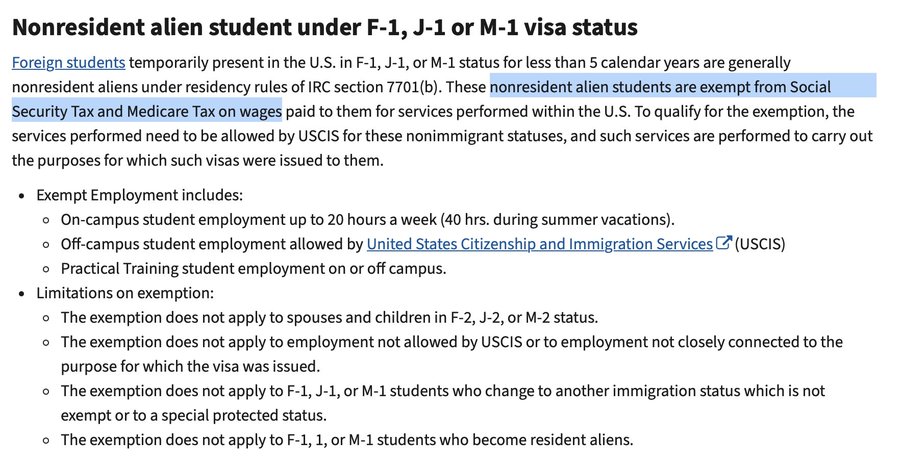
[SOURCE – and IRS SOURCE – and Alternate Source]
Apparently, this is now the common approach within the hospitality industry to save money and increase profit from payrolls. Unfortunately, this approach puts young Americans at a disadvantage when seeking summer or short-term seasonal employment.
For fiscal Year 2025: The U.S. State Department processed 506,142 applications and successfully issued 451,803 J-1 visas.
Now, obviously there may be some regions or areas where there are not enough young people to fill the jobs. However, if you do the math that 7.5% employer contribution saved is a lot of incentive for the corporation to avoid hiring seasonal American workers.
One student making $20/hr x 500 hours worked (over 3 months) = $10,000 payroll. The company has to pay an additional $750 in social security if the student is American. The $750 is saved if they use a foreign J1 student worker.
If the hospitality organization hires 20 seasonal workers for 3 months, using the J1 visa process saves them $15,000 in taxes.
A private equity group, multinational owner or corporation running the business is likely to be looking at the bottom line.
Additionally, this J1 entry allows the overall immigration system to be abused if the person doesn’t leave the USA at the conclusion of their employment. How many illegal aliens are created by those who enter under a J1 visa and never leave?
Suspicious Cat is now aware, and, well, increasingly suspicious:
I may have commented here before on this, but my Son worked as a ski instructor in high school when we first moved to CO. He had to work at a smaller resort because most of the big ones all hire foreigners.
After he graduated, we found out he would have to pay out of state tuition in CO because we had not resided there for one year. Illegal aliens only pay in state tuition rates in CO, and it has been that way since 2013.
He decided to move back to WI and live on his own and attend college.
This practice of hiring foreigners for seasonal work or illegal aliens paying less tuition has been going on for years.
And yet we just cannot convince some Republicans to act to fix this mess.
Just because an elected official has an “R” behind their name doesn’t mean they don’t have their hand in someone’s pocket.
This is true at all levels of government.
I sometimes refer to them as Democrat-lite.
This is mostly in Blue States I believe.
Here’s another snag: out of the $20/hr, the American kid must cough up 7.5% of it for FICA; the foreign kid does not.
Easy fix.
The foreigner isn’t charged the 7.5% social security because presumably, they aren’t going to retire in America to receive social security.
Therefore, make the employer pay the 7.5%, hence bringing the foreigner vs American disparity to zero, but upon nearing the expiry of the visa, allow the foreign student to reclaim that 7.5%.
Everybody is a winner (except the greedy employer).
For the SS number, have a prefix such as F to denote that the account belongs to a foreigner not entitled to SS.
How about we just don’t permit them to work? That’s a lot simpler; hire Americans
That’s a great idea. However, sometimes they can’t fill all with Americans. So, if we make it a 10% tax on J1, the incentive is to hire Americans first, then if there’s a shortage, they will go to J1. The 10% surcharge can be split with 5% going to ICE and 5% going to help SS stay solvent longer. 🙂
Utter nonsense. There will always be SOME foreign workers, as there are in EVERY SINGLE COUNTRY ON EARTH.
Charge the employer an 8% ICE support tax.
Oh, but foreigners who have never paid into the system do get SSI. You can sign up your non-citizen abuela who is living with you taking care of your kids while you work for government cheese. All kinds of people who never paid a dime are getting those benefits we all worked so hard to fund.
They can also get disability-when the neediest of us Americans can’t get crapola.
SSI is a welfare program administered by Social Security. I don’t think there is any requirement to have paid OADSI or Medicare tax as a condition.
J1Back in around 2010, at the major ski resorts along I70 the non-citizens also got free housing.
Ocean City MD is that way, became a mecca for eastern European student/workers. It used to be all American kids. Business owners will tell you that they don’t get any interest from Americans like they used to. Just BS. It is true that the school start dates in the US overlap with the high season, leaving a manning gap at the end of the summer. But the foreign students I have talked to do seem to have an awfully flexible school year. More likely they are not students at all. This J1 visa scam is the “broken” immigration system our lazy a** politicians from both sides love to shout about, promise a fix to get elected, and then do nothing. None of this is rocket science fix, and there’s nothing wrong with a system that FORCES assimilation. but sound bites and cocktail parties are easier. We don’t need 30M immigrants each year.
Gotta keep their donors happy
Appreciate the reporting and analysis.
So bizarre that this was posted today. Not 2 days ago a retired family member starting working part time at a Marriott and noticed most of the employees were younger Jamaican women. I researched a bit and found the J-1 program. Follow the $
This is crazy! Our students should have preference over ANY foreign worker, period.
If the employer is not paying his 7.5%, I wonder if the employer is deducting and paying the employEE’s 7.5% into Social Security.
I would bet not.
6 flags here in Missouri hires Jamaicans
Everyone knows the issue isn’t pretty young White females from Berlin exploiting this…
Darn it
DISGUSTING
It’s rare for Sundance to posit something totally ridiculous, but the worry that a private equity firm (or does he mean a private equity-owned firm, they are two different things) would hire J1 Visa holders for seasonal work pay is, well, ridiculous. Private equity firms themselves do not do seasonal work or own any colleges or universities, both of which are carve-outs for this benefit for foreigners at the expense of Americans. If Sundance meant private equity-owned firms, please provide receipts.