There are various points of view on a controversial section 219 within the National Defense Authorization Act (NDAA) bill that passed the House of Representatives last night and is heading to the Senate.
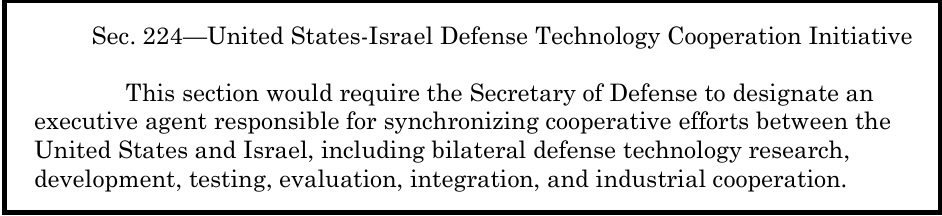
Section 219 (formerly Section 224) is part of the Fiscal Year 2027 NDAA. It directs the Secretary of Defense to designate a Pentagon executive agent responsible for overseeing the United States-Israel Defense Technology Cooperation Initiative, which aims to accelerate joint research, development, testing, evaluation, and industrial cooperation between the U.S. and Israel in defense technologies; specifically: missile defense, counter-drone systems, artificial intelligence, cybersecurity, quantum computing, directed energy, biotechnology, and autonomous systems.
Many people are mistakenly viewing this section as a merge of the military; that’s not the case. The issue is specifically about joint collaboration on missile defense systems and drone technology. Secretary Marco Rubio was asked about it today. Rubio’s response is outlined below:
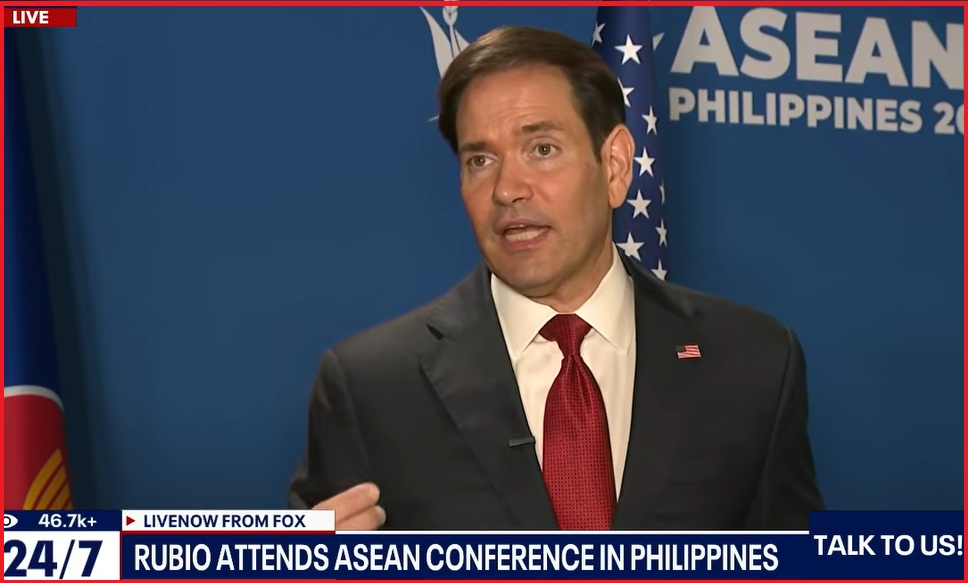
QUESTION: Mr. Secretary, you know the Senate better than most anybody. They’re debating the new military policy bill right now after the House passed it. One of the more controversial topics is about fusing the U.S. and Israeli military when it comes to co-production on things. Do you have any sovereignty concerns about that, if there are situations where the United States wants to send weapons? Iron Dome came up with Ukraine when the Israelis —
SECRETARY RUBIO: You’re asking about NDAA? Yeah, I mean, that – largely the Department of War manages that legislative portfolio, so I’m aware of the provision you’re discussing that involves cooperation on technology. And look, at the end of the day, the truth is we do that with countries all over the world.
QUESTION: So you support it?
SECRETARY RUBIO: I mean, if somebody – well, I haven’t read the specific provision in terms to tell you in detail. I understand – I understand the topic, though, because it’s not new. On air defense, for example, we’ve long cooperated with the Israelis. Look, if we have a breakthrough in our system or they have a breakthrough in theirs, we could share that in a way to improve our own systems as well. So if they’ve come up with some novel way of defeating drones, for example, of course we would want to have that and benefit from it. By the way, they’re not the only country in the world that we would do that with. We do that with other countries as well.
So I think that’s the provision you’re referring to, and that’s something we’re already doing. I mean, that’s something that already exists. But I don’t think there’s – that’s different from sovereignty. I mean, it’s not like U.S. forces are going to come under the command and control of a foreign general or anything of that nature.
QUESTION: But when Ukraine was asking for Iron Dome, the United States and some lawmakers, including Lindsey Graham, wanted the U.S. to send Iron Dome battery that was in the East Coast. Netanyahu vetoed that – that was co-production – he vetoed that —
SECRETARY RUBIO: Well – yeah, yeah, but any time you enter into co-production, we have those restrictions too. I mean, if we provide weaponry to a country and it’s part of an agreement, they can’t transfer that to a third country without our approval. That’s – we do the same thing. And Israel’s not the only country in the world that does it. Other countries do it with their systems as well. That’s just a normal way – when you do arms sales, part of the restrictions is you get to veto them passing it on to a third country. That’s not just us or Israel; it’s every country.
{SOURCE}
Wha?? Very interesting… take a listen. In fact, listen to this twice.
Rep. Lauren Boebert addressed why she missed a critical vote on the (NDAA) Section 219, US-Israel Defense Integration Into the annual defense bill.
Boebert said unnamed GOP staffers “lied to her” during…
— MJTruthUltra (@MJTruthUltra) July 23, 2026
I believe it’s incredibly naive to believe that once the door is opened slightly that it won’t be kicked all the way opened later. The bottom line is this is a bad idea that will have consequences we’ll pay for later. Same as it ever was…
Unfortunately another step towards peonage. Regarding the USS Liberty our troops were killed and Jonathan Pollard, the most consequential spy according to IC, gave Israel our most sensitive secrets and now Section 219/224 will not be a benefit to the US. Finally, if you disagree with Israel/AIPAC, you’re a racist/antisemite.
The USS Liberty was a play against Egypt directed by LBJ, similar as the Gulf of Tonkin was against North Vietnam. He not only was perfectly willing to sacrifice all of the sailors on board, and the ship itself–that was the goal of the operation. He ordered the return of F-4s, A-4s, and A-1s to the USS Saratoga and USS America, which were sailing off of Crete and had launched in response to Liberty’s call for support; some were only 15 minutes from target.
The failure of the Israelis to sink the Liberty with all hands, before it could send its distress signal thwarted the plans for a cassis belli against Egypt.
Just another production brought to you from the City of London bankers, to induce more tension between the Soviets and Americans.
It was brought to you by LBJ, a Democrat.
LBJ benefited from JFK’s death
The NSA records of the event are now publicly available, having finally been released through FOIA. Interesting reading.
Read the materials very carefully. Then read the congressional record regarding the hearings on the USS Iowa explosion, and the evidence levels required. See what is identical. Once you understand, you know.
I was tipped off on what to look for by a federally-retained expert witness years ago, who felt his life would be at risk if he publicly and openly explained.
Who just fought by your side against Iran?
We do the same thing with multiple countries and have been for decades.
Even assuming you are correct, two wrongs don’t make a right. Something, something foreign entanglements. Americans ought to be demanding our government pull out of them all.
Something, something foreign entanglements…
Sadly, the entanglement has been progressing since the day those words were spoken.
Though prudent, we must accept the world as it now is.
Stated differently
“that train has sailed” ~Austin Powers
I respectfully disagree; we do not have to accept the world as it is now. That pervasive attitude is what got us where we are now. I would rather I and my children die with honor and dignity as human beings, and Americans, fighting on their feet than be beggars on their knees as our treasury is looted constantly for the benefit of others, regardless of whom they may be.
I must have missed the part about emptying our treasury.
Look around you and observe.
Lol
It’s a big planet.
Can you be more specific?
Sure:
https://www.usdebtclock.org/
I don’t put any weight into paying it back, BTW. At this point the average American should just repudiate it.
The debt is not intended to be repaid to keep us in servitude. Please see the the link I sent to LafnH20.
Thank you. I don’t disagree. Perhaps I should have been more clear in that many seem to think repaying it is obligatory and morally correct. It’s mathematically impossible at this stage. Thus my comment that repudiation is key.
“the part about emptying our treasury.”
Read about it here:
https://theconservativetreehouse.com/blog/2026/07/23/thursday-july-23rd-open-thread-2/comment-page-1/#comment-12713353
N/M
Don’t we do those through bilateral agreements? Rather than putting it in a NDAA
not sure. But Trump’s switch on the nuclear deal with the saudis today felt odd. As if he got a call to add the Abraham accord provision.
I have read that what this does vs. voluntary annual foreign aid is LOCK IN THE CURENT LEVEL OF MONETARY AID. That the NDAA was the vehicle to make that funding mandatory. But … I need to read it entirely.
Oh so that makes it ok then?
And… Why does this one require an act of Congress?
It’s in the article , “specifically: missile defense, counter-drone systems, artificial intelligence, cybersecurity, quantum computing, directed energy, biotechnology, and autonomous systems.” – This is THE future of the defense of Western civilization, which ought to be maintained by the people that started it and the people that wish it to continue.
Why congress, and why now?
Because it adds legitimacy. Because congress can change suddenly.
Have you not noticed the “I hate America” wing of representatives teaming up with the “I hate Joooooos” representatives?
“We do the same thing with multiple countries…”
Pleases name them with some specifics. I am not disputing you, but pleases name them with some specifics.
I’d like to see that, too.
In peacetime, or in war?
What ever makes us think that any “foreign relationship” will remain intact or even the same? I don’t care WHAT the explanation is, the United States of America should NOT be sharing research, development, testing, etc.
As far as cybersecurity, the division of israeli intelligence known as Unit 8200 operates here and has employees AND their technology embedded in many companies already.
International relations can change on a dime…this is the wrong time to tie any administration to this agreement.
What is the Israeli ‘Iron Dome for America’?This transcript is from a CSIS event hosted on February 11, 2025.
https://www.csis.org/analysis/what-iron-dome-america
Kari A. Bingen: On January 27th, 2025, President Trump signed an executive order on the Iron Dome for America that would defend the American homeland – both its citizens and critical infrastructure – from attacks through a next-generation missile shield. It is being tested in Guam.
If you want to choose believe that this is a good idea grounded in the logic that it’s being done for America’s best interest, you are free to do so. I would only point out that every immoral, unethical, unconstitutional thing ever by every President has been done under the same pretense and that hasn’t worked out well.
Something along the way must have worked out, we’ve managed to survive and are still here.
At what cost though?
I’d like to hear your answer to your own question. I like to refer back to SD and others here when I look for perfect solutions in a real world. Do we let the search for perfect outweigh the reality of the good? What are you looking for the govt, the President to do in order to exist in a rapidly smaller world happening everyday with every tech innovation. What policies are going to work and still maintain America’s freedoms? How do we negotiate and work with our allies and enemies?
Sure. I believe that the government should be brought back to levels where they are no longer threats to individual liberties. We as individuals ought to be deciding our destinies, not the government. All the bogus claims of being a Luddite or isolationist are on those who level the charge to prove. History shows that growing government isn’t a solution.
The countries should actually go through the Treaty process.
I would like to see the argument you gave when the US entered into the Five Eyes agreement….???? Is this a different issue because it’s now Israel??
Nope. Five Eyes was a Cold War thing. The Cold War ended 35 years ago. Five Eyes should have been shut down then. Israel mattered during the Cold War too, but not anymore. Just that simple.
Great question!
Incrementalism.
It’s how we got here.. look at what happened when we cracked that door open on the gay closet.
Be scared of your real enemies, the Muslims. They are trying to destroy and you worry about the Jews who are fighting side by side with us.
I’m aware of how to determine who my enemies are, thank you.
Didn’t AOC jump in on X and tell people it was a merger? She was soundly corrected.
Time will tell. I don’t trust Israel and our government’s fascination with being subservient to them.
I trust Israel much, much more than I do Democrats and half the government is filled with those criminal sympathizing clowns.
You trust a foreign government more than your fellow countrymen?
Half of our “countrymen” are not to be trusted…
Yes. Today’s Dims are full-on lawless Commies who would slit our throats on a whim.
Kathy J. I’m a Kathy J. and don’t agree with you. Kind of creeps me out.
No “subservience” in that. Sounds like spook stuff.
Israel being but a piece of the puzzle, how about we don’t do this with any country? I dont trust any country out there, unfortunately my own also. Even if I did trust Trump, why would I want this legislation knowing another different intentioned administration could interpret things or do things differently? There is absolutely no need for this in the NDAA, especially if we already do this with other countries outside of the NDAA
Logical & well reasoned response, thank you.
You do realize we do this with multiple countries and we have been for decades?
I could care less. Let’s not share with any of them. Given what we spend on R&D and defense compared to, say our European counterparts, why should there be such likely lopsided sharing? Let’s not send billions in actual money, or inversely give away billions in R&D. Someone explain, explicitly, what we have benefited on and what the exact perceived benefits to gain for the USA. This isnt even about humanitarian giving or being greedy. This is purely about items defensive in nature
How do we know it it would be lopsided?
What is the definition of “lopsided?”
If another country finds a “novel way of defeating drones”, and we have a distinct disadvantage wrt defeating drones, would it not be prudent to have access to such technology before those drones set American defense infrastructure ablaze?
How do we know there are not 1000’s of said drones hiding away in sea containers in Des Moines? Or, Denver? Or, LA? Or Shreveport?
What price does one pay to have a fighting chance of preventing dozens of 9/11’s?
People have strong feelings about this particular provision, but I would like to inject that there is no, and never has been, a substitute for real-world testing. Which is a big reason why we are closely tied militarily to Israel, a country in the unenviable position of being under near constant attack for decades.
Sounds ghoulish.
Are you saying that 1Israel & the US should do real-world testing in the ?
So you were probably patriotic act also.
Some of the most brilliant minds of the past 5 centuries were Jewish.
We/You might not like it, but it’s a fact.
If some brilliant tech is invented by an Israeli scientist, you don’t think we should be interested ?
I get the “if we invent it” part.
But people negotiate deals all the time and both parties regularly push the envelope on the details.
I am not sure how this should be resolved.
But if your neighbor develops a better system for ANYTHING pertinent to your quality of life than the system you use, you sure as hell would like him to share it with you. Like a good neighbor….
Maybe it all comes down to the money.
Pay me for “this” if you really want it.
And I’ll pay you for “that” if I really want it.
You seem to think I care whether someone is Jewish or not. Why is that?
That’s the go-to in the comments.
Hate to break this to you, but Jews live in the US too, so why do we need Israel? Or are you implying only real Jews live in Israel?
The problem is that this isn’t a situation where I can choose to purchase something from my neighbor if they made something better. That’s the free market and 100% OK.
This is locked in to our War Department spending framework. In other words, we WILL share with Israel and they in theory will share with us.
That is a setup not a free market.
As an aside, I think that Israel should be sharing with us, just because we’ve always been there for them, and we deserve something in reciprocation from them for all the trillions we have ALREADY SPENT ON THEM TO DATE.
F-35 Israeli improvements would be but one.
Look up F-35l Adir for more info.
Until I see the F35 in real combat against a real adversary, say over Russia. I will withhold judgement. There are many things I dont care for about the F35, such as the high maintenance after low flight hours, or the single engine design. Or even the integration of so much tech when low cost tech may be what is and has been used as a good deterrent in far flung conflicts. This is a given since projection of power requires significantly increased resource use. Purely from a cost vs use standpoint, it is yet to be seen if the F35 ever pans out vs something like the A10 for some things or F22 or F18, etc. I think we had a good stock of planes with no real new or improved specs vs other proven platforms.
You have obviously not had to “work” with Israeli’s. You would stop posting on the subject.
you’re welcome,
Pogo
Israel is way ahead of us in defense technology.
That’s a bit of an overstatement, we are ahead in some areas but won’t be after this.
🤣
Then they don’t need anymore of our money. Let the technologically more advanced country pay their own bills.
Reading all these comments, I’m surprised that apparently no one has either heard of, or remembers, the Five Eyes agreement the US currently has……with ‘Eyes’ by the way, that were directly involved in Trump’s impeachment, Ukraine, etc.
You are effectively saying the US shouldn’t do any arms sales.
Have you thought about the consequences of such a stupid idea?
Whom else will countries get arms from if not from the US?
We have INTEGRATED weaponry among allies, which helps in effective joint actions as it were in Afghanistan and Iraq. How will we have integration if the US uses US made weaponry, but the allies use weapons made in China, Russia, Turkiye etc?
I haven’t even gone into the drastic changes in costs of developing and manufacturing if the US is the only customer because you don’t feel comfortable about this wholly normal deal.
“So I think that’s the provision you’re referring to, and that’s something we’re already doing. I mean, that’s something that already exists.”
So then we don’t need Sec. 219. It already exists. Get it out of the NDAA.
It was previously Sec. 224 and has been in every NDAA for years.
Why just call out Israel then and not other countries?
Because they have the best tech??
Still do not need to call out just one country….especially if we have this relationship with other countries as well.
What if only one country has the technology we need; and said country will only share with US with explicit “restrictions” wrt 3rd party sales?
Exactly — how the HELL is this possible?!!!!!!!!!!!!!!!!!!!
NO country ought to have more advanced materiel than we —
ABSOLUTE national security!
Because Israel, unlike many so-called allies, is wealthy enough and has the defenses to defend itself. Why so many refuse to acknowledge this is beyond me. Christians are supposed to help the poor and downtrodden, not those with the abilities and resources to help themselves.
Wealthy enough? Then why do we need to send them billions of dollars every year?
And, what makes Israel so special for Christians? If we’re throwing money around, I’d rather send money to defend Christians in Nigeria than a nation that is “wealthy enough” to take care of itself.
Has Israel defended or aided Christians?
Yes, we send Israel approximately $3 billion a year, and instruct them to use that money to buy US weapons. That’s how that money is used.
Little low.
After looking at the 2026 ndaa, this seems like a massive expansion with ill-defined terms.
Needs to be authorized again, Sunshine 😎😂
From the article:
”SECRETARY RUBIO: I mean, if somebody – well, I haven’t read the specific provision in terms to tell you in detail…”
If true, maybe he should get the details before giving a generic response…
I don’t know, just makes me not quite trust that he knows the answer if he doesn’t actually have the facts.
What do ya’ll think?
I think we’ve been doing this with Israel and other countries for decades and that this is just another pressure point for the leftists who have infiltrated the MAGA movement to try to drive another wedge.
If we’re already doing it what’s the point of section 219?
You’re revealing much in this statement. I find it curious and telling that you’re using the red-herring that if one doesn’t fall into lock-step they must be a Leftist and not MAGA. Who is the real divider here?
The same could be said of you.
I suppose one could but that would require intellectual honesty and show the error in my thinking. Simply saying something doesn’t make it so.
Back at ya
Indeed
Does the CIA approve of this? No other opinion matters.
“Does the CIA approve of this?”
If the CIA didn’t approve of it then it wouldn’t exist. The question to ask is if this was this the CIA’s idea all along. Ultimately the sale of weapons is central to the conversation. Whether the sales are covert or not, it’s also a prime revenue stream for the CIA.
Just as lucrative patents for “vaxxxines” et al are to the CDC…very.
Source?
Dr David E Martin, patent expert.
Which are also weapons.
Oh yes they are, Gipper.
I no longer recognize this world, although I do see the hand of unmitigated evil which apparently knows it has a short time to do its worst, and so has come out of the darkness to complete its work.
Arms sales always produce some “skim”
That’s been the method for decades.
Centuries old Modus Operandi.
I can’t stand Boebert! She’s as fake as Luna!
“She’s as fake as Luna!”
Like so many other women, she’s as real as her mascara.
I did not need to hear her complain about her Botox injections.
So if we do this with other countries, why do we need a special section for “Israel” called out in an NDAA?
If someone wanted to “trial balloon” the House and Senate on Israel’s behalf to see who they can count on in an election year, this would be one way to do it. Forced to take a public position on a policy that is already executed in reality and would change nothing if stripped completely from the NDAA.
Bingo! That is the tell.
The answer, Atenizo, is that having it in writing makes it legally binding. This is important to note.
I don’t trust Israel.
I don’t trust the American Left.
What Rubio says is true, for many prior years …
‘…I understand the topic, though, because it’s not new. On air defense, for example, we’ve long cooperated with the Israelis….’
There have been people, defense contractors, associated with Offut air force base (Omaha), that have met with Israel
and vice versa…for many prior years.
And furthermore, that provision that someone is giving sunlight, has been within d c, congressional approved funding agreements for a long, long time.
p.s.
the biotechnology part of the provision, is new to some people
p.s.
it is better to cooperate,
than to have technology stolen [ which some countries do ] or
to have some people in the usa sell it to other countries – without people knowing.
p.s.
and yes, when an armament, or technology is used vs. an opponent,
that also opens up the opportunity for the opponent to reverse engineer the armament from the remnants.
( i.e. the russia hyper sonic missiles will not be unique, forever… )
p.s.
does anyone wonder why automobiles, bicycles, planes, trains, pencils, computers look and function similarly across the world?
hmmm…
yet, europe does have its castles from a prior era …
and other countries do have some unique architecture to their buildings etc.
imho
“it is better to cooperate,
than to have technology stolen [ which some countries do ] or
to have some people in the usa sell it to other countries – without people knowing.”
Israel will steal it anyway is a poor argument.
“Israel will steal it anyway is a poor argument”
That was your comment.
imho
For instance,
developing a technology that allows a moving missile,
to hit another moving missile,
was far, far from an easy task.
p.s.
for practice, simulation,
toss a baseball high into the air,
then take another baseball and try to throw and hit the baseball that you previously tossed into flight.
[ then, try to get that to happen 40 times in row…
…then try to do it in the rain, the wind, the dark etc. ]
At Mach 2
…30 years late,
it sounds like the tragic loss of passengers on Flight 800 near Long Island
was the consequence of one of the early u.s. military missile to missile tests,
gone awry
(and covered up by the professional dc obfuscators, incl. those in elected offices running for re-elections…for 30 years…)
i.e. it is not an easy task to get it right, most every time.
i.e. Sometimes, mutual collaboration, can become mutually beneficial.
Some have known, for a long, long time.
imho
Flight 800 link:
https://theconservativetreehouse.com/?s=flight+800
Another good source on TWA 800 is Jack Cashill. Check out his Substack.
You would need some serious trigonometry skills to do so.
I was a Math teacher. I know.
Maybe we should invite Cailin Clark to this problem.
Clark, and other basketball players, shoot a basketball towards a stationary basket.
Now, if the basket was moving,
and the baskets were made – consistently – then one would have an apt analogy.
The mental trigonometry, or intuition to:
-hit a fast moving round baseball, with a round bat, every time would be an apt analogy (yet, there are many misses)
or
-a qb throwing a football to a moving receiver would be similar (yet, there are many, many incompletions)
Yet, all of that is relatively, much slower speeds.
imho
I was thinking of skeet shooting…
That’s ( skeet ) a good analogy, especially if a ‘single bullet’
was used to hit a flying clay disk
( instead of a ‘shell’ – that sends a spray of many b-b’s which increases the chances.)
p.s.
some of the best basketball, baseball, football players etc.
miss
more than they connect.
( yet fan$ think it is great,
for good reason – because it is not easy, under duress. )
Imho
“…can’t hit a moving target, eh?”
W. C. Fields in International House.
That’s old technology. We have had missiles capable of hitting an aircraft flying at Mach 2 for sixty years. And those manned aircraft are capable of deploying countermeasures and taking evasive action. Intercepting a missile is not the big deal you are making it out to be.
Maybe that, uhhh… ‘old technology’, is why some other old countries do not want to find a way to obtain it from someone else,
instead of doing the math etc. etc. etc. for years, themselves? / sarcasm intended
But, they do want…
hmmm…
And for some reason,
some want to mutually agree to collaborate minds etc.
to continue to make things better than how they find it today along their faith life journey’s.
( motivated by the likelihood, that someone else(s) may be doing so, unknown elsewhere ?)
Love thy neighbors
Noticed comments on twitter/X the other day about the US supposedly turning over our military into a subsidiary of Israel’s and thought someone left the looney tune gate open so put it into the 72-hour before thinking about it category.
Now reading this glad it was put into that 72-hour box as this makes perfect sense so the U.S. agencies can openly work with Israel while our agencies can learn and incorporate Israel’s technology for creating our own version of their Iron Dome protection system.
I’m sorry but I care about America and Israel can bless itself.
This comes down to knowing when one is going about building a better mouse trap that the offer to gain a greater understanding about the mechanisms of the one that currently works.
Has nothing to do with the personal preferences or prejudices for or against Israel, it has everything to do with finding the best means to save lives and that certainly involves incorporating what works and learning from past mistakes as to what doesn’t work.
Sometimes time is of the essence and taking advantage of those willing to add to the work is a mark of wisdom.
That presumes that Israel’s tech stack is so overwhelmingly awesome that we must have this special relationship to that we have it all to ourselves. I see no evidence of that.
They should be like any other arms vendor – show your wares and we buy them if they are better.
No need for a special relationship.
We should never give up any level of sovereignty. We used to be allies with the soviet union and china……
What many ignore is the fact that there is One who blesses Israel and those who bless Israel…
That has no bearing in foreign policy
There are no looney institutions anymore…. So no looney gates can be opened.
Although I think it’s high time to bring them back.
Could reduce your 72 hour box rule to 24 hours.
Iron Dome?! Who wants that junk?
During the hot period of this war, Iranian missiles simply flew past their “Iron Dome”. Obsolete junk.
And, during that time, any Israeli could be put in jail for up to 5 years for posting videos of the attacks online.
That isn’t a nation that is confident in its defensive systems: You advertise successes and hide failures.
Mighty Glacier, I was in Israel Feb/March in the thick of things, and I can tell you first hand that the Iron Dome and David’s sling worked unbelievably, so im not sure where you got the impression it didn’t. The amount of ballistic missles raining down on all areas of Israel, a small portion hit, but as we sat in the shelter nightly, we heard all the interceptions above us.
Such a misinformed and I was going to say ignorant, but I thought that might be too strong, comment.
No, I do not support it. The United States should operate completely independent of any country in our military and Intelligence affairs. We should design and build all our defensive and offensive military weaponry ourselves, and everything including all components and spare parts should be manufactured in the Continental United States by United States citizens.
I suppose this if enacted could give Israel access to things like Palantir R&D directly without being filtered through security release channels. Avoiding those channels obviously important to Israel, see the effort they put into Jonathan Pollard.
Other countries we want to sell mil tech to would be wise to wonder if they are getting the “dumbed down” version compared to Israel. Though I have no problem if we give dumbed down Patriots to the Ukies, countries that are actually paying us need more consideration.
No other nation bought the F22 Raptor. Unit cost is between $335m and $350m.
Many nations bought into the F35 platform. Unit costs are $80m to $100m.
Isolationism in weaponry development and manufacturing hurts the USA, not just the allies.
Need to think deeper and see beyond ones nose.
The issue here is that regardless of realities of this legislation, the optics reinforce the rapidly growing public sentiment that Israel exerts too much influence over the American political system.
Whether you or I agree or disagree with that sentiment, and whether we are correct or not for doing so, is irrelevant to that observation.
Let me fix that for you:
Boebert said “… unnamed GOP (Deep State) staffers “lied to her” during …”
There’s a friggin’ surprise! lol
Speaking of which, I haven’t watched my “Yes Minister” and “Yes, Prime Minister” DVDs lately. If anyone wants true insights into how governments actually function (and are manipulated), they would be well advised to watch these “comedy” episodes …. and then cry afterwards, because you know deep down, that this is how deep state operatives actually work.
It would be treasonous for any country to come up with a tech that revolutionized/breakthrough warfare or defense and then immediately share that with any other country – regardless which country. This is an unstated truth that runs both ways.
May or may not be “treasonous”, but demands careful consideration not automatic acceptance. We executed the Rosenbergs for passing R&D.
Diana West detailed reports that DR’S aides shipped the blueprints for our Manhatten Project to Stalinist Russia during WW2.
Once again “chicken little, the sky is falling”.
If your one of those who is screaming at the sky over this than just look at who’s screaming with you, Ocassio Cortez.
This is nothing new with military tech collaboration with other nations.
Of course it’s new. I’ve handled FMS cases and decisions about what technical cases get released to which ally is handled at the highest levels. There’s no concept of “automatic sharing”.
All leftist/Rino news outlets need to to create MAGA friction is to mention Israel or Epstein in a pejorative way in their reports or questioning.
Yeah, but the tactic is losing its effectiveness. After too many laundries, the specialness wears out.
Like calling someone “racist” for …. .anything they say that you don’t agree with.
Or anti-semite
If you read the bill it explains the bill.
It doesn’t say integrated military it says integrated technology. Kind of like we do for all of our other allies, and they with us, via weapons systems, radar, platforms, software, aircraft. Etc. Allies share tech…this has been going on forever but because people can’t read or think for themselves they’re easily manipulated into “omg unified and integrated us/Israel miltuhtarry!”
Its stupidly frustrating that no one just reads the text or happens to look up anything from a historical context anymore.
well one way to consider this is that IF the US has pledged to assist Israel against the Islamic horde, which we have and there is no denying it is in our best interests to do so (I happen to believe this true in the national security interests…because we do have a common enemy and we have not had hostilities and only cooperation mostly, as reasonable as can be expected given the circumstances of what drives the Israeli’s to strike palestine terror groups and also the Iran state and it weapons programs….which happen to be the same targets in kind that the US is also striking.
If that is the plan for securing some years of peace from Iran..I call that winning…expensive…yes, but winning a kind of peace from the everyday threat that did exist before that Iran was on the path to its stated death cult annihilation.
sharing technology for military effective weapons systems only seems logical and a plan to make sure our defenses are in tune with and match the threats that exist in that region. We also happen to be doing the same thing with Ukraine by providing an enormous level of very technical and secretive sensors, guidance, intercept and anti drone, drone technologies…as well as the standard conventional weapons. In return, the US gets to have first pick over the weapons systems effectivness and in what direction ukraine is choosing to utilize it hybrid military arsenal. This intelligence is worth billions in research and development. By proxy, the US benefits in refining the sharp edge of our weapons and doctrines….that is how the modern war industry in the US operates. It has served us well. We should not be so nieve to assume the US did all of this in a vacuum. No, we had and paid for plenty of systems design and information sharing about that.
Making this part of law makes it legally credible and also carves out most likely a budget allocation that focusing solely on the US-ISRAELI arsenal co development. I am not against such a provision. It is good we state what priority we make in allocating money to proven results.
God Bless America
I concur in large part. However I sincerely believe we have zero national strategic interests in Ukraine. We should not provide them anything. They’ve been at it with Russia for hundreds of years. It’s a corrupt dump of a nation. Not a single national strategic reason we have any business with Ukraine.
Just heard on In The Litterbox podcast with Jewels and Catturd that Laura Loomer has done a 180 on Ukraine. She is interviewing Smiffy the Clown🙄
Agreed!
Thank you regitiger for a dose of Common Sense. I am just an old 80 year and find those folks that do not like AIPAC and cooperation with Israel are mostly in a tent with antisemites. It is hard to stay above the fray when your tentmates are 10 antisemites to 1 so called America firster.
When the light comes on in the tent the cockroaches leave and there will not be many of you left.
Yep, I am much more concerned about Islamists than Israelis.
Their are billions of privately-held firearms and trillions of rounds of privately-held ammunition in the U.S. We don’t need anyone to protect us from any horde, we just refuse to do it. We unreasonably expect the government to do it.
Israel is a one-way check valve for weapons tech.
What we don’t ‘share’ they steal. What PRC and Russia want, they sell. Example?
https://usahitman.com/patriotmissiles-china/
Just say NO to military support to Israel.
THE WAY we lost ” OUR ” Tech on RADAR and SONAR …
That explains all the Israeli defense companies that have plants in the US.
Dual citizenship
Actually, Israel buys weapons from us, improves them, and then shares the improvement with us.
WELL
1) WE KNOW that SHE TAKES COUNCIL WITH ” UNKNOWN ” STAFFERS
2) HER STAFFER Did NOT MONITOR a FLOOR VOTE ( blamed for HER MISSING the VOTE )
3) she GETS BOTOX Injections…
4) imo – DEFINITELY HAS ” GONE Native ” District of Columbia
FIRE HER also
ALSO —> WHY WERE the Representatives of Guam and Territories EVEN ALLOWED to VOTE in COMMITTEE ?
https://moylan.house.gov/media/press-releases/moylan-advances-nearly-19-billion-for-guam-as-house-armed-services-committee-approves-fy2027-ndaa
So commenters are against this technology sharing arrangement? Israel is one of our closest allies and may I remind everyone what group of individuals (Jews) are namely responsible for the US producing the Atomic bomb and Edward Teller being he father of the H-Bomb. The Israeli’s are very smart and very skilled at weapons of war. It’s in the best interests of the US to he technically aligned and partnered to believe otherwise is simply naive. Any nation that can use pagers to blow your dicks off then blow your head off when you switch to a phone for safety for fear of pagers is a nation I would partner with on advanced weaponry any day.
Agreed!
More like a closest client, in no way an “ally”. Allies don’t do Liberty or Pollard. While those loyal individuals were helping the US, other individuals in Palestine were working to kill Brits.
It’s time you understood what the USS Liberty situation actually was. It’s obviously NOT what you’ve heard.
Do we have a closer ally?
Canada never attacked any of our ships or stole nuclear material.
As the saying goes, a nation has neither permanent friends, nor permanent enemies, but a nation has permanent interests. Get what we can from a relationship with Israel and have no allusions.
NO….NO… NO
We have Jews in America too. Did all the dumb ones stay in the US and the smart ones migrate to Israel?
Dual citizenship
When folks believe the lies, it keeps them from understanding your logic.
Sundance, Have you ever actually worked with the Israelis on sensitive SCI and SAR/SAP programs and their related issues etc? I have and it (even its current form) is WAY more than just the Camel’s nose. The moment you say ITAR once this actually happens and goes forward, you will be ending your career even if you are a GS or GM 14/15. This is insanity on a scale I have never seen before and my career was from 1969 – 2013.
I’ve worked on SAPs and IMO no way/no how would I ever want that data going to Israel.
What is your opinion, then, on the Five Eyes alliance?
Whataboutisms
I think they will eventually work out whatever aspect of sec 219 and/or the spending amount of bill that some have a problem with.
However, I definitely want some coordination on R&D with Israel.
I just read an article about some of their new drone defense technology…
Israel’s R&D is one we want to jointly cooperate with…
+++
IAI unveils HYPNOSIS, an electronic warfare system built to blind drone swarms before they find their targets
https://defence-industry.eu/iai-unveils-hypnosis-an-electronic-warfare-system-built-to-blind-drone-swarms-before-they-find-their-targets/#google_vignette
All you need is a wavefront (not trivial) regurgitated with a scaling time drift and enough ERP to capture the nav aid tracker and all the little buggers end up somewhere else. Been there, done that. works every time for doohickies that rely on an external rf signal. Now, how do you fool the ones that don’t use ext rf nav-aids?
Sounds similar to SLQ-32 (V3) Rotman-lens fed multi-beam array
technology.
“The United States cannot afford to postpone this evolution in combat as it has already witnessed how UAVs have impacted modern battlefields. The 2020 conflict between Armenia and Azerbaijan, for example, demonstrated how unmanned platforms can dominate and overwhelm traditional platforms used by conventional armies.
Azerbaijan’s drone fleet was able to target Armenian forces at a fraction of the cost of those targeted platforms. Using such a tactic allowed Azerbaijan to achieve a swift victory, but one that could not be achieved without the use of subtle, small drones. By weakening Armenia’s defenses with drone strikes, Azerbaijan could advance with its own conventional forces.”
https://www.nationaldefensemagazine.org/articles/2022/11/1/transitioning-from-human-pilots-to-drones
In order to finish the genocide they & Turkey perpetrated on Armenians & Pontic Greeks in 1915.
So! The House created this section of the bill but the President and Secretary of War does not want it? I am amazed that it is even in the bill if the Commander in Chief and Secretary of War does not want it.
This is a national security issue in my opinion. Surely the President and Secretary of War should have some say. Allies of today can easily be adversaries tomorrow. Some secret technologies should not be shared with anyone.
Just my opinion.
The bill’s Poison Pill?
camels nose is under the tent
To remind those who pre-calculate their opinions. This Adminitarion is the FIRST in 13 prior entities that is attempting to unwind over 250 years of abuse by other NAtions. and The go along to get along position of the other 13 puts us in difficult position.
That being said, many times the opinions of the multiude become just that. Opinion.
Wildy picking number from the spinning wheel, thi Administraion is at least 85 /15 in the 10 ring.
An ode to those who have a beer can holder in their massage chair.
😅
As usual the truth is never told.
The Jew hatred of WW2, the world over has been resurrected in all f-ing places, but HERE in the U.S.A, the DSA and Muslim $$$$$$$$ has ramped it up exponentially into Tulip Mania.
I am not surprised or insulted that something should be in the books, in law, to not freeze Israel out of defense because after all these are highly intelligent and innovative people who share with US.
Hasn’t the end goal since 2008 and especially since Oct 7th., been about demoting an entire country into the dust.
Looks that way to me. I want to vomit that our country is devolving into civil war over right and wrong.
Right and wrong is the American way, and we were only right by the guidance and grace of GOD from our inception.
We are being dragged away from that and we need to ‘FIGHT, FIGHT, FIGHT” evil for our grandchildren.
Bingo.
The ONLY reason this is even an issue this year is because Hamas attacked Israel and a bunch of stupid Jew haters in the USA decided to side with Hamas. It has become the “issue” of the moment leading up to mid-terms… just like BLM garbage did.
This is insanity and people need to get over it. Israel has a right to exist, they have brilliant tech and have worked with the USA on many incredible products for YEARS. It is not just military, they have life saving drugs, technology… all kinds of good stuff.
So sick of this constant “outrage” over anything to do with Israel.
Bingo!!!!!
Especially when you understand that the nut-bag Islamic mutants in the Mideast are fully allied with the “Progressive” Left here at home in a war against Western Civilization.
How can any American disrespect Israel’s intentions?
Like it or not, we have a common enemy trying to take us all out and we’re allies.
The Democrat Left would like nothing better than to see another Holocaust and every bit of bullshit they spew is pointed in that direction.
Yes, exactly, CM!
I don’t think Israel is going to be sharing much of the good tech. They can keep secrets and probably don’t trust the US to keep their traps shut.
Boy, the Star Trek force field needs inventing and now! Of course, the Chinese would figure out how to override the dang thing and give it to Iran.
”Will no one rid me of these meddlesome tribes?” (Apologies to “Henry Vlll.” Wm. Shakespeare)
Fascinating stuff, this Section 219 … especially since ALL the Major US Defense Contractors have had offices, joint engineering operations and co-production facilities in ISRAEL as long as I have known, back to about 1965, when major US Weapons systems started showing up in the IDF. They were building and designing the same stuff there as here in the US. Hard to fathom or believe for that matter that there is not already US Department of War staff in place on both sides of the Ocean.
Even when I was doing EXPAT work in Turkey in 1986, there was a JUSMATT office in Ankara jointly manned by US DoD and Turkish Defense Forces personnel (Air, Naval and Land), with whom I had to interact and report my actions .. the US side had report back through DoD and State Department.
Even when Egypt was co-producing M-60 and M-1 Tanks … there was a TACOM and DoD office set up.
As for Israel stopping a transfer to Ukraine …. that is highly likely if there is technology involved (especially sensor and laser weapon) that belongs to Israel and the US has incorporated it into a US System, under some contractual arrangement. The US does the same with ALL systems we second and sell off-shore with end user agreements.
Secretary Rubio said all the above ..especially the point that this is noting new and that the US has done this all time when working foreign military entities … just wanted to add some personal experience.
Open the door slightly, kick the door hard and it hits us in the head while we are trying to see/determine the threat.. okay fine, and you ?
Neither Hegseth nor the White House have made any public statements about section 219 (for or against) from what I can find.
+++
House Passes Defense Authorization Bill on Largely Party-Line Vote
https://legis1.com/news/house-defense-authorization-bill-vote-passes
“Peace, commerce and honest friendship with all nations; entangling alliances with none.” — Thomas Jefferson
“Against the insidious wiles of foreign influence, (I conjure you to believe me fellow citizens) the jealousy of a free people ought to be constantly awake; since history and experience prove that foreign influence is one of the most baneful foes of Republican Government.” — George Washington
I wonder if the people who are so concerned about this, are also concerned with the similar relationship that we have with the Five Eyes countries….UK, Canada, Australia and New Zealand. Just a thought.
Yes!
Carney from Canada
Starmer sent 100 Labor operatives to Pennsylvania to campaign for Kamala
Alexander Downer from Australia collaborated with Christopher Steele/ to target Pres Trump via Papadop
Hardly the behaviour of decent intel allies.
Only one party will be bringing $$$ and technology to the table paid for by U.S. taxpayers as usual.
Extremely a bad idea but that is how Is Fake got their hands on nukes from the U.S.
“Who the h3ll made this crap up that the NDAA “merged” our military with Israel’s?”….
+++
Did the Iran Lobby start the integration fearmongering?…
That is when I turned Bannon off. When he continued to have this Trita Parsi on. Hell, I could even read what his interests were.
Before Russia went into Ukraine during Dumbo’s administration, Ukraine was considered the most corrupt country in Europe. Every country with high tech defense technology doesn’t want to give it to some thug that will sell it to the highest bidder.
Israel has every right to veto giving their technology to corrupt thugs that will turn around and sell it to Israel’s enemies.
On AOC claiming NDAA is an existential threat.
“Instead of merging the part of your brain that hates Jews with the part of your brain concocting your daily lies, you should try merging the part of your brain responsible for reading bill text with the part of your brain responsible for critical thinking,” Zeldin wrote on X.
https://www.military.com/2027-ndaa-provision-seeks-sweeping-us-israel-defense-tech-integration
So did the Clinton Administration.
Both U.S. and Israel have tightened security and added oversight controls re any sharing of military technology (especially from Chinese straw companies).
Isreal has sold tech to China in the past – our tech:
https://www.military.com/defensetech/2013/12/24/report-israel-passes-u-s-military-technology-to-china
Sec 244(b)(8) states: Network integration, data fusion, and contested logistics.
So I guess this means our defense networks will be open season to Isreal?
244(c) seems to imply that this is not just related to defense tech but other areas too.
And the soviet union. Thanks for looking at the text.
WJC allowed the sale of 5 axis milling machines to Chyna.
You need 5 axis machines to produce the quiet propellers our nuclear submarines use.
And? That justifies what?
“Boebert said unnamed GOP staffers “lied to her” during negotiations in a backroom deal.”
Let us know their names and we will believe you.
AOC roasted over defense bill claim as GOP lawmaker tells her to ‘stop stoking Jew hatred’
https://www.foxnews.com/politics/aoc-roasted-defense-bill-claim-gop-lawmaker-tells-stop-stoking-jew-hatred.amp
The stupidity constantly on display, and willfully ignored by almost everyone, it seems, is astounding.
The measure outlines joint measures for the development of defense systems. Israel is a major producer of such technology.
How is such an effort a nefarious plot???
Conflating this with, say, Ukraine wailing for Iron Dome technology is specious, at best. They produce nothing. They aren’t partners in development, they are clapped out hookers looking for a sugar daddy.
This creeping antisemitism is gaining speed and it is a horrible black eye for America.
From my understanding after listening to a couple of people explain this NDAA, ot describes a sharing/collaboration on R&D, technological advances on systems, weapons, drones, tunnel warfare, AI systems used in warfare, cyberspace/security. In some of these instances, Israel is farther along on not only development, but real time use in a military war situation and in many cases, making changes snd updates in real time. Something that the US military is lacking, such as tunnel warfare, protection against these cluster type drones using fiber optics, which Israel has been dealing with since they are deadly, lasers against missiles, not to mention that they have the best technology in tanks, snd when they receive F16s, F35s, they have developed even better systems that they install in those planes and use the systems daily. Israel gives us that invaluable knowledge, and saves the US military billions of dollars and short time frames to develop. Israel and the US work together on lots of projects I’m sure.
I’m not arguing one way on the other on this NDAA, but the world is a nasty place and we are up against several nefarious countries, so any leg up we can get only keeps our military that much more advanced. Israel is not the enemy here. Every country can and has done sneaky stuff. We certainly do not have clean hands when it comes to spying. The 5 eyes group are a bunch
of unsavory characters. In fact, after we found out that our 5 eyes group worked against Trump in 2016, so keep that in mind when trashing another ally.
Sure they are. They pulled us into this war.
The fatigue is real
Better to get and share intel with Israel than the treacherous 5 eyes lo
Israel is ahead of America in technology. Israel is working very hard to produce all its weapons. The USA NEEDS Israel more than Israel needs America. I know that’s hard for many to get their heads around.no DEI in Israel.
That’s ridiculous. Israel would not exist without the benevolence of the United States. Are you Niki Haley’s speech writer?